
Tag Archives: bitcoin

nike shoes 1425208

How the blockchain could help email security

BitMessage

Every day we send thousands of emails and such communication has become a daily routine and a MUST for any person and company.

But options to secure communications are not so common and strong. Also, the existing services are too difficult for people to use and they should use a trusted channel.

  
This is the reason why it has been opened the open source project called BitMessage, a service who helps to decentralize and encrypt messages and solves the problem of trusting a third party security authority. 
But BitMessage doesn’t use the bitcoin blockchain, but a distributed ledger created by the BitMessage Community itself. 

How it works

Thanks to BitMessage and its wallet, you will be able to create a private key and your contacts will receive a string that look like a bitcoin address. 
This way you will have a long alphanumeric string among your contact lists instead of email addresses, and you need a proof-of-work to send your message, even offline. 
In fact, BitMessage proposes a system where customer uses a hash of a public key that it is the same as the user’s address. “If the public key can be obtained by the underlying protocol, then it can easily be hashed to verify that it belongs to the intended recipient. The data exchanged by the user can also include a version number for forwards capability, a stream number and a checksum”, explained the whitepaper. 

Here you can read the full whitepaper, in which BitMessage is described as a “peer-to-peer message authentication and delivery system” platform.


The invention

BitMessage was opened in November 2012 by Jonhatan Warren, who also created PyBitmessage, or the official instant messaging client for BitMessage.

Technical details

Its source code use Python as a language and the Qt cross-platform application framework; OpenSSL allows its cryptographic functions. BitMessage is available for Microsoft Windows, Mac OS and Linux.
Unfortunately, it is not available for mobile devices.

Download the latest version here !

Open your free digital wallet here to store your cryptocurrencies in a safe place.

Amelia Tomasicchio
money under the mouse 18 1239129

How to buy Bitcoin through PayPal

paypal-bitcoin-ecoin-visa-wirex
The producer of bitcoin debit card, E-Coin (previously known as Wirex) now allows people to buy bitcoin through Paypal


Improving the Bitcoin Use

Here the full list of countries where it is possibile to use E-Coin to buy Bitcoin via PayPal.
Bahamas, Bahrain, Botswana, Bulgaria, Chile, Croatia, Estonia, Georgia, Gibraltar, Honduras, Iceland, Indonesia, Israel, Italy, Jordan, Kazakhstan, Latvia, Lesotho, Liechtenstein, Lithuania, Luxembourg, Malaysia, Malta, Mauritius, Moldova, Morocco, Mozambique, Oman, Philippines, Romania, San Marino, Saudi Arabia, Senegal, Serbia, Slovakia, Slovenia, Turkey, United Arab Emirates and Uruguay.

How E-Coin works

E-coin is very simple to use. You just have to follow some simple steps.
To buy Bitcoin via PayPal through E-Coin platform, you need a PayPal account with a positive balance and a virtual E-coin Visa debit card with $3 at least.

E-Coin Fees

E-coin will not charge any fee for this service, but PayPal requires $5 for each transaction, while the minimum withdrawal is $10.

Step-by-Step Guide to Buy Bitcoin

  • Log in into your PayPal account
  • Go to “Money” and then click on the “Add A Card” button
  • Click on “Add another card”
  • Fill the form with Name, Card Type and Billing address
  • Click on “Save” 
  • Then, you need to provide a PayPal code. Return to your PayPal account and insert the 4-digit code. This way you will link the E-Coin card to your PayPal account.
  • Go to your E-Coin account and under “card transactions,” there is a 4-digit code from PayPal 
  • Return to your PayPal account 
  • Go to “Withdraw Money.” 
  • Select “Withdraw Funds To Your Card”
  • Enter the amount to withdraw, click on E-Coin Visa card, and then on “Continue.” 
Now the withdrawal is been requested. The funds will be available into your E-Coin card within seven days.
When funds are avaialble on your E-Coin card, you can buy bitcoin, so log into your E-Coin account and select “Buy Bitcoin”. 
The minimum amount is 0.01 BTC.

Open your free digital wallet here to store your cryptocurrencies in a safe place.

Amelia Tomasicchio

Smart Contracts through Rootstock, Ethereum and Bitcoin thanks to RSK Labs

smart contracts bitcoin ethereum blockchain
Some days ago Rootstock received $1m in seed funding for its own blockchain startup called RSK Labs who provides smart contracts through the bitcoin distributed ledger and compatible with the Ethereum platform.
The funding came from the bitcoin mining company Bitmain Technology and from the bitcoin companies Coinsilium and Digital Currency Group (DCG).
During a recent interview, Diego Gutierrez Zaldivar, CEO at RSK Labs, commented they aim at building a blockchain platform for bitcoin miners and for developers.
Zaldivar said to CoinDesk:
“Our idea is to leverage everything that has been built by the community so far. Not only on the network effect of bitcoin, because the miners will have an additional revenue stream by merge-mining Rootstock, but by providing Ethereum developers a place to build their applications.”
Probably RSK Labs will launch its platform within the end of 2016. 


Smart contracts with the Blockchain

Even if the RSK Labs is very good news, the most important thing we can learn from this event is the interesting development of contracts managed through the blockchain. 
Smart contracts were originally proposed 20 years ago by the famous cryptographer Nick Szabo
A decentralized blockchain with smart contract applications can allow a global financial inclusion, new democratic political systems and the improve of the Internet of things. 
In fact, smart contracts are technology protocols that verify and ease the stipulation of a contract. 
This way smart contracts can provide a better security compared to a traditional contract and allow a significant reduction in transaction fees. Also, smart contracts can provide a service with less risks and without central counterparties. 
To know more about smart contracts and RSK, read this article.

Open your free digital wallet here to store your cryptocurrencies in a safe place.
Amelia Tomasicchio
Microsoft

Microsoft adds 5 blockchain partners to Azure and it still accepts Bitcoin
Last month we talked about the decision of Microsoft Corporation to start testing the blockchain technology and to create its own blockchain-as-a-service (BaaS) product.
In fact, Microsoft opened its Azure cloud computing platform, adding a growing number of partners to its BaaS solution including ConsenSys, Emercoin and MultiChain.
And now Microsoft has announced the addition of five new blockchain partners to its Azure platform, including prediction market Augur and Ethereum network Slock.
Some other partners previously announced include Lisk, BitShares, Syscoin, BitPay, Eris Industries and Factom.
microsoft bitcoin

Microsoft still accepts Bitcoin payments

According to CNBC, Microsoft continues to accept Bitcoin among its allowed methods of payment.
On Monday they accidentally announced that it would no longer accept bitcoin, but the company belies this announcement.
In fact, Microsoft Corportation still accepts Bitcoin for purchasing contents in the Windows and Xbox stores.


“We apologize for inaccurate information that was inadvertently posted to a Microsoft site, which is currently being corrected,” told a company spokesman to CNBC.


Open your free digital wallet here to store your cryptocurrencies in a safe place.

Amelia Tomasicchio
orange light 1182121

Electricity through Bitcoin

On February 2016, MIT Enterprise Forum of Cambridge organized an event about clean energy distribution and how the blockchain can help this so important sector. 
This event was sponsored by the Massachusetts Clean Energy Center, an organization who wants to diffuse clean energy, of course. 
One of the most interesting project was the one presented by Usizo, a crowdfunding company who is trying to improve energy payments between users and schools in the African country. 
During the event Usizo presented its demo that has allowed to turn the light on at the Emaweni Primary School in Soweto.
CEO of the blockchain startup Bankymoon, Lorien Gamaroff, explained how electricity in South Africa works: rather than paying for electricity after it is received, users have to pay for it in advance; and it could be very expensive for those who live in a peripheral area. Also, this system relies on third parties who act between final customers and power companies, so prices get higher.
“A prepaid payment system makes the energy a lot more expensive because those vendors need infrastructure, there’s traveling cost, and it’s also very expensive to make those payments. If you’re in a remote area and your lights go out, there’s no way to make a payment, no easy or electronic way to do it.”
But this situation can be fixed thanks to digital currencies:
“You can now have a smart meter, a bitcoin blockchain-enabled meter, and foreign donors can send money directly to the meter without having to send it to an organization that will take or re-distribute the funds.”

How Usizo works

Usizo works thanks to a smart meter that accept digital currencies and through a crowdfunding platform where people can donate their bitcoin.
Donor can see the electricity needed by a school and can know how much he will contribute based on the BTC he donates.

What’s next?

During a recent interview with Grid Singularity CEO Ewald Hesse, Usizo won’t be only a test. 
According to him, in fact, the startup will partner with some non-governmental organizations to keep the lights on and help the education in Africa. 
Grid Singularity is a startup who use blockchain technology to develop an energy data exchange platform to facilitate energy data analysis, energy trade validation, trade of green certificates, investment decisions and smart grid management.

Open your free digital wallet here to store your cryptocurrencies in a safe place.
Amelia Tomasicchio

AirBnB wants to use the blockchain

Some months ago Don Tapscott, author of Blockchain Revolution book, explained how blockchain technology could replace services like Uber and AirBnB.
airbnb, blockchain, blecharczyk, city am,
In fact, at the World Economic Forum (WEF) held in Switzerland, Tapscott suggested:


“Why do you need a 60 billion dollar corporation called Uber? You can have a real sharing economy which it would be a distributed application on the Blockchain […] and the same is for AirBnb”.


AirBnB replies…


Well, even if might not be because of Tapscott’s suggestions, AirBnb is now interested in using the blockchain technology for its service.
During a recent interview conducted by City A.M., in fact, Airbnb co-founder Nathan Blecharczyk annonunced the possible blockchain application among the company plans for this year.
These were Blecharczyk words:


“I think that, within the context of Airbnb, your reputation is everything, and I can see it being even more so in the future, whereby you might need a certain reputation order to have access to certain types of homes. But then the question is whether there’s a way to export that and allow access elsewhere to help other sharing economy models really flourish. We’re looking for all different kinds of signals to tell us whether someone is reputable, and I could certainly see some of these more novel types of signals being plugged into our engine”.


Open your free digital wallet here to store your cryptocurrencies in a safe place.
Amelia Tomasicchio
CarChargingviaEthereum

Ethereum used for Car Charging in Germany

A German power company, RWE, started a partnership with the Ethereum-based startup Slock.it, to develop proofs-of-concepts (POCs) using the Eth blockchain.


Germany supports green power

On May 2011 the German Environment Minister Norbert Rottgen announced the government’s decision to close all the nuclear power plants within 2022.
During an interview conducted by the BBC, in fact, Mr Rottgen commented:
 
It’s definite. The latest end for the last three nuclear power plants is 2022. There will be no clause for revision.”
So, RWE, company who provides coal and nuclear energy infrastructures in Germany, has now decided to invest money in a new sustainable energy and in an Ethereum project to reduce expenses.
To do so, RWE created a working team to test the blockchain technology to aim at trim costs by lowering expenses related to energy transmission.

Car Charging with Smart Contracts


In a recent interview conducted by CoinDesk, RWE Carsten Stöcker commented on a possible application of the blockchain: electric car charging stations that use smart contracts to authenticate users and manage the billing process.
“We would like to solve the problems and really push electric vehicle deployment forward by looking into establishing a seamless and affordable electrical charging infrastructure.”
This project debuted at the Lift 2016 conference in Geneva, Switzerland and it will play out within 2017.
According the RWE project, customers will use charging stations by accepting a smart contract programmed on the Ethereum blockchain.
Through this system users will save money thanks to a payment that is connected to the consuption of electricity during the charging, instead of paying according to the time connected to the station.


“What’s really exciting here is that people are going to be able to use smart contracts to contract with a machine directly, rather than contracting with a human being or a corporation,” he said to CoinDesk.


Open your free digital wallet here to store your cryptocurrencies in a safe place.
Amelia Tomasicchio
padlock different angle 1472741

How to use the blockchain to secure medical records

Guardtime, a blockchain platform for ensuring the integrity of systems, is now working together with the Estonian eHealth Foundation to develop a blockchain network to secure one million patient medical records.

eHealth will use the Guardtime’s KSI (Keyless Signature Infrastructure) into its database to improve the security and the real-time availability of patient medical records.

Guardtime aims at protecting those records with an “independent forensic-quality audit trail”, so it will be impossible to edit the information.

During a recent interview conducted by Coindesk, a spokesperson for Guardtime said:

“In guarding sensitive records, the danger is that they could be altered, deleted, improperly changed or updated, affected by hackers, malware, system issues, etc. The blockchain in this case can prove the integrity of the record, and everything that has happened to it over time”

Why in Estonia?

Maybe you are asking yourselves why this kind of innovation is being conducted in Estonia.

Well, Estonia is already famous for its e-government system which use a chip-embedded ID card that allows citizens to access government services including filing taxes and voting online.

Guardtime Insights

In 2007 Guardtime invented a “Keyless Signature Infrastructure”, a blockchain platform created to ensure the integrity of systems, networks and data at industrial scale.

Keyless Signature Infrastructure (KSI) is designed to provide scalable digital signature based authentication for electronic data, machines and humans. KSI uses only hash-function cryptography, allowing verification to rely only on the security of hash-functions and the availability of the blockchain.

According to the company itself, Guardtime’s method is similar to the one used by the blockchain startup Factom. In both cases, in fact, every time a file changes, a new signature is generated and stored in the blockchain.

Open your free digital wallet here to store your cryptocurrencies in a safe place.
Amelia Tomasicchio
Immagine 2

Ethereum is bigger than ever

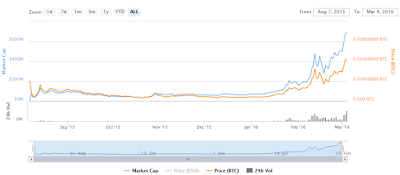
During the past months cryptocurrency Ethereum was growing fast, increasing its value and consequently its own popularity.
Today the Ethereum price is about $9 (0.022 BTC) and it undergone very few changes with an almost always upward price.
Just in the last day Ethereum raised its market capitalization by 26%, reaching almost $730 million, representing more than 10% of Bitcoin’s market cap.
This behaviour is truly important as Ethereum is proving to be much louder than the other altcoins, reaching the market capitalization of all the other altcoinsll together, excluding bitcoin.

Microsoft Corporation certified Ethereum

Some days ago a startup who provides Ethereum softwares, BlockApps became the first certified company on Microsoft Azure’s Blockchain-as-a-Service (BaaS).
Director of Blockchain strategy at Microsoft Corporation, Marley Gray, commented:
“The simple, rapid and flexible one-click deploy of Ethereum blockchain architecture launched on the Microsoft Azure Marketplace enables enterprises and developers to quickly deploy a certified blockchain environment on Azure.”

But, what is Ethereum?

Created in 2013 by Vitalik Buterin, Ethereum is a cryptocurrency and a blockchain platform who provides decentralized services.
  At the moment Ethereum is in the so-called Homestead phase, the second of the six phases of its rollout that they company planned. The other phases will be “Metropolis (Mist release), Serenity (proof of stake Casper plus abstraction, aka Ethereum 1.5), Ethereum 2.0 and Ethereum 3.0 that will focus on scalability”, commented Buterin during a recent interview conducted by Bitcoin.com.
Thanks to Homestead, said Buterin, “the risk of using the Ethereum platform is now substantially reduced”.

Open your free digital wallet here to store your cryptocurrencies in a safe place.
Amelia Tomasicchio
credit card 2 1510272

Visa is working on a secure and scalable Blockchain

The American multinational financial services corporation Visa annonuced its “secure and scalable” blockchain project.
To do so, Visa opened a position for software engineers who have to “explore and develop technologies that are critical to the payments industry in the future”, as stated in the job advertisement.
visa, blockchain, job, job position, scalable blockchain

Job Description

The researches will cover three key areas: data analytics, security and future of payments, so the team will work on develop a sort of proof-of-concept for the Visa blockchain network.


“Working on Future of Payment research at Visa is a unique opportunity at a time when the payments industry is undergoing a digital transformation with data as a critical differentiator. We offer you the opportunity to be at the center of innovation in the payments industry and unleash the power Visa technologies and massive data in innovating the future of payment concept.”


The perfect candidates must have programming experience, cryptography and “competency in data structures, algorithms and software design optimized for building highly distributed and parallelized systems”. 


Visa partners with Chain

Some months ago, Chain raised $30 million in a new venture funding, drawing funds from some financial companies including Visa.
Chain is a a blockchain developer platform that serves an enterprise market.

The blockchain is no longer a choice

Previously, on December 2015, Visa Europe stated that “the blockchain is no longer a choice”.
In an interesting blog post entitled “Why 2015 was the year of payments”, in fact, they commented on financial technologies including the subject of digital currencies, by saying:


“2015 has turned blockchain into something the industry has to live with. It is no longer a choice anymore. Recent news speculating about the identity of its creator and the formalisation of virtual money as a commodity just makes it more real than ever before.”


To know more about Visa perspective on the blockchain, you can read the full post here.

Open your free digital wallet here to store your cryptocurrencies in a safe place.

Amelia Tomasicchio