Tag Archives: blockchain

programmer 1 1534401

Philips announces its own Blockchain Lab

The Dutch multinational company Philips decided to open its own Blockchain Lab, a group of experts whose focus is the decentralized ledger.
After a half year of researches on the Blockchain, in fact, Philips announced its objective to use the distributed ledger technology for healthcare uses. 
Philips blockchain lab project developer

To do so Philips launched a call for developers and experts coming from the startup ecosystem who can submit their own CVs and apply “to work on several blockchain use cases”.
The call for talents from now on will be continuosly open, which supposedly indicates an evergoing interest of the company in developing new projects based on this disruptive technology. 
It’s always worth to remember that the innovation brought by the blockchain doesn’t impact the financial system only, but potencially has relevant implications in many aspects of our lives, including the secure transmission of information regarding our health.
The Philip Blockchain lab is located in the company’s headquarters in Amsterdam, the Netherlands. 
Head of the Blockchain Lab, Arno Laeven, commented:

“As a company committed to innovation you need to constantly explore new and emerging technologies and their application in areas where they might have an impact and added value. Our aim is to learn if blockchain technology could potentially add value to the process of data exchange in the healthcare industry.

Previous Statement

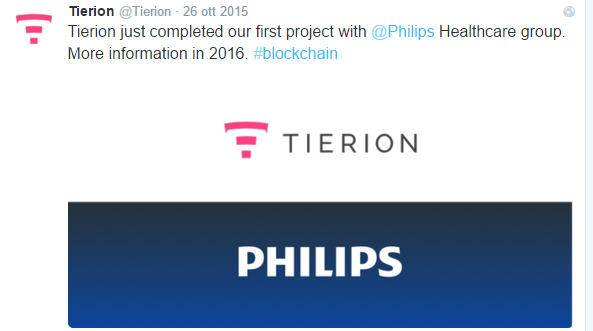
On October 2015, Philips Healtcare interest was announced in a Twitter post published by Wayne Vaughan, CEO of the blockchain startup Tierion, who reported that his company has been the first blockchain project within the Philips research perimeter on the subject.
tierion ceo philips project blockchain healthcare
 

Open your free digital wallet here to store your cryptocurrencies in a safe place.

Amelia Tomasicchio
orange light 1182121

Electricity through Bitcoin

On February 2016, MIT Enterprise Forum of Cambridge organized an event about clean energy distribution and how the blockchain can help this so important sector. 
This event was sponsored by the Massachusetts Clean Energy Center, an organization who wants to diffuse clean energy, of course. 
One of the most interesting project was the one presented by Usizo, a crowdfunding company who is trying to improve energy payments between users and schools in the African country. 
During the event Usizo presented its demo that has allowed to turn the light on at the Emaweni Primary School in Soweto.
CEO of the blockchain startup Bankymoon, Lorien Gamaroff, explained how electricity in South Africa works: rather than paying for electricity after it is received, users have to pay for it in advance; and it could be very expensive for those who live in a peripheral area. Also, this system relies on third parties who act between final customers and power companies, so prices get higher.
“A prepaid payment system makes the energy a lot more expensive because those vendors need infrastructure, there’s traveling cost, and it’s also very expensive to make those payments. If you’re in a remote area and your lights go out, there’s no way to make a payment, no easy or electronic way to do it.”
But this situation can be fixed thanks to digital currencies:
“You can now have a smart meter, a bitcoin blockchain-enabled meter, and foreign donors can send money directly to the meter without having to send it to an organization that will take or re-distribute the funds.”

How Usizo works

Usizo works thanks to a smart meter that accept digital currencies and through a crowdfunding platform where people can donate their bitcoin.
Donor can see the electricity needed by a school and can know how much he will contribute based on the BTC he donates.

What’s next?

During a recent interview with Grid Singularity CEO Ewald Hesse, Usizo won’t be only a test. 
According to him, in fact, the startup will partner with some non-governmental organizations to keep the lights on and help the education in Africa. 
Grid Singularity is a startup who use blockchain technology to develop an energy data exchange platform to facilitate energy data analysis, energy trade validation, trade of green certificates, investment decisions and smart grid management.

Open your free digital wallet here to store your cryptocurrencies in a safe place.

Amelia Tomasicchio

AirBnB wants to use the blockchain

Some months ago Don Tapscott, author of Blockchain Revolution book, explained how blockchain technology could replace services like Uber and AirBnB.
airbnb, blockchain, blecharczyk, city am,
In fact, at the World Economic Forum (WEF) held in Switzerland, Tapscott suggested:


“Why do you need a 60 billion dollar corporation called Uber? You can have a real sharing economy which it would be a distributed application on the Blockchain […] and the same is for AirBnb”.


AirBnB replies…


Well, even if might not be because of Tapscott’s suggestions, AirBnb is now interested in using the blockchain technology for its service.
During a recent interview conducted by City A.M., in fact, Airbnb co-founder Nathan Blecharczyk annonunced the possible blockchain application among the company plans for this year.
These were Blecharczyk words:


“I think that, within the context of Airbnb, your reputation is everything, and I can see it being even more so in the future, whereby you might need a certain reputation order to have access to certain types of homes. But then the question is whether there’s a way to export that and allow access elsewhere to help other sharing economy models really flourish. We’re looking for all different kinds of signals to tell us whether someone is reputable, and I could certainly see some of these more novel types of signals being plugged into our engine”.


Open your free digital wallet here to store your cryptocurrencies in a safe place.

Amelia Tomasicchio
padlock different angle 1472741

How to use the blockchain to secure medical records

Guardtime, a blockchain platform for ensuring the integrity of systems, is now working together with the Estonian eHealth Foundation to develop a blockchain network to secure one million patient medical records.

eHealth will use the Guardtime’s KSI (Keyless Signature Infrastructure) into its database to improve the security and the real-time availability of patient medical records.

Guardtime aims at protecting those records with an “independent forensic-quality audit trail”, so it will be impossible to edit the information.

During a recent interview conducted by Coindesk, a spokesperson for Guardtime said:

“In guarding sensitive records, the danger is that they could be altered, deleted, improperly changed or updated, affected by hackers, malware, system issues, etc. The blockchain in this case can prove the integrity of the record, and everything that has happened to it over time”

Why in Estonia?

Maybe you are asking yourselves why this kind of innovation is being conducted in Estonia.

Well, Estonia is already famous for its e-government system which use a chip-embedded ID card that allows citizens to access government services including filing taxes and voting online.

Guardtime Insights

In 2007 Guardtime invented a “Keyless Signature Infrastructure”, a blockchain platform created to ensure the integrity of systems, networks and data at industrial scale.

Keyless Signature Infrastructure (KSI) is designed to provide scalable digital signature based authentication for electronic data, machines and humans. KSI uses only hash-function cryptography, allowing verification to rely only on the security of hash-functions and the availability of the blockchain.

According to the company itself, Guardtime’s method is similar to the one used by the blockchain startup Factom. In both cases, in fact, every time a file changes, a new signature is generated and stored in the blockchain.

Open your free digital wallet here to store your cryptocurrencies in a safe place.

Amelia Tomasicchio
credit card 2 1510272

Visa is working on a secure and scalable Blockchain

The American multinational financial services corporation Visa annonuced its “secure and scalable” blockchain project.
To do so, Visa opened a position for software engineers who have to “explore and develop technologies that are critical to the payments industry in the future”, as stated in the job advertisement.
visa, blockchain, job, job position, scalable blockchain

Job Description

The researches will cover three key areas: data analytics, security and future of payments, so the team will work on develop a sort of proof-of-concept for the Visa blockchain network.


“Working on Future of Payment research at Visa is a unique opportunity at a time when the payments industry is undergoing a digital transformation with data as a critical differentiator. We offer you the opportunity to be at the center of innovation in the payments industry and unleash the power Visa technologies and massive data in innovating the future of payment concept.”


The perfect candidates must have programming experience, cryptography and “competency in data structures, algorithms and software design optimized for building highly distributed and parallelized systems”. 


Visa partners with Chain

Some months ago, Chain raised $30 million in a new venture funding, drawing funds from some financial companies including Visa.
Chain is a a blockchain developer platform that serves an enterprise market.

The blockchain is no longer a choice

Previously, on December 2015, Visa Europe stated that “the blockchain is no longer a choice”.
In an interesting blog post entitled “Why 2015 was the year of payments”, in fact, they commented on financial technologies including the subject of digital currencies, by saying:


“2015 has turned blockchain into something the industry has to live with. It is no longer a choice anymore. Recent news speculating about the identity of its creator and the formalisation of virtual money as a commodity just makes it more real than ever before.”


To know more about Visa perspective on the blockchain, you can read the full post here.

Open your free digital wallet here to store your cryptocurrencies in a safe place.
Amelia Tomasicchio
BlockchainImplementation

ISITC Survey Reveals Financial Industry focus on the Blockchain

On March 1st, 2016, ISITC, the International Securities Association for Institutional Trade Communication, published the results of its annual survey about the financial services progress which it gives also a specific forecast on how the industry will be during the current year.
This annual survey polled 45 members who work in several sectors within the financial industries.The survey revealed that 62% of companies want to invest in technology with a lot of interest in blockchain and cybersecurity technology and 55% of those companies are studying or already developing solutions based on blockchain technology.

Also 74% of those companies have concrete plans to invest in cybersecurity by the end of 2016/17, up from 57% in the 2015 survey.

Interesting facts about the 2016 survey

This annual survey also revealed:

  • 82% anticipate no operational issues related to the move to a T+2 settlement cycle in 2017
  • 80% of firms see cost reduction as the biggest challenge for them in 2016/17
  • 63% of firms measure operations success on the ability to reduce risk and cost
  • 62% of firms named investment of infrastructure an area of operational focus in 2016

A word from the experts…

Jeff Zoller, Chair of ISITC and Vice President at T. Rowe Price commented:

“New and emerging technologies have taken the financial services industry by storm. The results of our annual member survey confirm this sentiment, as firms plan increased investment in blockchain and cybersecurity technologies, as a method for combating long-term risk and cost. We look forward to continuing the dialogue around the challenges and opportunities these disruptive technologies bring to the industry at our March event in Boston”. In addition, according to Nigel Solkhon, CEO of ISITC Europe, the current interest and investment in the blockchain among financial companies will have a significant impact within the next 18 months.

The ISITC 22nd Annual Industry Forum and Vendor Show will be held March 20-23, 2016 at the Renaissance Boston Waterfront Hotel.

Open your free digital wallet here to store your cryptocurrencies in a safe place.
Amelia Tomasicchio

DH Corporation introduced blockchain solutions
During the recent months a lot of companies such as Dwolla, Earthport and PayCommerce announced the development of various solutions based on the blockchain.
Today is the turn of DH Corporation, also known as D+H, a Canadian leading end-to-end provider of retail, commercial and transaction banking solutions.
D+H introduced a proprietary blockchain solution within its Global PAYplus platform.
Global PAYplus already allows different methods of payment and D+H probably will announce soon the introduction of the digital currencies.
According to Moti Porath, D+H’s executive vice president of global pre-sales, the blockchain will help the company in several ways:

“We believe that 2016 will see banks transitioning from experimenting in the innovation labs to implementing solutions that drive value to their customers. At this time, we see the most relevance for blockchain capabilities in payments, so it made sense to move quickly to add capabilities to our global payments hub”, he said.
So it seems D+H really believes in the blockchain potential:
“[Banks] will be able to utilize a secure, closed loop, distributed ledger system to connect bank networks, move money in real-time, and improve access to liquidity.”
Going deep, D+H wants to create a node similar to a liquidity pool, with several liquidity pool accounts externally created.
This is Porath’s explanation:
“The liquidity pool node simulates accounts in a central bank and, when value is exchanged and the blocks are being updated, the central bank node is updated to reflect the exchange of value.”

D+H partners with Ripple

On October, 2015, D+H started a partnership with Ripple “to deliver innovative payment capabilities by integrating Global PAYplus, its global payment services hub, with Ripple’s distributed ledger technology, creating a foundation for further disruptive payments innovation”, stated dh.com.
Gene Neyer, head of product management, said:

“Distributed ledgers have the potential to radically transform the payment process. They remove the frictional costs and reduce the complexities of using multiple intermediaries; reduce or eliminate the reconciliation processes; and transform and enrich existing business processes by providing alternative sources of liquidity. This investment in distributed financial technology demonstrates D+H’s continued commitment to payments innovation. The payments landscape is rapidly evolving and D+H’s forward-looking solutions enable financial institutions and corporations around the globe to grow and compete.”

Download the whitepaper here

Also, D+H published a whitepaper in which they explain the five reasons why the company believes the banking industry should invest into the blockchain technology. You can download it here for free.

Open your free digital wallet here to store your cryptocurrencies in a safe place.
Amelia Tomasicchio
RussianCentralBankopenstoBlockchain

Bank of Russia is working on the blockchain


the bank of russia, russian central bank, blockchain
Bank of Russia has revealed its decision to study the potential applications of the blockchain.
On Sunday 28th, February 2016, the central bank, in fact, has announced that they started to analyse the “advanced technologies and innovations in the financial market”, including the blockchain.

Previous statements in Russia

Bank of Russia’s deputy chairman Olga Skorobogatova previously commented:
“The development of modern financial markets is inseparable from the development of financial technology.”
Also, Rambler News Service has reported that Skorobogatova previoulsy commented in 2014 that the Russian central bank thinks the blockchain can have an important role in the future:
“In 2017-2018, we will see real examples of the use of this system. As a closed system, I think the blockchain is the future, and we need to prepare for it.”
In the meantime Russia is supporting a possible “ban on monetary surrogates”, a definition that also includes digital currencies.
In fact Russia’s Ministry of Finance, State Duma and the Investigative Committee have previously commented about the use of the blockchain within their businesses.
Also, earlier this month, Bank of Russia’s head, Elvira Nabiullina, stated that the Russian bank was “monitoring the blockchain to develope its own approach to financial innovation”.

How banks want to improve their users base


“Users of bitcoin and other cryptocurrencies now number 200,000, with only the US, China and Germany having higher numbers”,
reported member of the Russian State Duma, Andrei Lugovoi.
In fact, Lugovoi stated that the Russian central bank is now positive for a “careful approach to bitcoin and saw a serious economic potential” in the blockchain with the likely objective of a potential growth of their users.

Open your free digital wallet here to store your cryptocurrencies in a safe place.
Amelia Tomasicchio
www.eddieseatery.com28129

Australian commission said blockchain can help governments regulation

On February 15th Greg Medcraft, chairman at Australian Securities and Investments Commission (ASIC), stated that the blockchain can have “profound implications” on how government regulates the markets.
During the Official Monetary and Financial Institutions Forum Roundtable held in London, in fact, Medcraft commented that regulators need to better understand this technology before thinking how to regulate it.

How to adopt the Blockchain

Medcraft also said that if capital markets will adopt the use of the blockchain it will be able to improve market efficiency and the access to markets, decrease fees and help transactions transparency.
“Blockchain will have profound implications for how we regulate. We will need to find the right balance between speed of execution and streamlining of business processes. As regulators and policy makers, we need to ensure what we do is about harnessing the opportunities and the broader economic benefits, not standing in the way of innovation and development.”
Medcraft also spoke about how Australian securities regulators act, talking about surveillance of firms, products released in the market and the development of methods to involve the blockchain.
“We are working to understand how enforcement action can be taken where a transaction entered into here or overseas is recorded in the blockchain”, he said.

Australia is in the vanguard

Previously this year, the Australian Stock Exchange (ASX) revealed its plans to adopt the blockchain for trades clearing and settlement.
To do so, the ASX wants to create its own private blockchain with the partnership of Digital Asset Holdings (DAH).
The first phase of this program will run at the end of 2016 and will replace ASX’s existing trading and risk management systems.
To know more about this project, you can read the full press release here.

Open your free digital wallet here to store your cryptocurrencies in a safe place.
Amelia Tomasicchio
BlockchainandBitcoinregulationYesornot

“Blockchain can help governments”, says Blockstream CEO

According to Blockstream CEO, Austin Hill, blockchain technology will be able to help government regulatory agencies.

During a recent inverview with Bloomberg TV, in fact, Hill stated that blockchain “is a fundamental shift in how the underpinnings of how finance work, moving much more to an open, permission-less innovation platform. I think people are beginning to realize that some of the underpinnings of our finance system have not changed in 20 years. Wire transfers, international remittances, post-trade settlement, the entire way that banks and finance organizations do netting, a lot of issues around how stock and assets are traded and actually tracked which led to some of the problems in 2008 of systemic risk”. 
bitcoin regulation


What Blockstream is?

Austin Hill and his team have developed a blockchain “sidechain” technology to link the bitcoin blockchain to the other existing public and private blockchains.


“We want to power interoperable markets that are fair and accountable. Openness, accountability and public ledgers should be the norm and should not require users to sacrifice privacy. We seek to empower users with trustable and secure financial mechanisms via public auditability of their transaction history without disclosing more than is necessary for the integrity of the blockchain”, reports their official website


Recently Blockstream has announced $55 million in series A funding to further enhance their sidechain technology, expand their operations globally, and support new industry partnerships, bringing their total investments in the company to $76 million.

“We’re changing how the actual ledger works. It offers huge cost savings for financial organizations in the area of regulatory compliance, trust with other organizations because right now there’s a huge amount of reconciliation that has to occur where everyone has their own copy of the ledger and no one agrees”. 

The Bloomberg TV journalist asked him if he is worried about the regulatory environment, so Hill answered that it is not a problem as regulators only want to remove risks:

“This technology offers some of the best potential to actually remove systemic risk. And a lot of regulators around the world are beginning to realize that, so they’re looking at their own solutions even at the national government level to say if we do support fiat currency issued on a blockchain, what is the right technology to do so?”

Open your free digital wallet here to store your cryptocurrencies in a safe place.

Amelia Tomasicchio