Category Archive: blockchain

chainthon

Chainthon – The Bitcoin and Blockchain Hackathon in Athens, Greece

Athens, Greece is about to have its first Bitcoin and Blockchain Hackathon, aptly named the Chainthon, on October 17th. The hackathon is a direct response to growing support for Bitcoin as well as growing pressures on the local financial system. The Hellenic Bitcoin community explained their situation in a press release:

This year, we are witnessing an economic crisis escalate into a humanitarian crisis. Hundreds of thousands are fleeing the war in the Middle East in search of a better life, only to find different obstacles in Europe. Many of the countries they travel through are facing a severe economic crisis, making it difficult to transfer money or receive donations.

The refugee issue facing much of Europe has reignited age-old tensions between ethnic groups that have been at odds for centuries. The growing amount of forcefully or willfully unbanked refugees and ex-pats is an immediate use case for Bitcoin technology. However, it is almost certainly the latter group of ex-pats, not refugees, that are currently taking advantage of Bitcoin. George Papageorgiou, the organizer of the event, laid out the main goal of the event:

The Hellenic Bitcoin community is hosting a hackathon aiming to increase awareness locally and tackling the more prevalent issue of value transfer in situations of socioeconomic crises. We will try to hack together, a practical and accessible system that can transfer donations to anyone without requiring a lot of education or an intermediary.
HolyTransaction is a digital currency company that believes in the promise of Bitcoin and blockchain technology. International payments, transfers, and people are our audience. As we’ve noted before, the Greek area is unique poised to benefit from the promise of Bitcoin and cryptocurrencies because of recent economic crises and also the new escalating pressures.
Introducing newcomers, especially those with strong developing and coding skills, to Bitcoin is a crucial service that cannot be promoted enough. HolyTransaction believes that people just finding out about Bitcoin should focus heavily on education. Read the whitepaper! Check out good Bitcoin videos, as it’s often easier to listen to a charismatic speaker than it is to read a dense wiki.
If you are in Athens, please check out the first Greek Bitcoin and Blockchain Hackathon. HolyTransaction supports Bitcoin events and would love to hear about your upcoming Bitcoin or Blockchain hackathon.

Open your free digital wallet here to store your cryptocurrencies in a safe place.

Satoshi
Imogen Heap feature 009

Imogen Heap Releases New Single Using Ethereum

In a recent event at Guardian live!, popular music artist Imogen Heap talked about the release of her new song, Tiny Human, on the Ethereum blockchain. By working with BitTunes, Ethereum Developers recently demonstrated smart contract functionality by purchasing the song using Ether. Imogen started with just a thought:
And I thought, wouldn’t it be nice if I could decide what I wanted to do with my music, who I wanted to have it for free, or not have it for free?

She eventually found her way to the bleeding edge of technology and has now officially brought her music to the digital age with blockchain smart contracts.

Music Is Finally Entering the Digital Age

Since the days of Napster, LimeWire, and even iTunes, music has come a long way in the digital age. Before physical mediums for music storage and music playing were developed, the only way to purchase music was to buy a single listen in the form of (likely) an orchestra or choral concert. With physical medium such as vinyl, cassettes, CDs, and now MP3s, the business model changed to allow consumers to buy “unlimited” listens by having the music file. Newer services such as Spotify, Pandora, and 8Tracks have created a newer business model that returns to using the “listen” as the basic unit of measurement. Music ownership has progressed and regressed; however, the connection between artist and music buyer has only continually grown wider and wider. Imogen commented:

“…now, you get a download, but often it’s not connected to the artist in any way.”

Blockchain Technology Allows for New Possibilities

After talking about blockchain technology with her friend Zoë, Imogen realized that technology had finally reached a point where users could get a download that is connected to artists in a financial way. Imogen described her realization:“I realized there is actually a way that you can connect a file with its payment attached into a digital wallet. And so when somebody listens to a track — the technology is very close to being there — it immediately recompenses me, and then I can split it off to my choreographer, to Zoë for thanking her, to whatever, it can immediately go into their bank accounts. Instead of having to wait two years, sometimes, even more, for money to come back to me, it can be instant.”

It turns out that technology can benefit the fans, who can receive provable special attention from their favorite artist, and the artists, who can receive payments sooner and with less middle men in between. Imogen Heap’s decision to use Ethereum and blockchain technology now that she is free of the shackles of contracts made by record labels tells us something about the future. This same move toward smart contracts will be emulated in other industries. Ethereum, and by extension Bitcoin and blockchain technology as a whole, will change the world.

 About the author: Caleb Chen is a cryptocurrency advocate and research assistant at the Chamber of Digital Commerce.

Open your free digital wallet here to store your cryptocurrencies in a safe place.
Satoshi

Bitcoin’s Monthly Recap of September 2015

Welcome to HolyTransaction’s ninth monthly recap for the year 2015. This past month of September has been marked by some pretty developments in old cases and the long awaited release of new products; during that time, the bitcoin price rose from a low of $229.86 on September 1st to a high of $236.12 on September 30th, according to Bitcoin exchange Bitstamp.
 
Mike Tyson Proud to Be In Bitcoin, Opens Bitcoin ATM in Las Vegas
Weeks ago, Mike Tyson announced that he would be releasing a Tyson branded Bitcoin ATM in Las Vegas. The Lamassu Bitcoin ATM currently sits at the Linq in Vegas, is the 7th in Sin City, and has gathered a lot of attention. Tyson believes that Bitcoin will grow as education on it grows. He commented: “People don’t really understand a currency based on numerical equations. I personally still don’t … but I’m grateful to be a part of the revolution and hoping that my participation in this space will lead to more conversations and help increase knowledge and awareness.”
 
More Corruption in FBI Silk Road Case As Variety Johns Comes Forward
Variety Johns, the man long associated with working with Ross Ulbricht and Silk Road, has turned himself in and revealed a very convoluted tale. He claims that a corrupt federal agent is threatening the Ulbricht family and is in control of an encrypted Bitcoin wallet with Ross Ulbricht’s bitcoins. Posting to the internet, Variety Johns revealed his real name and the alias of the supposed agent hunting him: Diamond. The years old investigation into Silk Road is still ongoing.
 
21 Inc. Releases 21 Bitcoin Computer
21 Inc., one of the most well-funded Bitcoin companies in the world, has released its first product: the 21 Bitcoin Computer. At its core, the Bitcoin computer is just a Raspberry Pi 2 with an attached 21 Inc. Bitcoin mining chip that is rather efficient. The Bitcoin computer enables a developer to have full access to the Bitcoin network as a full node. Already, the computer has become the #1 best selling server on Amazon.
 
R3 Blockchain Initiative Brings 22 International Banks Together
In a sure sign of the times, many big name banks from around the world have committed to working with new Bitcoin company R3. R3 is planning a blockchain development initiative that will update the financial infrastructure that banks use to include blockchain technology, whether or not Bitcoin will be involved remains to be seen. The CEO of R3 stated: “The addition of this new group of banks demonstrates widespread support for innovative distributed ledger solutions across the global financial services community, and we’re delighted to have them on board.”

Open your free digital wallet here to store your cryptocurrencies in a safe place.
Satoshi

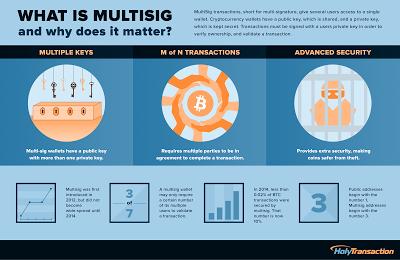
Infographic: What is MultiSig and why does it matter?

What is Bitcoin multisig infographic HolyTransaction


Open your free digital wallet here to store your cryptocurrencies in a safe place.
jorge
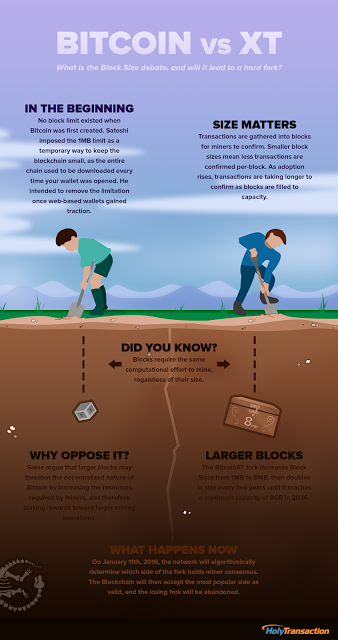
Fork Infographic HT Final

Infographic: What is the Block Size debate, and will it lead to a hard fork?

Block Size debate infographic HolyTransaction


Open your free digital wallet here to store your cryptocurrencies in a safe place.

jorge
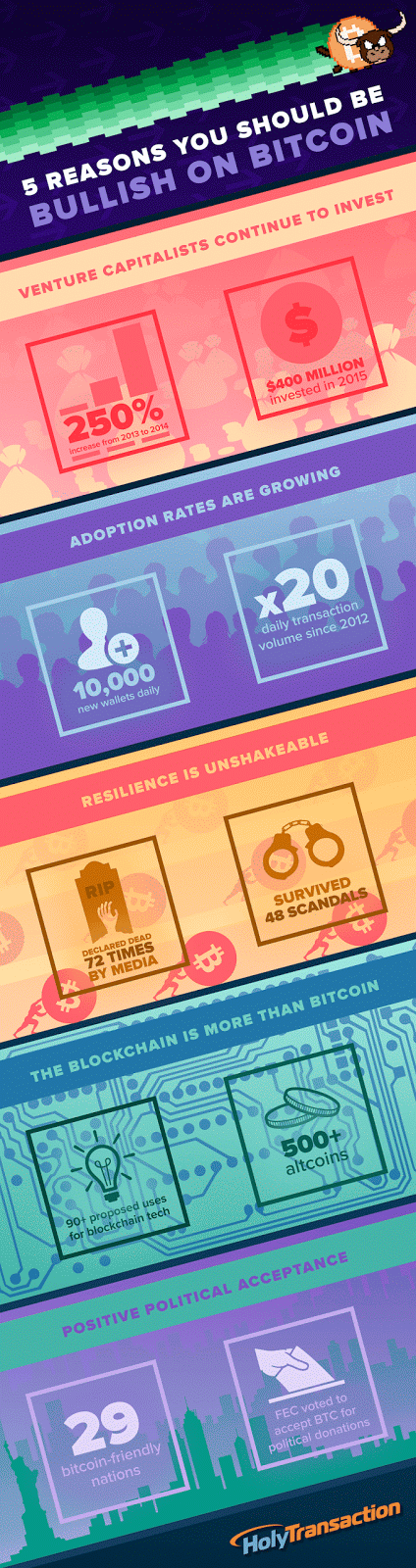
5 reasons you should be bullish on bitcoin holytransaction

Infographic: 5 reasons you should be bullish on Bitcoin!
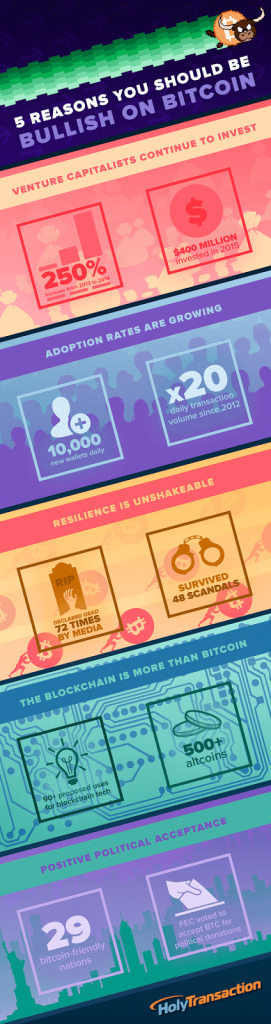
5 to be bullish on Bitcoin infographic HolyTransaction


Open your free digital wallet here to store your cryptocurrencies in a safe place.
jorge

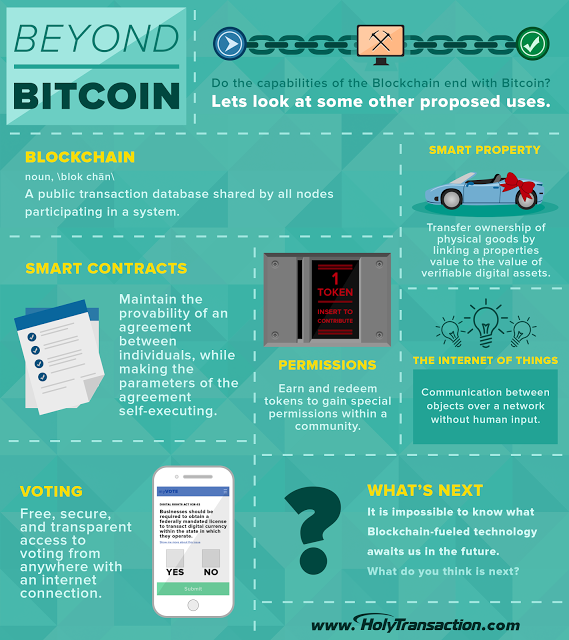
Infographic: Do the capabilities of the Blockchain end with Bitcoin?

Capabilities of Blockchain Bitcoin Infographic HolyTransaction

Do the capabilities of the Blockchain end with Bitcoin?

Open your free digital wallet here to store your cryptocurrencies in a safe place.

jorge
tumblr inline nsqh78t2MG1t3ciw3 500

HolyTransaction partners with RibbitRewards to further Blockchain-based rewards programs

HolyTransaction is thrilled to announce its integration with the Blockchain-based coalition rewards platform, RibbitRewards. This partnership represents a year of interaction between our two companies, beginning in 2014, and underscores our desire to continue working together for many years to come.
RibbitRewards is the first coalition rewards program built using Blockchain technology. Their platform allow companies to recognize the loyalty of their customers by awarding points that can be spent, saved, or shared with others. Additionally, RibbitRewards stands prominently out from the crowd as a result of their dedication to philanthropy; a percentage of all RibbitRewards created are donated to charity.
Ribbit.me uses extensive HolyTransaction API to make invoicing and payment processing. It will make life much easier for users with HolyTransaction account and will give ability to get new HolyTransaction account instantly for those who do not have it yet. All of this gives the users seamless experience on both platforms.
HolyTransaction multi-currency wallet users have access to storage for Bitcoin, Litecoin, Dogecoin, Dash, Blackcoin, and Mastercoin (Omni Layer). Today, we add RibbitRewards to this list.
Users will be able to receive, store, and spend their rewards via their HolyTransaction wallet, as well as exchange them instantly with one of our accepted digital currencies, as listed above. Our integration improves the experience of all users across both platforms, and we are dedicated to providing new and exciting experiences for our community and to continuing the proliferation of Blockchain technology.

Open your free digital wallet here to store your cryptocurrencies in a safe place.
Satoshi
blockchain 1

Think the Internet’s disruptive? Hold tight for blockchain!

Wonder what all the fuss is about Bitcoin? A growing number of technology watchers are becoming increasingly excited about the peer-to-peer system on which the digital currency is built.
(Diginomica) The blockchain, this is the distributed, encrypted record that Bitcoin uses to record every transaction. An article in the Telegraph last week by Matthew Sparkes explained how the blockchain works:
The idea is that each and every transaction is broadcast by the person initiating it. Rather than telling the bank we want to spend [$5], we tell the world. That transaction is bundled up with thousands of others and cryptographically bound into a ‘block’ by ‘miners’ …
To quote the wiki dictionary maintained by ‘the Bitcoin community’ — perhaps the nearest you can get to an official explanation — ‘mining is intentionally designed to be resource-intensive and difficult so that the number of blocks found each day by miners remains steady … The primary purpose of mining is to allow Bitcoin nodes to reach a secure, tamper-resistant consensus.’

This matters because, as Sparkes sets out under his provocative headline of The coming digital anarchy,
this is a system that can be applied not just to money but to any kind of transaction, from domain name registration to legal arbitration or public elections. In between those two extremes, it could completely overturn the way enterprises organize themselves and tout for business.

The fifth protocol
To better understand the impact on business, it’s worth going back to a longform blog post from April by Angellist CEO and co-founder Naval Ravikant, in which he states that cryptocurrencies will create a fifth protocol layer powering the next generation of the Internet:
The Four Layers of the Internet Protocol Suite are constantly communicating. The Link Layer puts packets on a wire. The Internet Layer routes them across networks. The Transport Layer persists communication across a given conversation. And the Application Layer delivers entire documents and applications.
This chatty, anonymous network treats resources as ‘too cheap to meter.’ It’s a giant grid that transfers data but doesn’t transfer value. DDoS attacks, email spam, and flooded VPNs result. Names and identities are controlled by overlords — ICANN, DNS Servers, Facebook, Twitter, and Certificate ‘Authorities’.
Where’s the protocol layer for exchanging value, not just data?
Where’s the distributed, anonymous, permission-less system for chatty machines to allocate their scarce resources? Where is the ‘virtual money’ to create this ‘virtual economy?’ …
Cryptocurrencies are an emergent property of the Internet — almost a fifth protocol in the Internet suite. If [Bitcoin creator] Satoshi Nakomoto did not exist, it would still be necessary to invent them.
Someday, they will be used by the machines in our network, on our desk, in our garage, and in our pocket to exchange value and achieve consensus at blinding speeds, anonymously, and at minimal cost.

What Ravikant is really describing here is not Bitcoin per se but the work of the blockchain, providing a trusted, shared transaction record that allows machines to own and exchange value without human intervention. Although in strict engineering terms it’s not really a protocol, its impact is potentially as huge as any of these other building blocks of the Internet.

Effectively, Ravikant is arguing the blockchain is how the Internet of Things will exchange value — not just monetary value, but also many of those other components of business transactions that we currently find much harder to quantify, such as trust and reputation.

blockchain blocksAutonomous things

Now back to Sparkes, who recounts a scenario imagined by Mike Hearn, an ex-Googler who now works on Bitcoin:

Jen wants a taxi. She tells her smartphone where she’s heading and it immediately starts gathering bids from nearby taxis and ranking them based on price and user reviews. This system on which requests and offers bounce around is called TradeNet, and it would be based on blockchain technology.
The strange thing about these vehicles is not that nobody drives them, as self-driving cars will have become commonplace decades before, but that nobody even owns them. They are what Hearn calls ‘autonomous agents’, independent machines which earn their own money through fares, pays for their own fuel and repair and operates utterly without outside control.

Far-fetched it may be, but this is the kind of scenario that is getting venture investors excited about blockchain right now — and you can understand why.

Open your free digital wallet here to store your cryptocurrencies in a safe place.

Satoshi

Bitcoin, Dogecoin, and the Blockchain

The prevalent idea of modern day cryptographic currencies originated when Bitcoin launched in 2009. With Bitcoin, for the first time in history, the world had access to a completely decentralized medium of exchange. This medium of exchange reliably transfers value from one entity to another in a hostile, trust less environment by solving a problem that previously necessitated centralized entities, such as financial banks, to arbiter value exchanges. The main role of the centralized entity was to assure the recipient that the money has been taken from the sender, and given to the recipient, and the sender could no longer spend the same money (i.e., double spend it). The problem of double spending can be modeled under an abstract Byzantine Generals’ Problem that focuses on achieving majority consensus in a decentralized network.
The Byzantine Generals’ Problem is a topic that deserves its own blog post. For now, let’s just remember that the problem of double spending was thought impossible to solve in a decentralized manner before Bitcoin solved it. This solution was implemented in what is now called the Blockchain.

What is the Blockchain?

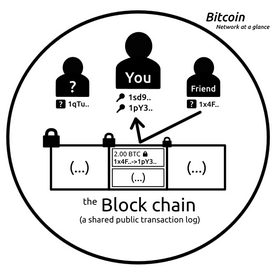
In simple terms, the Blockchain is a book of accounts that is divided into batches of transactions, or blocks, which are naturally a collection of transactions. Bitcoin uses a number of technologies that came before it, including decentralized file sharing (see: BitTorrent), Public Key Cryptography, and Proof of Work Hashing (see: Hashcash). Bitcoin introduced a new technology: the Blockchain. Most subsequent cryptographic currencies, such as Dogecoin, use the same technology with minor changes (e.g., a different Proof of Work hashing algorithm).
The Blockchain facilitates reliable transfer of units of account (later on referred to as values) between certain cryptographically valid entities. In Bitcoin, the total units of account that will ever exist is 2.1 Quadrillion Satoshis, or 21 Million Bitcoin. In Dogecoin, this is 100 Billion Dogecoin until March 2015, and 5 Billion additional Dogecoin annually after that. Dogecoin and Bitcoin consist of two separate networks of peer-to-peer nodes. Each Bitcoin or Dogecoin portefeuille tries to keep its local copy of the book of accounts up-to-date.
In order to make use of the power of the Blockchain and its fast, decentralized, low-fee transactions, one must understand what constitutes a transaction:
A transaction is simply a cryptographically verifiable instruction from the sender to transfer value the sender owns to one or more valid recipients. The sender(s), and receiver(s), have cryptographically verifiable identities, known as addresses (see: Public Key Cryptography).
In the Blockchain, here’s what a (simplified) transaction looks like:


{
    "txid": <a unique transaction identifier>
    "inputs": <an array of inputs>
    "outputs": <an array of outputs>
    "tx_hex": <transaction content as a hexcode string>

    "blockhash": <a unique block identifier this transaction belongs to>
    "time": <the time this transaction's block was processed>
    "confirmations": <number of blocks that confirmed this transaction>
}

The very basic parts to understand in the above snippet are: a transaction has inputs, and outputs. The inputs are specifications of which values to transfer from the sender’s address(es), and the outputs are specifications of how much of the total input value each recipient’s address(es) receives. Inputs in this transaction were outputs in a previous transaction, with the exception of when the network generates new coins.
New coins are generated by the Dogecoin network as rewards for miners for solving a block (example), i.e., miners work hard to find the correct hash for a batch of transactions, also known as a block (see: Hashcash, Proof of Work). If the total input values are higher than the total output values, the difference is paid to miners of the block as a transaction fee. Total input value is never less than the total output value in a single transaction.
When a miner finds a new block, they confirm all the transactions contained within it as valid. However, a block does not exist on its own — it is linked to blocks previously solved in a chain of blocks all the way to the Genesis Block. The Genesis Block was created when Bitcoin or Dogecoin networks were created (see: Dogecoin Genesis Block). Therefore, where a block is solved, and appended to a chain of previously found blocks, it confirms the transactions within it, as well as the transactions in all the previous blocks in its chain. Hence the name: Blockchain.
So, what is the Blockchain? In very concise terms, it is a chain of blocks!

Open your free digital wallet here to store your cryptocurrencies in a safe place.

Satoshi