Category Archive: blockchain

Ray Ban RB2140 Original Wayfarer Sunglasses Leonardo

Hitachi is studying the Blockchain

Some days ago the Japanese company Hitachi announced that it will open a research laboratory in the US that will study the blockchain ledger and its possible applications.
The lab will partner with Hitachi technology innovation division and it will be opened next month in Santa Clara, California.Hitachi wants to use the research laboratory to work on some projects for its customer base.

In a press release, Hitachi explained:

“By establishing the Financial Innovation Laboratory in the Silicon Valley, Hitachi will accelerate research [and] development of blockchain technology, collaborative creation with customers, and development of solutions to support business innovation in financial institutions.”


Hitachi partners with Hyperledger

This statement follows a previous company’s news related to the blockchain: in fact, in February Hitachi joined the Hyperledger Project, an advaced blockchain technology that aims at “identifying and addressing important features for a cross-industry open standard for distributed ledgers that can transform the way business transactions are conducted globally.”

The Hyperledger Project is a Linux Foundation collaborative project that stars some of the most important companies in the world, including IBM, J.P. Morgan, Fujitsu and many more.

Open your free digital wallet here to store your cryptocurrencies in a safe place.

Amelia Tomasicchio
private property 1563209

Overstock to place its public shares on t0 blockchain platform

During the 41st Annual International Futures Industry Conference, the American online retailer Overstock decided to issue its public shares on a proof-of-ownership blockchian called t0.
Announced in August, t0 is “built upon decentralized, cryptographically protected ledgers, which anybody can access and inspect. This ensures fairness to the entire market, without regard for size or geographic location”, explained the official website.

SEC approves Overstock’s issue on the blockchain

To do so, Overstock had to obtain a specific authorization from the Securities and Exchange Commission (SEC), who approved the issue of public shares via Internet in December.


sec approves overstock blockchain t0 public shares

In fact, Overstock will be the first company in the world to do a Blockchain public offering.

“This is yet another historic event: the creation of a security that will trade and settle entirely on a distributed ledger. I’ve said from the beginning that blockchain technology is going to change the world of finance forever, and we’re leading that charge”, commented t0 CEO Patrick M. Byrne (and Overstock CEO and founder) in the official press release.
This way, the company stock will be issued in two versions: one available on traditional trading systems (such as Nasdaq) and another one on t0.


But it is limited to…

Only the Overstock shareholders will be able to benefit from this offering, provided that they are in the records as of a date yet to be decided; also it will be limited to 1,000,000 shares of blockchain and traditional Series A preferred stock.


Open your free digital wallet here to store your cryptocurrencies in a safe place.

Amelia Tomasicchio
bank of england6142011

Bank of England will create its own cryptocurrency

The Bank of England announced its decision to create its own digital currency.

The cryptocurrency will be called RSCoin and it will use the blockchain, the decentralized ledger where bitcoin transactions are written and executed.

More Centralized Control

RSCoin has been developed by researchers at the University College of London.

Of course, this new cryptocurrency will provide a more centralized control compared to bitcoin.“RSCoin introduces a degree of centralization into the two typically decentralized components of a blockchainbased ledger: the generation of the monetary supply and the constitution of the transaction ledger. In its simplest form, the RSCoin system assumes two structural entities: the central bank, a centralized entity that ultimately has complete control over the generation of the monetary supply, and a distributed set of mintettes that are responsible for the maintenance of the transaction ledger”, it is said in the RSCoin abstract.

How could this be positive?

Even if RSCoin is centralized and the opposite thing of Bitcoin, we could say that it is positive as it means that worldwide Central Banks are starting to give importance to cryptocurrencies.

However, RSCoin has its own benefits: for example no double spending, non-repudiable sealing, timed personal audits, universal audits and exposed inactivity.

Read the complete documentation

Univerisity College of London researches George Danezis and Sarah Meiklejohn published an abstract about RSCoin.

The full whitepaper is intitled “Centrally Banked Cryptocurrencies”.

The abstract begins from the bitcoin history, to explain everyone the impact of the digital currencies not only in the finance world:

Recently, major financial institutions such as JPMorgan Chase and Nasdaq have announced plans to develop blockchain technologies. The potential impacts of cryptocurrencies have now been acknowledged even by government institutions: the European Central Bank anticipates their “impact on monetary policy and price stability”.

People’s Bank of China and its own cryptocurrency

In January 2016, the People’s Bank of China commented about its plans to launch its own digital currency and create a new financial infrastructure for the country.

The project started in 2014, when researches began to study cryptocurrencies related to business operations.

People’s Bank of China commented:

“The issuance of digital currency can reduce the significant costs of issuing and circulating traditional currencies, improve the convenience and transparency of economic transactions, reduce money laundering, tax evasion and other criminal acts, enhance the central bank’s control of over the money supply and currency circulation, better support economic and social development and aid in extending financial services to under-served populations”.

Open your free digital wallet here to store your cryptocurrencies in a safe place.
Amelia Tomasicchio
Microsoft

Microsoft adds 5 blockchain partners to Azure and it still accepts Bitcoin
Last month we talked about the decision of Microsoft Corporation to start testing the blockchain technology and to create its own blockchain-as-a-service (BaaS) product.
In fact, Microsoft opened its Azure cloud computing platform, adding a growing number of partners to its BaaS solution including ConsenSys, Emercoin and MultiChain.
And now Microsoft has announced the addition of five new blockchain partners to its Azure platform, including prediction market Augur and Ethereum network Slock.
Some other partners previously announced include Lisk, BitShares, Syscoin, BitPay, Eris Industries and Factom.
microsoft bitcoin

Microsoft still accepts Bitcoin payments

According to CNBC, Microsoft continues to accept Bitcoin among its allowed methods of payment.
On Monday they accidentally announced that it would no longer accept bitcoin, but the company belies this announcement.
In fact, Microsoft Corportation still accepts Bitcoin for purchasing contents in the Windows and Xbox stores.


“We apologize for inaccurate information that was inadvertently posted to a Microsoft site, which is currently being corrected,” told a company spokesman to CNBC.


Open your free digital wallet here to store your cryptocurrencies in a safe place.
Amelia Tomasicchio

Ethereum and Arcade City could kill Uber

A few days ago Don Tapscott suggested the idea that the blockchain could cause the death of services like Uber and Airbnb.
And it seems like this is truly happening, as a service called Arcade City has officially published a press release where they “declare war on Uber over fare cuts and plan to replace drivers with self-driving cars”.

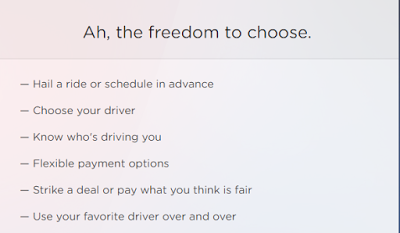
Arcade City is an open marketplace where riders connect directly with drivers. It only works via a mobile app, available for both iOS and Android. 

How it works

Let the company speaks for itself:

It works through the Ethereum Blockchain

Most importantly, Arcade City integrates the Ethereum blockchain.
During a recent interview with CoinTelegraph, Christopher David, founder at Arcade City, commented: 

“the main deciding factor was that the vision of Ethereum aligns precisely with our own vision of peer-to-peer transportation and distributed logistics”.

Where can we move with Arcade City?

At the moment Arcade City is active in the US.
These are the states: Arizona, Arkansas, California, Colorado, Florida, Georgia, Illinois, Indiana, Kentucky, Louisiana, Maryland, Michigan, Minnesota, New Mexico, North Carolina, New Hampshire, New Jersey, Ohio, Oklahoma, Oregon, Pennsylvania, South Carolina, Texas, Virginia, Washington and Washington D.C.
Drivers are also available in Australia; while Mexico, Canada and Sweden will be launched next spring.

Open your free digital wallet here to store your cryptocurrencies in a safe place.

Amelia Tomasicchio
Screen Shot 2016 03 14 at 12.29.28 AM

Ethereum Launches Homestead

Blockchain project Ethereum has just launched Homestead, the first release of its software implemented at block 1,150,000.
ethereum launches homestead, homestead release
This new implementation comes at a time when more and more financial institutions and startups are revealing their interest in Ethereum and in creating projects related to the blockchain.
Just a few days ago, in fact, we talked about how Ethereum now is bigger than ever.


Special advisor at Ethereum Foundation, William Mougayar, explained that Ethereum processes almost 25,000 transactions per day: about 10% of the number of Bitcoin.

“You need to look at the growth of the Ethereum network via the growth of its nodes, sitting at 5,100 versus bitcoin’s about 6,000 roughly. That’s quite significant and shows the stability and global nature of the Ethereum network,” commented Mougayar.

Homestead vs Frontier


Homested is preceded by Frontier, that was released in July 2015.
Co-founder of ConsenSys Enterprise, Andrew Key, commented that Homestead will help users to expand their possibility on Ethereum and the simplicity that will allow them to be able to build proof-of-concept products.
Keys said to CoinDesk:

“Homestead’s arrival will begin to demonstrate the next generation of blockchain technology, whereby anything we can dream of, can be accomplished in a decentralized manner using Ethereum.”


“We’ve seen Microsoft and IBM doing projects on Ethereum. There’s a lot of coders. It’s exciting to see something you were in on in the early stages growing and bearing fruit,” said Ethereum co-founder Anthony Di Iorio.


Ethereum helps Car Charging

In Germany the startup called Slock is working with RWE on a project to use Ethereum for car charging uses.

This project debuted at the Lift 2016 conference in Geneva, Switzerland and it will play out within 2017.
According to the RWE, customers will use charging stations by accepting a smart contract programmed on the Ethereum blockchain.


Open your free digital wallet here to store your cryptocurrencies in a safe place.

Amelia Tomasicchio
programmer 1 1534401

Philips announces its own Blockchain Lab

The Dutch multinational company Philips decided to open its own Blockchain Lab, a group of experts whose focus is the decentralized ledger.
After a half year of researches on the Blockchain, in fact, Philips announced its objective to use the distributed ledger technology for healthcare uses. 
Philips blockchain lab project developer

To do so Philips launched a call for developers and experts coming from the startup ecosystem who can submit their own CVs and apply “to work on several blockchain use cases”.
The call for talents from now on will be continuosly open, which supposedly indicates an evergoing interest of the company in developing new projects based on this disruptive technology. 
It’s always worth to remember that the innovation brought by the blockchain doesn’t impact the financial system only, but potencially has relevant implications in many aspects of our lives, including the secure transmission of information regarding our health.
The Philip Blockchain lab is located in the company’s headquarters in Amsterdam, the Netherlands. 
Head of the Blockchain Lab, Arno Laeven, commented:

“As a company committed to innovation you need to constantly explore new and emerging technologies and their application in areas where they might have an impact and added value. Our aim is to learn if blockchain technology could potentially add value to the process of data exchange in the healthcare industry.

Previous Statement

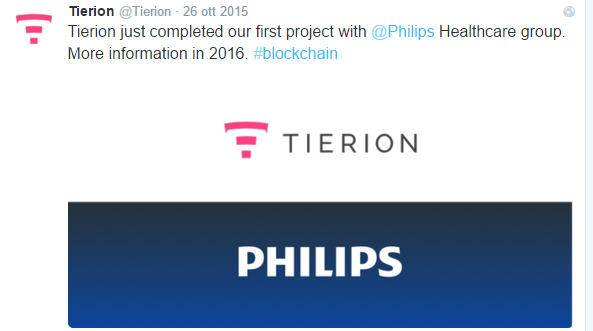
On October 2015, Philips Healtcare interest was announced in a Twitter post published by Wayne Vaughan, CEO of the blockchain startup Tierion, who reported that his company has been the first blockchain project within the Philips research perimeter on the subject.
tierion ceo philips project blockchain healthcare
 

Open your free digital wallet here to store your cryptocurrencies in a safe place.

Amelia Tomasicchio
orange light 1182121

Electricity through Bitcoin

On February 2016, MIT Enterprise Forum of Cambridge organized an event about clean energy distribution and how the blockchain can help this so important sector. 
This event was sponsored by the Massachusetts Clean Energy Center, an organization who wants to diffuse clean energy, of course. 
One of the most interesting project was the one presented by Usizo, a crowdfunding company who is trying to improve energy payments between users and schools in the African country. 
During the event Usizo presented its demo that has allowed to turn the light on at the Emaweni Primary School in Soweto.
CEO of the blockchain startup Bankymoon, Lorien Gamaroff, explained how electricity in South Africa works: rather than paying for electricity after it is received, users have to pay for it in advance; and it could be very expensive for those who live in a peripheral area. Also, this system relies on third parties who act between final customers and power companies, so prices get higher.
“A prepaid payment system makes the energy a lot more expensive because those vendors need infrastructure, there’s traveling cost, and it’s also very expensive to make those payments. If you’re in a remote area and your lights go out, there’s no way to make a payment, no easy or electronic way to do it.”
But this situation can be fixed thanks to digital currencies:
“You can now have a smart meter, a bitcoin blockchain-enabled meter, and foreign donors can send money directly to the meter without having to send it to an organization that will take or re-distribute the funds.”

How Usizo works

Usizo works thanks to a smart meter that accept digital currencies and through a crowdfunding platform where people can donate their bitcoin.
Donor can see the electricity needed by a school and can know how much he will contribute based on the BTC he donates.

What’s next?

During a recent interview with Grid Singularity CEO Ewald Hesse, Usizo won’t be only a test. 
According to him, in fact, the startup will partner with some non-governmental organizations to keep the lights on and help the education in Africa. 
Grid Singularity is a startup who use blockchain technology to develop an energy data exchange platform to facilitate energy data analysis, energy trade validation, trade of green certificates, investment decisions and smart grid management.

Open your free digital wallet here to store your cryptocurrencies in a safe place.

Amelia Tomasicchio

AirBnB wants to use the blockchain

Some months ago Don Tapscott, author of Blockchain Revolution book, explained how blockchain technology could replace services like Uber and AirBnB.
airbnb, blockchain, blecharczyk, city am,
In fact, at the World Economic Forum (WEF) held in Switzerland, Tapscott suggested:


“Why do you need a 60 billion dollar corporation called Uber? You can have a real sharing economy which it would be a distributed application on the Blockchain […] and the same is for AirBnb”.


AirBnB replies…


Well, even if might not be because of Tapscott’s suggestions, AirBnb is now interested in using the blockchain technology for its service.
During a recent interview conducted by City A.M., in fact, Airbnb co-founder Nathan Blecharczyk annonunced the possible blockchain application among the company plans for this year.
These were Blecharczyk words:


“I think that, within the context of Airbnb, your reputation is everything, and I can see it being even more so in the future, whereby you might need a certain reputation order to have access to certain types of homes. But then the question is whether there’s a way to export that and allow access elsewhere to help other sharing economy models really flourish. We’re looking for all different kinds of signals to tell us whether someone is reputable, and I could certainly see some of these more novel types of signals being plugged into our engine”.


Open your free digital wallet here to store your cryptocurrencies in a safe place.

Amelia Tomasicchio
padlock different angle 1472741

How to use the blockchain to secure medical records

Guardtime, a blockchain platform for ensuring the integrity of systems, is now working together with the Estonian eHealth Foundation to develop a blockchain network to secure one million patient medical records.

eHealth will use the Guardtime’s KSI (Keyless Signature Infrastructure) into its database to improve the security and the real-time availability of patient medical records.

Guardtime aims at protecting those records with an “independent forensic-quality audit trail”, so it will be impossible to edit the information.

During a recent interview conducted by Coindesk, a spokesperson for Guardtime said:

“In guarding sensitive records, the danger is that they could be altered, deleted, improperly changed or updated, affected by hackers, malware, system issues, etc. The blockchain in this case can prove the integrity of the record, and everything that has happened to it over time”

Why in Estonia?

Maybe you are asking yourselves why this kind of innovation is being conducted in Estonia.

Well, Estonia is already famous for its e-government system which use a chip-embedded ID card that allows citizens to access government services including filing taxes and voting online.

Guardtime Insights

In 2007 Guardtime invented a “Keyless Signature Infrastructure”, a blockchain platform created to ensure the integrity of systems, networks and data at industrial scale.

Keyless Signature Infrastructure (KSI) is designed to provide scalable digital signature based authentication for electronic data, machines and humans. KSI uses only hash-function cryptography, allowing verification to rely only on the security of hash-functions and the availability of the blockchain.

According to the company itself, Guardtime’s method is similar to the one used by the blockchain startup Factom. In both cases, in fact, every time a file changes, a new signature is generated and stored in the blockchain.

Open your free digital wallet here to store your cryptocurrencies in a safe place.

Amelia Tomasicchio