Category Archive: adoption

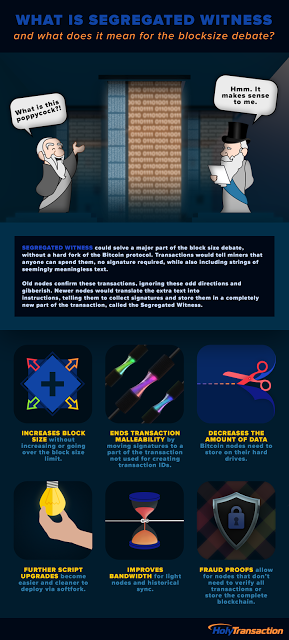
Segregated Witness HolyTransaction Infographic

Infographic: What is Segregated Witness?

What is segregated witness infographic HolyTransaction


Open your free digital wallet here to store your cryptocurrencies in a safe place.
jorge
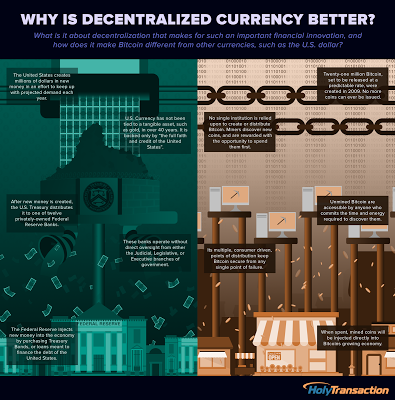
Decentralization Infographic

Infographic: Why Is Decentralized Currency Better?

Why is-decentralized currency better infographic HolyTransaction


Open your free digital wallet here to store your cryptocurrencies in a safe place.
jorge
bts header

BitShares 2.0 – Will Users and Banks Be Using Graphene in the Future?
Graphene, the super material that our computer chips might be made of soon, still isn’t very well known. However, with BitShares 2.0 being called Graphene, the word might become a stable part of your lexicon soon. The BitShares 2.0 has been long anticipated by both the BitShares and cryptocurrency communities. Since its announcement earlier this summer, BitShares has started to restructure themselves in preparation for BitShares 2.0. Though they are adding a lot of functionality, the core stake distribution is not changing at all. In testing, they have been able to sustain 3000+ tx per 3sec block, compared to the 7 transactions per second that the Bitcoin network is theoretically limited to. To reach even larger network sizes, Graphene is tapping into the same future expectations that Bitcoin users expect to keep their network viable: Moore’s Law. The pace of technology is such that eventually just one rented VPS will be able to handle all of the world’s financial transactions.
“We can trade peer to peer anywhere in the world in a few seconds. We’ve got capacity for every existing exchange to become a member of our network, treating their own customers to the combined market depth of all exchanges on a shared transparent ledger.”
Graphene works as an open source toolkit, and the original BitShares team needed this change because they were having to sell BitShares just to keep going. The list of new features include:
Votable Network Parameters, Flexible and Dynamic Access Control, Transferable Account Names, On-Chain Proposed Transactions, a New Full Node/Client Concept, a Referral Program, Recurring and Scheduled Payments, and the addition of new Privatized BitAssets. More information about Graphene and the newest features can be found here.

BitShares Style Decentralization Is What Banks Need

Decentralization provides the BitShare network, and all altcoin networks, with a new type of security that banks do not have – maybe even for functions we traditionally use a bank for. A network that functions by consensus and push transactions instead of pull transactions, is almost a holy grail in the banking industry. It’s no wonder that we’ve seen banks rush to “blockchain” technology. BitShares is confident in their security, they commented:
“It’s impervious to the hacker attacks that even the biggest exchanges have suffered.”
BitShares was one of the first cryptocurrencies to to engage in fiat and asset pegging, which is an angel that banks will certainly be interested in exploring. As we see more and more banks enter the Bitcoin and blockchain space, though, how many of them will realize that BitShares already has what they might need?

Open your free digital wallet here to store your cryptocurrencies in a safe place.

Satoshi
bitcoin in politics

Infographic: Bitcoin in Politics

Bitcoin in Politcs infographic HolyTransaction

Open your free digital wallet here to store your cryptocurrencies in a safe place.
jorge
chainthon

Chainthon – The Bitcoin and Blockchain Hackathon in Athens, Greece

Athens, Greece is about to have its first Bitcoin and Blockchain Hackathon, aptly named the Chainthon, on October 17th. The hackathon is a direct response to growing support for Bitcoin as well as growing pressures on the local financial system. The Hellenic Bitcoin community explained their situation in a press release:

This year, we are witnessing an economic crisis escalate into a humanitarian crisis. Hundreds of thousands are fleeing the war in the Middle East in search of a better life, only to find different obstacles in Europe. Many of the countries they travel through are facing a severe economic crisis, making it difficult to transfer money or receive donations.

The refugee issue facing much of Europe has reignited age-old tensions between ethnic groups that have been at odds for centuries. The growing amount of forcefully or willfully unbanked refugees and ex-pats is an immediate use case for Bitcoin technology. However, it is almost certainly the latter group of ex-pats, not refugees, that are currently taking advantage of Bitcoin. George Papageorgiou, the organizer of the event, laid out the main goal of the event:

The Hellenic Bitcoin community is hosting a hackathon aiming to increase awareness locally and tackling the more prevalent issue of value transfer in situations of socioeconomic crises. We will try to hack together, a practical and accessible system that can transfer donations to anyone without requiring a lot of education or an intermediary.
HolyTransaction is a digital currency company that believes in the promise of Bitcoin and blockchain technology. International payments, transfers, and people are our audience. As we’ve noted before, the Greek area is unique poised to benefit from the promise of Bitcoin and cryptocurrencies because of recent economic crises and also the new escalating pressures.
Introducing newcomers, especially those with strong developing and coding skills, to Bitcoin is a crucial service that cannot be promoted enough. HolyTransaction believes that people just finding out about Bitcoin should focus heavily on education. Read the whitepaper! Check out good Bitcoin videos, as it’s often easier to listen to a charismatic speaker than it is to read a dense wiki.
If you are in Athens, please check out the first Greek Bitcoin and Blockchain Hackathon. HolyTransaction supports Bitcoin events and would love to hear about your upcoming Bitcoin or Blockchain hackathon.

Open your free digital wallet here to store your cryptocurrencies in a safe place.

Satoshi

The 7 Best Bitcoin Youtube Video

Open your free digital wallet here to store your cryptocurrencies in a safe place.
Satoshi
Who Uses Bitcoin Infographic

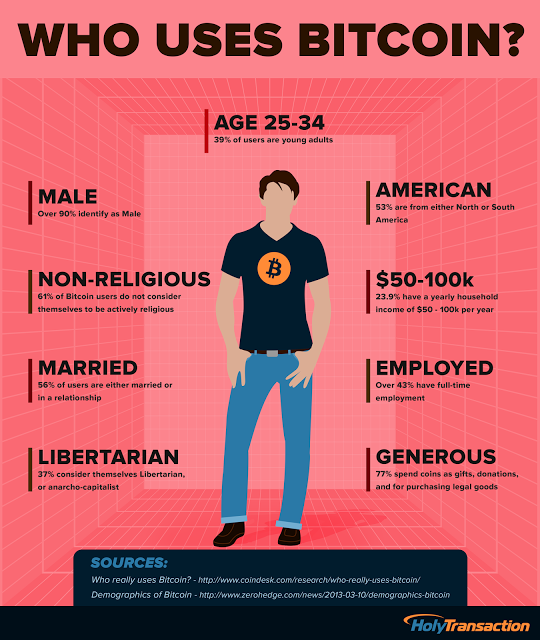
Infographic: Who Uses Bitcoin?

Who uses Bitcoin infographic HolyTransaction

Open your free digital wallet here to store your cryptocurrencies in a safe place.
jorge

New North Carolina Money Transmitter Bill Could Push Out Bitcoin Companies

How many Bitcoin companies operate in North Carolina? How many will there be? A new piece of legislation making its way through the North Carolina State Senate is attempting to enact further regulations on companies that handle digital currencies such as bitcoin. Originally sponsored by a state representative that also happens to be a vice president at Wells Fargo, the North Carolina legislature has moved forward with H289. H289 has made it through the North Carolina House of Representatives, and has started making its way through their state Senate. Luckily for us, the new senate bill S680 will not be voted on until Spring 2016. S680 is officially drafted by the North Carolina Banking Commission, which specifically mentioned that the proposed legislation is coming about as a result of requests by certain companies seeking clarity about digital currency regulation. It’s pretty easy to figure out which company that is.

The Politician Forgot to Take Off his Banker Hat

Before delving into the implication of this new update to the North Carolina Money Transmitters Act, we should consider the ridiculousness of how it came to be in the first place. The Representative that forgot to take off his hat was none other than Republican Representative Stephen Ross. Officially, his title is Executive Vice President, and he often votes on and sponsors financial industry related bills. Ross has also voted to protect officials that refuse to perform same-sex ceremonies. Such a bill has thus far only seen success in Utah.
A much better example of how to wear two hats can be found in a Virginia Representative. Mark Keam, a vice president for Verizon Communications has vowed to abstain from voting on issues that might present a conflict of interest with his Verizon job. Why this isn’t a basic requirement is still baffling to me. More importantly, Keam committed to not submitting any telecommunications bills during his time on the job. Representative Stephen Ross, from just a state south of Virginia, is truly only representative of the perceived political corruption and rot that fuels the anarchist movement. In a world where people are wearing more hats, both literally and figuratively, better rules to weed out moral hazard and stymie conflicts of interest are needed. More importantly, people who will follow these rules, and not bend them until they break, are also needed.

Coinbase Supports This Bill

As Bitcoin company BitGo’s engineer Jameson Lopp notes in a Medium article, Coinbase is the only Bitcoin company with lobbyists in North Carolina and it is believed that these lobbyists are actively pushing for more regulation of Bitcoin companies. These regulations would benefit companies such as Coinbase but would damage the efficacy of other smaller companies in North Carolina. In fact, Coinbase published a blog post where they praised the proposed legislation out of North Carolina. Coinbase wrote:
We want to thank the NC Bank Commissioner’s office for engaging with industry while modernizing its MTA and working to make NC a welcoming place for tech innovation. Please join us in thanking both Representative Ross and Senator Gunn, who sponsored the legislation in the NC House and Senate, respectively, and in urging the NC Legislature to move quickly in passing the legislation.

Proposed Changes May Harm Some Bitcoin Companies

Previously, the net worth requirement for receiving a license and being a fully legal Bitcoin company in the state was 100K, now it could be 250K. Depending on the volume your company handles, the surety bond that you need to provide could cost as much as 100K more than the previous $150K amount. The application fee itself has increased from $500 to $1,500 and the annual assessment fee has been raised to $5,000 and also heightens depending on transmission volume.
As Coinbase has settled itself into North Carolina. Other Bitcoin companies, such as Xapo and CoinOutlet, have announced their departure from the state. Jameson Lopp hopes that S680 can suffer a fate similar to AB1326 in the California legislature. He is working with the Chamber of Digital Commerce to create amendments to the bill that would exempt certain types of entities or activities from this legislation, and potentially give some Bitcoin companies some breathing room. However, he notes that the complete defeat of the bill is a preferred outcome.

About the author: Caleb Chen is a cryptocurrency advocate and is a research assistant at the Chamber of Digital Commerce.

Open your free digital wallet here to store your cryptocurrencies in a safe place.

Satoshi

Bitcoin’s Monthly Recap of September 2015

Welcome to HolyTransaction’s ninth monthly recap for the year 2015. This past month of September has been marked by some pretty developments in old cases and the long awaited release of new products; during that time, the bitcoin price rose from a low of $229.86 on September 1st to a high of $236.12 on September 30th, according to Bitcoin exchange Bitstamp.
 
Mike Tyson Proud to Be In Bitcoin, Opens Bitcoin ATM in Las Vegas
Weeks ago, Mike Tyson announced that he would be releasing a Tyson branded Bitcoin ATM in Las Vegas. The Lamassu Bitcoin ATM currently sits at the Linq in Vegas, is the 7th in Sin City, and has gathered a lot of attention. Tyson believes that Bitcoin will grow as education on it grows. He commented: “People don’t really understand a currency based on numerical equations. I personally still don’t … but I’m grateful to be a part of the revolution and hoping that my participation in this space will lead to more conversations and help increase knowledge and awareness.”
 
More Corruption in FBI Silk Road Case As Variety Johns Comes Forward
Variety Johns, the man long associated with working with Ross Ulbricht and Silk Road, has turned himself in and revealed a very convoluted tale. He claims that a corrupt federal agent is threatening the Ulbricht family and is in control of an encrypted Bitcoin wallet with Ross Ulbricht’s bitcoins. Posting to the internet, Variety Johns revealed his real name and the alias of the supposed agent hunting him: Diamond. The years old investigation into Silk Road is still ongoing.
 
21 Inc. Releases 21 Bitcoin Computer
21 Inc., one of the most well-funded Bitcoin companies in the world, has released its first product: the 21 Bitcoin Computer. At its core, the Bitcoin computer is just a Raspberry Pi 2 with an attached 21 Inc. Bitcoin mining chip that is rather efficient. The Bitcoin computer enables a developer to have full access to the Bitcoin network as a full node. Already, the computer has become the #1 best selling server on Amazon.
 
R3 Blockchain Initiative Brings 22 International Banks Together
In a sure sign of the times, many big name banks from around the world have committed to working with new Bitcoin company R3. R3 is planning a blockchain development initiative that will update the financial infrastructure that banks use to include blockchain technology, whether or not Bitcoin will be involved remains to be seen. The CEO of R3 stated: “The addition of this new group of banks demonstrates widespread support for innovative distributed ledger solutions across the global financial services community, and we’re delighted to have them on board.”

Open your free digital wallet here to store your cryptocurrencies in a safe place.

Satoshi
bitcoin blockchain bank

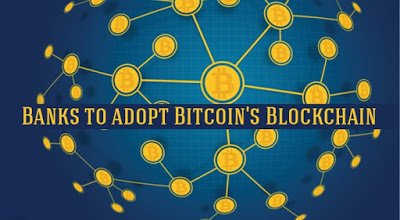
Deutsche Bank Is Bringing Bitcoin-Inspired Blockchain Technology to Germany

In a recently translated piece by the Deutsche bank, originally written by Thomas F. Dapp and Alexander Karollus, the German bank discussed how banks in general might be able to benefit from p2p networks like Bitcoin. The authors specifically mention a hypothetical future scenario where banks might assume new tasks that still play on banks’ perceived trustworthiness – “e.g. as custodians of cryptographic keys.” Other existing centralized services might have to adapt to serve other roles in the coming decentralized world. Don’t be surprised if someday soon Bloomberg to self-proclaim themselves as an oracle? They went on to note that the politics of Bitcoin would eventually lead to a head with regulators, law enforcement, etc. However, in the face of this new technology and potential regulatory backlash, Deutsche bank still wants to push forward… Because the concept of a blockchain really is that compelling, and the banks are finally starting to get it. Dapp and Karollus wrote:“Traditional banks should not rely on the regulator now, though, but instead actively experiment with the new technologies in their labs and collaborate without prejudice in order to create their own digital ecosystem in the medium run.”

This piece was originally published by Deutsche bank in late July. Since then, the German bank has delved head first into the investigation of blockchain use. Deutsche Bank is joining Morgan Stanley, Bank of America, HSBC, and Citi among other banks in a distributed ledger initiative lead by R3. Other banks include BNY Mellon, Commerzbank, Mitsubishi UFJ Financial Group, Royal Bank of Canada, SEB, National Australian Bank, and the Societe Generale and Toronto-Dominion Bank. The international representation in the project’s participants is not to be ignored. Many of these banks have also hosted big name Bitcoin companies, at least for a few weeks. For some banks, this move is clearly away from Bitcoin and to the blockchain – whatever that means. R3 CEO David Rutter commented:
 
“The addition of this new group of banks demonstrates widespread support for innovative distributed ledger solutions across the global financial services community, and we’re delighted to have them on board.”
Why are the banks rushing toward Bitcoin now? Why are they pushing the use of the words “distributed ledger” and “permissioned database” over “blockchain?” Why didn’t that sentence contain the word “Bitcoin?” All the banks delving into this new distributed technology know that they believe in blockchains more than bitcoins. After all, bitcoins have already suffered the taint of money laundering in the pen of the mainstream media and the eyes of the undiscerning reader, of which there are way too many. HolyTransaction believes in many blockchains, as evidenced by our support of other altcoins including our most recent addition – Gridcoin.
The community still isn’t quite sure what R3 is going to be doing with all of these banks and how involved Bitcoin will be. The emphasis that released products would be open source but might move away from proof of work, which some consider environmentally unviable. R3 is leading the world’s banks to the blockchain light. Better late than never!

Open your free digital wallet here to store your cryptocurrencies in a safe place.

Satoshi