Category Archive: adoption

bitcoin_prices

Thailand Bank tests Blockchain with IBM

Thailand bank tests blockchain to certify official documents. To do so, it is is working with the IBM company.

According to Reuters magazine, in fact, Kasikornbank wants to cut costs related to record keeping.

The bank is one of the most important in Thailand and it is looking to create a document certification service by next year.

Also, Kasikornbank is talking with other Thai banks with the goal of establishing new collaborations that could involve a few members of the national financial system. According to the current plan, other banks together with Kasikornbank could use the blockchain network to certify documents.

In a press release published back in April, Kasikornbank revealed its decision to study and test new technologies,  including machine learning and the distributed ledger.

At the time, the Thai bank explained that blockchain is “a technology that offers other benefits, e.g., reducing costs and increasing cross-border settlement efficiency that can be verified”. 

This news also represented a turn within the Thai country, as two years ago the specter of a bitcoin ban in Thailandia led to problems for the local exchange activity.

After that, Thailand decided not to ban digital currencies, but published a warning to its citizens about their use.

<img src="/images/Thailandbanktestsblockchain.jpg" alt="Thailand Bank Tests Blockchain" height="264" width="350" />

Open your free digital wallet here to store your cryptocurrencies in a safe place.
Amelia Tomasicchio
KVR 000365 00246 1 t218 105426

MasterCard Releases Blockchain API


MasterCard releases Blockchain API, an experiment to work on an emerging technology such as the distributed ledger.

So Visa won’t be the only credit card company to work on the blockchain.

But while Visa is releasing a B2B blockchain, MasterCard releases blockchain API with more collaborative objectives.

The MasterCard website now contains 3 APIs connected to its internal blockchain platform, including offerings based on smart contracts and payment settlement. Those APIs were created by MasterCard Labs, the innovation program of the credit card giant.

MasterCard blockchain lead Justin Pinkham explained that the company created the API platform in October to stoke interest among banks and merchants.

Pinkham explained to CoinDesk magazine:

“This is part of our initiative to publish experimental APIs from Mastercard Labs and give developers the chance to work on emerging technologies that haven’t yet been commercialized by us.”

Also, Pinkham explained that MasterCard company is continuing to work on technology use cases and it is looking for new partnerships that can be useful for the MasterCard’s business.

“We believe that there is a role of blockchain in the future of commerce. This future needs to be developed in partnership with banks, merchants and industry participants,” Pinkham commented.

This news is one of the most important for MasterCard company, who used to criticize bitcoin in the past.

But if MasterCard releases Blockchain API, this means that it is beginning to push some of the work done by its tech lab.

According to Pinkham it won’t be the last, as he said that the company is creating a new foundation for blockchain tech that will be focused on the distributed ledger use cases including inter-bank payments, trade finance, digital identity and also the exchange of know-your-customer information.

This work was possible also thanks to the new partnership between MasterCard and startups through its Start Path Global program, as well as 30 more blockchain-related patents that Pinkham explained the company submitted.
<img src="/images/mastercardreleasesblockchainapi.jpg" alt="MasterCard Releases blockchain api" height="264" width="350" />

Open your free digital wallet here to store your cryptocurrencies in a safe place.

Amelia Tomasicchio

IBM Blockchain to solve delivery issues

Singapore startup FreshTurf is working on a IBM Blockchain project to develop a network for solving issues related to delivery and storage lockers.

According to a press release, the two companies wants to create a network to track delivery shipments and storage lockers through the blockchain with the objective of providing a faster and safer service to the customers.

This way, in fact, users will be able to track their packages more easily thanks to a distributed ledger platform. 

This is not the first project for the IBM’s BlueMix garage, a wordwide network of innovators that provides a hub for startups and companies to test and study the blockchain.

The BlueMix is a part of IBM blockchain broader strategy for fintech applications.

The two companies commented in a press release that their goal is providing a system for clients to check the status of their packages in real time.

“Not only can the application of blockchain technology help provide visibility across the fulfilment chain, allowing users to track their parcel and delivery status from the convenience of their phone, it can help stakeholders to conduct shipping transactions in a highly secure and trusted environment.”

This distributed system, currently in development, works through the IBM blockchain.

It is not still clear if the companies will sell the technology for commercial use.

IBM Blockchain and Australian Postal Service

Blockchain has been used for several use cases, including package delivery.

In fact, Australian Postal Service released a report explaining how they could use the distributed ledger to track packages movements. Read more about Australian Postal Service new project by clicking here. 

Also, US Postal Service discussed its idea to create a new digital currency called PostCoin.

And this is not the first time IBM works on a blockchain-related project. Read more news about the IBM Blockchain here.

Open your free digital wallet here to store your cryptocurrencies in a safe place.

Amelia Tomasicchio

Illinois Blockchain Strategy: a new working group

The U.S.A. State has created a new Illinois Blockchain Working Group for integrating the technology within the government.

This working group, created at the beginning of 2016, includes several representatives from public agencies, including the Department of Innovation and Technology, Department of Financial and Professional Regulation and the Department of Insurance.

Its main goal is identifying how the distributed ledger can improve government services and making it easier for users doing business with State agencies.

Director of the state’s Department of Insurance, Anne Melissa Dowling says her office is involved in a strong education campaign, to be the first agency in the U.S.A. to use the blockchain.

“Right now we’re trying to determine if we become a first mover in this space by developing a distributed ledger vision for government. But we’re doing a lot of listening and learning.”

During an interview, she explained that the distributed ledger can be used to make it easier relationships among Illinois insurance companies, regulators and policy holders.

So, the state wants to explore how the ledger can help to speed up this process.

“In concept its an absolutely beautiful thing. But we need to have a little more experience we need to spend a little more time with the data.”

Illinois Blockchain and Regulators

William Mougayar, author of “The Business Blockchain”, said that a semi-private blockchain developed by the state would be a strong basis to welcome in market stakeholders. According to him, the real challenge will be getting regulators on board, or the National Association of Insurance Commissioners.

“I suspect that the regulatory aspect is a more critical hurdle that will need to be addressed,” he said.

At the moment Dowling and her group are still thinking about the options they have. She explained that she studying the technology and its potential use cases for her agency, so she’s still learning more and more about the blockchain.

As part of that process, Dowling will participate in a blockchain regulatory panel held in Chicago on November 8th and she says that her first goal will be learing as much as possible.

Also, Dowling comments she is observing working models that can explain how blockchain can be implemented in insurance groups.

These were here words:

“These efforts are really on behalf of consumers to ensure we can serve them in the most efficient and cost-effective way. Illinois wants to look at everything possible to achieve that goal.”

<img src="/images/IllinoisBlockchain.jpg" alt="Illinois Blockchain" height="264" width="350" />

Credit: Coidesk.com

Open your free digital wallet here to store your cryptocurrencies in a safe place.

Amelia Tomasicchio

Blockchain Insurance: applications for insures

Five major European companies will work on a blockchain insurance project to provide faster and safer services to their clients.

This project, called the Blockchain Insurance Industry Initiative (B3I), has the goal of testing use cases that could help the insurance sector.

To do so, in fact, Allianz, Aegon, Munich Re, Swiss Re and Zurich, or the biggest companies of this field, are working to provide a meeting ground to exchange ideas with this objective: improving the insurance service and creating a new method of doing business.

“We want to be at the heart of these developments and see Blockchain as one of those potential catalysts for change. By actively creating partnerships and making strategic investments we can build smarter solutions together with our clients,” explained Mark Blook, chief technology officer at Aegon.

Allianz – which has already explored smart contracts for catastrophe bonds exchange and has already  worked with fintech startups – belives that the distributed ledger can allow them to help transparency for their users.

“This initiative, enabling alternative operating models based on the Blockchain technology, can help us increase transparency and efficiency and deliver a better experience to our customer,”  commented Allianz Group COO Christof Mascher.

Those 5 companies said they hope that other brands in the insurance and reinsurance industries will join the project with them.

According to a press release, the mai objective is taking advantage use cases “across the entire insurance value chain”.

<img src="/images/blockchaininsurance.jpg" alt="Blockchain Insurance" height="264" width="350" />

Open your free digital wallet here to store your cryptocurrencies in a safe place.

Amelia Tomasicchio

Bitcoin euro: withdraw with ATM machines

Holytransaction Trade is a new platform offered by HolyTransaction wallet for Bitcoin Euro instant conversion.

Holytransaction.trade is useful when you want to convert your bitcoin into euro, by using any ATM machine with Halcash that you can find in Spain and Poland.

Thanks to HolyTransaction Trade you can do this operation in a few minutes, without having to wait a few days as if you use traditional exchanges.

Anybody can convert his own bitcoins into euro from an ATM machine with Halcash, whether he has a wallet on HolyTransaction or not.

Where is the service available?

The Halcash service is available only in Spain and Poland at the moment.

How much fees?

To convert bitcoin into euro with Halcash, this platform holds a 2% fee.

How does it work? Bitcoin Euro instant conversion

Here you can read a step-by-step guide to convert your bitcoin into euro by using HolyTransaction Trade and the 10.000 HalCash ATM you can find in Spain (or Poland).

  1. Go to Holytransaction.trade website
  2. To do a transfer from Bitcoin to Halcash you need to select “Bitcoin” on the right and “Halcash” on the left. Then, click on “Continue”. main_holytransaction-trade_
  3. Select an amount and your telephone number where the system will send a verification code. transaccion_hplytransaction
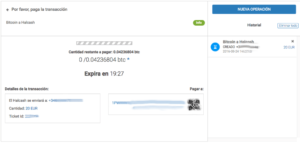
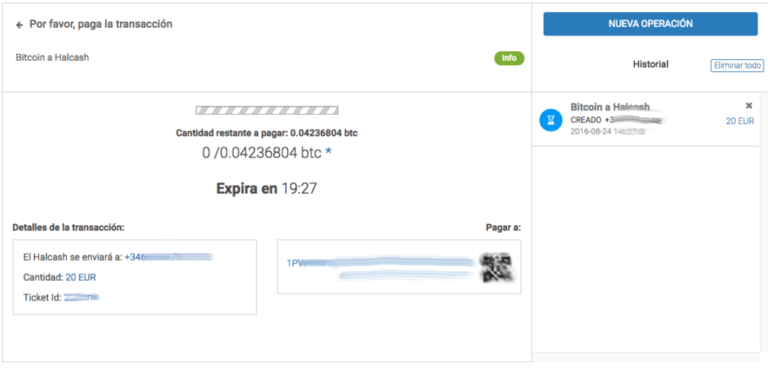
  4. Follow the instructions and open your wallet to do a transaction to the address on the screen. Of course, you need to send the same amount you selected in the previous window. 
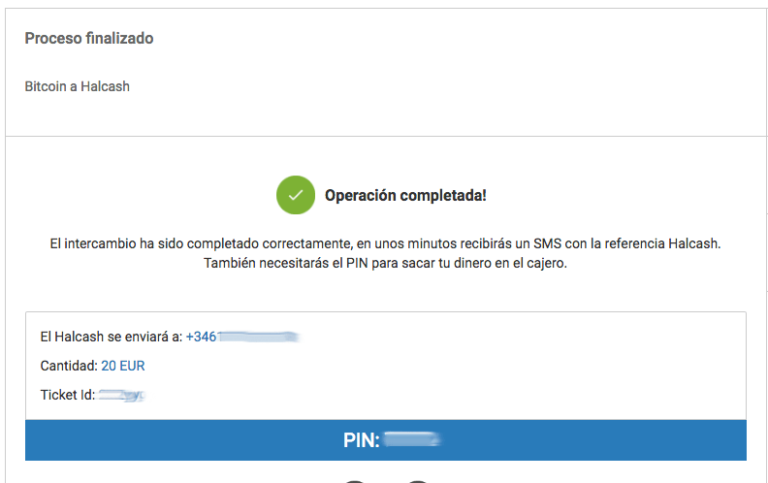
  5. Once you did, the transaction will be confirmed on the blockchain and you’ll receive a message on your mobile with the password to withdraw your funds at a Halcash ATM. SMS Halcash ChipChap
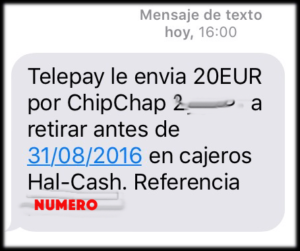
  6. Then go to a Halcash ATM, enter your password and withdraw your euro. You need to fill all the fields with mobile number, amount, password, reference number (you received it on your smartphone).
  7. You can withdraw your amount. This whole operation takes only you a few minutesfinalizada_holytransaction

Download the HolyTransaction App here for free.

Open your free digital wallet here to store your cryptocurrencies in a safe place.

Amelia Tomasicchio
programmer 1 1534401

Philips announces its own Blockchain Lab

The Dutch multinational company Philips decided to open its own Blockchain Lab, a group of experts whose focus is the decentralized ledger.
After a half year of researches on the Blockchain, in fact, Philips announced its objective to use the distributed ledger technology for healthcare uses. 
Philips blockchain lab project developer

To do so Philips launched a call for developers and experts coming from the startup ecosystem who can submit their own CVs and apply “to work on several blockchain use cases”.
The call for talents from now on will be continuosly open, which supposedly indicates an evergoing interest of the company in developing new projects based on this disruptive technology. 
It’s always worth to remember that the innovation brought by the blockchain doesn’t impact the financial system only, but potencially has relevant implications in many aspects of our lives, including the secure transmission of information regarding our health.
The Philip Blockchain lab is located in the company’s headquarters in Amsterdam, the Netherlands. 
Head of the Blockchain Lab, Arno Laeven, commented:

“As a company committed to innovation you need to constantly explore new and emerging technologies and their application in areas where they might have an impact and added value. Our aim is to learn if blockchain technology could potentially add value to the process of data exchange in the healthcare industry.

Previous Statement

On October 2015, Philips Healtcare interest was announced in a Twitter post published by Wayne Vaughan, CEO of the blockchain startup Tierion, who reported that his company has been the first blockchain project within the Philips research perimeter on the subject.
tierion ceo philips project blockchain healthcare
 

Open your free digital wallet here to store your cryptocurrencies in a safe place.
Amelia Tomasicchio
CarChargingviaEthereum

Ethereum used for Car Charging in Germany

A German power company, RWE, started a partnership with the Ethereum-based startup Slock.it, to develop proofs-of-concepts (POCs) using the Eth blockchain.


Germany supports green power

On May 2011 the German Environment Minister Norbert Rottgen announced the government’s decision to close all the nuclear power plants within 2022.
During an interview conducted by the BBC, in fact, Mr Rottgen commented:
 
It’s definite. The latest end for the last three nuclear power plants is 2022. There will be no clause for revision.”
So, RWE, company who provides coal and nuclear energy infrastructures in Germany, has now decided to invest money in a new sustainable energy and in an Ethereum project to reduce expenses.
To do so, RWE created a working team to test the blockchain technology to aim at trim costs by lowering expenses related to energy transmission.

Car Charging with Smart Contracts


In a recent interview conducted by CoinDesk, RWE Carsten Stöcker commented on a possible application of the blockchain: electric car charging stations that use smart contracts to authenticate users and manage the billing process.
“We would like to solve the problems and really push electric vehicle deployment forward by looking into establishing a seamless and affordable electrical charging infrastructure.”
This project debuted at the Lift 2016 conference in Geneva, Switzerland and it will play out within 2017.
According the RWE project, customers will use charging stations by accepting a smart contract programmed on the Ethereum blockchain.
Through this system users will save money thanks to a payment that is connected to the consuption of electricity during the charging, instead of paying according to the time connected to the station.


“What’s really exciting here is that people are going to be able to use smart contracts to contract with a machine directly, rather than contracting with a human being or a corporation,” he said to CoinDesk.


Open your free digital wallet here to store your cryptocurrencies in a safe place.

Amelia Tomasicchio

9 Best Bitcoin Video Animations

Open your free digital wallet here to store your cryptocurrencies in a safe place.

Satoshi

Bitcoin is “digital gold” and will mark the end of cash. Ametrano from IMI Bank explains.

(Sole24ore) Bitcoin is periodically back in the news, most of the time in a bad way like the recent presented use of the currency, then denied, from islamic terrorist authors of the attacks in Paris. At the same time banks and financial institutions seem extremely interested in the tech behind bitcoin.
We talk about this with Ferdinando Ametrano(*), from IMI Bank, Banca Intesa Sanpaolo group.
Professor Ametrano, what is Bitcoin?

Bitcoin is a private currency, that isn’t issued by any central bank nor guaranteed by any institution. It is electronically transferrable in a practically instant way, utilising a cryptographic security protocol. It is based on a completely decentralized network: the transactions don’t require a middleman, cannot be censored, don’t have any kind of geographical or amount restriction, and are possible 24 hours a day every day and are substantially free.

How can transaction be substantially free? Who covers the costs of the bitcoin network? Who guarantees its safety?
Bitcoin’s network security is handled by nodes, that validate transactions and are also called miners.
The costs that they sustain while doing this activity are covered by issuing new bitcoins.
We’re more and more hearing about blockchain, how is it related to bitcoin?
The validated bitcoin transactions are “stacked” in blocks. Every new block of transactions is written down on a public and distributed ledger, organised like a ordered chain of blocks. This public ledger is in fact called blockchain, a term generally used to define the underlying technology of bitcoin. The blockchain tech regulates the transfer of a “digital token” to the whom can be associated a variety of goods and rights of the real world. The token, that is fundamental for the existence of this technology, gains value due to its use in the digital world.
The bitcoin currency is in fact the digital token of the first and most distributed blockchain: it’s impossible separating the two. It’s hence possible having technological applications that “hide” the token or in which the token has a value not relevant if compared to the right or to the good that it represents, and avoid calling it bitcoin or utilising a different blockchain from the one bitcoin’s using.
Is it true that bitcoin’s author could be proposed for the nobel prize in economics?
The white paper that describes the bitcoin protocol was published around October 2008, by a person known as Satoshi Nakamoto, an identity which has yet to be confirmed. Nakamoto released the source code for Bitcoin in January 2009, and then he gradually vanished, leaving the development to others. He vanished completely around mid-2010, when he stopped answering to any message. As of today, even due to the poor understanding of Bitcoin and to the lack of diffusion it has, the Nobel prize is just a boutade.
We frequently hear about anonymity in bitcoin transactions. Why?
We should instead talk about pseudonymity: the blockchain is in fact a public ledger and all the transactions take place in a transparent way between the different bitcoin addresses, which are like IBANs from our bank accounts. There is not however any way to force the identification of the person or organization behind the address.
The lack of user identification and the fact that transaction can’t be censored are aspects that make bitcoin interesting for terrorists and criminals, don’t they?
In theory, yes. But in practice the interest is limited. The common sense suggests that the currency used by terrorist in still in most cases the US dollar, because it’s globally accepted.
Back in October the British Treasury has completed a study revolved around the key points in money laundering and terrorism financing: Bitcoin was found to be the one with less risk, before banks, legal services and accountancy, gambling, cash etc. We know that criminals use internet, cellular phones, and transport services: we can’t shame technology because of this.
There are always new challenges and we have to adapt to them: the authorities have shown they know how, for example when they took down Silk Road, the darknet market that used bitcoin as the go-to currency. The most sensitive point in the Bitcoin environment are for sure the exchanges, where people can buy and sell bitcoins: they represent the point where Bitcoin and the regulated financial system make contact, where suspect actions can be intercepted.
Obviously, regulating and prosecuting the illicit uses of bitcoin is necessary, exactly like how it’s done with all the other tools we have to our disposal. How far are we in doing this?
The international regulators are following with great attention the Bitcoin phenomenon. The New York Department of Financial Services has released last June, the so-called BitLicense, a regulatory framework developed in about two years of study and consultations. The head of this department said that the regulator should not, especially at this time of development, suffocate the innovation that this new technology brings. This was repeated in the following months by the chairman of the Australian Securities and Investment Commission and the Canadian Standing Senate Committee on Banking, Trade and Commerce. Bank of England defined this promising technology as a payment system.
The European Central Bank has published two studies. If other countries and states are prudent, Europe decided a more cautious approach: the European Banking Association urged national regulators to discourage banks from buying, selling and holding bitcoins.
And yet Banks, stock exchanges, and the financial institutions in general, even while staying away from bitcoin are really interested in blockchain technology.
Of course, and for an absolutely crucial reason. Financial transactions are reversible for a long time (with credit card chargebacks possibile for up to 6 months) and even when they seem to take an instant they are actually regulated (clearing and settlement) in two or three days after the transaction itself through central counter-parties and clearing houses. The settlement system is burdened by significant costs and levies. In a world where information travels instantly at virtually no cost, these layered and convoluted processes are inefficient, expensive and inadequate. The validation of a transition on blockchain happens at the same time as its clearing and settlement and is not reversible, resembling in a lot of ways cash transactions. When you receive bitcoins you are certain that whoever sends them is in real possession of them and that the transfer is immediately effective and irreversible.
How is Bitcoin’s monetary policy defined?
The validation of a new block of transactions happens every 10 minutes or so, and requires a significant work from miners. Those who exhibit this kind of work (proof-of-work) is paid back as of now with 25 bitcoins every block. This reward halves every four years and it will reach 0 approximately in 2140, when the system will have to cover its costs with transaction fees, that, at the moment, are negligible. This defines entirely bitcoin’s monetary policy.
So, can we expect the rise of new and more efficient financial services and the redefinition of the actual ones on through blockchain technology?
It’s hard to find clear arrival points in this pioneering phase. The ‘fundamentalists’ of the blockchain technology believe that the traditional financial world will be swept away completely; these are opposed to radical conservatives who believe existing financial institutions will instead simply incorporate and adapt the tech to its needs; as always, the truth probably stands in the middle. In any case, despite the general enthusiasm or concern, it is not yet clear if and which applications will be adopted by the traditional financial world.
The blockchain technology aims at uncensored transactions guaranteed by an inherently decentralized ecosystem. Decentralization is, however, naturally inefficient in terms of scalability in the number of transactions (about 3 per second, compared to the 60 thousand possible inside the centralized VISA network) and completely sealed against regulatory processes. These features make it a problem for financial institutions and regulators.
And yet blockchain technology is more and more being represented as able to solve all the problems that currently burden our financial system: costs, inefficiency, lack of transparency, etc.
I often have the impression that behind the blockchain innovation label is behind hidden the attempt to reform the organizational side of these processes even before the technological one. Many of the proposed solutions are simple misinformation, implemented through databases in a more efficient and cheap way than a blockchain. In general, the blockchain is suitable for public goods or services, which must therefore be handled in a transparent, decentralized way.
For example, the transfer of monetary value between different countries and different currencies: you could have IOUs issued and guaranteed by banking groups and placed on a circuit that automates their compensation. A similar situation is offered by Ripple, one of the distributed public ledger solutions alternative to bitcoin. It’s easy imagining a group of banks that share this idea, maybe utilising the concept in a different distribution.
It is recent news that thirty of the most important banks in the world have joined the R3CEV consortium. The goal is to make the public distributed ledger useful in the financial world traditional, going past scalability limits. Will Intesa Sanpaolo be there?
The event that you are describing is certainly the most interesting, if nothing else just for of the caliber of participants: Intesa Sanpaolo is considering whether to join or not and in any case it will be interesting to follow the work that will be done there. The performance limits of the current blockchain technology are intrinsic to the exceptional level of decentralized security: they can be mitigated or even improved by reintroducing a minimal centralization in the network. Along this path of centralization, however, you might find that the database technology has a competitive advantage. In recent months, the debate on the distributed records saw the opposition of public (no control, such as bitcoin) to private (controlled, as Ripple). It is open to question whether and how the private distributed registers differ from simple replicated databases.
What role could banks play in the blockchain ecosystem?
The stability of the financial market needs an influential player, able to provide adequate guarantees of reliability. Banks play this role in our economy, even if not flawlessly. The customer identification (for anti-money laundering and to fight of terrorism financing), being a ‘custodian’ for the whole system and granting its functionality, giving out credits, the market-making on financial markets: these and many other activities have the banks in leadership.
I don’t think the entry in the banking world of technology giants is imminent, although it should be noted that Apple capitalise about the same as the top 30 banks in the eurozone. Moreover, the British Bank Association wrote that “banks must agree to the fact that they are more and more part of a wide ecosystem that consumers themselves are building. Well, their role in the ecosystem is far from secure. ” A lesson has already been tried in other areas by leading brands such as Kodak, Blackberry or Blockbuster.
What is Intesa Sanpaolo doing right now? Between all the great international groups you are the ones with the most conservative public profile about it.
Our bank has been following the Bitcoin phenomenon since May 2014 at least. A study task force coordinated by our Chief Economist, Gregorio De Felice, worked six months involving all of the bank’s the different functions and summarised what should be the strategy guidelines for the group. In July, we responded publicly with a documented analysis to the “Call for Evidence” of the European Security Market Association. It is certainly a land where you need to move with caution: this is why we are evaluating with great selectivity a number of initiatives. I am confident that soon enough our operational choices will become more clear.
As of now bitcoin hasn’t really imposed itself as a currency for commercial transactions, not even online.
This because bitcoin is not a good currency for transactions, but rather a speculative investment. In the digital environment bitcoin it is more comparable to gold than to a currency, sharing with gold some severe limitations in the use. A good currency should have three characteristics: being a mean of exchange, utility conservation, unit of account. Bitcoin is unbeatable on the first two aspects: instantly transferable, divisible without limit, tamper-proof, non-perishable, with virtually zero cost of conservation, and it can be easily stored for later use.
The not so good sides of Bitcoin come out when analysing the unit of account: the currency, in general, is the good we reference when we measure the relative value of other assets. And a unit we use to measure. The value of each asset, however, is determined by the law of supply and demand: as the supply of bitcoins is deterministically fixed and completely inelastic, any change in demand is reflected in changes in value. The value of Bitcoin has appreciated by a few cents in 2010 to about $ 300 today (almost touching, with a frightening volatility, the level of $ 1,200 in 2013): this aspect makes the joy of speculators but makes it impossible to have stable prices in bitcoin, contract mutual, fix salaries or lock in forward prices.
In the recent years we’ve been hearing controversial things about e-money. So is bitcoin going to fail
I wouldn’t talk about failure: bitcoin could be used, in the future, as a digital “gold reserve” asset for a next generation of cryptocurrencies with a flexible monetary policy, the ones i call “Hayek Money”. Gold was adopted without any central planning by all civilizations in the world, for its peculiarities (the fact that it does not rust and its rarity) and uses (jewellery and ornaments). The adoption of bitcoin is spreading in a similar way in the digital domain, without central planning, for its peculiarities (available in a limited non-alterable quantity) and utilities (transferable token can not be duplicated). The possibilities that are opening up in money’s history are extraordinary.
What exactly do you mean?
Money is a social relations tool and on it we’ve based the whole exchange economy. It was created by mankind to cooperate with those who are outside of the gift economy, a characteristic of the family and of close relationships. Gold has historically established themselves as a monetary standard: the minting of the coin from Caesar will initially only confirmed purity and quantity. Gold has been gradually replaced by notes, that were initially conceived as certificates that could be converted into gold, guaranteed first from private individuals and later by kings, governments and central banks.
Gold has been gradually reduced as a tool of monetary policy, due to the restrictions it involves: today we use fiat money (fiat from the Latin “fiat lux et fuit lux“), money without intrinsic value whose acceptability is based on a social contract which determines the legal tender. All democracies and developed economies have delegated the management of the currency and its stability to an independent central bank, to avoid abuses that governments could make.
The Blockchain technology has the opposite trend: for the first time after thousands of years it looks like currency can be used without Cesar controlling it.
We often hear about non financial uses of the blockchain: public vehicle record, land register, digital id certification, notary services. What is your opinion about them?
With the blockchain we have for the first time a digital token which can be transferred, but cannot be duplicated. This opens new scenarios: I have great interest and curiosity in the various proposals and I try to support their development through participation in AssoB.it, the Italian association for the promotion of the blockchain technology. But i must confess that for know i see bitcoin as the killer app in blockchain technology, like e-mail was for internet back in the 90s. There will certainly be in future businesses and services difficult to predict, like Google, Amazon or Facebook we some time ago. Personally i’ve yet to identify them.
In a time of growing demand for dramatically scarce blockchain skills, i’m afraid that Italian universities are not really being receptive. Luckly something is moving with the private research center BlockchainLab in Milan.
What could be the next big thing in the bitcoin/blockchain environment?
The digitalization of cash, which is in my opinion the most urgent and inevitable. The pros of bitcoin over cash are its traceability, transparency and the fact that it’s impossible to forge it. The blockchain could be for payment systems what was internet for communication and information.
Author: Massimo Chiriatti, technologist and member of Assob.it
*F. Ametrano is a leading italian expert in the field of coins often called virtual, mathematical or cryptographic. Professor at the University Milano Bicocca is also a member of the supervisory body of AssoB.it

Open your free digital wallet here to store your cryptocurrencies in a safe place.

Satoshi