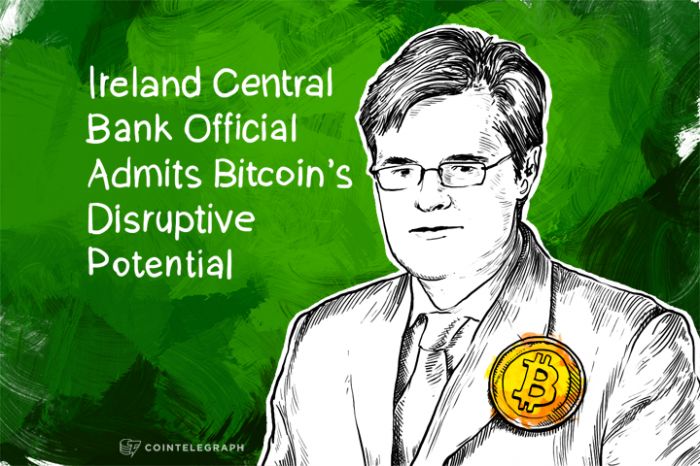
Virtual and digital currencies can challenge the sovereignty of states

official. At a recent digital money conference in Dublin, he mentioned
that rivals are interfering with a bank’s ability to sway the price of
credit for the entire economy. Murphy warned that there might be
considerable threat to the finances of a country if increasingly more
transactions for services and goods fade away from the tax system due to
the use of crypto currencies such as Bitcoin. He added:
“Central banks, [out] of necessity, have monopolized the exercise
of these functions. Virtual currencies pose new challenges to central
banks’ control over these important functions.”
Bitcoin conference. It gathers the brightest minds in finance,
payments, banking, and business. The goal is to host fearless debates on
the risks and opportunities involved with decentralized currencies.
Bitfin (Bitcoin Finance) wants to shape
the future of corporate strategy, commerce, and economic policy in the
current industry of peer-to-peer digital money. “Bitcoin Finance is the
digital money conference you’ve been waiting for,” the official press
release reads.
trigger significant drops in economic activity. The Central Bank has
constantly emphasized that it doesn’t recognize digital currencies such
as Bitcoin in Ireland. Nonetheless, those who choose to use Bitcoin anyway won’t have consumer protection.
Murphy is well aware that virtual currencies could offer a great option
for people looking to buy and sell different services and goods. He
added that in these circumstances, the anti-money laundering rules will
be thoroughly tested. Failure of settlement infrastructure and
payments, or any sort of “financial plumbing,” could have a great impact
on the country’s economic activity and consumer confidence. Murphy
said:
“In effect, economic activity is the aggregate of domestic
transactions in the ‘euro-denominated economy’ and the ‘virtual currency
economy.’”
institutions and banks will most likely feel the effects. Other major
financial institutions don’t see Bitcoin as a threat to their
operations. However, in Murphy’s view, these institutions would be
foolish to have this kind of attitude towards the technology,
mentioning:
“This is likely to have a profound operational impact on these firms and their regulatory risk profile.”
economic challenges. Digital currencies defy the way these institutions
calibrate exchange rates, monetary policy and set price of credit.
Supporting Bitcoin and encouraging its growth would have to be
attentively monitored. Gareth Murphy added:
“The existence of a ‘euro-denominated economy’ and a ‘virtual
currency economy’ raises the prospect of an internal balance of payments
between two sub-economies where suppliers may prefer one currency over
another as a means of payment (for different goods and services).”
the most frequently used on a global scale. Bitcoin undermines a
central bank’s ability on matters such as economic analysis, data
collection, supervision, policy formation, enforcement and resolution,
so these sort of implications can’t be overlooked.
shouldn’t take things for granted and assume its actions will keep
falling under US and Switzerland regulations. He did mention that
Bitcoin should be used to support indefinite innovations that may come
from a wiser use of the technology:
“We should not presume that current regulations are
future-proof. It is possible that further innovations will mean that
these regulations may no longer apply. This suggests that new
regulations may ultimately be needed which are based on new legal
concepts with a clear scope which must stand the test of time.”
because they’re offering lower fees, commissions, greater convenience
etc. Bitcoin might gain control over the most important functions of
exchange rate and monetary policy. In spite of the currency’s relative
instability, more people are turning their attention to Bitcoin, and the
more publicity it receives the higher chances it has to become
ubiquitous in our everyday lives.
Open your free digital wallet here to store your cryptocurrencies in a safe place.
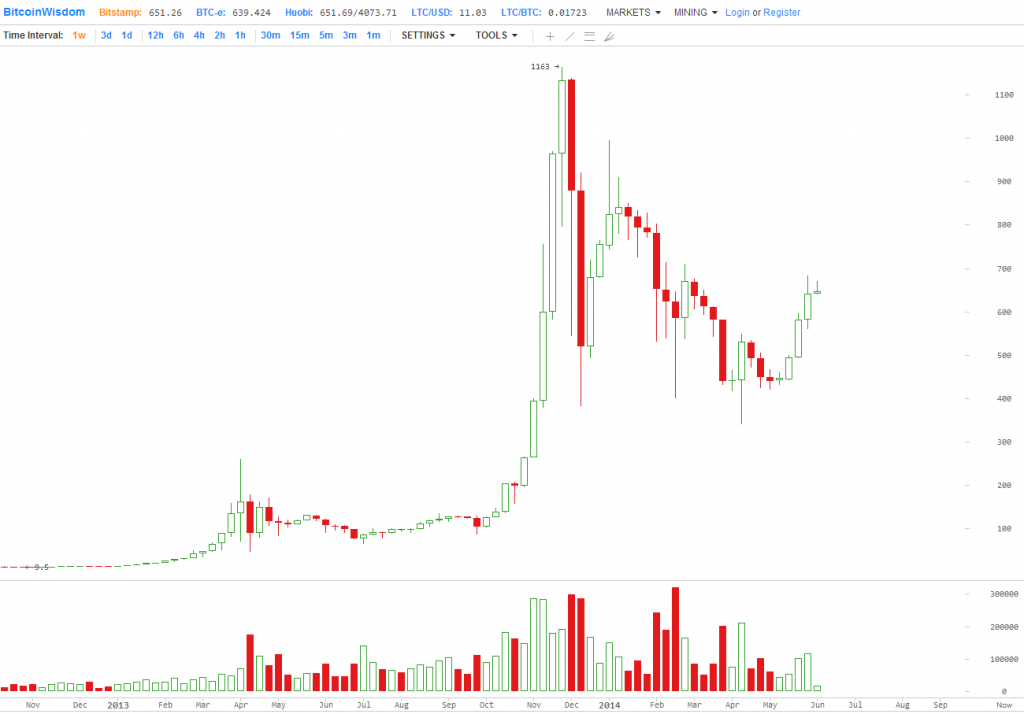
Four charts that suggest Bitcoin value could be at 10,000 USD next year
The chart below shows us the Bitcoin/USD value over the same 2013-2104 period on a logarithmic scale.
Google Trends on Bitcoin
“Bitcoin is still in the earliest phases of industry development. The first years of Bitcoin were about building the infrastructure. Bitcoin entrepreneurs were busy setting up the most basic but fundamental aspects, including wallet and mining services. Today, Bitcoin is just starting to enter the investment phase, where venture capitalist, hedge funds and other financial firms are starting to invest money and capital into this nascent technology. Bitcoin isn’t quite ready for the consumer phase, where end users begin to utilize the services. If the entire history of Bitcoin was a clock, we’re still in the very early time. I would say were maybe in the second second of the entire history.” Nicholas Cary, CEO of Blockchain.info (source)
Disclaimer: The (funny) definition of an economist is “Someone that can use economic theory today to explain why he got all his predictions wrong yesterday“. The market is unpredictable and I can’t always be right
Open your free digital wallet here to store your cryptocurrencies in a safe place.
Nick Szabo (Bitcoin founder Satoshi Nakamoto?) Breaks his Silence with a Tweet
to bitcoin, the person who coined the term smart contracts in 1993, and
believed by many to be Satoshi himself, published a one line blog post
today which simply contained a link to his twitter account.
2013, almost seven months ago, leaving many to wonder whether he would
ever post again. The seven months silence seems to have followed
increasing attention on Nick Szabo after numerous suggestions that he might be Satoshi.
In April 2014, researches from Aston University’s Centre for Forensic
Linguistics claimed that forensic analysis of Bitcoin’s White Paper
suggests that Nick Szabo was the author of the paper.
that he is Satoshi and many argue that it is highly unlikely that he is
the author of the white paper. Nick seems to have been focused on
bitgold, writing a blog post about bitgold two months after Satoshi
announced bitcoin.
pictures of him, no verifiable details of his age, location, profession
or education. Previously, in a Wikipedia article, it was claimed that he
was a law professor at George Washington University, but reporters claim
that after contacting the University they found no record of a person
named Nick Szabo ever being a professor at that university, although
there was one record of a person having studied at that university under
that name. The name therefore might be a pseudonym, a pen name.
Nick Szabo Highlights the Dangers of Centralized Currencies
retweet of a statement by Proton Mail complaining that their PayPal
account had been frozen, blocking access to $275,000 of funds. In a
statement in their blog Proton Mail details what happened:
details, he questioned whether ProtonMail is legal and if we have government approval to encrypt emails.”
Paypal froze $215K in encrypted email startup, @ProtonMail‘s account over “government approval to encrypt emails”? https://t.co/VoqpHSTrEE
— lilia (@liliakai) July 1, 2014
intermediaries as emphasized by both Nick Szabo in his blog post and
Satoshi in his announcement on bitcointalk. We need to trust that our
accounts will not be blocked, our funds will not be tampered, our
government will not arbitrarily take funds, or that our banks will not
bankrupt our country as they did in Greece and Cyprus.
need no such trust. There is no authority that can block our private
keys to interact with our public keys, so accessing our wealth and using
it in whatever way we alone see fit.
Open your free digital wallet here to store your cryptocurrencies in a safe place.
Blackcoin Announces Proof-of-Stake Protocol v2
(CoinTelegraph) Blackcoin is one of the most
exciting altcoins in the cryptospace right now. It has a 30 second
confirmation time, large market cap, their BlackHalo project is keeping
it in the forefront of the Bitcoin 2.0 space and they seem to be the
only team to get altmining pools done in a responsible way that doesn’t
harm other coins.
It is also proof-of-stake based, with its proof-of-work mining period long over. While, as the team and the white paper is quick to point out,
proof-of-stake has been secure enough to prevent any serious security
breaches to its 15 – 20 million dollar market (not to mention the
markets of other proof-of-stake coins like NXTCoin, Peercoin and
Novacoin) there have been some concerns voiced by the community.
Rather than waiting to see if their coin can withstand a serious
attack when potentially hundreds of millions of dollars are on the line
(assuming Blackcoin continues to grow) the developers are taking a
proactive approach and plugging up those potential vulnerabilities now.
Proof-of-stake protocol v2 ditches the somewhat controversial Coinage
system completely. Coinage is a system that has only coins, which have
been moved into a wallet recently (after thirty days but less than
ninety days), accruing interest in the minting process. This system was
designed to encourage transactions and therefore spending. However, it
resulted in a less secure system as nodes were able to gain enough
influence over the system to perform a double spend. There was also an
issue where honest nodes would only remain on while their coins were
gaining interest. More nodes equates to a more secure network, so the
new system is designed to encourage nodes to participate at all times by
not deactivating minting on coins.
Adjustments have also been made to stop pre-computations of
proof-of-stake. Proof-of-stake pre-computations had attackers matching
or exceeding the network hashrates for short amount of times and
rewriting the blockchain to double spend coins they do not yet have.
Blackcoin’s new system addresses this by changing the stake modifier at
every modifier interval.
Blackcoin will also be switching from Scrypt to SHA256d because
Scrypt doesn’t offer any advantages in a proof-of-stake system and since
Blackcoin’s proof-of-work phase is over, it is no longer needed.
The team behind Blackcoin is dedicated, talented and apparently has a
real knack for solving problems. Steve McKie, Project Manager for the
Blackcoin Development team and representative of the Blackcoin
Foundation stated:
“With PoS Protocol V2.0, we wanted to plug any searing
vulnerabilities that may have existed in the protocols previous version
that were left over from previous attempts at PoS (Peercoin, NovaCoin).
The main developer of the protocol, Rat 4 (Pavel Vasin) has been hard at
work making sure that BlackCoin users and merchants are as protected as
possible from malicious attacks on the network”
In the same vein, Blackcoin is switching its Timestamp rules from
ones that mirrored Bitcoin’s to one that is designed to take advantage
of the proof-of-stake system. You can see the differences below:
Bitcoin
Past limit: median time of last 11 blocks
Future limit: +2 hours
Granularity: 1 second
Expected block time: 10 minutes
Blackcoin (New rules)
Past limit: time of last block
Future limit: +15 seconds
Granularity: 16 seconds
Expected block time: 64 seconds
McKie and the team have big aspirations for Blackcoin and believe
that the proof-of-stake system will prove to be more effective.
“Proof-of-stake, we believe, will be the leading protocol going forward
in regards to security and overall energy efficiency,” they said.
Open your free digital wallet here to store your cryptocurrencies in a safe place.
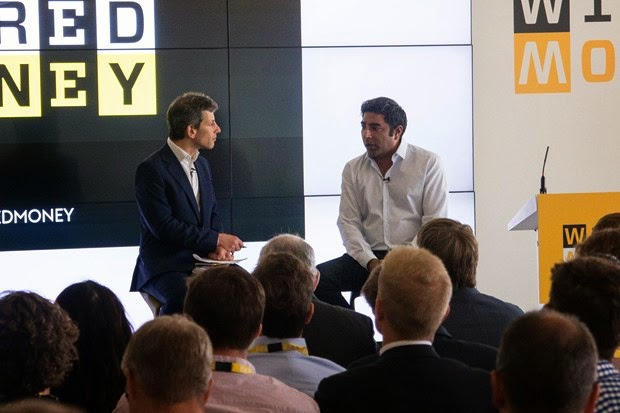
Shakil Khan: cryptocurrencies are here, embrace them
already disrupting payments and won’t be stopped, serial investor
Shakil Khan told the audience at Wired Money 2014. So get on board
with change.
much-misunderstood, unstable currency, to a more mature offering
that is finding its place in ecommerce and investor portfolios. So
rather than focus on regulation, which will only delay the
inevitable, the financial sector needs to focus on supervision and
take on the opportunities cryptocurrencies provide.
David Rowan, has invested in Spotify and YPlan, and advised teen
founder of Summly Nick D’Aloisio. But it was in 2012, when he first
heard about a payment company attempting to tackle the Bitcoin
ecosystem, that the cryptocurrency crossed his path. In the
following years, he found himself becoming a point-of-contact for
investors, suddenly intrigued by a currency that went from $10-25
per Bitcoin in 2012 to $260 in 2013.
entrepreneurs asking who is this company Mt Gox? Not because I was
the smartest person, but because there was a different wave of
people who weren’t publicly talking about Bitcoin. Morgan Stanley
was phoning me not because we had a relationship, but because
people were calling them and asking advice, and they were coming to
me.”
BitPay. That’s a lot of hard cash for a currency that dips and
peaks dramatically according to government opinion — for instance
when the FBI referred to it as a currency, Bitcoin became stronger;
when China restricted exchanges and warned it would keep an eye on
the currency, its value tumbled.
average consumer to participate in this — it’s the same as
stocks,” said Khan. We in the tech industry are more than familiar
with Bitcoin, beyond the Silk Road headlines, and those in the
financial sector have followed suit. But it is not yet something
that is impacting the average banking customer. “Right now, it’s
something that’s not for the faint hearted, just like stock trading
where people make 3 percent gains one day, and 25 percent losses
the day after.”
made in the cryptocurrency ecosystem — and this is because, as
Khan reiterated onstage, there is a “fundamental problem with
payments”.
three seconds. But if I want to pay someone 200 kroner online it’ll
cost be $32 and might take four days for the payment to arrive.
That makes zero sense, and cryptocurrencies solve this
problem.”
result of this, says Khan.
Andreessen Horowitz, Fred Wilson and Redpoint. This is a sector
everyone knows is going to get disrupted, and they need to be part
of that journey. Companies like Bit Pay were very early, now we
have ecommerce companies starting accepting Bitocin. Amazon has its
own plans on virtual currency.
then we had email. We’ve seen this over and over, and if you have
passion and an appetite for risk, why wouldn’t you? I don’t want to
turn around and five years say why wasn’t I part of this.”
evidenced by the stories being published by Khan’s own site
Coindesk, which are picked up by the likes of the Wall Street
Journal and Dow Jones. “Over the last 12 months it’s
much less of Silk Road, and more of Visa setting up a group looking
into cryptocurrencies and Western Union or Ebay looking into
Bitcoin.”
Bitcoin, Khan points out that the US $100 note is the chosen
currency of the criminal world — it’s what they’ll find in raids,
and its what the CIA drops in bales of cash into Afghanistan.
“They’re not sending smartphones, they were sending US dollars.”
Recently, the US government sold off the 30,000 Bitcoin it seized
during the Silk Road shutdown. Khan points, “I don’t remember the
US government selling cocaine seized from raids, so you can’t say
it’s illegal and shouldn’t be allowed.”
you don’t understand something, you get fearful of it.”
there is something attractive here for investors — Khan says the
coins, currently priced at $650 each, went for above that
value.
not broken. “I’m guessing there are laser printers out there
devaluing that money quicker than the paper can be printed,” Khan
said.
Open your free digital wallet here to store your cryptocurrencies in a safe place.

Winklevii Bitcoin ETF under the ‘COIN’ symbol
As some have speculated, evident of the twins’ latest filing, the first of its kind bitcoin ETF will trade on the NASDAQ under the ‘COIN’ symbol.
“Identifying the ticker symbol and the exchange are two major events that further demonstrate that we are moving forward as expected.”
Open your free digital wallet here to store your cryptocurrencies in a safe place.

Tim Draper, venture capitalist, wins government Bitcoin auction
(OnBitcoin) Tim Draper,
a Silicon Valley venture capitalist, was the sole winner of the US
Marshal Bitcoin auction. Mr. Draper purchased all 30,000 BTC, outbidding
many other participants in the auction such as Barry Silbert’s
SecondMarket.
Draper is an investor in Vaurum, an exchange platform for financial institutions.

In a statement,
Vaurum founder Avish Bhama said that Draper’s new bitcoins will be used
to provide liquidity to emerging markets through Vaurum.
“Bitcoin frees people from trying to operate in a modern market
economy with weak currencies. With the help of Vaurum and this newly
purchased bitcoin, we expect to be able to create new services that can
provide liquidity and confidence to markets that have been hamstrung by
weak currencies,” said Draper. “Of course, no one is totally secure in
holding their own country’s currency. We want to enable people to hold
and trade bitcoin to secure themselves against weakening currencies.”
Open your free digital wallet here to store your cryptocurrencies in a safe place.
Bitcoin ~ Hands On Code: Discover Bitcoin Open-Source Technology

LUISS ENLABS in collaboration with Bitcoin Foundation Italia and
Codemotion presents the first of a series of technical conferences
“Bitcoin ~ Hands On Code”.
The event will take place on Wednesday, 2nd of July, from 4pm to 8pm and enjoys the participation of speakers Thomas Bertani, Founder&CEO BitBoat Ltd, Guido Dassori, IT&building automation Freelancer, Luca Matteis, Semantic Web Developer, as well as Francesco Simonetti, Andrey Zamovskiy, Nickolay Babenko in live streaming from San Francisco.
The mission of the conference is to remove friction between bitcoin and
developers, encouraging the development of an appropriate tech scene
around Bitcoin, an incredible open-source based technology, aiming to
disrupt finance and money as we know them today.
There’s an
enormous opportunity for developers, who are already jumping in and will
have a real impact on the future, contributing to this open-source
technology.
Jump on board!
Program:
16.00 – Welcome: Tobia De Angelis, Augusto Coppola
16.15 – 17.15 – Panel moderated by Franco Cimatti, Developer and President of Bitcoin-Italia: Speakers’ interventions
17.15 – 17.30 – Break
17.30 – End (Around 20.00) – Hands on Code, guided by Thomas Bertani, a developer with a deep expertise in bitcoin/blockchain and founder of BitBoat.net.
Open your free digital wallet here to store your cryptocurrencies in a safe place.

One auction bidder claimed all 30,000 Silk Road Bitcoins
undisclosed bidder claimed all of the roughly 30,000 bitcoins seized
from online black market Silk Road and sold in its recent auction.
blocks, according to the USMS. Further, the bitcoins have already been
transferred to the winner, according to Blockchain.
whether they had secured any of the blocks on 30th June. The auction
took place on Friday, 27th June over a 12-hour span.
“The US Marshals Bitcoin auction resulted in one winning
bidder. The transfer of the bitcoins to the winner was completed today.”
Results trickle in
from the USMS on 30th June, when the agency said that 45 registered
bidders took part in the process. At the time, the federal agency didn’t
have a clear number on the final amount of winning bids.
auction date and procedural details last month. At the time, the
federal agency outlined how participants could express interest in the
roughly $18 million worth of bitcoin.
including SecondMarket founder and CEO Barry Silbert, have outlined
their participation in the auction. Silbert later announced via Twitter
that his auction syndicate, which consisted of 42 bidders for a total of
186 bids, was outbid on every bitcoin block.
by the USMS. Other bidders included Pantera Capital and Bitcoin Shop,
both of which have confirmed that they did not enter the winning bid.
Open your free digital wallet here to store your cryptocurrencies in a safe place.
Deloitte: media ‘distracting’ from Bitcoin’s disruptive potential
(CoinDesk) The report, titled ‘Bitcoin: Fact. Fiction. Future.’ and authored by Tiffany Wan and Max Hoblitzell, points out that the media tends to focus on bitcoin’s volatility, government crackdowns and exchange meltdowns instead of “its potential long-term significance as a disruptive new money technology”. In addition, Deloitte UP sees potential for bitcoin in fields that are often overlooked even by proponents of the digital currency:
“Bitcoin is more than just a new way to make purchases. It is a protocol for exchanging value over the Internet without an intermediary. Much has been written about the payment applications of bitcoin, including remittances, micropayments, and donations. However, bitcoin could soon disrupt other systems that rely on intermediaries, including transfer of property, execution of contracts, and identity management.”
Bitcoin evolution and new use cases
system, and why it has to deal with less overhead than the traditional payments system.
Speculation and regulation
caveats. Speculators rank high on the list, adding to the volatility and creating the impression of a get-rich-quick scheme. Thus, they introduce more reluctance on the part of everyday investors. The regulatory environment still leaves much to be desired. Like speculation, regulatory moves have a big impact on the price, creating even more volatility.
More than money
“Today, if someone buys a donut with a credit card, the merchant pays an interchange fee to the credit card issuer. This interchange fee is usually a small flat amount (10-20 cents) plus a percentage of 1-3 percent. For a low-margin good like a donut, a 10- to 20-cent flat fee can approach 100 percent of the cost of goods. This interchange fee is often passed on to the customer. Using bitcoin, the transaction fee could be lowered to as little as 1 percent. This could ultimately evolve into a new payment system for credit card companies and banks.”
New use cases
various contracts. Using the bitcoin protocol to manage identities would practically eliminate the possibility of forging identification documents and it would help put confidence artists out of work. A network operated by the government, a contractor or any other entity could verify anyone’s identity simply by scanning a bitcoin key.
About the publisher
Open your free digital wallet here to store your cryptocurrencies in a safe place.