Category Archive: Analysis

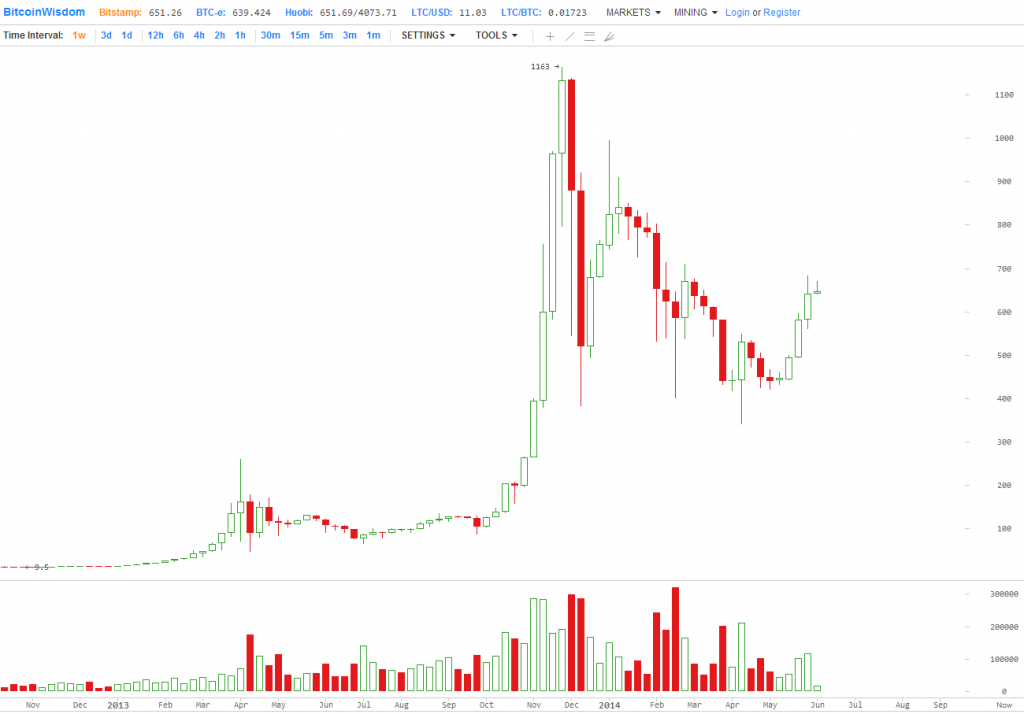
Bitcoin price chart USD 1024x714

Four charts that suggest Bitcoin value could be at 10,000 USD next year

Has the Bitcoin Value bubble burst? Looking at the most recent prices, we seem readier for a gentle nosedive than a new rollercoaster ride to the top. Many altcoins are heading down too: Litecoin, Peercoin and your beloved Dogecoin are all in a steady slide to the drain of the cryptocurrency world. But looking at the charts below, many would argue that Bitcoin is up for a new rise to 10,000 USD. This recent bubble wasn’t the first bubble, and it won’t be the last for Bitcoin.
You see that tiny top in April 2013? That was a bubble just like the most recent big one. It was playing out on a lower price level, but the percentage rise was equally big. There have been more bubbles in markets ever since markets were invented. All start with a slow rise in price, then a parabolic jump to the top, and the inevitable crash and rebound. At the end of every bitcoin bubble, the value is about 2x higher than what it was. Every time.
To see this trend in action, we have to display the price on a logarithmic scale. This is useful for values that grow exponentially.
The chart below shows us the Bitcoin/USD value over the same 2013-2104 period on a logarithmic scale.
This is the very same chart, but on a different scale. You can see exponential growth, more or less stable over the years. In 2012 the price grew from $5 to $13. In 2013 from $13 to $800. If we make a similar jump in 2014, we come to the (crazy) price of 10,000 per bitcoin. For this the value only has to continue its trend. Following the full 2012-2014 chart on bitcoinwisdom, one can see continious valleys followed by spikes. We are currently in a valley, which is very good news. What will be the value in 2015? The chart below takes an educated guess:

Google Trends on Bitcoin

The fact that we are in a valley is confirmed by Google. Google trends shows us how popular a keyword is. It tracks the number of searches for ‘Bitcoin’ and other keywords, and displays that in a graph over time. The resulting chart of user interest shows peaks and valleys corresponding in time with the peaks of the price, as can be seen in the excellent research in this forum post.
Does this mean more user interest increases the price? Or does a higher price generate more user interest? We can’t be sure, but it is clear that they go well together. We are currently in a valley of user interest, which means another top is in the make. Bitcoin news is widespread, but how many people do you know that own one? According to wallet counts, the number of current Bitcoin users has hardly reached more than one million yet. Bitcoin is at it’s very infancy.

“Bitcoin is still in the earliest phases of industry development. The first years of Bitcoin were about building the infrastructure. Bitcoin entrepreneurs were busy setting up the most basic but fundamental aspects, including wallet and mining services. Today, Bitcoin is just starting to enter the investment phase, where venture capitalist, hedge funds and other financial firms are starting to invest money and capital into this nascent technology. Bitcoin isn’t quite ready for the consumer phase, where end users begin to utilize the services. If the entire history of Bitcoin was a clock, we’re still in the very early time. I would say were maybe in the second second of the entire history.” Nicholas Cary, CEO of Blockchain.info (source)

The next jump in price could be ignited by the Winklevoss brothers bringing Bitcoin to the Nasdaq, or by the SecondMarket Bitcoin Investment Trust handing over Wall Street dollars. But wherever it comes from, the charts are definitely bullish. My advice is simple. Buy now, and wait.

Disclaimer: The (funny) definition of an economist is “Someone that can use economic theory today to explain why he got all his predictions wrong yesterday“. The market is unpredictable and I can’t always be right

Open your free digital wallet here to store your cryptocurrencies in a safe place.

Satoshi
Close up of Sweden Flag

Swedish central bank acknowledges benefits of cryptocurrencies

Close up of Sweden Flag(CoinDesk) Sveriges Riksbank, Sweden’s central bank, has published a brief economic commentary on the impact of digital currencies on the retail payments market.
The document outlines the basics behind digital currencies and focuses on bitcoin, but it also mentions some altcoins such as litecoin and dogecoin. Aside from a relatively basic introduction to digital currencies and background information for novices, the document also sheds light on the state of bitcoin in Sweden and the bank’s attitude towards bitcoin and other cryptocurrencies.

Take-up remains limited

The Sveriges Riksbank report found that the use of digital currencies in Sweden remains very limited. The authors point out that it is particularly difficult to obtain accurate information on the use of digital currencies in different countries, hence most analyses are usually limited to the total issue value and global usage. The report tries to isolate Sweden and examine transactions limited to Swedish krona (SEK) exchanges. Even so, the data may not be complete, as it only deals with transactions involving SEK.
“On average, around 212 bitcoins per day were converted to or from SEK during the period December 2012 to May 2014 at an average value of just over SEK 266,000. However, the daily value varied substantially, between SEK 2,500 and SEK 2.5 million, depending on the exchange rate and the number of bitcoins exchanged,” the report notes.
The authors caution that the statistics are incomplete, as there is no data on transactions between private persons and other movements of funds that could be relevant. Therefore, they concede, the exchange statistics may underestimate the use of bitcoin in Sweden. However, the report concludes that the values involved in cryptocurrency transactions pale in comparison to traditional transactions. This is how bitcoin stacks up:

“Households make daily payments using cards and cash totalling 8 million in volume and to a total value of over SEK 3 billion. Even if the use of bitcoin in Sweden were to be much larger than the average exchange value of just over SEK 266,000, this is a relatively low value in relation to other types of payment. At present, there only seem to be around 25 swedish companies accepting Bitcoin.”

Risky but innovative

Although the report contains the usual set of caveats found in most central bank statements involving digital currencies, it also includes some relatively positive commentary. The report states that digital currencies are one of many innovations in the Swedish payments market and like other innovations, digital currency is essentially positive:

“It can contribute to meeting new payment needs and to making payments cheaper and more secure. Those who choose to use a particular payment service can be expected to do so because it gives them an added value in relation to other payment services. This also applies to virtual currencies, which can for instance make some cross-border payments simpler, faster and cheaper. Another advantage is if the payer does not need to share sensitive information, such as card number or bank account number, with the payee.”

Cryptocurrencies may also be better suited for micropayments made via websites, the report further notes. Disadvantages associated with digital currency platforms include lack of clear regulation, lack of consumer protection regulation, volatility, security risks and the risk of using digital currencies for illicit transactions. The report concludes that the impact of any innovation depends on how much it is used. The use of digital currencies is “very limited” both in terms of the number of users, the number of transactions and the value involved in said transactions. Therefore both the positive and negative effects of digital currencies on the payment market in Sweden are currently negligible.

Open your free digital wallet here to store your cryptocurrencies in a safe place.

Satoshi