Cryptocurrency Fundamentals
2014 will be a year of revolution, not politically but economically. Sweeping reforms are coming that will forever alter the way our financial system works. In order to understand how cryptocurrency will be so revolutionary, you need to understand who it was made by, why it was made and how it works.
Imagine there were a group of ten nomadic tribes in a valley with a lot of hills. One day they discover a hundred precious stones all with unique symbols written on them. To decide how best to regulate trade and prevent theft and fraud, the tribes decide to make it law that whenever a stone is traded between villages, both of the tribes must record it on this huge wooden board placed where the stones were first found with the stone’s unique symbol telling the other villages that that stone has been traded. They do this when no one is looking and keep their stones hidden from each other. If a stone changes hands without it being recorded on the board, then you know it was a theft or fraud.
Leaving the analogy: the tribes are now computers, the smoke signals are the internet, and the precious stones are Bitcoins. Bitcoin is only one of many hundreds, even thousands, cryptocurrencies out there. Cryptocurrency has three main advantages over national currencies like the US Dollar.
1. It is decentralized; the currency is regulated by the market and community, not by a central bank like our Federal Reserve.
2. It is anonymous; users can spend their money on whatever they want without fear of being tracked by the government.
3. It is digital; you do not need to carry them around with you (even though you can).
Bitcoin – is just one of many cryptocurrencies (AKA altcoins, alternative currencies, etc). It was the first and most famous, mainly for its mob associations in the Silk Road. It was created by an individual or group of individuals known as Satoshi Nakamoto (Personally, I think it’s a small team). It has the greatest market capitalization (as in the quantity of Bitcoins times the value of each Bitcoin given in dollars) of all cryptocurrencies.
Here is a visualization of the market capitalizations of all the cryptocurrencies.
Most cryptocurrencies have nothing unique to them. Some may even be scams, but far more are simply unimaginative wannabes. They are developed by anyone from a leading company to a hacker in his parent’s garage (although you can easily tell). The top fifty cryptocurrencies are usually the only ones with anything creative or innovative about them. But to reach the top you cannot merely have creative mechanics or features to your coin, you must have a community. Coins that want to be in the big boys club must reach out to a group of people online who identify with something about the coin. Often it is as simple as having a “cool” name, like the amusingly blatant Potcoin. A community of people who support and use the coin means that it will have consistent trading and mining and will maintain its value. But don’t take that to mean that you don’t need a well-constructed coin itself. Several times has a coin emerged with a huge opening to a lot of fans before suffering from a massive technical failure and breaking down (looking at you Ripplecoin). This is why we should think of cryptocurrencies as investments like high-volatility bonds than actual mediums of exchange for the time being. Volatility will fall with mainstream adoption and market maturation just like with stocks and bonds.
The competition between altcoins is cutthroat. If your coin/exchange/mining pool gets a bad name as a scam then it will be plastered all over the main cryptocurrency forums (don’t knock forums, these are more influential than maintream media news stations in the crypto community) and your coin/exchange/pool will be ruined. If a coin/exchange/pool comes up just like yours but with that little extra awesome thing about it (I mean literally ANYTHING) then your users can easily notice the rival and switch to it. In order to stay profitable a coin/exchange/pool must not only have value innovation when it release but must continue to create more value and innovation for the user.
Mining – mining is how coins are introduced to the market. In incredibly simplified terms, people with computers download a program that solves very very complex algorithms to generate a unique solution. Each solution is recorded in computer-speak, forming a new cryptocurrency coin. To reclarify: this is almost an oversimplification of the process. This can work in two ways: Proof-of-Work, and Proof-of-Stake. In PoW, you get more blocks containing coins the more work you have done mining that coin in the past. In PoS, you get more blocks containing coins the more total coins you own (so if you continue to own 1% of all the coins then you will continue to receive 1% of coins that are mined) Some cryptocurrencies have a hybrid of both, in which people can mine for coins via PoW or receive them via PoS. Each has its own advantages and disadvantages. If you want to challenge your reading comprehension and computer science skills try reading the articles on both linked above.
PoS (Proof of Stake) was first proposed on Bitcointalk here.
You may think it’s kind of unfair and weird that someone can just go
out and mine cryptocurrency coins “for free” using just a computer, that
makes the coin “not backed by anything.” This belief is full of logical
fallacies. Firstly, the miner must spend money to get computers,
internet access, etc in order to even do the process. Then he must spend
time, effort, expertise and electricity generating the coin. Then he
may sell it. Sounds easy? Wrong. You can similarly trivialize the
process of mining gold, or silver, or any other precious metal. All you
have to do is spend some money to buy a pick, a shovel and a pan then go
out to a river in Oregon and squat in it.
Just because something doesn’t require physical labor doesn’t mean it
isn’t hard, or worthless. Not everyone can or wants to mine, that alone
restricts the supply. In addition, the more miners there are, the
higher the difficulty rate goes. The difficulty rate
decides how many coins are given out in a given time to a given miner;
the higher it is, the less coins the miners get. This also helps to
restrict mining. Today the difficulty rate of Bitcoin is so high that
they are completely mined by big companies with powerful non-personal
computers.
Think of each cryptocurrency as its own precious substance like gold
or diamonds. Gold isn’t “backed by anything” either. Your US Dollar is
only backed by your neighbors’ home mortgages and the debt our banks owe
to other banks. Both cryptocurrencies and precious metals can be mined
“for free,” but that doesn’t mean it is not hard to do so. They may not
be “backed by anything” other than human desire, but that doesn’t mean
they are devoid of value.
Blocks/ Blockchains – here
you can see a infographic explaining how the blockchain system within
Bitcoin works. The blockchain is basically a record of everyone who has
owned each Bitcoin, which Bitcoins they owned, and when. It is a perfect
ledger of all transactions. You may say, “but wait what about
anonymity?” Just about to get there. The ledger doesn’t record your
name, your social security number, your fingerprint etc just your wallet
address. This is not the same as your IP address.
Whenever you want you can go online and download a free unique wallet
with its own address (given anonymously) from the website of each
cryptocurrency. This will sit, just like any other file, in your
computer. While you cannot exactly open it and read or copy the data
within (and thus expose Bitcoin to fraud) you can rest easy knowing your
money is at least digitally in front of you. If you just did something
like buying ten porn magazine subscriptions, you can go download another
unique wallet and toss the old one. This ledger is pretty much useless
for tracking all the transactions, but it does help if one wants to
investigate huge sales that happen all at once.
One of the most important things about cryptocurrency is that it is
not controlled by any government. The most they can do is ban or
restrict it in some way by law, which drives down the price of the coin.
However, this is imprecise and as more countries and companies adopt
the technology, not only will the impact of these laws be lessened but
governments will be face more obvious economic incentives not to. The
fearful prohibitions (which don’t even work as evidenced by at least two
of the top ten crypto exchanges being Chinese at all times) are not
evidence of cryptocurrency’s instability. Rather, they are proof of the
lengths governments which heavily manipulate their currency and repress
their people will go to keep this technology out.
Cryptocurrencies’ decentralized system contrasts greatly with
national currencies or fiat currencies like the dollar or euro. The
federal government has a great deal of control over the US Dollar. I’m
not going to go into the federal reserve
here because I’m sure many non-Libertarians roll their eyes when they
see us go into that stuff and it’s too much for this article. But you
can check it out here:
Want to see a debunking of all those scary things you hear about Bitcoin and cryptocurrency in general? Here.
Written by Mars
Open your free digital wallet here to store your cryptocurrencies in a safe place.
California lawmakers pass bill to update currency law
 |
| Image: GetToKnowBitcoin |
Open your free digital wallet here to store your cryptocurrencies in a safe place.

Major Italian newspaper il Giornale accepting Bitcoin for digital subscriptions
for digital subscriptions, we’re learning from a reader email this
morning. The bitcoin logo is boldly visible on il Giornale‘s digital subscriptions page [link], where nearby it says, “The Journal is the first newspaper in Italy and in Europe who accepts payments in Bitcoin.”
all news categories and articles in PDF files optimized for Android
smartphones, iPads, and other tablet devices.
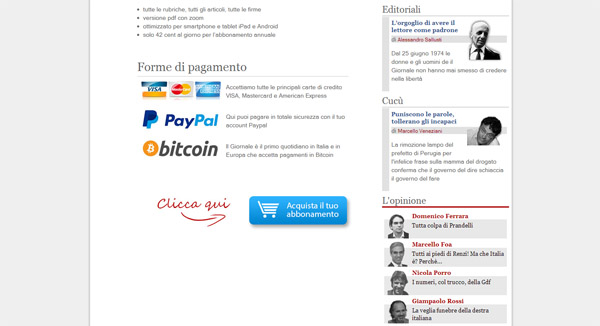
given the paper’s previous interest in the digital currency. In early
February, the paper put up a bitcoin paywall as a test of how users
would interact with using bitcoin (users had the option of donating to a
non-profit). The results were overwhelmingly positive, with 713 donors.
While we haven’t exactly seen widespread adoption of bitcoin for
digital news subscriptions, it’s nice to see it getting a start in Italy.
Open your free digital wallet here to store your cryptocurrencies in a safe place.
Swiss government report: Bitcoin too ‘insignificant’ for legislation
for the time being, it will not create legislation relating specifically
to bitcoin or other digital currencies.
claims the economic importance of these currencies is currently “fairly
insignificant” and the council doesn’t expect this to change in the
near future.
of postulates by National Councillors Jean-Christophe Schwaab and
Thomas Weibel last year, which asked the Federal Council to examine the risks and opportunities associated with bitcoin.
No ‘legal vacuum’
point the government is keen to stress in the report is that virtual
currencies are not in a “legal vacuum”, meaning that existing laws apply
to activities associated with these currencies. It states:
“Contracts
with virtual currencies are enforceable in principle and penalties can
be imposed for criminal offences associated with virtual currencies.
Certain business models based on virtual currencies are subject to
financial market laws and need to be subjected to financial market
supervision.
Professional trade in virtual currencies and the
operation of trading platforms in Switzerland generally come under the
scope of the Anti-Money Laundering Act. This includes compliance with
the obligation to verify the identity of the contracting party and
establish the identity of the beneficial owner.”
of the laws that apply to certain uses of digital currency include the
Swiss Code of Obligations, the Federal Act on Combating Money Laundering
and the Financing of Terrorism in the Financial Sector, plus the
Federal Act on Banks and Savings Banks.
Legal certainty
told CoinDesk he was pleased the report had clarified the legal status
of bitcoin: “The report ensures legal certainty. That’s the most
important topic at this point. Now, people who trade bitcoin can know
which financial sector regulation applies or not.”
“The more I learn about bitcoin, the less I remain sceptical about it!”
a big mistake for a country like Switzerland with a strong financial
sector. I hope the banking sector will be cleverer than the Government
on that point, but I’m pessimistic.”
the last months, my personal views about bitcoin have evolved: the more
I learn about bitcoin, the less I remain sceptical about it!”
Roussel, CEO of Swiss based cryptocurrency broker SBEX, said the report
represented good news for the Swiss bitcoin ecosystem.
an ATM would be considered directly as money transmitting service, with
tighter rules. This is starting to shape how bitcoins ATM will work,”
Roussel said.
need to be licensed, unless they can ensure the user is in control of
the private key of the bitcoin wallet they are sending to.
is imposing high standards in the bitcoin financial world, but this will
be beneficial for consumers in the end,” he added.
The risks
report gives examples of the risks associated with bitcoin, stating
that, while there is no risk of it damaging the country’s existing
financial sector, consumers are vulnerable to volatility and security
issues.
Open your free digital wallet here to store your cryptocurrencies in a safe place.
Family to travel across the US, apending only Bitcoin
their family of four this week, during which they will only spend
bitcoin.
Washington on Friday, the first stop on the “Uncoinventional Living
Tour”, for the Bitcoin in the Beltway conference.
annual Porcupine Freedom Festival and then to Kansas City, Missouri –
Bleish’s hometown – over the Independence Day holiday before returning
back to Texas.
Fighting a different way
and Bleish are both grassroots activists that spent years fighting the
political system in the US. Each helped start local political action
committes that focused on constitutional activism, civil liberties and
anti-police state causes in their hometowns of Austin, Texas and Kansas
City, respectively.
realisation that they needed to change their lifestyle choices – opting
instead to look for ways of being self-sufficient and building
communities separate from government influence. Bush told CoinDesk:
“We
started to think that if we really want to change the world to create a
more free society, the first thing we can do is to change the way we
live and start to live more free ourselves, and stop participating in
centralised or coercive institutions … Both of us began to realise that a
lot of work we were doing wasn’t making us more free. In fact, it was
just exhausting us and spending all our energy and our money and our
time.”
The Blush family farm
off the grid, the family moved just outside of Austin, to start a farm
on which it produces its own food, provides its own source of water and
harvests its own alternative energy.
lifestyle to be realised, they’ve set goals: to produce 50% of their own
food, store 50% of their own water, and reduce their dependency on the
central energy grid by 50%.
said Bush. “Trying to document and educate people about the values of
living a voluntary, natural life.”
their lives as they learn each day from their lifestyle, their
communities and themselves, as well as teach others how everyone can be
self-reliant and free from government influence – without fighting.
After they’ve wrapped filming for episodes five and six of “Sovereign
Living” they hope to be able to share it with the world through a media
streaming service like Netflix or Hulu.
Planning ahead
mentioned that this is the first time in their bitcoin experience where
they’ve had enough tools and resources to live on bitcoin alone, citing
platforms such as Gyft and eGifter, as well as the recent news by Expedia. Nevertheless, she emphasised the amount of effort it takes to plan a bitcoin-only itinerary:
“It’s
hard, it’s taken a lot of pre-planning. I had to look at every single
stop along the way and see what gas stations they had to make sure that
we were buying the appropriate amount of gift cards for each gas
station.”
the northeast of the country, she found Exonn gas stations at each stop,
but that on the drive back home there weren’t any – but there were BP
stations.
added: “I want the world to know that it is possible to travel the
country using bitcoin only. And it’s not only possible but you can do it
comfortably and take care of a family of four along the way.”
Open your free digital wallet here to store your cryptocurrencies in a safe place.

Education to consider for the Bitcoin user
(CoinTelegraph) This month, the number of educational institutions welcoming students who wish to pay using digital currency has increased substantially. This comes as no surprise, however, since the current academic year just ended, registration is opening up for the fall semester.
The King’s College, NYC, US
One of the leading institutions in the United States – The King’s College announced that it will be welcoming students who want to pay using Bitcoin.
The King’s College is a Christian liberal arts college founded in 1938 by Percy Crawford, located in Lower Manhattan, New York.
Now with help of New York’s Coin.co it becomes the first accredited
college in the US to accept digital currency. Dr. Gregory Alan
Thornbury, President of The King’s College stated:
“The King’s College seeks to transform society by preparing students
for careers in which they help to shape and eventually to lead strategic
public and private institutions. Allowing Bitcoin to be used to pay for
a King’s education decreases our costs while simultaneously allowing
our students to be a part of this exciting new technology.”
Team Treehouse
On Thursday June 12, a famous US-based online education provider – Team Treehouse – officially announced that it will be accepting Bitcoin via Coinbase as one of a payment options. The company’s press release stated:
“As one of the fastest growing payment methods, Bitcoin will give
more people across the world the opportunity to learn with Treehouse.”
Treehouse is a place for people who want to learn how to coup with HTML or CSS, make iPhone apps, start their own business.
University of Nicosia, Cyprus
Once again we mention the University of Nicosia,
which was the first to accept Bitcoin for payment of tuition and other
fees. Dr. Christos Vlachos, Chief Financial Officer for University of Nicosia stated:
“Digital currency will create more efficient services and will serve
as a mechanism for spreading financial services to under-banked regions
of the world. In this light, we consider it appropriate that we
implement digital currency as a method of payment across all our
institutions in all cities and countries of our operations.”
Anyone who wants to advance their education here will probably find a
an area of interest they’re looking for – University of Nicosia offer
schools of business, education, humanity, social science, law,
engineering and arts.
A big advantage of the University of Nicosia is that it is accepting
Bitcoin throughout their whole University network, including affiliated
institutions in London, Cyprus, Greece, Romania and others.
University of Cumbria, UK
In the beginning of the year, the University of Cumbria in the United Kingdom also announced that it will accept Bitcoin for the payment of fees. The founder and director of IFLAS, Professor Jem Bendell, stated:
“We believe in learning by doing, and so to help inform our courses
on complementary currencies, we are trialling the acceptance of them.
The internal discussions about currency and payment innovation and the
practical implications for different departments have been insightful.”
The acceptance of Bitcoin is limited to the two programs only – Certificate of Achievement in Sustainable Exchange and Postgraduate Certificate in Sustainable Leadership. Both courses are already in progress as a trial though it shouldn’t be the last one as “the university will learn from this trial and develop its awareness of innovations in complementary currencies and payment technology.”
Language centers
Additionally, there are also various private languages studios all over the world happy to accept digital currency.
A2Z School of English could be the first English as a Second Language (ESL) school in the world to accept digital currency. The announcement that it will adopt Bitcoin as a payment method was published back on November 5, 2013. A2Z School of English was founded in 2006 by James and Luciene Taylor and today has locations in Manchester, London and Dublin, offering various English language classes. BairesClases accept Bitcoin for Spanish classes. You can have face to face lessons in Buenos Aires Argentina or classes over the Internet for students anywhere in the World for anyone from beginner to advanced. Ru-SprachStudio.ch offer Russian courses in Zürich or Zug, Switzerland for Bitcoin. Customers may choose one-on-one private lessons or lessons in groups of 3-4 people. Their teaching approach also uses modern methods to develop your ability to communicate in the Russian language. Cinta Bahasa in Bali, Indonesia, offers Indonesian Language courses to foreigners and they also accept Bitcoin. They have schools in Ubud, Sanur, Kuta, and Canggu, Bali to teach students the language they will need to feel comfortable travelling around in Indonesia. Educational institutions are a major driver in the world’s progress. By embracing cryptocurrencies, these schools and universities are demonstrating their willingness to prepare students for a world with cryptocurrencies and a better future.
Open your free digital wallet here to store your cryptocurrencies in a safe place.
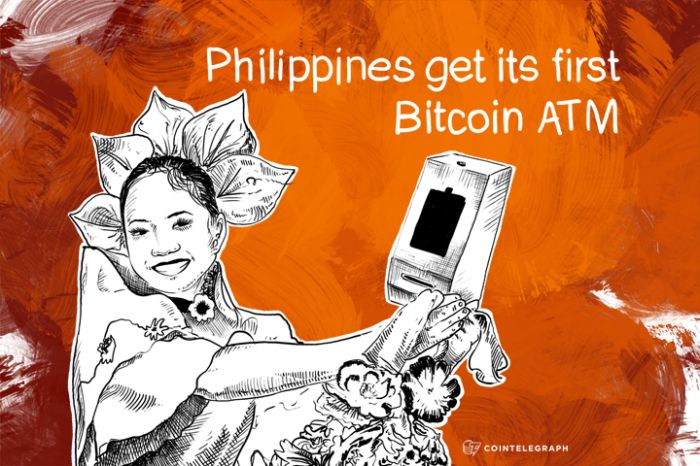
Philippines get its first Bitcoin ATM

(CoinTelegraph) The Philippines welcomes its first Bitcoin ATM. Brought by Satoshi Citadel Industries and Bitmarket.ph,
the machine will be ordered from Skyhook and will cost $US 999. ATMs
are no longer exciting news, yet this one is a lot smaller in size and
it will speak to the success of Bitcoins on a global scale. The ATM will
appeal to a wealth of people and cultures with money to trade and
transactions to process.
A better understanding of Project Skyhook
What is Skyhook? Skyhook is an open-source Bitcoin ATM.
Selling Bitcoins was once difficult, and many people were tired of
depending on exchanges and centralized banks to buy Bitcoins. Skyhook
changed everything. The company developed a tiny and secure machine
everyone can use to exchange Bitcoins.
It comes with a hefty security mounting plate and a password-on-boot
options. It someone steals it, you have nothing to worry as your
Bitcoins will be safe. The ATM accepts Australian, US, and Canadian
dollars, as well as Argentinean Pesos, Yuan, Euros, and numerous other
currencies.
Easy to set up, Skyhook comes with a detailed guide you should use to
get started. Buyers will require a Wi-Fi or wired internet connection, a
power cable, and Bitcoins to sell. The touch-screen graphical interface
of Skyhook will ease your job to buy Bitcoins and make use of the QR code for wallet address recognition.
Skyhook sets Bitcoin prices automatically using major exchanges.
Afterwards, it adds a minimum price protection so that you can get paid
for using Bitcoins. The ATM machine is excellent for vendors,
storefronts, bars, meet-ups, and merchants. Set your rate and start
trading.
Bitcoin, a global phenomenon now available in compact size in the Philippines
Unlike the other two popular Bitcoin machines, Lamassu and Robocoin,
Skyhook is a lot smaller, and of course, less expensive. Owned by a
Filipino company known as Bitmarket.ph, locals will finally be able to
trade Bitcoins with Philippine pesos and not have to worry about
exchange rates. To use Bitmarket.ph all you have to do is activate and
access your account. Next, type your transaction’s details (details of
the buyer and item for sale). Enter your selling price and exchange it
in Bitcoins immediately.
Generate a QR code and use the code to share it with clients.
Bitmarket additionally offers cash settlements where you can convert
Bitcoins into Philippine pesos daily. Bitcoins provide fast, real time
transactions to customers. Trading Bitcoins keeps people away from
chargebacks, bank fees, and commissions. Unlike other forms of exchange,
Bitcoins provide transparency where you can track each one of your
transactions in real time. Vendors accepting Bitcoins are essentially
adding value to their business by gaining a competitive advantage as a
first adopter and cutting costs.
Now that the Philippines is finally welcoming its first Bitcoin ATM,
people will “dispense Bitcoins for Pesos on the spot in a matter of
seconds at competitive and fair rates.”
Open your free digital wallet here to store your cryptocurrencies in a safe place.
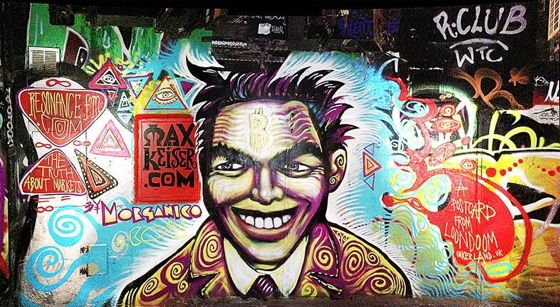
Max Keiser talks altcoins, investment and political disruption
The case for altcoins
“Altcoins offer ways to gain exposure to different segments of the crypto-universe. Dash is a brilliant coin that addresses a real need. As I said before, the market as a whole is set for 100x growth so there is plenty of upside.”
The future of maxcoin
“In the case of maxcoin, this was a coin that was started by students at Bristol University who I don’t think were prepared for the huge interest they got but I supported them and continue to do so because they’re very talented and we’re still very early in the game.”
Bitcoin still the king
“Let me be clear. Everybody should have, as their core holding, some bitcoin. Bitcoin is here to stay and is set to top $400 billion. I agree with the Winklevoss twins on this.”
“As long as Amir [Taaki] and his followers are around, bitcoin and alt coins will be pushing the political envelope and God bless them. We need as much political disruption as can get these days.”
Strange alt of the week
Open your free digital wallet here to store your cryptocurrencies in a safe place.
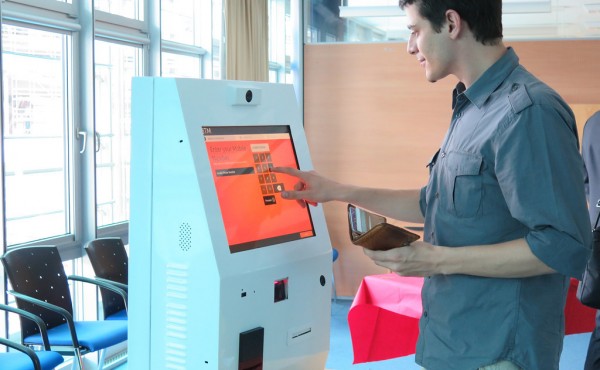
Swiss regulators give green light for Bitcoin ATM Network
Jumping through regulatory hoops
“We finally got clearance from ARIF, who were asking FINMA many questions about how they should deal with us. [The clarification from ARIF] is what we were expecting.”
Cancelled ATM launch
“I don’t really know why [Bitcoin Suisse AG] made so much noise [about its ATM]. Maybe they wanted to get themselves known or they want things to move quicker.”
“I think SBEX fulfilled all the regulatory requirements before Bitcoin Suisse did, so they got the approval first.”
Bitcoin Suisse chief executive Niklas Nikolasjen said his firm was working on obtaining the necessary regulatory approvals for their ATM. He said the media had overstated his firm’s cancelled ATM launch and that it had been consistently working to obtain regulatory approval.
“It is now clear to everyone in the industry that the regulatory authorities require certain steps to be undertaken by companies who professionally deal with digital finance. BTCS is naturally following these requests as well,” he said.
Expansion plans
Open your free digital wallet here to store your cryptocurrencies in a safe place.
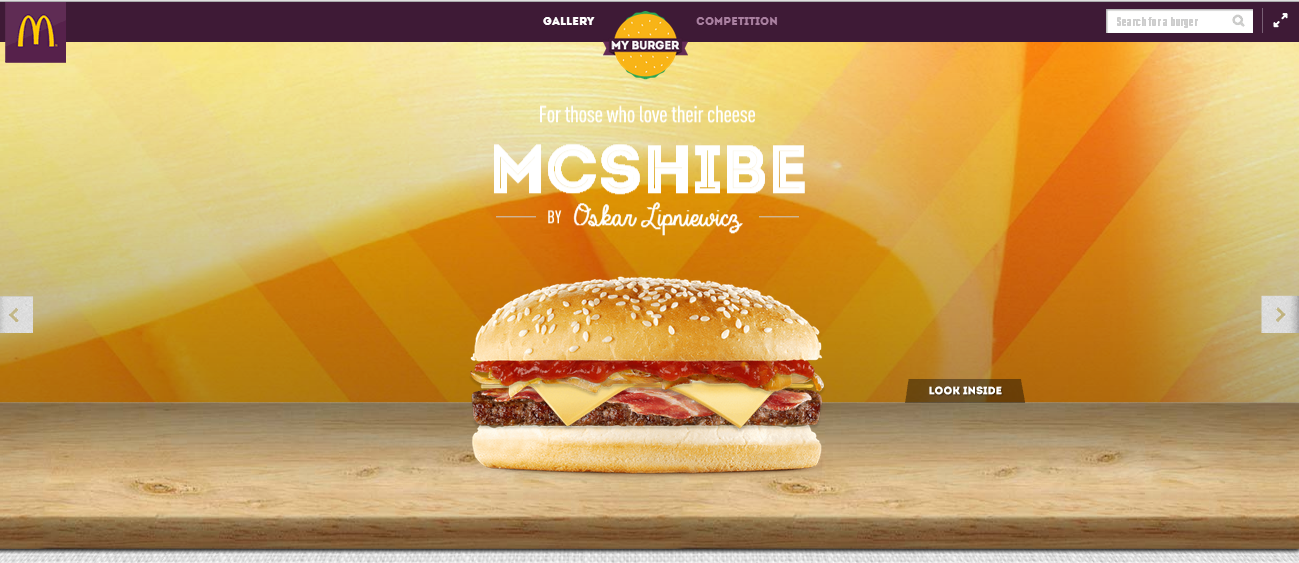
McShibe! McDonalds Dogecoin burger approved for judging
Back in May, the Dogecoin community decided to take advantage of a competition McDonalds was hosting and tried to add a Dogecoin themed burger to the McDonalds menu. The competition is simple: design a burger online, pick the ingredients, and name it. The top voted burgers would be selected for judging and the winning burgers would sold in McDonalds restaurants for a week.
Early Troubles
Initially, multiple variations of the “Dogecoin” burger were submitted for entry. Examples include the McDogecoin, the McDoge, and the Doge Burger. Despite having been voted to the top, McDonalds had to remove most of these entries due to the name. In hindsight, this decision makes a lot of sense. Some customers (especially those who aren’t aware of the Doge meme) would find it very strange if McDonalds started selling “Doge” burgers all of a sudden.
Redemption
Of all the entries, the McShibe burger was the most tame and an announcement earlier today disclosed that McDonalds had selected the burger and invited the contestant to the kitchen.
Details
The judging will be held on June 29th and 11 other finalists will be invited. Of these 11, judges will select the top 5. These top 5 burgers will be made available on the UK McDonalds menu for a period of one week each.
Conclusion
Well — I guess we can add this to the eternal list of amazing things Dogecoin has done. It remains to be seen whether or not the judges will actually select the burger (or how good it actually tastes). Hopefully one of the judges is secretly a Shibe.
Open your free digital wallet here to store your cryptocurrencies in a safe place.