Category Archive: bitcoin

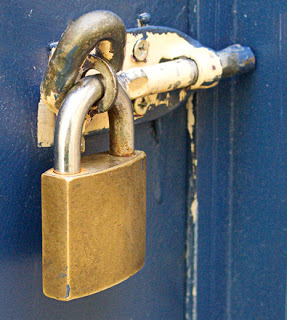
padlock different angle 1472741

How to use the blockchain to secure medical records

Guardtime, a blockchain platform for ensuring the integrity of systems, is now working together with the Estonian eHealth Foundation to develop a blockchain network to secure one million patient medical records.

eHealth will use the Guardtime’s KSI (Keyless Signature Infrastructure) into its database to improve the security and the real-time availability of patient medical records.

Guardtime aims at protecting those records with an “independent forensic-quality audit trail”, so it will be impossible to edit the information.

During a recent interview conducted by Coindesk, a spokesperson for Guardtime said:

“In guarding sensitive records, the danger is that they could be altered, deleted, improperly changed or updated, affected by hackers, malware, system issues, etc. The blockchain in this case can prove the integrity of the record, and everything that has happened to it over time”

Why in Estonia?

Maybe you are asking yourselves why this kind of innovation is being conducted in Estonia.

Well, Estonia is already famous for its e-government system which use a chip-embedded ID card that allows citizens to access government services including filing taxes and voting online.

Guardtime Insights

In 2007 Guardtime invented a “Keyless Signature Infrastructure”, a blockchain platform created to ensure the integrity of systems, networks and data at industrial scale.

Keyless Signature Infrastructure (KSI) is designed to provide scalable digital signature based authentication for electronic data, machines and humans. KSI uses only hash-function cryptography, allowing verification to rely only on the security of hash-functions and the availability of the blockchain.

According to the company itself, Guardtime’s method is similar to the one used by the blockchain startup Factom. In both cases, in fact, every time a file changes, a new signature is generated and stored in the blockchain.

Open your free digital wallet here to store your cryptocurrencies in a safe place.
Amelia Tomasicchio
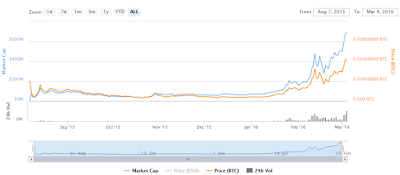
Immagine 2

Ethereum is bigger than ever

During the past months cryptocurrency Ethereum was growing fast, increasing its value and consequently its own popularity.
Today the Ethereum price is about $9 (0.022 BTC) and it undergone very few changes with an almost always upward price.
Just in the last day Ethereum raised its market capitalization by 26%, reaching almost $730 million, representing more than 10% of Bitcoin’s market cap.
This behaviour is truly important as Ethereum is proving to be much louder than the other altcoins, reaching the market capitalization of all the other altcoinsll together, excluding bitcoin.

Microsoft Corporation certified Ethereum

Some days ago a startup who provides Ethereum softwares, BlockApps became the first certified company on Microsoft Azure’s Blockchain-as-a-Service (BaaS).
Director of Blockchain strategy at Microsoft Corporation, Marley Gray, commented:
“The simple, rapid and flexible one-click deploy of Ethereum blockchain architecture launched on the Microsoft Azure Marketplace enables enterprises and developers to quickly deploy a certified blockchain environment on Azure.”

But, what is Ethereum?

Created in 2013 by Vitalik Buterin, Ethereum is a cryptocurrency and a blockchain platform who provides decentralized services.
  At the moment Ethereum is in the so-called Homestead phase, the second of the six phases of its rollout that they company planned. The other phases will be “Metropolis (Mist release), Serenity (proof of stake Casper plus abstraction, aka Ethereum 1.5), Ethereum 2.0 and Ethereum 3.0 that will focus on scalability”, commented Buterin during a recent interview conducted by Bitcoin.com.
Thanks to Homestead, said Buterin, “the risk of using the Ethereum platform is now substantially reduced”.

Open your free digital wallet here to store your cryptocurrencies in a safe place.
Amelia Tomasicchio
credit card 2 1510272

Visa is working on a secure and scalable Blockchain

The American multinational financial services corporation Visa annonuced its “secure and scalable” blockchain project.
To do so, Visa opened a position for software engineers who have to “explore and develop technologies that are critical to the payments industry in the future”, as stated in the job advertisement.
visa, blockchain, job, job position, scalable blockchain

Job Description

The researches will cover three key areas: data analytics, security and future of payments, so the team will work on develop a sort of proof-of-concept for the Visa blockchain network.


“Working on Future of Payment research at Visa is a unique opportunity at a time when the payments industry is undergoing a digital transformation with data as a critical differentiator. We offer you the opportunity to be at the center of innovation in the payments industry and unleash the power Visa technologies and massive data in innovating the future of payment concept.”


The perfect candidates must have programming experience, cryptography and “competency in data structures, algorithms and software design optimized for building highly distributed and parallelized systems”. 


Visa partners with Chain

Some months ago, Chain raised $30 million in a new venture funding, drawing funds from some financial companies including Visa.
Chain is a a blockchain developer platform that serves an enterprise market.

The blockchain is no longer a choice

Previously, on December 2015, Visa Europe stated that “the blockchain is no longer a choice”.
In an interesting blog post entitled “Why 2015 was the year of payments”, in fact, they commented on financial technologies including the subject of digital currencies, by saying:


“2015 has turned blockchain into something the industry has to live with. It is no longer a choice anymore. Recent news speculating about the identity of its creator and the formalisation of virtual money as a commodity just makes it more real than ever before.”


To know more about Visa perspective on the blockchain, you can read the full post here.

Open your free digital wallet here to store your cryptocurrencies in a safe place.
Amelia Tomasicchio
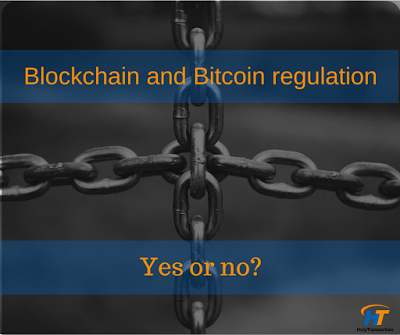
BlockchainandBitcoinregulationYesornot

“Blockchain can help governments”, says Blockstream CEO

According to Blockstream CEO, Austin Hill, blockchain technology will be able to help government regulatory agencies.

During a recent inverview with Bloomberg TV, in fact, Hill stated that blockchain “is a fundamental shift in how the underpinnings of how finance work, moving much more to an open, permission-less innovation platform. I think people are beginning to realize that some of the underpinnings of our finance system have not changed in 20 years. Wire transfers, international remittances, post-trade settlement, the entire way that banks and finance organizations do netting, a lot of issues around how stock and assets are traded and actually tracked which led to some of the problems in 2008 of systemic risk”. 
bitcoin regulation


What Blockstream is?

Austin Hill and his team have developed a blockchain “sidechain” technology to link the bitcoin blockchain to the other existing public and private blockchains.


“We want to power interoperable markets that are fair and accountable. Openness, accountability and public ledgers should be the norm and should not require users to sacrifice privacy. We seek to empower users with trustable and secure financial mechanisms via public auditability of their transaction history without disclosing more than is necessary for the integrity of the blockchain”, reports their official website


Recently Blockstream has announced $55 million in series A funding to further enhance their sidechain technology, expand their operations globally, and support new industry partnerships, bringing their total investments in the company to $76 million.

“We’re changing how the actual ledger works. It offers huge cost savings for financial organizations in the area of regulatory compliance, trust with other organizations because right now there’s a huge amount of reconciliation that has to occur where everyone has their own copy of the ledger and no one agrees”. 

The Bloomberg TV journalist asked him if he is worried about the regulatory environment, so Hill answered that it is not a problem as regulators only want to remove risks:

“This technology offers some of the best potential to actually remove systemic risk. And a lot of regulators around the world are beginning to realize that, so they’re looking at their own solutions even at the national government level to say if we do support fiat currency issued on a blockchain, what is the right technology to do so?”

Open your free digital wallet here to store your cryptocurrencies in a safe place.

Amelia Tomasicchio

Japan wants to regulate Bitcoin as Currency

japan bitcoin
Yesterday we read about the decision of an American judge to define bitcoin as property, as according to him bitcoin is a intangible personal property rather than a currency.
 
This is a very important matter on which lots of words have been spent since Satoshi Nakamoto invented this cryptocurrency. In fact, this definition has a lot of implications on how bitcoin is regulated, especially in terms of VAT and taxation in general.
 
Well, today Japanese regulators stated the decision to propose bitcoin among the methods of payments, so to define the digital cryptocurrencies as conventional currency.
 
In fact, Japan’s Financial Services Agency (FSA) wants to make “revisions to legislation that would classify digital currencies as fulfilling the functions of currency”, reported Coindesk.
At the moment Japan recognizes bitcoin as a property and not as a currency, but:
“Under the FSA’s proposed definition, virtual currencies must serve as a medium of exchange, meaning that they can be used to purchase goods and services. They must also be exchangeable for legal tender through purchases or trades with an unspecified partner”, said an article by Nikkei.
This possible modification might be submitted during the current legislative session of the Japanese legislature which runs from 4th January to 1st June, even though this it is not official yet.

About the author: Amelia Tomasicchio is a writer and a journalist of Bitcoin-related news and articles. She started writing about Bitcoin in 2014 and she graduated in Rome with an essay about movie industry related to Bitcoin.

Open your free digital wallet here to store your cryptocurrencies in a safe place.

Amelia Tomasicchio

“Bitcoin is Property, Not Currency”, stated California Bankruptcy Court

Some days ago an American judge for the Northern District of California stated that bitcoin is a property and not a real currency.
This happened during a case in which US Bankruptcy Court for the Northern District of California heared HashFast, a bitcoin mining service that declared bankruptcy in 2014.
The case sees a fiduciary suing the HashFast promoter, Mark Lowe, because he wants his 3,000 BTC bank, amount that is said to have been illegally transferred to Lowe himself.

Bitcoin: property or currency?

The main problem turned to be the classification of bitcoin as a currency or a property: should bitcoin be considered as a currency, Lowe would have to return the 3,000 BTC at the value they held when he received them (almost $360,000).
But judge Dennis Montali on February 19th decided that bitcoin is a property, so Howe must return about $1.3m.
These were his words:
“I understand how the parties acted, but that doesn’t make them dollars”.
Montali said that he would return to the question, if required and Lowe would transfer the 3,000 bitcoins or the equivalent dollar amount.

Pasted cases and decisions

Previously the US Commodity Futures Trading Commission (CFTC) and the Internal Revenue Service (IRS) stated that bitcoins are a commodity too. But in October, 2015, the European Union’s Court of Justice decided that bitcoins are a currency and they are tax free so exchanges don’t have to pay VAT.

About the author: Amelia Tomasicchio is a writer and a journalist of Bitcoin-related news and articles. She started writing about Bitcoin in 2014 and she graduated in Rome with an essay about movie industry related to Bitcoin.

Open your free digital wallet here to store your cryptocurrencies in a safe place.

Amelia Tomasicchio
barclays btc

Barclays is using the Blockchain to help people in Africa

“The Blockchain could be the most significant innovation for Africa”, said Barclays.
Some days ago the well-known worldwide legacy bank Barclays stated that the blockchain could be the most useful technology innovation for the African continent.
“Blockchain could be the most significant social and political innovation to impact Africa in 100 years”, said Arian Lewis, head of Open Innovation at Barclays. “People in Africa do banking on their mobile phones, but our talent base is all built on bricks and mortar banking”, she continued.

Bitcoin is very popular in Africa

Also, on February 19th, Quartz Africa, a news website based in Kenya, Nigeria and South Africa, released a new report in which they revealed that bitcoin is very popular in Africa because it provides more accessility than banking services, even if this country has been “late to the fintech party”.
“I think the banking sector in Africa is going to be disrupted faster than anywhere else in the world”, said Lingham. “What you have with bitcoin and blockchain is a trustless method of operating. You don’t need third parties like banks operating as trust brokers anymore. It’s all built into the code. The way mobile leapfrogged fixed lines communications in Africa; blockchain will leapfrog a lot of the financial infrastructure that exists today”, commented Vinny Lingham of Civic startup in the report.
For this reason Barclays decided to start financing a blockchain startup based in Cape Town called Consent, a platform that uses the blockchain to store medical records.

Dream Bitcoin Foundation

Among the several startups who work in Africa, the nonprofit Dream Bitcoin Foundation (DBF) is one of the most important as it aims at facilitating the use and “acceptance of cryptocurrencies as an alternative form of payment by providing an online cryptocurrency exchange platform and merchant solutions”.
Its founder, Philip Agyei Asare, wants to raise “Bitcoin funds for projects that will build a bright future for Africa [in particular Ghana] by bringing together all young, ambitious and self-determining entrepreneurs and enabling them to achieve their dreams, without the need for government assistance”.
To do so, in March, 2015, DBF also organized a Bitcoin-focused event called Coinfest.

Bitcoin in Kenya

To prove the Bitcoin huge potential in Africa, we want to quote a short documentary, shoot in Kenya by filmmaker Tomer Kantor.
In 2014 he filmed Bitcoin in Kenya with his own IamSatoshi Production.
This video tells the story of MPesa, a service launched in 2006 that allows people to transfer value using their mobile phones in a peer-to-peer way.


Open your free digital wallet here to store your cryptocurrencies in a safe place.

Amelia Tomasicchio
burger king in bitcoin

Burger King accepts bitcoin

The well-known fast food company, Burger King, has started to accept bitcoin among its allowed payment methods, but only in Arnhem, Netherlands.
Located in the city center of Arnhem, this Burger King venue will accept bitcoin and anyone that will pay with in this way will receive a second burger (a whopper) for free.
Another interesting news is that Burger King will host bitcoin meetups to increase the number of people who know what bitcoin is.

But, why Arnhem?

Since the opening of the Arnhem Bitcoinstad (also known as Arnhem Bitcoincity), the number of merchants who decided to accept bitcoin increased exponentially, and now Arnhem has 100 shops (including malls, coffee shops and restaurants) where people can spend their cryptocurrency.
In fact, yesterday (February 18th) Arnhem Bitcoinstad stated:


“The project Arnhem Bitcoincity has reached a new milestone: There are now 100 venues that accept Bitcoin in Arnhem. The Burger King in the city center is the latest to join the project. For Bitcoin enthusiasts Arnhem is like heaven as you can practically pay everything with bitcoins.”


Growing bitcoin enthusiasm

Bitcoin enthusiasm is growing fast in Arnhem and merchants have started to keep bitcoin instead of converting them immediately.
“When this project started, all merchants converted their bitcoins to euros immediately through the payment processor BitKassa, but a growing number of merchants now keep their bitcoins, since they can pay some of their supplies with bitcoins themselves at other merchants who accept Bitcoin as well. For instance a restaurant owner who pays for his bread at a bakery that also accepts bitcoins,” Arnhem Bitcoinstad team commented.

Life on Bitcoin

Maybe you have watched the documentary Life on Bitcoin, or maybe not, but all around the world there are a lot of cities where you can at least survive using bitcoin as the only payment method.
In fact, Life on Bitcoin shows how a young married couple could live and travel everywhere with payments only in bitcoin.
Of course, there is still a very long way to go but this couple has proved that it is already possible to conduct a normal life with the crypthocurrency.
For about 100 days, Austin and Beccy Craig decided to eliminate from their life credit cards and cash, relying only on bitcoin and they found several merchants who decided to accept bitcoin in exchange for meals and ground transports.
Life on Bitcoin has also inspired another travel: the one by Felix Weis, a 27 years old programmer who started to live for a whole year using only bitcoin. Felix writes about his adventures on his blog and he also shooted a documentary.

Where to live using bitcoin: CoinMap and BitMap
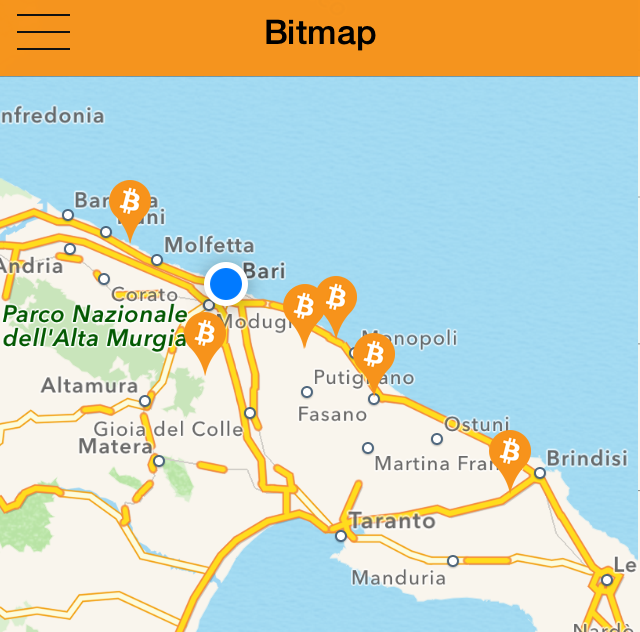
There are a lot of startups who decided to create platforms where you can read about all the restaurants and shops who accept bitcoin.
One of this is CoinMap, who reports more than 7000 shops all around the world. It is a web platform so you can use it from your laptop.
But, if you prefer a mobile app instead, you can download BitMap, available for IOS or Bitcoin Map for Android.
About the author: Amelia Tomasicchio is a writer and a journalist of Bitcoin-related news and articles. She started writing about Bitcoin in 2014 and she graduated in Rome with an essay about movie industry related to Bitcoin.

Open your free digital wallet here to store your cryptocurrencies in a safe place.

Amelia Tomasicchio
AussieBitcoin

How the blockchain can improve the Australian voting system

Flux Party is a new Australian political party that wants to renovate the voting system by using the blockchain.

In fact, they have proposed a new token-based political system based on the Bitcoin technology.
The Flux Party has more than 500 members and its objective is to have six senators on ballots during the next election that Australia will hold in September/October.

How it works

A special feature of this party is that its members are free of its own policies and they can vote for or against a legislation at the bidding of token holders.
“If they didn’t have to be senators, if they could just be software or robots they would be, because their only purpose is to do what the people want them to do”, commented the Flux Party co-founder Max Kaye.
So the bitcoin token could be used by the Flux members for voting but also for trading with other people.

Too old for the Internet era

Australian Flux party is clearly suggesting that the current democratic system is too old for the Internet age and for this reason they want to redistribute the political power by using Bitcoin.
Their own website states: “Our current system doesn’t work well enough; politics gets in the way of policy. Flux is an incremental upgrade to democracy designed to redistribute political power, maximise participation, remove bad policy, and empower voters.”
The Flux Party system will allow voters to be able to set their votes to experts on these issues.

A revolutionary but not so new idea

The idea of a blockchain-based voting system is very revolutionary and it is not developed only by the Fluxa Party.
In fact, Nasdaq and the Bitcoin Foundation have worked both on their own voting systems throught the blockchain technology.
About the author: Amelia Tomasicchio is a writer and a journalist of Bitcoin-related news and articles. She started writing about Bitcoin in 2014 and she graduated in Rome with an essay about movie industry related to Bitcoin.

Open your free digital wallet here to store your cryptocurrencies in a safe place.
Amelia Tomasicchio
Gemaltobuilding

Gemalto joins Symbiont to use the Blockchain

Recently we talked about several companies all around the world, like Microsoft or IBM, that are conducting tests about the blockchain and how to introduce it on their business.
Well, today is the turn of Gemalto, a digital security multinational who announced today its interest in the bitcoin technology.
Gemalto has in fact started a new partnership with Symbiont, a well-known blockchain startup that aims at “bridging the gap between the emerging blockchain ecosystem and Wall Street, with the first issuance and trading platform for Smart Securities™”.
According to a new interview with Gemalto’s vice president of business strategy Mark Yakabuski, the blockchain has two potential applications within the market.
These are his words:
“We believe that the first generation of blockchain is going to be driven by the financial services industry. The second generation, we believe the blockchain has the ability to be adopted within the Internet of Things. […] From what I’ve seen, security within the bitcoin and blockchain solutions is certainly in its infancy and there’s a lot of room for growth and improvement. […] But we believe that the solutions built on blockchain will expand quite rapidly, and we want to be a leading security option for our customers as that expands.”
So Gemalto – together with Symbiont – wants to find all the possible applications of the blockchain (like smart and programmable contracts, for example) and also wants to use the Bitcoin technology to improve Gemalto’s existing hardware and APIs.
“Our partners are looking for the level of assurance we provide on our products, and that leads us to believe that these ledgers are going to be adopted by those institutions”, he continued during an interview with Coindesk.
However, it is important to remember that Gemalto already works with some bitcoin exchanges, using its HSMs for cryptographic security.
Furthermore their techs can “adopt to new use cases, and we’re doing what we’ve done across financial industries, which is protecting identities and the transactions they perform”, continued Yakabuski.

About the author: Amelia Tomasicchio is a writer and a journalist of Bitcoin-related news and articles. She started writing about Bitcoin in 2014 and she graduated in Rome with an essay about movie industry related to Bitcoin.

Open your free digital wallet here to store your cryptocurrencies in a safe place.

Amelia Tomasicchio