Author Archives: Satoshi

Bitcoin’s Monthly Recap of March 2015


Welcome to HolyTransaction’s third monthly recap for the year 2015. This past month of March has been a real eye opener for the Bitcoin community; during that time, the bitcoin price fell from a high of $258.34 to a low of $244.24, according to Bitcoin exchange Bitstamp.


Third US Marshals Service Silk Road Bitcoin Auction Completed
https://www.coindesk.com/third-usms-bitcoin-auction-bidder-interest/


Compared with the previous two US Marshals Service auctions of Silk Road bitcoins, the number of participants was lower. However, at 14 bidders placing 34 bids during the auction, the participation is markedly higher than the second Silk Road Bitcoin auction which saw a low of 11 bidders. These USMS auctions have been ongoing since before Ross Ulbricht’s trial because of a deal struck in January of 2014 between the courts and Ulbricht and Ulbricht’s lawyer. At the time of the auction, the block of 50,000 BTC was worth roughly $13.4 million USD. The first auction was won by noted venture capitalist Tim Draper while the second auction was won by SecondMarket, the offerers of the new $GBTC Bitcoin investment fund. There remains one last auction of Ross Ulbricht’s bitcoins, seized during the Silk Road trial, for a block of 44,000 bitcoins. The final auction date has not been set.


Bitcoin Investment Trust Bitcoin “ETF” Shares Trading On OTC Market Before Winklevoss’s
https://www.nasdaq.com/article/the-first-bitcoin-etf-offers-easy-way-to-profit-from-virtual-currency-gbtc-cm450589#/ixzz3VcocZkx0


The Bitcoin Investment Trust, created by SecondMarket, has received approval from the Financial Industry Regulatory Authority to launch a Bitcoin fund and sell shares on the OTC market. Though Silbert has since moved on to the Digital Currency Group, his influence is still felt. Notably, the GBTC Bitcoin fund isn’t technically an ETF but it has launched ahead of the Winklevoss Bitcoin Trust ETF, which was gunning to be the first but is still mired in the regulatory approval process. The current price of a GBTC share, however, is well, over the market price of bitcoin. For accredited investors, there is now a new safe way to bet on Bitcoin volatility.


T-Mobile Accepts Bitcoin in Poland and Even Offers 20% Bonus
https://bitcoinist.com/t-mobile-poland-discount-bitcoin-purchases/


T-Mobile in Poland has started to embrace Bitcoin like no other large telecom service provider before. Polish users of the T-Mobile cell network can now top off their accounts using bitcoin, which is accepted online, and receive a 20% bonus: Talk about incentive! In Poland, T-Mobile is one of the largest mobile phone operators with well over 15 million customers in the European country. The bonus and bitcoin acceptance comes from a partnership with Warsaw-based payments company, InPay. T-Mobile is currently testing out a 3 month trial. The Polish Bitcoin community is strong, as evidenced by this deal. Internationally, there have been Bitcoin for mobile minute credits and/or code conversion websites for years; however, the acceptance of Bitcoin by a major provider in a major country is a major milestone.


Dark Net Marketplace Evolution Admins Disappear with $12 million USD in Bitcoin
https://www.theguardian.com/technology/2015/mar/18/bitcoin-deep-web-evolution-exit-scam-12-million-dollars


Following the arrest of Ross Ulbricht in October of 2013, Evolution was one of many underground marketplaces to spring up on the infamous darknet. In fact, another underground marketplace called Sheep Marketplace also saw its owner disappear with user funds. Users and law enforcement alike have started to look for the thieves that have perpetrated the latest “Bitcoin exit scam.” The Bitcoin price fell on the news of the marketplace disappearing and hasn’t recovered since.


In the standard budget proceedings this year, Chancellor George Osborne released the government’s research on digital currency to date. The United Kingdom has taken an admirable approach to regulating but not stifling Bitcoin and digital currency innovation within the historical world financial capital of London. Future legislation from the UK will include measures to protect and support digital currencies and their related business development. Many Bitcoin companies in the UK stepped up to teach the government about digital currency when the “call for information” was released months ago.


Two Federal Agents Arrested, Charged With Stealing Bitcoins and Blackmailing During Silk Road Investigation
https://www.usatoday.com/story/news/2015/03/30/federal-agents-charged-with-stealing-bitcoin-from-silk-road-case/70672058/


Two former federal agents, Carl Force of the DEA and Shaun Bridges of the Secret Service, have been charged with counts of money laundering, wire fraud, theft, and conflict of interest. Agent Force is charged with blackmailing nearly a million dollars worth of bitcoin from Ross Ulbricht, who was recently convicted of running the Silk Road underground marketplace that only used bitcoins. Force also worked at Bitcoin exchange CoinMKT as their supposed anti-money laundering and compliance officer. The evidence and charges against agents directly involved in the takedown of Silk Road did not appear in Ulbricht’s trial because they were sealed at the time. Bridges, on the other hand, allegedly stole nearly $800,000 worth of bitcoins from the government after the bitcoins were seized from Silk Road servers. These newest revelations have undoubtedly shaken things up for those following the Silk Road Bitcoin story with interest.

Open your free digital wallet here to store your cryptocurrencies in a safe place.

Satoshi
6 bitcoin myths debunked 01

6 (More) Bitcoin Myths Debunked

We’ve all heard them before.
As a groundbreaking innovation, bitcoin naturally attracts skeptics just as strongly as it attracts supporters, and the technical and theoretical complexity of the digital currency can cause a considerable amount of confusion with those who are not ‘in the know’.
The result is that critics of bitcoin oftentimes fall back on one or two euphemisms to express why they think it will never succeed – simplified statements like “bitcoin is a ponzi scheme” that highlight often misunderstood characteristics of the digital currency but rarely fully address the situation.
One of the first articles published on CoinDesk was dedicated to debunking these “bitcoin myths“, and because they still pervade the industry, we’re revisiting the topic.
Here are six (more) bitcoin myths, debunked.

1. It’s just a speculative investment opportunity

Many people first hear about bitcoin in the context of its price. Whether it was the bubble of late 2013 or the recent dip below $300, a good chunk of the general public thinks of bitcoin only in terms of how volatile the price is and how good (or bad) of an investment it could be.
The truth is, of course, that bitcoin goes far beyond its classification as a commodity. The decentralized peer-to-peer payment network made possible by bitcoin is only one example of how bitcoin is breaking down doors. If the price of bitcoin were theoretically to stay the same forever, it would still have utility in many other areas other than as a speculative investment.

2. The blockchain is the real breakthrough and bitcoins are unnecessary

It’s true – the blockchain is arguably the real genius of Satoshi Nakamoto’s invention. The distributed ledger and trustless security of the blockchain is what gives bitcoin its magic, but oftentimes when people first realize this, they discount bitcoin as just one use case of the blockchain.
In reality, mining is the bread-and-butter of the bitcoin protocol, and without miners there would be no blockchain. Consequently, miners need to be rewarded for their work, otherwise they would have no incentive to contribute their time and computing power to maintain the blockchain. As its native reward token, bitcoin is essential to the functionality of the blockchain.

3. The government could/will shut it down

While governments around the world may still be figuring out how to approach digital currencies, many misinformed people fall into the trap of thinking that, like almost anything else we’re used to, bitcoin could be shut down by governments if one or more of them hoped to do so.
Yes, governments have the power to make it very difficult for their citizens to use bitcoin andsome form of government regulation is inevitable as bitcoin matures. Even so, because of its infrastructure, it would take considerable time, money and energy for any government to pose a serious threat to the global bitcoin network, if they even could at all.

4. You can’t buy anything practical with bitcoin

Perhaps as a follow up to myth number one, a lot of people are surprised to hear that bitcoin is more than a speculative investment and that it can actually be used to pay for everyday goods and services.


In addition to the retailers above, PayPal has announced partnerships with bitcoin companies and Microsoft recently began accepting bitcoin for a host of digital content like games and videos. Add in the countless small businesses that accept bitcoin either online or in their brick-and-mortar locations, and it’s safe to say there are options when it comes to spending your bitcoin.

5. There are no advantages of bitcoin over cash or credit cards

Once people realize that bitcoin can, indeed, be used to buy real things, they may not see what the digital currency has to offer that their incumbent payment methods like cash and credit cards don’t. Luckily it doesn’t take long to debunk this myth.
Some of bitcoin’s most obvious benefits are its low transaction fees. Typically, transacting bitcoin saves merchants 1-3% compared to transacting credit cards, and when compared to services like Western Union, bitcoin is clearly superior – especially for sending money abroad.

6. The only people who would ever use bitcoin are tech nerds and criminals

Some of the earliest adapters of bitcoin may be techies and dark market shoppers, but the same could arguably be said about the Internet – and look who uses that now. Regardless of how esoteric the bitcoin community may be right now (and it’s pretty esoteric), adoption takes time.
As entrepreneurs in the space continue to build consumer-friendly apps with bitcoin and awareness of the digital currency spreads, a more diverse crowd will come to use it in their everyday lives. There’s also another important demographic that many forget about: the millions of unbanked people throughout the developing world who rely on mobile phones as their computer, bank and communication device all in one.
Whether it’s any of the above myths or perhaps one of the 10 we previously debunked, bitcoin is ripe with misunderstanding. For bitcoin to reach its full potential, this knowledge gap needs to be bridged so that the myths and misinformation come to an end.

Open your free digital wallet here to store your cryptocurrencies in a safe place.

Satoshi

Bitcoin’s Monthly Recap of February 2015


Welcome to HolyTransaction’s February monthly recap for the year 2015. During this past month of February, the bitcoin price fell from a low of $226.93 to a high of $258.34, according to Bitstamp.


Payment Processor Stripe Lets Its Businesses Accept Bitcoin Simply


Starting a few weeks ago, the popular online payment processor Stripe ended its Bitcoin beta and rolled out the ability to accept bitcoin to any of its business customers. International businesses that use Stripe include Facebook, Lyft, and Kickstarter. Any of these companies could now start accepting Bitcoin with just a few lines of code. Stripe processes Bitcoin payments for a cost of .5% and uses Coinbase to facilitate the fiat settlement. Bitcoin’s reach expands by thousands of merchants and Stripe, which has also backed other cryptocurrencies in the budding industry, shows just how serious it is about Bitcoin and the power of the blockchain.


Dread Pirate Roberts Unmasked: Ross Ulbricht Convicted On All Charges


After hearing days of testimony from both sides, the jury in the historic Silk Road trial found Ross Ulbricht guilty on all charges. The jury found the government’s evidence that Ross Ulbricht was operating Silk Road under the pseudonym ‘Dread Pirate Roberts’ since day one. Ulbricht’s defense, led by lawyer Joshua Dratel, rested his entire defense on suggesting that Ross Ulbricht may have founded Silk Road but he had long ago left it to a successor, who then came back around to frame Ulbricht. The chat logs from the laptop that was taken from Ulbricht’s hands at a public library where he was using it may have been forged, the defense alleged. The jury was not convinced, and Ulbricht is now behind bars pending sentencing later this year.


CNN’s Morgan Spurlock Of Super Size Me Finds The Inside Scoop On Bitcoin


Morgan Spurlock, of Super Size me fame, has done it again with an episode in his CNN show Inside Man. He spearheads an entire episode dedicated to the new e-currency known as Bitcoin. The episode follows Spurlock as he survived on only Bitcoin for a week. That means that he only lived on things that he could spend bitcoins on, and learned a lot about it in the process. He lived his week in New York where he was able to talk bitcoin with Bitcoiners from the New York Bitcoin Center. The episode went a long way in introducing Bitcoin to a largely uneducated populace and a different demographic.


Dell Starts Accepting Bitcoin In United Kingdom and Canada


Ousting Newegg and TigerDirect, Dell is now the largest electronic retailer that accepts bitcoin internationally. Earlier in February, Dell announced that it was happy with its US bitcoin pilot and was not extending bitcoin acceptance to Canada and the United Kingdom. The international company emphasized that businesses and customers are using bitcoin to purchase just about everything that Dell has to offer. Dell has even processed as much as $50,000 worth of bitcoin for a single item purchase, a large server system. Dell uses Coinbase as a third party payment processor to accept bitcoin. In Dell’s words: “This form of payment is clearly resonating with consumer, small and medium businesses.”


Ledger Hardware Bitcoin Wallet Startup Raises 1.3 Million Euro Seed Round


French hardware Bitcoin wallet maker Ledger recently announced the closing of a 1.3 million euro seed round led by French VC fund XAnge Private Equity. Other investors such as Hi-Pay and Pascal Gauthier, CEO of Bitcoin stealth startup Challenger Deep. Ledger’s first hardware wallet offering, the Nano Wallet, was released at the end of 2014 and was quite popular. Ledger was created by a fortuitous meeting of minds at the French la Maison du Bitcoin, the first “Bitcoin embassy” in Europe. To date, Ledger has already sold thousands of Nano wallets in several dozen countries. Future plans for the bitcoin wallet include NFC and Bluetooth LE capabilities. The startup has also announced plans to move to America with the new funding and participate in some accelerators.


Privacy Centric Cryptocurrency Dash Unveils InstantX Transactions


The new version of the Dash Core wallet, v.0.11.1, will include InstantX. InstantX adds on top of existing Dashsend and MasterNode anonymity features that will have the industry standard 6 confirmations in an average of 1.25 minutes. Dash is different from Bitcoin because it uses the X11 hashing algorithm instead of the SHA-256 algorithm, which makes it much more ASIC resistant. Upon the successful implementation of the InstantX feature, the Dash price experienced a notable rise in value at the exchanges. The Dash development team has promised future updates and new features, some that have been seen on Bitcoin’s wish list and some that have not.

Open your free digital wallet here to store your cryptocurrencies in a safe place.

Satoshi

Bitcoin’s Monthly Recap of January 2015

Welcome to HolyTransaction’s first monthly recap for the year 2015. This past month of January has been a great opener for the Bitcoin community; during that time, the bitcoin price fell from a high of $321 to a low of $226.93, according to Bitstamp.
 
Bitcoin Exchange Bitstamp Loses 12% of Bitcoins in Security Breach
Early in January, the world was again shocked by another high-profile Bitcoin theft from a high-volume Bitcoin exchange. Bitstamp, the exchange in question, halted trading on 1/4/15 after telling customers “we have reason to believe that one of Bitstamp’s operational wallets was compromised on January 4th, 2015.” The Bitcoin exchange avoided their booth at the Bitcoin World at CES 2015 and worked to fix and migrate their exchange while trading, withdrawals, and deposits were halted for several days. Bitstamp has since returned and offered zero trading fees for a limited time as a form of apology. Many attribute the fallen Bitcoin price to the high-profile Bitcoin exchange theft.
 
Coinbase Raises $75 Million USD in Series C Funding Round
Coinbase recently announced the closing of its $75 million USD Series C funding round that Bitcoin users around the world have been expecting since late last year. The Bitcoin service has currently raised $106 million USD to date. Round participants included DFJ Growth, USAA, the NYSE, and more. In a good sign for the company’s investor confidence, previous investors such as Andreessen Horowitz, Union Square Ventures, and Ribbit Capital also joined in the round. Besides Coinbase, other Bitcoin companies have started off the year strong with millions of dollars in funding for Bitcoin 1.0 and Bitcoin 2.0 applications and technologies thus far in the year.
 
Coinbase Launches Lunar: Supposedly the First Regulated American Bitcoin Exchange
Coinbase has just announced its Bitcoin exchange, called Lunar, which industry experts have been suspecting to be in the works for months now. Coinbase seems to have been drawn out to release its Bitcoin exchange by the announcement of the Gemini Bitcoin exchange by the Winklevoss twins. Lunar currently only supports roughly half of American states; additionally, Coinbase has taken some criticism for claiming to the “first” and “regulated” in this space. The California Department of Business Oversight (DBO) has told Bitcoin media sources: “The California Department of Business Oversight has not decided whether to regulate virtual currency transactions, or the businesses that arrange such transactions, under the state’s Money Transmission Act. California consumers should be aware Coinbase Exchange is not regulated or licensed by the state.”
 
Reddit Decides to Ditch RedditNotes and Cryptocurrency Engineer
Former BitPay employee Ryan Charles has been recently let go by Reddit amid internal company strife and change of direction. The former-CEO of Reddit, Yishan, was apparently the one that was pushing for a Reddit cryptocurrency, popularly dubbed Redditnotes. Unfortunately, we won’t be seeing anything from Reddit anytime soon, and Ryan Charles won’t be involved. Charles has already started planning his next move in the Bitcoin sphere, where he believes that Bitcoin 1.0 opportunities are still widely available and largely unexplored.
 
Ross Ulbricht Stands Trial for Alleged Role as Dread Pirate Roberts on Deep Web Market Silk Road
Ross Ulbricht and the Silk Road trial started this past month in a monumental case for both privacy and Bitcoin. The government is presenting evidence that Ross Ulbricht is none other than the Dread Pirate Robert (DPR) that ran the Silk Road for the entirety of its existence. Ulbricht’s defense lawyer, Dratel, tried to make it clear to jurors that digital evidence could be planted, fabricated, distorted, moved, or “manipulated.” Even has Silk Road 1.0’s trial is just finishing, Silk Road 2.0’s legal consequences are also unfolding. Meanwhile, Silk Road 3.0 and over a dozen copycat Deep web marketplaces continue to thrive.

Open your free digital wallet here to store your cryptocurrencies in a safe place.
Satoshi
bitcoin in russia

Russia reconsidering Bitcoin?

(CryptoCoinsNews) Could Bitcoin make it back into Russia? The latest news is that the draft law is in need of major revision as the Russian Ministry of Economic Development has not approved the draft in its current form. This is certainly not because of the desire to enhance freedom and liberty for Russian citizens, but because it may hurt Russian corporations ability to attract new business. The “quasi-money” designation includes things like gift cards and certificates that businesses use to bring in new customers. Banks, major retailers, and telecom companies would take a huge hit, and with the national GDP/economy is already having a terrible year, this bill does more harm than good overall.
“The proposed draft regulation act doesn’t solve any tasks assigned, but only serves to create legal barriers to the implementation of marketing programs of businesses and business development in general,” according to the Ministry of Economic Development.”
The issue with nation-states attacking Bitcoin out of defense of their currency is a complicated one. Many nations are in debt due to their debt-based fiat currency/central banking system. The current inherently flawed system is designed to leave nations indebted. Bitcoin and it’s potential growth leave open a way to build new businesses, generate new revenue streams by attracting investors, and ways for future taxation to help alleviate the nation’s indebtedness. Russia’s previous hard stance against Bitcoin was taken before many of their current economic issues and sanctions manifested.
Russia’s economic situation may continue to spiral downward, as they may soon suffer from restriction of access to the global financial system. In particular to the payment system SWIFT (Society for Worldwide Interbank Financial Telecommunication, which supplies secure messaging services and interface software to wholesale financial entities. An international banking computer partnership). Some critics say the government should pay more attention to financial innovations instead of trying to ban them.
Does this mean Bitcoin is in the clear? Not exactly. The bill most likely will be revised, but it may just benefit Russian corporations, but still restrict Russians ability to use electronic currency. The ban may just work around gift cards and bonus cards and remain for digital currency. The nature of the extent of the revisions remains unclear. What do you think Russia will do with Bitcoin?

Open your free digital wallet here to store your cryptocurrencies in a safe place.

Satoshi
mastercoin logo

HolyTransaction opens it’s doors to the world of crypto 2.0 with new Mastercoin WebWallet

November 24, 2014 – SANTA MONICA – HolyTransaction announced today that they have extended support on their platform to the Mastercoin Protocol and all of Mastercoin’s Smart Properties which allow their users to host digital tokens recorded on the blockchain.
Since the introduction of Bitcoin in 2009, Decentralized Applications have been creating waves in almost all sectors of the world, especially in finance. HolyTransaction is positioning itself to support any and all developments in this space.
Mastercoin uses the Bitcoin Blockchain to store records/data. It has highly useful feature which allows a party to create their own digital tokens, thereby creating smart properties that can enable online exchange of assets (i.e. stocks, bonds, real estate and various finance and security features) with the security and cost-savings of Bitcoin protocol.
We believe that digital asset transfer protocols will replace outdated bureaucratic rituals in the near future and are extremely happy to push towards this direction,“ said Andrey Zamovskiy.
HolyTransaction is a transparent, accessible universal cryptocurrency wallet that allows users to store multiple digital assets in one location. HolyTransaction comes with a one-of-a-kind currency exchange feature that allows users to easily convert one asset to another. Francesco Simonetti, co-founder of HolyTransaction, says: “The Mastercoin Protocol can be used for things such as decentralized crowdfunding, asset management, and user currencies all by creating tokens built on top of the Bitcoin Blockchain”.
About HolyTransaction:


Typically if you want to hold 10 different cryptocurrencies (Bitcoin, Litecoin, Dogecoin, Peercoin, etc.) you need to have 10 different wallets, which makes cryptocurrency security hard to manage. HolyTransaction, your personal multi cryptocurrency wallet, solves this problem, plus it comes with currency exchange features so that you can easily convert one cryptocurrency to another.

Open your free digital wallet here to store your cryptocurrencies in a safe place.

Satoshi
bitcoin 20 glass

Bitcoin’s revolution moves beyond currency
(CoinDesk) Just when people were getting used to the idea that bitcoin might not be a boom-and-bust fad destined for failure, entirely new applications of the technology have joined digital currency on stage.
Crypto 2.0 – also know as cryptography 2.0, decentralized applications, or, popularly, as bitcoin 2.0 – is the application of block chain or distributed ledger technology to things other than digital currency. The block chain offers the ability to facilitate decentralized ownership and store, transfer and process information in a decentralized, programmable way. Many consider that innovation to be the true value of this technology.
In May, New York-based investment firm Ledra Capital took to Twitter to crowdsource a list of what kinds of information the block chain could be used for. Currency transactions, of course, topped the list. But, it was followed by things like stocks, bonds, mortgages, land titles, gun permits, contracts, votes, bets, trademarks, data storage, domain names, proof of authorship and much, much more.
As Robby Dermody, co-founder of Counterparty, told CoinDesk:

“Bitcoin can be used to pay for things like a cup of coffee, but that’s not bitcoin’s ‘killer app’. To the average customer it’s just as easy to pay with their credit card. A killer app would need to offer massive advantages in another area.”

A community of developers and entrepreneurs recognize this notion and have been busy building out many crypto 2.0 concepts. Dominik Zynis, the former head of business development at Mastercoin, commented on the significance of this movement to CoinDesk, saying:

“We ought to be paying very close attention to crypto 2.0 because bitcoin has redefined how we launch web services.”

Zynis believes crypto 2.0 companies are laying the foundation for a new generation of “secure and scalable Internet applications” that will be more resilient to hacking, fraud, scalability and privacy problems.
Bitcoin’s role as a digital currency is still a work in progress, both at the code and implementation level, as well as on the consumer and institutional adoption side. Still, the wider impact of distributed ledger technology is beginning to rapidly take shape. Vitalik Buterin, co-founder of Ethereum, illustrated the movement’s broader vision to CoinDesk, adding:
“I think now might be the time when we have just enough cryptographic, crypto-economic building blocks to finally make a proper shot at advancing a radically different vision for Internet architecture and society.”

Rise of the decentralized exchange

A year ago it might have been hard to believe that in just 12 month’s time, a publicly traded company would be openly exploring the possibility of launching a cryptosecurity on a decentralized asset exchange.
Overstock.com CEO Patrick Byrne has been outspoken in his support of digital currency, and he recently told CoinDesk that Overstock intends to figure out how to launch a cryptosecurity so other companies can use their system to raise funds. Overstock published a wiki on 29th July that currently details 12 organizations that have either launched decentralized exchanges or are building them.
Among them, Counterparty, NXT and BitShares have exchanges that are operational right now. Counterparty has been live since January and NXT’s Asset Exchange since May, while BitShares’s platform is only a few weeks old. Each exchange’s implementation differs in various ways, but they all share common features, namely the ability to create and trade user-defined assets without the need for a centralized third party.
Company shares are an obvious application of these platforms. On NXT’s Asset Exchange, for instance, where more than 220 user-defined assets have already been created, digital currency exchange service Coinomat has issued a cryptoasset that offers shareholders a 1.5% dividend of the company’s weekly profits. This is really an example of a smart contract that is automatically confirmed and processed over a block chain.
Other current examples of block chain implementations include the Digital Tangible Trust, which offers a tradable gold-backed cryptoasset. Non-traditional assets are also emerging, like those being created by MyPowers, whose digital tokens allow people to buy and trade brand equity in artists and organizations. Other projects are moving beyond assets, like Pavilion, which is planning to utilize block chain technology to sign and publicly publish contracts.
Future goals for cryptoassets include smart property linked to physical assets; imagine a rental car whose key was tradable as a token on a decentralized exchange and downloadable to a fob that would unlock the vehicle. There are also plans to launch what are called decentralized autonomous companies (DACs) – namely by projects like BitShares – which operate autonomously on top of a block chain and earn profit for shareholders.

Decentralized applications will hide the block chain

Beyond assets, there have been efforts to utilize the block chain as a way to store data. Namecoin, an attempt to create a decentralized domain name registry outside the control of ICANN, was arguably the second implementation of block chain technology after digital cash transactions. More recently, efforts like MaidSafe and Storj have completed fundraising rounds.
MaidSafe is attempting to use the bitcoin block chain to create a fully decentralized internet by sharing processing and memory power across a distributed network. Its April crypto-crowdsale notably raised $7m in five hours, although, due to the poor liquidity of the Mastercoin it received, it soon revised that number to $5.5m.
Storj completed its crypto-crowdsale on 20th August, raising 910 BTC. The Storj platform offers online storage similar to Dropbox or Google Drive, but does so over a distributed network. Utilizing the bitcoin block chain, Storj allows users to buy available disk space on the network, and in addition, allows users with free storage space to sell it to those in need.
Shawn Wilkinson, founder of Storj and a bitcoin developer, noted the value of expanded applications of the block chain, saying:

“Essentially you can take the technology from bitcoin, which is a $5bn–$6bn industry, and apply it to an existing area like cloud storage, which is a $150bn dollar industry.”

With applications like Storj, Wilkinson pointed out, you move past things like regulation, public perception, price volatility and the complexity of the underlying technology. Decentralized applications provide a user interface whose back-end could be a traditional network but happens to be a distributed one.

Sidechains, treechains and a question of blockchains

One important point of contention within the crytpo 2.0 space is what block chain this next generation of implementations should be built on top of. In one camp are the organizations like Ethereum and BitShares that are building their own, entirely new block chains on top of which their platforms will operate.
In June, bitcoin core developer Gavin Andresen addressed the Ethereum project in a blog post and suggested that Ethereum’s intentions to create a new proof of work system and currency seemed extraneous at first blush.
He wrote:

“Bitcoin already provides a global currency and distributed ledger – there is no need to reinvent those wheels. Combining real-world information with bitcoin is where things start to get really interesting.”

Alternatively, BitShares uses a mechanism called delegated proof-of-stake (DPOS), where stakeholders delegate their voting power to 101 delegates that take turns updating BitShares block chain. Distributed proof-of- helps prevent known risks of proof-of-work, including risk of a 51% attack.
Other crypto 2.0 initiative are seeking to adapt the bitcoin block chain to scale more effectively, be less decentralized and allow for permissionless development. One such effort is through bitcoin core developer Peter Todd’s treechain concept, which Todd is developing while working at crypto 2.0 start-up Viacoin. Side chains are another potential implementation that will allow new features to be added to the existing bitcoin block chain through new block chains that interact with it.

Open your free digital wallet here to store your cryptocurrencies in a safe place.
Satoshi

Could Bitcoin be a replacement for Gold?
(CoinDesk) Gold has been used as a store of value for eons, thanks to its beauty and almost magical ability to never tarnish. Furthermore, despite radical shifts in human values over the past 100 years, its worth still has not diminished – even soaring to over $1,000 an ounce in recent times.
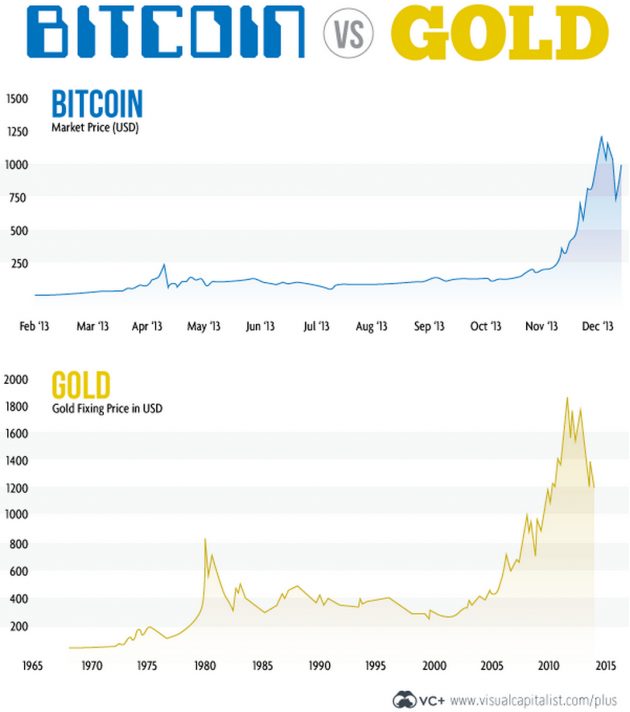
Now, though, there is a new, digital challenger on the scene that, when its price chart is compared with that of gold, bears some striking similarities
It’s no wonder, then, that companies like Netagio now allow people to trade bitcoin for precious metals like gold – it is a sign that investors want the ability to trade BTC seamlessly with other investment vehicles.
In a sense, bitcoin could be considered an upgrade from gold. Some even consider it as gold with transformational, information-like properties.

bitcoin vs gold

Digital gold with a twist

George Gilder, author of the forthcoming book Bitcoin and Gold: The Information Theory of Money, is impressed with bitcoin and has developed a well-thought argument for bitcoin as a sort of “next-generation gold”.
That’s because bitcoin builds upon the properties of gold and has spawned an information-based variation, he said.
Gilder told CoinDesk:

“Satoshi [Nakamoto] was right with bitcoin. That’s what amazes me. Satoshi arrived at a foundation for the value of bitcoin that’s valid.”
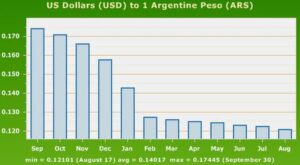
Gilder sees economic uncertainty as advantageous to bitcoin, a fact evidenced by the increasing interest in bitcoin observed in Argentina and other countries hampered by volatile fiat currencies.

argentine peso decline

The decline of the Argentine peso versus the US dollar from 2013 to 2014. Source: exchange-rates.org

As an example, Gilder believes that increased government control of money, such as capital controls or quantitative easing, means more uneasiness in terms of economic sentiment.
The more money [governments] print, the more uncertain the people become,” said Gilder. “Bitcoin is based on the understanding that the money supply doesn’t really matter.
Adrian Ash, the head of research at BullionVault, a gold storage company, pointed out:

Digital gold currencies have been tried and failed many times in the last 20 years. They came to nothing thanks both to state resistance, but also to lack of adoption.

However, it’s safe to say that bitcoin has progressed further than its failed predecessors. That may be, though, because previous electronic money alternatives like E-gold were backed by gold, and not by cryptographic keys. As a result, bitcoin might be the first to offer a substantial alternative that would appeal to gold enthusiasts.

Role as a currency

Another characteristic of bitcoin that makes it seem like an upgrade over gold is its protocol that allows value to be moved quickly around the globe. Regardless of how supportive gold enthusiasts are of their favorite store of value, there’s no denying it has limited appeal to mainstream consumers.
Bitcoin adoption by the average person remains a hurdle to overcome to ensure success, but the digital currency’s combination of novel innovations might allow it to complement existing methods of exchange.
“[The] chicken-and-egg situation [of adoption] might be resolved by bitcoin’s most exciting aspect – zero-cost exchange of value,” said Ash.
Along with adoption as a means of exchange, bitcoin could become a very useful currency, commodity and recording mechanism via its block chain. According to Gilder, the problem of velocity, or how much people spend a thing of value, is what will ultimately make bitcoin a success. Or a failure.
Gilder said:

“Velocity is what determines value. Not just printing money. Satoshi [Nakamoto] has an absolute 21 million bitcoin limit. Bitcoin is determined by velocity, by turnover rate governed by the people holding the coins.”

Bitcoin might be an iteration of gold – a 2.0 version. People can hold stores of it, as well as spend it – a property that gold cannot compete with.
“It’s important to note that gold isn’t used as currency anywhere today,” said Ash.
Given that even Ash concedes this point, bitcoin’s long-term success may lie in adoption. In other words, whether bitcoin is able to triumph and replace gold will lie with its peer-to-peer network, and just how large this base of bitcoin believers becomes in the years ahead.

Bitcoin believers

It’s hard to tell how many bitcoin users there really are. New bitcoin products and services are seemingly announced every day, and Mary Meeker’s presentation of bitcoin’s growth via the use of a chart showing the number of wallets in use (see below) shows there is traction.
While wallet use is growing, it’s not a one-to-one correlation – or even if many of the newly created wallets actually have bitcoin in them. It does show increased awareness overall, however.
Source: CoinDesk

Source: CoinDesk

However, it can be argued that gold investors will have to see the promise of bitcoin over the precious metal not only as a store of value, but also as a spending and transactional innovation.
The rise of consumer services continues, and energy focused on that particular sector of the bitcoin economy is notable.
For instance, in Canada, there are a number of options for people to buy or sell bitcoin. Not only do residents of Canada have access to an established exchange for the Canadian dollar, there are storefronts and even bitcoin ATMs available in most major cities.
Access to bitcoin for gold investors is the best way to prove the value of bitcoin to this subset of the market, and this is especially true in the US market.
In a poll conducted by Harris Interactive in December 2013, when bitcoin prices were at their all-time pinnacle, the majority of people still didn’t even know what bitcoin was. And, likely because of this, they indicated that they would much rather invest in gold over bitcoin.
Harris poll question: Would you rather invest in gold or bitcoin? Source: CoinDesk

Harris poll question: Would you rather invest in gold or bitcoin? Source: CoinDesk

The key to bitcoin as a new form of gold is to improve upon the precious metal. And that means making the most of its transport and currency capabilities.
For this to happen, an increase in awareness is needed  – and some proponents of gold already understand this fact.
Companies like the UK’s GoldMoney have been offering bitcoin as a storage option along with gold for some time. Furthermore. investment broker and author Peter Schiff, while making waves about his insistence that bitcoin could become worthless, is still nevertheless accepting it at his company, SchiffGold – a fact that should make gold investors take the digital currency a little more seriously.

Open your free digital wallet here to store your cryptocurrencies in a safe place.

Satoshi
bitapple

All 70,000 residents living in Dominica will be eligible to receive bitcoin

(CoinDesk) All 70,000 residents living on the Caribbean nation of Dominica will
be eligible to receive bitcoin as part of ‘The Bit Drop’ project, an
upcoming collaboration between bitcoin businesses, interest groups and
local government officials.
Scheduled to take place on 14th March3, 2015, The Bit Drop will feature an island-wide party boasting ‘celebrities, musicians and
supporters of bitcoin’, as well as education booths and free giveaways.
Speaking to CoinDesk, project manager Sarah Blincoe
suggested the ambitious project started with a simple question: how do
you get bitcoin into the hands of as many people as possible? From
there, she explained, a plan was launched to distribute an undisclosed
amount of bitcoin to island residents via text messaging.
While the event has serious goals, Blincoe said the group decided to adopt a lighthearted tone for the project, adding:


“Who doesn’t like a party? No one in the Caribbean, that is for sure.”

The ‘perfect location’

Dominica, with its relatively small population and gross domestic
product (GDP), proved an ideal location for the event, according to
Blincoe.
The country’s high mobile penetration rates, however, may have been
the most compelling factor. Blincoe believes Dominica’s smartphone users
will be able to solve real-world problems using bitcoin, adding:


“The island has opportunities for remittance due to many
islanders moving for work to [other] islands, as well as the local
medical university with students from around the globe. Dominica
citizens also face currency exchange issues when traveling to nearby
islands.”

Data from Eastern Caribbean Telecommunications Authority (ECTEL),
a regulatory body overseeing telecommunications in Dominica, bolsters
this claim, suggesting there were roughly 100,000 mobile subscriptions
active in the country in 2012. Additionally, bitcoin penetration is
comparatively low in Dominica.
“The young forward-thinking administration sees the long-term benefits
in the block-chain technology and is eager to support our project in any
way possible.”

Open your free digital wallet here to store your cryptocurrencies in a safe place.

Satoshi

Dogecoin to allow Litecoin merge mining in network security bid

(CoinDesk) The dogecoin development team has announced that it will soon enable auxiliary proof-of-work (AuxPoW), allowing merge-mining with litecoin that will address concerns over the altcoin’s future.
AuxPoW enables the dogecoin block chain to receive work from other scrypt-based networks. Dogecoin miners will still be able to generate blocks and receive DOGE, but now, litecoin miners will contribute hashing power to the dogecoin network.
The move, announced on the dogecoin subreddit, follows a months-long period of community debate focusing on the question of long-term viability in the dogecoin network. Litecoin creator Charlie Lee suggested the idea of merge mining in April, eliciting mixed reactions from both sides of the conversation.
According to the dogecoin development team, the AuxPoW integration will require a hard fork of the dogecoin wallet block chain. No specific integration date has been given, but the development team said that testing will begin soon.
As explained in the original announcement:
“Our topmost priority has always been to provide a stable platform for the currency and its services and of course its users. We hope that with AuxPoW we can achieve that in a better way than what it currently is like. Our hashrate has been on a decline and we hope that we can gain more of it with the acceptance of proof of work from other chains.”
As expected, community members voiced both enthusiasm and concern for the AuxPoW plan. Yet, advocates for the strategy, including Lee, say that the move will ensure the stability and security of the dogecoin network.

Plan to save dogecoin

AuxPoW is not new – several coins already enable work from other mining networks, with namecoin being the most prominent example. This long-standing reputation as a workable proofing system – and the strength of the litecoin network – has gained the idea support in recent weeks.
In a recent community post on /r/dogecoin, Dogetipbot creator Josh Mohland shared his perspective on the concept, saying that AuxPoW would help solve a key problem with dogecoin: the fact that it was never intended to function as a full-fledged transaction network.
Mohland explained:
“Dogecoin was built to die quickly – none of us expected it to grow into the absurd entity it is today. With that said, there’s absolutely an easy way to save the coin from its certain death (and by death I mean 51% attacked for the lulz), and that’s AuxPoW.”
He went on to call AuxPoW “a simple change” worth the trouble, owing to the fact that the risk of a 51% attack far outweighs perceived costs.
Other community members expressed concern over the idea, saying that the move enables large litecoin pools to crowd out smaller dogecoin miners. Questions were also raised as to whether or not AuxPoW would actually help prevent a 51% attack.

Dogecoin in ‘dire situation’, says Lee

Litecoin creator Lee hailed the announcement, telling CoinDesk that the development team made the right decision during a “dire situation”.
Lee argued that the move comes at the right time given the long-term threat to the dogecoin network – and, as some have pointed out, its falling price. He added that the move provides increased security for dogecoin without any repercussions, removing a source of concern for the network and enabling broader development in the community.
Lee told CoinDesk:
“[The community] can focus on what dogecoin does best (tipping, donations, wow) instead of worrying about defensive mining and network security.”

Open your free digital wallet here to store your cryptocurrencies in a safe place.

Satoshi