Bitcoin history: pre-blockchain digital currencies
(CoinTelegraph) For anyone not involved in
mid-90s cypherpunk scenes or early e-cash projects, the term “digital
currency” probably never came up in conversation until quite recently,
after the advent of Bitcoin.
But Satoshi’s white paper
did not invent digital money; that’s an idea as old as mainstream
internet usage itself. Bitcoin, and the altcoins it spawned, just
happened to be so revolutionary that all those electronic currencies
pre-2009https://holytransaction.com/page/before-bitcoin get overshadowed.
It’s like the Christian calendar. There is before-Bitcoin (BB), and then there is the current era, (AB).
Let’s take a look at some pre-Bitcoin technologies to get an idea of how far cryptocurrencies have come since.
1990: DigiCash
In 1982, cryptographer David Chaum applied the idea of blind signatures to money in his paper “Blind Signature for Untraceable Payments.”
Eight years later, he took these cryptographic protocols to market with
DigiCash, a company that ultimately went bankrupt in 1998.
1996: E-Gold
E-Gold sounded like a fine idea at the time: Create an account, send
in your gold or silver, and your accounted would be credited. Those
credits could then be easily transferred among accounts. The company
slowly built a successful operation through the late 90s.
By 2001, E-Gold was running into problems, however. The US Patriot
Act, first of all, tightened regulations on businesses that could be
classified as money transmitters. Gaining money transmitter licenses for
all 50 states proved too big of a hassle for E-Gold and its
competitors.
Furthermore, a campaign began to grow against E-Gold that marked it
as the currency of money launderers and child pornographers. A federal
indictment followed in 2005, which marked the end of E-Gold as a
meaningful alternative currency.
1998: Beenz.com
Beenz was a currency created to incentivize behavior such as visiting
specific websites, logging on through specific ISPs or shopping at
certain stores. This was back before the dot-com bubble burst, when
bored teenagers could take online quizzes, and marketing companies would
send them free stuff in the mail.
But the fetten Jahren ran their course, and Beenz.com was gone by 2001.
1999: Flooz.com
Flooz had a similar name and similar model to Beenz: Users were
rewarded for activity with flooz, which served as a medium of exchange
among its network of partners. Like Beenz, also, Flooz went bust in the
dot-com crash.
1999: InternetCash.com
InterenetCash.com filed a number of patents to protect its monetary
system based on prepaid cards, and it also relied on a network of
participating merchants where that cash could be redeemed. The company
ultimately raised $10 million in funding and had a staff of about 70
employees before the dot-com crash forced the company to close in August
2001.
After 2001, when economic realities hit many internet startups hard,
digital money never really caught on again, beyond some niche users,
until Nakamoto published the Bitcoin white paper in 2008. Of course, it
took a few years for most of us in the cryptocurrency community to catch
on, at which point cryptocurrencies took off far beyond what their
predecessors did.
We asked some community experts what present feature or
present reality in cryptocurrency tech today we will find funny and
old-fashioned in 15 years or so?
Aleksey Bragin:
“So many useless (or sometimes funny, as DogeCoin for example) alt
cryptocurrency clones emerged so quickly. That would go out of fashion
quicker than within 15 years, I suppose.”
Gideon Gallasch (coinsulting.eu): “I think mining – so much power and electricity is not sustainable long term.”
Lech Wilczyński (Co-Founder/CEO / Developer at InPay S.A.): “Centralized exchanges.”
J. Ryan Conley (CEO & Founder at Ryan Conley
Marketing & Training and CEO & Founder at Team Extreme
Worldwide): “That the banks were last to catch on to this awesome
concept! Staged viral video marketing platform.”
Patrick Dugan (CIO of Crypto Currency Concepts): “Centralized exchanges for sure, mining possibly.”
Lech Wilczyński (InPay.pl): “Bitcoin payment gateway.”
Open your free digital wallet here to store your cryptocurrencies in a safe place.
New Zealand central banker: cryptocurrencies could supplant cash
Advantages and drawbacks
“[Bitcoin] is a very low cost payment method with strong security features and usable for cross-border transactions, making it advantageous in some regards relative to more traditional payment mechanisms.”
“Key attributes of trust (that the ‘money’ gives rise to settlement of the obligation) and anonymity (it is often efficient for the sale/purchase parties not to have to identify one another) must be met, but if these can be accomplished reliably and sustainably, new technologies could supplant cash as we know it in years to come.”
Banks need to keep up
Apart from the carefully worded statement, regulators have taken any measures to curb or control the development of the bitcoin economy in the region.
Open your free digital wallet here to store your cryptocurrencies in a safe place.
Why Bitcoin may re-write banking practice
(BusinessTech) Bitcoin has grown from an experiment in digital cash to a vibrant, global economy supporting multi-million dollar companies with a market cap of $10 billion.
“While the road has been bumpy, and quite a rollercoaster ride, it is still nascent and holds immense promise to change the world in unprecedented ways,” said Simon de la Rouviere, speaking at the recent Nedgroup Investments Cash Solutions Treasurers Conference.
“In 2013, the hockey-stick growth often found in the technology space kicked off for Bitcoin, seeing adoption increase worldwide.” De la Rouviere, a technology entrepreneur who develops cryptocurrency applications, believes that Bitcoin’s global, public, distributed asset ledger is a fundamental innovation that could upset various industries – from banking to public records. “Any business in the field of recording information fit into a ledger that charges fees to be a middleman is at risk of becoming obsolete,” he said. As copy of Bitcoin’s ledger exists on every network participant’s computer, and is continually updated, reconciled and synchronized in real-time. Each member can make entries into the ledger, which records transactions of a certain amount of currency from one participant to another. Each entry is propagated to the network, so that every copy on every computer is updated near simultaneously and all copies of the ledger remain synchronized. “This blockchain technology could easily be adopted to work with title deeds, physical keys, private equity, derivatives, escrow, dispute mediation, passports, wills, domain names, and sim cards – to name but a few,” De la Rouviere said.
The future
Looking farther ahead, the technology could potentially bring about a new apolitical reserve currency that allows programs and machines to own forms of value without the requirement of human intervention.
This could herald an almost sci-fi era, where machines earn their keep by providing services to humanity at an even more cost-efficient, break-even level than currently possible, De la Rouviere said.
“By thinking of Bitcoin not as a currency, but as a single solution to a previously unsolved algorithmic problem in distributed systems, colloquially known as the Byzantine Fault Tolerance, humanity can create global systems of consensus powered by mathematics.” Bitcoin is a grand experiment, currently at the forefront of showing the equalizing force that the internet brought about. “It might still one day fail,” he added, “but rest assured, it is spurring innovative thinking across the board.” Sean Segar, head of cash solutions at Nedgroup Investments, said that while the bank believes in staying abreast of trends or fads that may affect the industry, “we have no plans to launch a Bitcoin fund”.
Open your free digital wallet here to store your cryptocurrencies in a safe place.
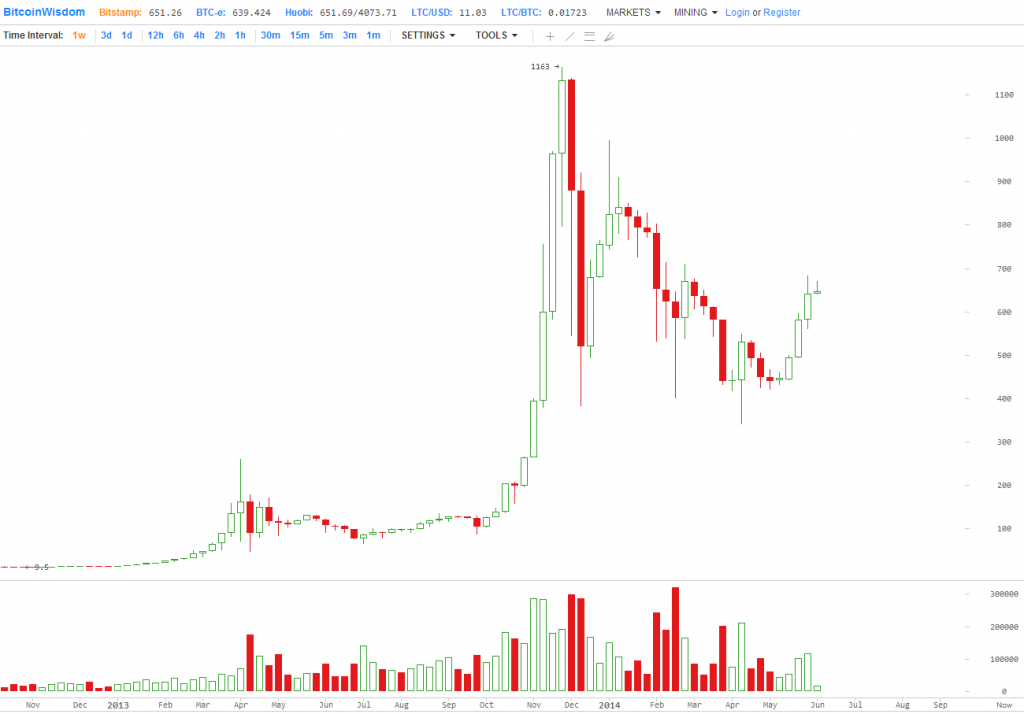
Four charts that suggest Bitcoin value could be at 10,000 USD next year
The chart below shows us the Bitcoin/USD value over the same 2013-2104 period on a logarithmic scale.
Google Trends on Bitcoin
“Bitcoin is still in the earliest phases of industry development. The first years of Bitcoin were about building the infrastructure. Bitcoin entrepreneurs were busy setting up the most basic but fundamental aspects, including wallet and mining services. Today, Bitcoin is just starting to enter the investment phase, where venture capitalist, hedge funds and other financial firms are starting to invest money and capital into this nascent technology. Bitcoin isn’t quite ready for the consumer phase, where end users begin to utilize the services. If the entire history of Bitcoin was a clock, we’re still in the very early time. I would say were maybe in the second second of the entire history.” Nicholas Cary, CEO of Blockchain.info (source)
Disclaimer: The (funny) definition of an economist is “Someone that can use economic theory today to explain why he got all his predictions wrong yesterday“. The market is unpredictable and I can’t always be right
Open your free digital wallet here to store your cryptocurrencies in a safe place.
Bitcoin ~ Hands On Code: Discover Bitcoin Open-Source Technology

LUISS ENLABS in collaboration with Bitcoin Foundation Italia and
Codemotion presents the first of a series of technical conferences
“Bitcoin ~ Hands On Code”.
The event will take place on Wednesday, 2nd of July, from 4pm to 8pm and enjoys the participation of speakers Thomas Bertani, Founder&CEO BitBoat Ltd, Guido Dassori, IT&building automation Freelancer, Luca Matteis, Semantic Web Developer, as well as Francesco Simonetti, Andrey Zamovskiy, Nickolay Babenko in live streaming from San Francisco.
The mission of the conference is to remove friction between bitcoin and
developers, encouraging the development of an appropriate tech scene
around Bitcoin, an incredible open-source based technology, aiming to
disrupt finance and money as we know them today.
There’s an
enormous opportunity for developers, who are already jumping in and will
have a real impact on the future, contributing to this open-source
technology.
Jump on board!
Program:
16.00 – Welcome: Tobia De Angelis, Augusto Coppola
16.15 – 17.15 – Panel moderated by Franco Cimatti, Developer and President of Bitcoin-Italia: Speakers’ interventions
17.15 – 17.30 – Break
17.30 – End (Around 20.00) – Hands on Code, guided by Thomas Bertani, a developer with a deep expertise in bitcoin/blockchain and founder of BitBoat.net.
Open your free digital wallet here to store your cryptocurrencies in a safe place.
Deloitte: media ‘distracting’ from Bitcoin’s disruptive potential
(CoinDesk) The report, titled ‘Bitcoin: Fact. Fiction. Future.’ and authored by Tiffany Wan and Max Hoblitzell, points out that the media tends to focus on bitcoin’s volatility, government crackdowns and exchange meltdowns instead of “its potential long-term significance as a disruptive new money technology”. In addition, Deloitte UP sees potential for bitcoin in fields that are often overlooked even by proponents of the digital currency:
“Bitcoin is more than just a new way to make purchases. It is a protocol for exchanging value over the Internet without an intermediary. Much has been written about the payment applications of bitcoin, including remittances, micropayments, and donations. However, bitcoin could soon disrupt other systems that rely on intermediaries, including transfer of property, execution of contracts, and identity management.”
Bitcoin evolution and new use cases
system, and why it has to deal with less overhead than the traditional payments system.
Speculation and regulation
caveats. Speculators rank high on the list, adding to the volatility and creating the impression of a get-rich-quick scheme. Thus, they introduce more reluctance on the part of everyday investors. The regulatory environment still leaves much to be desired. Like speculation, regulatory moves have a big impact on the price, creating even more volatility.
More than money
“Today, if someone buys a donut with a credit card, the merchant pays an interchange fee to the credit card issuer. This interchange fee is usually a small flat amount (10-20 cents) plus a percentage of 1-3 percent. For a low-margin good like a donut, a 10- to 20-cent flat fee can approach 100 percent of the cost of goods. This interchange fee is often passed on to the customer. Using bitcoin, the transaction fee could be lowered to as little as 1 percent. This could ultimately evolve into a new payment system for credit card companies and banks.”
New use cases
various contracts. Using the bitcoin protocol to manage identities would practically eliminate the possibility of forging identification documents and it would help put confidence artists out of work. A network operated by the government, a contractor or any other entity could verify anyone’s identity simply by scanning a bitcoin key.
About the publisher
Open your free digital wallet here to store your cryptocurrencies in a safe place.
Cryptocurrency Fundamentals
2014 will be a year of revolution, not politically but economically. Sweeping reforms are coming that will forever alter the way our financial system works. In order to understand how cryptocurrency will be so revolutionary, you need to understand who it was made by, why it was made and how it works.
Imagine there were a group of ten nomadic tribes in a valley with a lot of hills. One day they discover a hundred precious stones all with unique symbols written on them. To decide how best to regulate trade and prevent theft and fraud, the tribes decide to make it law that whenever a stone is traded between villages, both of the tribes must record it on this huge wooden board placed where the stones were first found with the stone’s unique symbol telling the other villages that that stone has been traded. They do this when no one is looking and keep their stones hidden from each other. If a stone changes hands without it being recorded on the board, then you know it was a theft or fraud.
Leaving the analogy: the tribes are now computers, the smoke signals are the internet, and the precious stones are Bitcoins. Bitcoin is only one of many hundreds, even thousands, cryptocurrencies out there. Cryptocurrency has three main advantages over national currencies like the US Dollar.
1. It is decentralized; the currency is regulated by the market and community, not by a central bank like our Federal Reserve.
2. It is anonymous; users can spend their money on whatever they want without fear of being tracked by the government.
3. It is digital; you do not need to carry them around with you (even though you can).
Bitcoin – is just one of many cryptocurrencies (AKA altcoins, alternative currencies, etc). It was the first and most famous, mainly for its mob associations in the Silk Road. It was created by an individual or group of individuals known as Satoshi Nakamoto (Personally, I think it’s a small team). It has the greatest market capitalization (as in the quantity of Bitcoins times the value of each Bitcoin given in dollars) of all cryptocurrencies.
Here is a visualization of the market capitalizations of all the cryptocurrencies.
Most cryptocurrencies have nothing unique to them. Some may even be scams, but far more are simply unimaginative wannabes. They are developed by anyone from a leading company to a hacker in his parent’s garage (although you can easily tell). The top fifty cryptocurrencies are usually the only ones with anything creative or innovative about them. But to reach the top you cannot merely have creative mechanics or features to your coin, you must have a community. Coins that want to be in the big boys club must reach out to a group of people online who identify with something about the coin. Often it is as simple as having a “cool” name, like the amusingly blatant Potcoin. A community of people who support and use the coin means that it will have consistent trading and mining and will maintain its value. But don’t take that to mean that you don’t need a well-constructed coin itself. Several times has a coin emerged with a huge opening to a lot of fans before suffering from a massive technical failure and breaking down (looking at you Ripplecoin). This is why we should think of cryptocurrencies as investments like high-volatility bonds than actual mediums of exchange for the time being. Volatility will fall with mainstream adoption and market maturation just like with stocks and bonds.
The competition between altcoins is cutthroat. If your coin/exchange/mining pool gets a bad name as a scam then it will be plastered all over the main cryptocurrency forums (don’t knock forums, these are more influential than maintream media news stations in the crypto community) and your coin/exchange/pool will be ruined. If a coin/exchange/pool comes up just like yours but with that little extra awesome thing about it (I mean literally ANYTHING) then your users can easily notice the rival and switch to it. In order to stay profitable a coin/exchange/pool must not only have value innovation when it release but must continue to create more value and innovation for the user.
Mining – mining is how coins are introduced to the market. In incredibly simplified terms, people with computers download a program that solves very very complex algorithms to generate a unique solution. Each solution is recorded in computer-speak, forming a new cryptocurrency coin. To reclarify: this is almost an oversimplification of the process. This can work in two ways: Proof-of-Work, and Proof-of-Stake. In PoW, you get more blocks containing coins the more work you have done mining that coin in the past. In PoS, you get more blocks containing coins the more total coins you own (so if you continue to own 1% of all the coins then you will continue to receive 1% of coins that are mined) Some cryptocurrencies have a hybrid of both, in which people can mine for coins via PoW or receive them via PoS. Each has its own advantages and disadvantages. If you want to challenge your reading comprehension and computer science skills try reading the articles on both linked above.
PoS (Proof of Stake) was first proposed on Bitcointalk here.
You may think it’s kind of unfair and weird that someone can just go
out and mine cryptocurrency coins “for free” using just a computer, that
makes the coin “not backed by anything.” This belief is full of logical
fallacies. Firstly, the miner must spend money to get computers,
internet access, etc in order to even do the process. Then he must spend
time, effort, expertise and electricity generating the coin. Then he
may sell it. Sounds easy? Wrong. You can similarly trivialize the
process of mining gold, or silver, or any other precious metal. All you
have to do is spend some money to buy a pick, a shovel and a pan then go
out to a river in Oregon and squat in it.
Just because something doesn’t require physical labor doesn’t mean it
isn’t hard, or worthless. Not everyone can or wants to mine, that alone
restricts the supply. In addition, the more miners there are, the
higher the difficulty rate goes. The difficulty rate
decides how many coins are given out in a given time to a given miner;
the higher it is, the less coins the miners get. This also helps to
restrict mining. Today the difficulty rate of Bitcoin is so high that
they are completely mined by big companies with powerful non-personal
computers.
Think of each cryptocurrency as its own precious substance like gold
or diamonds. Gold isn’t “backed by anything” either. Your US Dollar is
only backed by your neighbors’ home mortgages and the debt our banks owe
to other banks. Both cryptocurrencies and precious metals can be mined
“for free,” but that doesn’t mean it is not hard to do so. They may not
be “backed by anything” other than human desire, but that doesn’t mean
they are devoid of value.
Blocks/ Blockchains – here
you can see a infographic explaining how the blockchain system within
Bitcoin works. The blockchain is basically a record of everyone who has
owned each Bitcoin, which Bitcoins they owned, and when. It is a perfect
ledger of all transactions. You may say, “but wait what about
anonymity?” Just about to get there. The ledger doesn’t record your
name, your social security number, your fingerprint etc just your wallet
address. This is not the same as your IP address.
Whenever you want you can go online and download a free unique wallet
with its own address (given anonymously) from the website of each
cryptocurrency. This will sit, just like any other file, in your
computer. While you cannot exactly open it and read or copy the data
within (and thus expose Bitcoin to fraud) you can rest easy knowing your
money is at least digitally in front of you. If you just did something
like buying ten porn magazine subscriptions, you can go download another
unique wallet and toss the old one. This ledger is pretty much useless
for tracking all the transactions, but it does help if one wants to
investigate huge sales that happen all at once.
One of the most important things about cryptocurrency is that it is
not controlled by any government. The most they can do is ban or
restrict it in some way by law, which drives down the price of the coin.
However, this is imprecise and as more countries and companies adopt
the technology, not only will the impact of these laws be lessened but
governments will be face more obvious economic incentives not to. The
fearful prohibitions (which don’t even work as evidenced by at least two
of the top ten crypto exchanges being Chinese at all times) are not
evidence of cryptocurrency’s instability. Rather, they are proof of the
lengths governments which heavily manipulate their currency and repress
their people will go to keep this technology out.
Cryptocurrencies’ decentralized system contrasts greatly with
national currencies or fiat currencies like the dollar or euro. The
federal government has a great deal of control over the US Dollar. I’m
not going to go into the federal reserve
here because I’m sure many non-Libertarians roll their eyes when they
see us go into that stuff and it’s too much for this article. But you
can check it out here:
Want to see a debunking of all those scary things you hear about Bitcoin and cryptocurrency in general? Here.
Written by Mars
Open your free digital wallet here to store your cryptocurrencies in a safe place.

California lawmakers pass bill to update currency law
 |
| Image: GetToKnowBitcoin |
Open your free digital wallet here to store your cryptocurrencies in a safe place.

Major Italian newspaper il Giornale accepting Bitcoin for digital subscriptions
for digital subscriptions, we’re learning from a reader email this
morning. The bitcoin logo is boldly visible on il Giornale‘s digital subscriptions page [link], where nearby it says, “The Journal is the first newspaper in Italy and in Europe who accepts payments in Bitcoin.”
all news categories and articles in PDF files optimized for Android
smartphones, iPads, and other tablet devices.
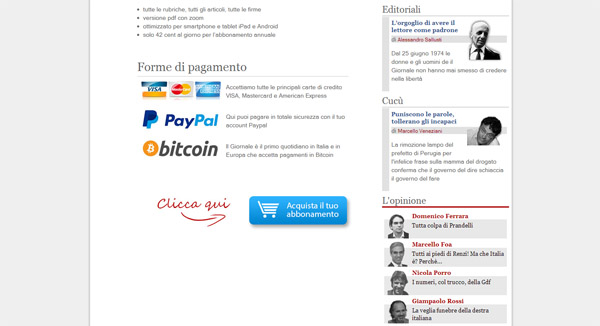
given the paper’s previous interest in the digital currency. In early
February, the paper put up a bitcoin paywall as a test of how users
would interact with using bitcoin (users had the option of donating to a
non-profit). The results were overwhelmingly positive, with 713 donors.
While we haven’t exactly seen widespread adoption of bitcoin for
digital news subscriptions, it’s nice to see it getting a start in Italy.
Open your free digital wallet here to store your cryptocurrencies in a safe place.

Swiss government report: Bitcoin too ‘insignificant’ for legislation
for the time being, it will not create legislation relating specifically
to bitcoin or other digital currencies.
claims the economic importance of these currencies is currently “fairly
insignificant” and the council doesn’t expect this to change in the
near future.
of postulates by National Councillors Jean-Christophe Schwaab and
Thomas Weibel last year, which asked the Federal Council to examine the risks and opportunities associated with bitcoin.
No ‘legal vacuum’
point the government is keen to stress in the report is that virtual
currencies are not in a “legal vacuum”, meaning that existing laws apply
to activities associated with these currencies. It states:
“Contracts
with virtual currencies are enforceable in principle and penalties can
be imposed for criminal offences associated with virtual currencies.
Certain business models based on virtual currencies are subject to
financial market laws and need to be subjected to financial market
supervision.
Professional trade in virtual currencies and the
operation of trading platforms in Switzerland generally come under the
scope of the Anti-Money Laundering Act. This includes compliance with
the obligation to verify the identity of the contracting party and
establish the identity of the beneficial owner.”
of the laws that apply to certain uses of digital currency include the
Swiss Code of Obligations, the Federal Act on Combating Money Laundering
and the Financing of Terrorism in the Financial Sector, plus the
Federal Act on Banks and Savings Banks.
Legal certainty
told CoinDesk he was pleased the report had clarified the legal status
of bitcoin: “The report ensures legal certainty. That’s the most
important topic at this point. Now, people who trade bitcoin can know
which financial sector regulation applies or not.”
“The more I learn about bitcoin, the less I remain sceptical about it!”
a big mistake for a country like Switzerland with a strong financial
sector. I hope the banking sector will be cleverer than the Government
on that point, but I’m pessimistic.”
the last months, my personal views about bitcoin have evolved: the more
I learn about bitcoin, the less I remain sceptical about it!”
Roussel, CEO of Swiss based cryptocurrency broker SBEX, said the report
represented good news for the Swiss bitcoin ecosystem.
an ATM would be considered directly as money transmitting service, with
tighter rules. This is starting to shape how bitcoins ATM will work,”
Roussel said.
need to be licensed, unless they can ensure the user is in control of
the private key of the bitcoin wallet they are sending to.
is imposing high standards in the bitcoin financial world, but this will
be beneficial for consumers in the end,” he added.
The risks
report gives examples of the risks associated with bitcoin, stating
that, while there is no risk of it damaging the country’s existing
financial sector, consumers are vulnerable to volatility and security
issues.
Open your free digital wallet here to store your cryptocurrencies in a safe place.