
Bitcoin’s youngest entrepreneurs and educators
money in digital currency and skilfully using it for in-game purchases,
tipping buddies on reddit and other really cool things which have yet to
be invented.
there are a few enterprising youngsters here and there who have already
discovered the advantages of bitcoin, are using it, and are even making
generous amounts of pocket money from it.
A swarm of talent
 |
| Image via Bees Brothers |
Hailing
from Cache Valley, in northern Utah, three brothers between the ages of
11 and 15 have their own successful honey business at home in the Cache
Valley.
swarm of bees as an experiment. Little did they know it would lead to a
small business and an obsession with bitcoin.
says they had no intention of starting a business. “As we started
working with honey and beeswax we started making new things for
ourselves, and eventually got a small business licence, more honeybee
hives, and started selling our items at our local Farmer’s Market,” he
said.
attracted by the concept of a decentralised, non-inflationary
currency. The ideals behind bitcoin seem to align with those of the
Huntzinger family.
father admits they have a different view of education. “We don’t believe
that government has a monopoly on education, nor that the only way to
learn is being forced to sit at a desk all day and stare at a book […]
The whole purpose of getting that first hive, and later the business
licence, was all about education. What would happen if we did this…?”
answer is a flourishing business and three boys learning about finance
and investing before they’ve even finished high school. Business is
booming. From selling pots of their honey locally, their company, Bees Brothers now
produces several different flavours of honey caramels, honey roasted
almonds, beeswax lip balms and candles both at the markets and via their
website. And all can be had for bitcoin, of course.
The publishing moguls

you’ll find a host of online tutorials, as well as the chance to buy a
host of books (using bitcoin) that explain the subject.
not the best part. The site and books, as well as a host of other blogs
and publications are all written by a trio of young sisters, who
describe themselves thus on their blog:
“We’re three
tech tweenpreneurs, also known as The Sabra Sisters. We were born in
2000, 2001 and 2003. We’ve been blogging since 2008, started making
money online in 2010, [and] became bestselling kindle authors in 2013.”
that they were all successful juvenile nonfiction authors, he
challenged the sisters to write a ’25 Fun Facts of Bitcoin’ book, which
eventually evolved into the five-book ‘Bitcoin for Kids‘ series.
immediately started researching into bitcoin and, less than 24 hours
later, surprised him with the launch of their brand new blog dedicated
to learning about the digital currency – the first post being entitled, ‘Yes, we’re interested Uncle I.J.‘ The rest as they say, is history.
girls generally divide up the different tasks required for the
publications, depending on their skills and preferences, but said JuJu:
“My sisters and I split up the various tutorials so everyone had a share in spending bitcoin and having fun. ;-)”
the home-schooled girls justifiably boast they are “professional
bloggers and bestselling authors”, with some credit given to their
mother Ponn – also a blogging professional – for her guiding input too.
the Sabra sisters have over two-dozen kindle books published, with an
astonishing 55,000 plus downloads during the past year, JuJu told
CoinDesk, adding:
“We rarely look at each individual title, but two books are our bestsellers making up nearly 40,000 of those downloads: ’Science Projects for Kids’ and the ’My First Smoothie Recipe Book’.”
Cuteness and cookies
 Image via DorkusPrime/reddit
Reddit
user DorkusPrime came across young entrepreneurs Mia and Taylor in
California back in January in the Noe Valley neighbourhood of San
Francisco. He posted a photo of the two little girls at their cookies and lemonade booth and it quickly became something of a web sensation.
adorable little girls just sold me snickerdoodles for Bitcoin in San
Francisco. I asked them to say cheese for the Internet :),” DorkusPrime wrote at the time.
The youngest bitcoin author

writer, Jaden Shelton (A.K.A. the Bitcoin Kid) claims to be “the
youngest author ever who has published a book offered only in bitcoin”.
“It was something funny that happened in my childhood – I used to not eat certain foods and we would say ‘are you scared of a blank?
I would say ‘no’ and we would keep joking around with it. A few years
later, we started thinking about making a book about it.”
promising TV presenter, Jaden has posted a series of videos in which he
interviews key staff at prominent digital currency businesses, such as
ripple, Mycelum and BitInstant.
“Well, you can’t buy anything unless you have a job, so I might be an entrepreneur … or maybe sell toys to kids.”
The shrewd investor

Karam isn’t your average nine-year-old. While most kids his age ask for
the latest must-have toy for their birthdays, Andrew requested shares
in Apple.
price of the stock with interest, checking regularly whether his
investment had gone up or down in value.
was incredibly excited about it and asked if I could take his Apple
stock and cash it out for BTC, so I made him a paper wallet and […]
bought a bit at a time,” Steve wrote in a post on reddit.
later told his teacher about his investment, revealing he had made
about $50 since his dad bought him some bitcoins. He said he was
originally thinking of cashing out 25% of his investment, but the savvy
youngster decided to hold on to his cryptocurrency.
to do more than just a talk at school to get his peers involved in
digital currency. So he asked his father whether he could sell bitcoins
to his classmates, then get them back by accepting BTC as payment for
his Wonder Bracelets, which he makes from colourful elastic bands.
story and enthusiasm struck a chord within the bitcoin community, with
some members of reddit making donations to the 4th grader.
said his son is “super excited” by all the support he is getting and
even commented that he wants to be a “professional millionaire” when he
grows up.
The chancer
 Credit: Imgur
And
finally, let us not forget the enterprising college kid who, in early
December 2013, made it onto TV holding up a sign with a bitcoin logo and
wallet QR code at ESPN’s ‘College GameDay’ game.
and caught the attention of the bitcoin community, who promptly sent
him a flurry of donations amounting to over $24,000 in bitcoin, some of
which he allegedly donated to Sean’s Outpost – a bitcoin-funded homeless outreach centre in Pensacola, Florida.
Open your free digital wallet here to store your cryptocurrencies in a safe place.
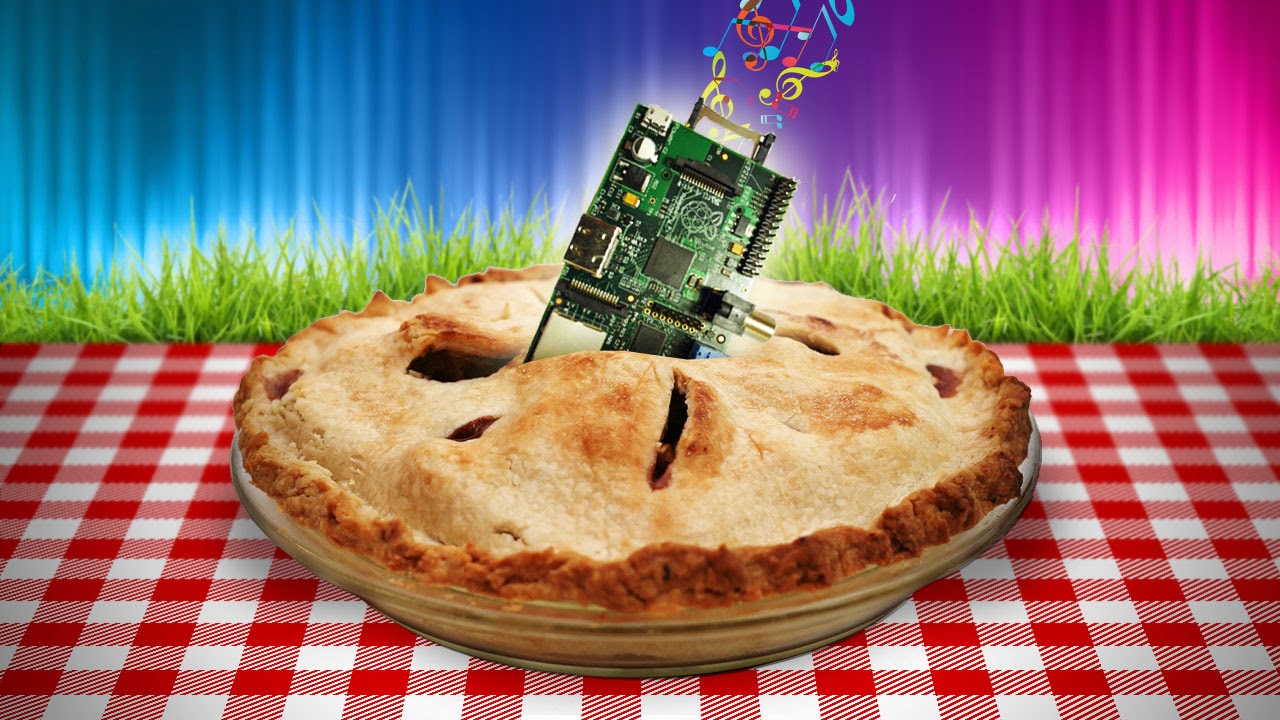
Spreading Peercoin on Pi: get 10 PPC for setting up a node!
 |
| User river333 from PeercoinTalk is ready to start giving out tips for spreading Peercoin on Pi! |
Here’s how to get the 10 PPC tip!
1. Follow Tea42’s guide on how to set up Peercoin on your Raspberry Pi. A full node is required to receive the tip, so be sure to complete the part of the guide entitled “Contribute to the Peercoin network” in part 2, which shows you how to allow port forwarding.
2. Post in this thread with a photo of your Pi, and also a photo of your Pi screen.
The following should be visible in the photo of your Pi’s screen:
A: A window showing your Raspberry Pi serial number.
B: The Peercoin Qt wallet with the green checkmark in the lower right hand corner indicating that the RPi is now a currently synced Peercoin node.
The “Receive coins” tab should be clicked so your wallet address to receive coins is visible.
C: The Peercoin Qt debug window open showing the command “getconnectioncount” having been typed in at the bottom and the window showing a number greater than 8.
3. Paste your PPC address into your forum post. This should match the one visible in the photo of your Pi’s screen.
If you follow the above instructions correctly, you will receive your tip!
A big thank you to NewMoneyEra for donating the PPC that will be used for tipping.
FAQsWhat is a Raspberry Pi?A Raspberry Pi is a low cost, credit-card sized computer that can be plugged into a monitor/tv, and a standard keyboard and mouse (https://www.raspberrypi.org/help/what-is-a-raspberry-pi/). It is used in programming education and also has a wide variety of other uses. Its low energy consumption makes it perfect for running a Peercoin node.
What model of Raspberry Pi should I buy?
Model B is the most used at the moment. I’ve read that the new model has the same hardware, and only the form is different, but I have no experience
with it. As for an SD card, it’s best to buy a class 10 or better, that is 10MB/s minimum write speed. Don’t get fooled by the read speed they mention on the packaging, that is always much higher. https://en.wikipedia.org/wiki/Secure_Digital#Speed_class_rating
A case is not necessary but recommended because it protects against stuff falling on your pi, small coffee spills etc
I have a pi I ordered for playing round with and remember you will need a power supply to for it, that and the SD card u need to buy, its a micro usb charger same as many android phones or tablets so u can use one of those if it gives a high enough voltage. I just remember when I ordered mine the wait on charges was 3 weeks longer than the 5 weeks for the pi, but I hope they more readily available now.
What is the purpose of this project? The purpose of this project is to encourage the use of Peercoin on Raspberry Pi, while also increasing the number of full nodes on the network. A connection count of more than 8 indicates that port forwarding is enabled and that you are running a full node. Minting is beyond the scope of this project. Can I mint on my Raspberry Pi too?
Yes, you can. However, for the moment it is advisable not to mint on a full node (i.e. with port forwarding) until more research has been done. You can find out more about this here and here if you are interested.

Open your free digital wallet here to store your cryptocurrencies in a safe place.

George Soros sells out of J.P. Morgan, Bank of America, Citigroup …. time for Bitcoin?
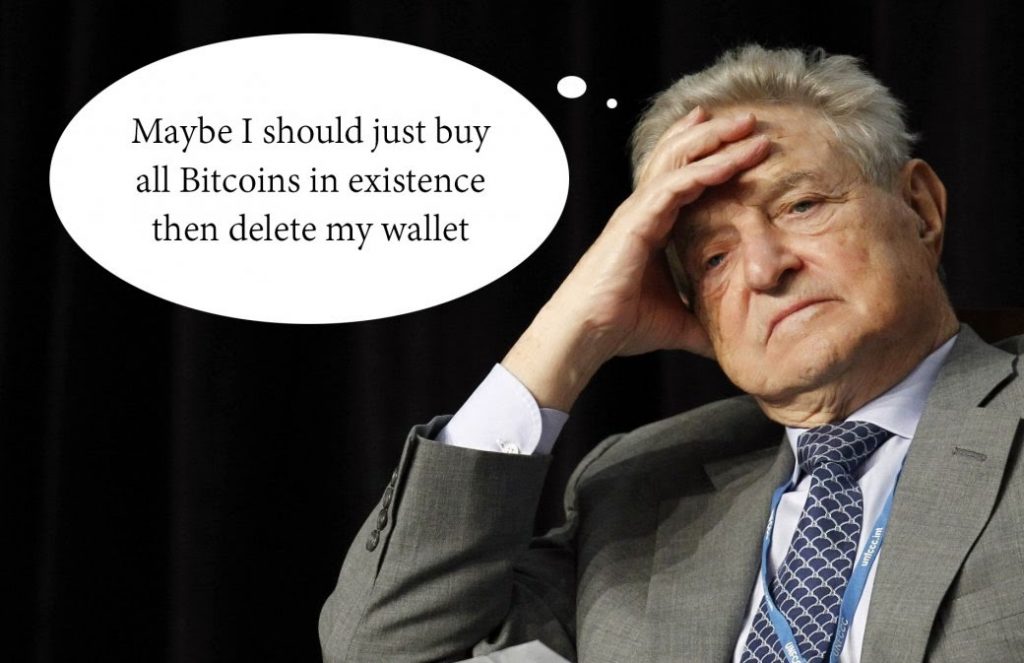
to several news sources billionaire George Soros recently sold nearly
all of his bank stocks, including shares of JPMorgan Chase, Citigroup,
and Goldman Sachs. Between the three banks, Soros sold more than a
million shares. Billionaire John Paulson dumped 14 million shares of
JPMorgan Chase (appr. 750 million dollars). Other billionaires are pulling out of US stocks too.
surely there is a growing discomfort about the all time high levels of
stock market prices. Some are expecting a massive correction. Even if
there is no good reason for it, fear could make such predictions a
reality.At BitcoinOwl we of course speculate that the growing success of
crypto currencies and their promise to revolutionize the financial and
other systems could be a factor as well. Just like email threatened the
business model of the postal services and file sharing scared the music
labels, crypto currencies without a doubt cause some anxiety to
financial institutions who see Bitcoin as a competitor instead of an
opportunity to reinvent themselves.
It may take years before Bitcoin makes any noticeable dent in
Citigroup’s profits, but Bitcoin’s existence alone raises some
uncertainty about the future of such financial institutions and their
profit margins. Some players like Western Union have already been forced
to drop their fees drastically in response to Bitcoin’s extremely low
transaction fees.
The question is where does all that money pulled out of the stock
market will go? Many investors like Kevin O’Leary publicly said that
they’ve put a few percents of their money into Bitcoin already. His
Bitcoins were without a doubt his best performing asset in 2013. It’s
likely that most billionaires pulling out of the stock market will put a
small part of their wealth into crypto currencies as it’s highly
independent from other assets which is important for healthy
diversification.
Let’s just see how much money are we talking about. Let’s assume only
a fraction of those stock dollars will be funnelled into cryptos. Half
percent of NYSE’s total market cap is 83 billion dollars.
If 70% of that 0.5% would flow into Bitcoin it would increase BTC’s
market capital 7 fold raising the price of Bitcoin to over $5,000. If
10% of it went to Litecoin it would increase LTC’s market capital by 13
times raising the price to $325. And we’re talking about just 0.5% of
one stock exchange in the world.
Potentially it is also possible that the crash of stock market prices
will scare crypto currency investors too. Although, it’s hard for me to
find a plausible reason why this would happen.
It will be interesting to see how the predicted decline in the stock
market will influence the valuation of the popular crypto currencies.
Open your free digital wallet here to store your cryptocurrencies in a safe place.

Japan to monitor Bitcoin rather than regulate it
(CoinReport) Japan’s involvement with bitcoin has taken a massive blow due to all of the negative press surrounding the Japanese failed bitcoin exchange, Mt. Gox. Since then, warnings of the risks involved with dealing in the digital currency have been spread throughout the world by regulators and critics alike.
Japan Will Monitor Bitcoin
However, rather than placing specific laws or regulations attached to how the country should be allowed to use bitcoin, it will just monitor it instead. On Tuesday, the Japanese government claimed that regulating bitcoin wasn’t under their jurisdiction. Sources say that Japan’s Ministry of Economy, Trade and Industry is devising a plan to make it easier to monitor illegal bitcoin activity. Prime Minister Shinzo Abe and his administration identify bitcoin as not being a form of currency. They do identify it as being an electronic payment method.
As most government officials and regulators do, Japan’s warn the public of bitcoin’s potential dangers, such as its uses in money laundering and drug trafficking.
Regulators Warn of Bitcoin
While Japan has no plans to enforce rules over bitcoin, other regulators feel that regulation over the digital currency is the only way for it to be safe enough for investors to get into. On the other hand, some feel bitcoin isn’t safe enough to implement into our economy, but for those that want in, they should do their homework first. Indiana Secretary of State, Connie Lawson claims that:
“The value of virtual currencies is highly volatile, and the concept behind the currency is difficult to understand even for sophisticated financial experts.”
Though this may be true in some cases, that doesn’t mean people can’t figure it out for themselves. Bitcoin was foreign to every enthusiast at one point in time. Like with all new concepts and innovations, time is needed to get acquainted with the technology. Once upon a time, even the Internet sounded dangerous and ludicrous idea. Regulators, whether in Japan or the U.S., need to stop putting fear in people and let bitcoin have an organic chance at success.
Open your free digital wallet here to store your cryptocurrencies in a safe place.

Building a Bitcoin Economy: how to stimulate adoption
evangelist? Want to learn how to start your mission into the world of
fiat economics? Having preached the good word of Satoshi to laymen of
all kinds, I’ve made my mark and learned a lot about promoting crypto
adoption. Before you begin your journey, take a moment to read and learn
about the science of Bitcoin evangelism.
things: intellectual capital (to code the software and design the
systems that make everything work) and financial capital (to pay for
hardware, commercial space, legal fees, and intellectual capital if it
is lacking). Adoption is probably the only field of the crypto industry
that requires cultural or social capital, at least at the grassroots
level. But what does that mean in practice?
connections you already have. In my case, that was a network of notable
Vancouver Meet Up groups, and a job as a venue promoter. At first you
won’t have existing merchants to refer to as references, so you’re going
to need to find people who really trust you. Plenty of free solutions
to accept exist, and once they realize the advantages of cryptocurrency,
they’re likely to stick with it.
superiority of accepting payments via Bitcoin is meaningless if nobody
is spending their bitcoins. Even if Bitcoiners prefer to spend
fiat–maybe because the price is on an upswing–just bringing their
business to the adopting merchant provides the necessary incentive, and
there are a number of ways you can do that.
come in handy. If you’re not a member of your local cryptocurrency Meet
Up, already, become one, or start your own group if none exists.
Community pages at Facebook and Google Plus will also help. Since all of
the businesses I signed up were event venues like coffee shops,
restaurants and bars, I was able to bring them business directly by
holding Meet Ups at their locations. Even for non-venue businesses,
though, a community allows you to connect producers to consumers and get
the word out.
more businesses on board, and that network should grow. In addition to
the natural benefits of cryptocurrency, you now can now promise
additional benefits in the form of direct customers–look for businesses
likely to be open minded, like those already hosting Meet Ups or listed
on websites like GroupOn or LivinSocial. Each new adopter you post to
social media will bring more Bitcoiners into the fold, which in turn
increases the amount of business (and incentive) you can provide.
you can bring more customers indirectly via publicity than you can
directly. You should probably have a couple local reporter contacts, by
now. New crypto Meet Ups and splinter groups will form, and inevitably
the majority of events and merchant connections will be initiated by
people other than yourself. This is natural in community building, and
even moreso in a community based on techno-libertarian roots–don’t be
discouraged.
marketing power to promote those working together for the cause. If you
maintain an honest, non-profit-focused campaign, you will become the
face of this new community; forward media inquiries where appropriate,
and engage positively with the mainstream media. Soon you’ll be ready to
take Bitcoin adoption to the next level.
Open your free digital wallet here to store your cryptocurrencies in a safe place.
“Commodity” is the right way to pitch Bitcoin
nothing like holding a stash of bitcoins and watching the price to make
you hold on for dear life (HODL – the cry of many a bitcoiner) or want
to get off. Its volatility is also a draw for people who would never
even consider such a thing to take a stab at day trading. The frequent
swings up and down make it seem like it should be easy to simply follow
the old rule of buy low and sell high. Most of those who try this,
though, soon learn that it’s not so easy to predict the market, time it
well enough to get a return, and make enough to beat the spread and the
fees.
news for Bitcoin. Price and volatility are important, of course, and the
price of a bitcoin is going to need to rise astronomically in price if
it’s going to fulfill its role as a global asset and currency. But price
is actually a feature of Bitcoin and not its make or break point. On
any given day, the fact that the price is soaring on the seeming
blessing of a hedge fund manager or crashing on some rumored meeting of
the PBOC in a back room somewhere in China is actually fairly
irrelevant.
right. Adoption is progressing, and for sure there are more and more
sellers accepting Bitcoin, but many of the sellers I’ve been in contact
with admit that they have gotten few, if any, Bitcoin sales. Merchants
have natural reasons to accept bitcoins in payment, but it isn’t nearly
as clear to consumers what the benefits to them are. The technical
difficulties, bad press, and risk of theft are great enough to easily
offset the advantages of saying bye bye to their bank accounts and
credit cards.
 No,
No,Bitcoin’s time to act as a currency has not yet arrived. Right now it’s
a commodity with an excellent appreciation outlook. And that’s how
Bitcoin should be being pitched. Purchase one or ten or twenty bitcoins,
put them in a paper wallet and forget about them; that small investment
may be the same as buying Microsoft stock or Berkshire Hathaway stock
20 or 30 years ago. Bitcoin is designed to be deflationary, and as
adoption increases, so will its value. Given the state of the political
and financial systems, for those worried about their retirement, their
kid’s university, or just the state of the economy, Bitcoin might be the
best investment there is.
in. When demand to hold Bitcoin as an investment has risen sufficiently
high that people stop looking at what a bitcoin is worth in terms of a
local currency and start pricing things directly in Bitcoin, Bitcoin POS
payments are going to take off. At this point, the fiat currency will
be valued against Bitcoin rather than the other way around. At this
point also, many of the concerns we currently have about regulation and
taxation are going to become moot as the regulators and taxmen will have
to recognize the reality on the ground and adapt or die.
an apt comparison. Bitcoin’s most famous feature is as a currency, but
the blockchain itself is a powerful development. Right now there are
companies and projects underway to create smart property (where you can
prove or transfer ownership of anything with a chip by showing
possession of a bitcoin ‘marked’ as that property), smart contracts
(where you can encode the terms of the contract to fulfill automatically
once certain conditions checkable on the Internet are met), distributed
shares in companies, anonymous, verifiable voting, and much more. It’s
possible that we are going to start to see some of these applications
gain wide adoption before most people are buying a coffee with Bitcoin.
People will come to Bitcoin, probably without meaning to, because of its
simple usefulness. This will dispel some of the myths and fears
associated with it. From there, people will start dropping their bank
accounts and credit cards in favor of saving in their own (by this point
easy and secure) wallets and paying for their coffee by keying in a PIN
on their phone.
and easily, bad press, and security are going to dog Bitcoin’s
development for the foreseeable future. But the trend lines are also
easy to see. Bitcoin is developing, expanding, and gaining in usefulness
every day. So the next time someone tells you they’re worried about
their retirement or their kid’s education, let them know that they
should do their own research and make their own choice, but that Bitcoin
might just be the best investment they could make.
Open your free digital wallet here to store your cryptocurrencies in a safe place.
Why simplicity is best for bitcoin growth
With the many people who have boarded the bitcoin train
lately, and bitcoin acceptance growing each and every day, security is
still of paramount concern and for those new to bitcoin or wondering
about buying some, there are still many doubts and uncertainties, which
hang over them.
 (BitScan) Bitcoin
is a fascinating technology and our job as users is to keep it safe. I
had a friend tell me this weekend that bitcoin was “too hard for people
to learn.” I reminded him that email is used by so many people and that
less than 10% of those who use it, understand it all. The same will go
for bitcoin.
Often these newcomers to bitcoin are overwhelmed with
- facts and figures
- hash rates
- difficulty
- brain wallets
- blockchain
- cold storage
- private keys
- the list goes on
It is not surprising it all sounds too complex to even begin to understand and get involved.
The email analogy
Imagine if I had told you when email was starting that there was this
cool electronic mail available now and I think you should check it out.
To that, you ask, “How does it work?” I could answer you in two ways:
1. “You type out a message, put in the intended recipients address, and click send.” Or
2. “To start, you go to your mail user agent, or your MUA. You
address your message to the intended recipient and click the “send”
button. This causes the MUA to format the message using Simple Mail
Transfer Protocol, or SMTP and delivers the message to a local mail
submission agent, an MSA that is located at an SMTP address that is run
by your ISP.

Your MSA looks at the destination address provided in the SMTP
protocol, starting with the part before the @ sign, which is the local
part of the address and often a username, and then the part after the @
sign, which is a domain name. The MSA resolves a domain name to
determine the fully qualified domain name of the mail server in the
Domain Name System or DNS. The DNS server responds with any MX records
that are listed as the mail exchange servers for that domain.
SMTP transfers the message and your recipient then needs to press the
“get mail” button in his MUA, which picks up the message using either
Post Office Protocol also named POP3 or the Internet Message Access
Protocol or IMAP. It’s easy as pie!”
I wonder how many of us would have forged ahead with email had the
second version been the usual explanation given. Bitcoin is still in its
infancy and products will be coming along as well as solutions to make
it easier on the user. Much like Outlook and Google made email easier,
so too will product developers and businesses make bitcoin easier.
Keep It Simple
So, when talking bitcoin, keep it simple.
Allaying Fears
One of the main worries that anybody, new to or expert in bitcoin
has, is over security and potential theft. With hackers and their tools
getting better and faster with each day, we must protect ourselves now
before it it’s too late.
First, line of defense is a secure password.
NEVER use the same password on more than one site. You may end up
giving a scammer universal access. So now they have your bitcoin, and
passwords to all your online wallets, exchanges, email and more.
An easy and free solution might be LastPass. It is a simple and
effective way to manage all of your passwords as it stores your entire
password, encrypted on your device and all you need is to remember one
master password. There are other options as well. Do a search for
password managers and make sure they are secure and reputable.
The take away here is every password you have should be unique, at
least 15 characters with some of each upper and lower case letters,
numbers and symbols, and not contain dictionary words, names or places.
There are other safety steps that can be taken including storing bitcoin offline or in a paper wallet. See what the creator of bitcoinpaperwallet.com has to say here.
All these measures can be used when greater amounts of bitcoin are
involved but for ease of use for a new user with a small amount, finding
the best bitcoin wallet or wallet app is key.
Your Bitcoin Wallet is like the wallet in your pocket – except you
have the private key for that wallet – so it is incredibly difficult for
anyone to steal your wallet and make use of the bitcoin without your
private key.
Together
The more people who are encouraged to adopt bitcoin, the stronger and
more normal it becomes. There are no regulators for bitcoin,
decentralization means that the bitcoin community has to keep its own
house in order. By sharing information and spreading the word the
community can help bitcoin in its progress. By helping each other stay
safe, the bitcoin horror stories can be kept to a minimum.
Open your free digital wallet here to store your cryptocurrencies in a safe place.
How XRP may actually benefit Bitcoin
As it stands, Bitcoin is king of the hill. However, at least one form
is clearing its own path and may actually end up helping Bitcoin and
others.
to be the next PayPal. The difference is that Ripple will handle
multiple currencies—perhaps even all of them—and make
transactions immediate. There will be no more waiting around for days in
order for a payment to move from one party to another. To facilitate
this process, Ripple invented its own currency, XRP. Unsurprisingly,
many have seen this digital currency as a natural rival to Bitcoin and
other versions. Yet this isn’t necessarily the case. Unlike Bitcoin, XRP
has a stated purpose it’s been designed “to streamline transactions”.
Ripple really doesn’t need it to do much more than that, so it
seems unlikely they have much interest in putting resources behind
making it the number one digital currency in the world. XRP may turn out
to be the best thing that ever happened to Bitcoin. One challenge to
Bitcoin, or any other digital currency for that matter, will always be
the public’s reluctance to adopt it. As the years go by, it may dwindle,
but for the foreseeable future, this remains a hurdle.
can involve Bitcoin without one party ever even knowing about it. For
example, if you wish to buy a book from someone using Bitcoins and they
wish to be compensated with yuan, this would normally be problematic.
You might even stop using Bitcoins because so many people you purchase
from don’t accept them. With Ripple, make the purchase and they’ll
convert your Bitcoin into XRP and then into yuan. You get your book
using Bitcoins and the seller gets the yuan they desire. This highlights
XRP’s ability to extend the reach of any digital currency on the
market. So while it may be viewed as a rival, the truth is that it might
be their greatest ally.
Open your free digital wallet here to store your cryptocurrencies in a safe place.
An Internet of Blockchains
The blockchain is a hard concept to wrap one’s head around because it describes a system for which no analog exists today, and it runs counter to everything we know about how trust works. In today’s world, trust can only be assigned or transmitted by an individual or organization. The idea that one could safely send money from point A to point B, and have that transaction fascilitated by potentially millions of agents without you knowing who those agents are, what motives they might have vis-a-vis your money, whether they are nefarious or not, is an anathoma. But that is exactly what the blockchain helps enable.
With the blockchain, trust stems not from the reputation of an actor or collection of actors, or from a process or set of controls that abstracts power and authority away from individuals. Nor does trust get transmitted through a graph of friends, or from an external auditor who can vouch for a claim. Instead, we place trust in a design pattern. But what does that mean, to trust in a design pattern? To answer that, let’s look at another decentralized system we have all grown to trust so much that it has transcended the need for trust entirely, and just is: the Internet. The Internet has no governing body or centralized authority. There is no mastermind responsible for making sure some secret collection of computers are plugged in and working. There is no facility that if compromised could “take down the Internet.” No, the Internet works because of a design pattern that dictates that data should move the same way between networks, as it does within networks. So if a network wants to take advantage of the access and opportunity afforded by the Internet, all it has to do is connect, and in so doing it begins contributing it’s own resources to the benefit of the whole, further decentralizing it, making it faster, and making it more resilient.
We take all of this for granted without knowing how this system works. But if you look back to your own history, assuming you were around when the Internet had it’s tipping point, I bet you will find a moment where you had to take a leap of faith. A moment when you had to drop AOL for a generic Internet Service Provider who provided no information services of their own. Of course, the later you made this leap of faith the easier the choice was to make because you were entering an increasingly useful and utilitarian landscape of services – companies like CNet, Excite, Yahoo!, Excite, and others. And the more companies that began building their businesses ontop of this infrastructure, the less and less people cared about the fundamentals of how it worked. The proof was in the pudding.
The blockchain today is operating in a time not that dissimilar to the Internet in the 1990’s. Consumers are baffled and confused by how a decentralized finance system could even function, while a growing number of people led by technologists, futurists and entreprenuers see the potential for ideas and companies that heretofore had been impossible due to the economics of a centralized system. But slowly, as more and more people take their own personal leap of faith, more and more people will stop caring about how it works, and just accept that it does. By then we will no longer be talking about “a blockchain,” but rather an Internet of Blockchains. And no longer will our computers simply connect to the Internet, they will contribute their computing cycles to an untold number of micro-economies that will power far more than even they are aware of.
Open your free digital wallet here to store your cryptocurrencies in a safe place.
How we know Bitcoin is not a bubble
The Value of Money
holdouts still remain who argue that it is a bubble destined to fail. To
address this claim, I will describe a theory that describes how to
appraise Bitcoin according to the Austrian theory of money.
means that a given value of money is demanded everywhere and can easily
be traded for goods. For example, say I had enough bitcoins to buy a
100-oz gold bar. In late 2010, this would have been worth around one to
two million bitcoins and would have been impossible to sell on the open
market without drastically affecting the price. By contrast, in early
2014, 100 ounces of gold was worth about 100 bitcoins, and this amount
could easily have been traded quickly on one of the major exchanges
without affecting the price noticeably. Thus, in early 2014 Bitcoin was
more liquid than in late 2010, and was therefore a better currency.
a means of appraising it because the liquidity cannot be separated from
the price. This is kind of a problem—it sounds like a circular argument
because it says that Bitcoin’s value is caused by its price! This
allows for no way to detect whether Bitcoin is overvalued or
undervalued.
element is required. Our observations about money come from the past,
whereas our judgments about its value are about the immediate future.
This makes the value of money into a positive feedback loop. If the
network is growing, then it will tend to continue to grow, whereas if it
is shrinking, it will tend to continue to shrink.
anything like an underlying value. Any price is as good as any other—the
only thing that matters is the direction it is moving. This is not
really an appraisal after all—but it is still the right way to
understand Bitcoin’s price.
Bubbles
price is showing an upward trend if one spots the trend early enough.
In other words, if one can predict that other people are likely to
appraise a good more highly in the future, regardless of whether that
appraisal is rational or irrational, then it makes sense to buy into the
change of sentiment. If lots of people begin to think this way, then
they can create a positive feedback among one another and bid up the
good beyond any rational appraisal of it. This is a bubble.
a good for its ultimate purpose. Once it is understood that the people
who actually use the good are being bid out of the market, then the
price crashes because people stop predicting higher and higher
appraisals to the price.
passed around from person to person, without ever being consumed. A
stock is valued by the sum of its interest-adjusted dividends. A bond is
valued by its redemption value adjusted by the interest rate and the
risk of default. A commodity is valued by the value of the goods it can
be used to produce. However, for money, there is no independent quantity
to provide a reality check. All money is like a bubble that never
bursts.
Metcalfe’s Law
from computer networking. Metcalfe’s law says that the value of a
network is proportional to the square of the number of nodes. The
rationale is that the network should be valued according to the number
of connections it supports, which is approximately proportional to n2 (for large n).
Consequently, as the network grows, it presents a better and better
opportunity for new members. As new members enter, the network improves
for all its present members.
exchange because some nodes in the trade network will be more valuable
than others. Those who have a lot of the medium are potentially able to
spend more than those who have little. Therefore, use the market cap of
the medium of exchange as n instead of the number of people.
Similarly, some transactions are also worth more than others, so it
makes sense to use the transaction volume rather than the number of
transactions.
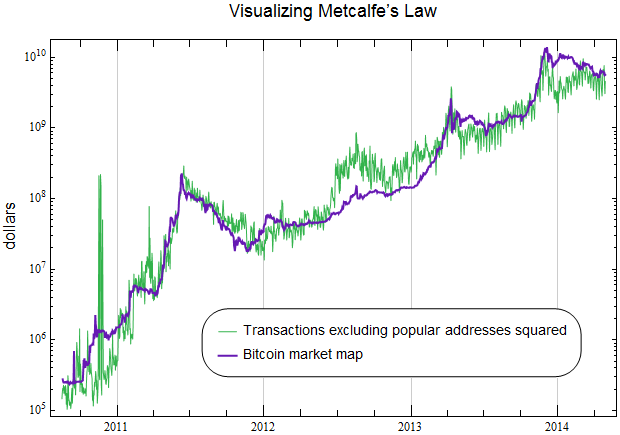
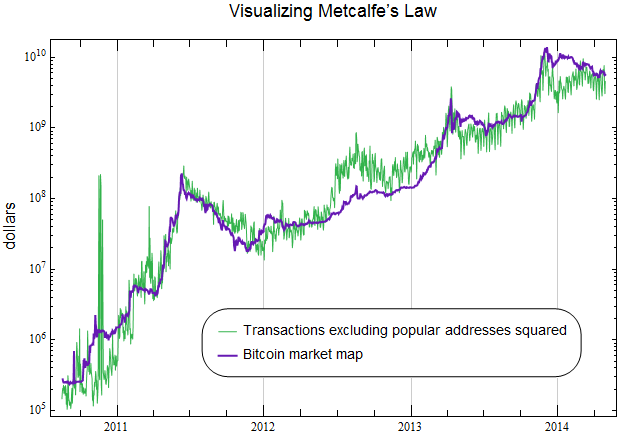
transaction volume excluding popular addresses in green. The axis on the
is the price in dollars. Exactly as Metcalfe’s law predicts, the
transaction volume increases very neatly as the square root of the size
of the network. The correspondence is beautiful. I wish I had thought to
make it first!
diagram. On the original Bitcoin Talk, thread, the green plot has been
labeled as the “Metcalfe Value”, as if it is an appraisal of the Bitcoin
that estimates what it could cost.
money I presented above. In my theory, the value causes the
transactions, whereas in the diagram, the transactions cause the value.
However, it is only potential transactions that cause the value. Past
transactions are of no value to anybody. The present size of the
network and the consequent opportunities is likely to provide tomorrow
will motivate people to buy and sell today.
effect can have serious consequences. For example, many people believe
that it is necessary to spend bitcoins and increase the transaction
volume in order to make Bitcoin more valuable. Of course this is
nonsense; all this does is fill up the network with transactions for
things that nobody actually wanted. That does not present a good value
for a newcomer because he will want a network that presents him with real
opportunities, not just ways of artificially increasing transaction
volume. The more that the Bitcoin network is focused on artificially
increasing the transaction volume to make it look good, the more it
resembles a Ponzi scheme. Rather, to make the network more valuable, we should be hoarders. This is more likely to present newcomers with lots of potential uses for Bitcoin as a medium of exchange.
Appraising Bitcoin
for electronics, but were then to acquire use as money once a network
effect formed around their price, an investor might be excused to call
the price an unsustainable bubble. However, it would turn out to be a sustainable bubble that inflates until it fills the entire economy. At least until Bitcoin came along.
rational appraisal or an investment bubble? The answer is easy, much
easier than with a commodity like gold. Bitcoins have almost no use
other than as a medium of exchange. Thus, the fact Bitcoin has any
price at all is evidence that there is a real network effect. It is
much easier to prove that Bitcoin acts like money than that gold does,
in fact.
for Bitcoin at all is enough to make it function as a medium of
exchange. If demand continues to grow, then it becomes a better medium
of exchange. There is no end to this process because the primary value
of Bitcoin is the network effect surrounding it, not any final
productive use.
prophesy: as more people believe in it as a medium of exchange and
become willing to buy it, they create the very conditions required of it
to make it more useful. There is nothing irrational, therefore, in
treating Bitcoin’s price as the cause of its value and no reason to
expect the momentum in its exponential upward trend to cease.1
Conclusion
hands, click your heels together three times, and believe in Bitcoin! It
will only take faith the size of a mustard seed.
-
This analysis leaves something to explain—if the value of a medium of
exchange is just the market cap, why does Bitcoin go through hype
cycles? Every time Bitcoin goes up in price, that is an increase in its
underlying value, so why does its price ever crash? I don’t know the
answer, but I think I have a reasonable hypothesis: the network takes
time to adjust to the enormous number of newcomers during each hype
cycle. Each member of the network adds value, but this takes time—the
members of the network must learn something about one another before the
value they add to the network is more fully realized. If this effect is
real, then the price could temporarily rise more rapidly than the
growth that the network can support.
Open your free digital wallet here to store your cryptocurrencies in a safe place.