Josh Wise will suit up in the Dogecar two more times this year!
(NewsBTC) Shibes: get ready to start your engines. That’s right, Josh Wise will suit up in the Dogecar two more times this year, it’s being reported. One of those times will be in Sonoma, California, Wise’s home state. That race will take place Sunday, June 22.
For all of the people who make fun of NASCAR for only having left turns, Sonoma will be sporting right turns in addition to some left ones. That means things might get a little crazy so you should watch.
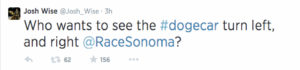
Josh then announced it.

The race god (dogecar backwards) has raced twice in the dogecar this year. Once was at Talladega and the other time was in North Carolina for the Sprint All-Star race, which Wise was voted in as the Sprint Fan Vote winner. Wise finished 20th and 15th in those respective races.
Wise will also race in the dogecar at Talladega for the last known time this year on October 19.
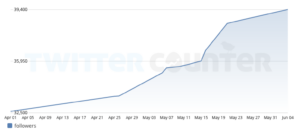
The reasons are obvious. Since Josh’s announcement of the dogecoin partnership his fan base has grown tremendously. Wise’s twitter followers have grown by about 20% in the last three months and the partnership has also helped dogecoin get noticed since the news was featured on several major media outlets.
Dogecoin supporters can only hope this will boost the coins price since another halving day is coming up in 31 days. Usually a lot of miners leave as the rewards lessen, but this comes at a time when scrypt asics are hitting the market. One thing for sure is that the community is on dogecoins side. The community is on their side and CoinGecko ranks dogecoin #2 by its metrics which include community.
Open your free digital wallet here to store your cryptocurrencies in a safe place.
You say Bitcoin has no intrinsic value? Twenty-two reasons to think again!
Intrinsic Value Defined:
we will use the common Wikipedia entry for the intrinsic theory of
value. This is found at: http://en.wikipedia.org/wiki/Intrinsic_theory_of_value
An intrinsic
theory of value (also called theory of objective value) is any theory
of value in economics which holds that the value of an object, good or
service, is intrinsic or contained in the item itself. Most such
theories look to the process of producing an item, and the costs
involved in that process, as a measure of the item’s intrinsic value.
the properties that make it valuable? Some pundits like Warren Buffett
seem to remain stuck in the belief that only things you can touch, feel,
and see can be intrinsically valuable.
are unique or ground-breaking. These properties did not exist before
bitcoin. Some people would rightly point out that many of these
properties can be duplicated. There is, however, one extremely important
factor that separates bitcoin from any other digital coins on the
horizon: the protective shell created by the network that prevents it
from being hacked or commandeered
Bitcoin intrinsic value properties:
- It transcends nations, politics, religions, cultures and regulations.
These vary from country to country in ways that may seem bizarre to
populations out of its own borders. While one may believe that
governments always have their best interests at heart, it may be wise to
see that knife cuts both ways. Some drugs are banned in certain states
or countries that are allowed in others. Bibles are banned from purchase
is some countries. Religion, custom, dogma, superstitions prevent
various purchases based on man-made borders that continually shift over
time. These policies tend to be created by limited segments of
populations that can be self-serving. If one happens to be included in
the “correct” political party, race, religion, items can be purchased or
outlawed. It’s all opinion.
Is this a moral decision? Many of the same governments think it morally
acceptable to hold their own state-lotteries. The lotteries hold
significantly worse odds and tends to target those in the community that
are the least educated and most susceptible to poverty, alcohol abuse,
and have a generally poor understanding of mathematical probability.
Many have gone on to say that lotteries are simply “a tax on people bad
at math”. Many argue that this is a double standard of governments
which prevents them from taking the moral high ground.
the short term). It can’t be counterfeit. There is a record of who owns
it (by wallet id) and its validity is publicly known. It requires no
central clearing house. With any other currency, one must trust the
government from which it is issued will continue to maintain its value
by not “overprinting” to pay for its own mismanagement. You can send it
globally without having to trust anybody. This is not true with any
state issued country, bank, credit card company, or anybody else.
Volatility and long-term trust is still building, but when one transacts
in bitcoin, nobody gets in-between sender and receiver unless agreed
beforehand. It’s permission-less.
By making wallet IDs public, one can track the flow of money through
other transparent wallets. You cannot do that with any other currency.
You can use this feature to do things like monitor your children’s use.
This can make obsolete entire industries that are built solely on the
fact that money can be hidden, disguised, cheated, etc. These can also
happen to bitcoin, but pressure can be applied by the people to make it
transparent and accountable when needed. Auditors may insist on it for
compliance. The list of possibilities of this intrinsically valuable
feature can scarcely be imagined.
Plans for product layers on top of bitcoin to further its use to become
spendable based on contracts that can be programmed to complete with
built in variables, or be valid to purchase only certain items. Insist
your college bound kid buys books and not beer for example. Or based on
GPS in a cell phone, you could send your kids off shopping and it could
be programmed to be spendable only in certain stores.
Wallets containing the currency can be set to only unlock with more
than one signing key. This will leave hackers and thieves frustrated.
Try doing that with your grandpa’s money. It is an intrinsic piece of
bitcoin technology.
Prepaid credit cards can do some of these functions, but only to
locations and countries that accept credit cards. This list of locations
in countries outside of the US is actually decreasing with the amount
of fraud in the networks. Technically, the only item limiting of bitcoin
is the merchant’s acceptance of it. Given the natural law of least
resistance, these limitations could erode as more merchants around the
world realize the potential savings. The network effect will continue to
work its magic.
Absolute clarity of events and their corresponding order is available
in the block chain. Proof of ownership and purchase can be established
without a third party. The trusted and reliable distributed ledger
cannot reasonably be altered (barring a massive scale network attack
which becomes less likely as the network grows).
is nobody’s debt. Paying with bitcoin isn’t a “promise to pay”. It is
payment in full. This could potentially reduces fraud related expenses
on massive scale. http://www.statisticbrain.com/credit-card-fraud-statistics/ There
is no need for a merchant to get bank information or any other kind of
personal information that can be later used in identity theft.
It can defeat government issued capital controls. The same governments
try to hold their own citizens “hostage” monetarily by outlawing
movement of money outside its own borders. Ask any citizen from any
country ravaged by hyperinflation if this is important. Could it be
possible that it might ever become important
in the USA? If you can foresee the day people will be clamoring to get
out of the US dollar, where do you think they are going to go? Ask
Argentina.
As the money exists on the global ledger, all you need is the key. This
can be memorized, or written on any piece of paper – even confined
inside a microdot
the size of the period that ends this sentence. Some old time gold bugs
say you can’t bribe the border guards with bitcoin like you can gold. In
the future, border guards will have cellphones and internet access too.
We aren’t living in the 1960s Vietnam or before any longer.
The people in the USA may think this unimportant in their bubble view
of the world, but is this also true of the 150 or so currencies and countries with terrible track records?
Which other currency enjoys this property? Will enough of the world
outside of the US believe it to be so? Is it hard to imagine the
properties of bitcoin being intrinsically valued by populations
subjected to terrible economic policies? It only takes a billion people
in India fed up with corruption to want an escape mechanism out of the
control of the system. At that point, they won’t give a hoot about what
some American pundit said on “bubble vision” about intrinsic value.
If the citizens stand up united and demand a transparent government,
they can use bitcoin to follow the money in the same way governments use
powers at their disposal for surveillance on their own populations. In
today’s world money corrupts. In tomorrow’s maybe it will become
vice-versa. Let’s see if 86% of the world agrees that any tool that makes less opportunity for corruption is valuable.
You can program it to settle contracts based on certain events such as
date, proof of ownership, death, or a host of other factors that can be
validated programmatically without a third party to validate if the
conditions were met. It can be used as a record keeping asset tag, and
proof of ownership. Ownership of the private key to the bitcoin is by
definition, the owner. In addition, it can be the source record of
ownership for property title, copyrights, and intellectual property that
transcends borders and locally interpreted laws. In effect, the
records become the de-facto “single source of truth”. The currency
itself is globally accessible proof of ownership. Can these functions
and properties be reasonably argued to be valuable beyond the currency
itself?
Paying for items in a global world requires bank accounts. Bank
accounts are legal properties that can only be established with those of
legal age (18 in most locations). There is no minimum age requirement
to pay for items globally using bitcoin. How many people under 18 have
cell phones, AND need to spend money with no credit card. Smart
businesses have started to recognize this intrinsically valuable
potential.
The main attributes of money are often quoted these days, but one
attribute is rarely mentioned. Money has become surveillance. As people
continue to learn of the horrors of the NSA and other government efforts
to spy on every aspect of their lives, it only takes one person drunk
with power to make all the well-intention sounding policies reverse into
shocking horror. One government required Jews to register themselves
for easy identification, which was then used to “dispose” of them.
national origin, political party, age, place of work, address, and much
more can be determined by how and where one spends their money. To those
who think they have nothing to worry about because they are not doing
anything wrong, might ask themselves, what did the Jews have to fear
during the time they were self-registering? They also were not
(generally) doing anything wrong. That’s only one example in a history
littered with them. Is the ability to obscure one’s spending habits
intrinsically valuable? Is it possible to imagine how much of the
population of the world would think it is?
If one were to transfer value between large companies or nations, much
of the world has discovered bitcoin to be a very efficient payment
network to do this. If bitcoin was thought of as envelopes to be stuffed
with dollars or other currencies for transport, only the size of the
envelope itself that contains the dollars inside would be the limiting
factor. To increase the ability and usefulness of this feature, the
envelopes represented in bitcoin price will have to inflate enormously
to take on that load. The Federal Reserve and former Vice Presidents have caught on. So has smart Venture Capitalist firms that have a knack for being one step ahead of everybody else.
are being built up around the new currency (in use, if not government
recognition). Gold towns sprang up into eco-systems but crashed when
the gold veins ran dry. We know exactly how deep the bitcoin well can go
and the rate at which it will be found. What other modern day
ecosystems are being built because of the intrinsic values of a
currency?
for centuries. Bitcoin has the possibility to change the paradigm
completely. These banks will likely find ways to maintain their power
and wealth and there is nothing preventing them from moving into digital
currencies to maintain it. However, which other currency has the
possibility to change the dynamic? Many in the world will likely place
much value in the paradigm shift that is possible. When was the last
time a monetary unit threatened to rewrite the rules from the ground up?
from a whistleblower from the World Bank reports that all networked
banking infrastructure throughout the entire world can be traced back to
12 people who make decisions at the privately controlled US Federal
Reserve bank. Consensus driven, public records, and democratization of
money made possible by bitcoin, might change the rules.
the poverty riddled villages with no access to banking were able to
lift themselves out of poverty with simple abilities to pay suppliers
and start businesses. With the cross border scale and usability of
bitcoin, imagine the same results x 1,000. Are there any national
currencies up to this task?
Muggers of the future will be at a loss for what to do with the bitcoin
they can’t take from your wallet or purse. That money will be no good
to them without the private keys to spend it. There likely will no
longer be credit cards there was well. Could robbery itself become
obsolete? Hackers will soon have a difficult time stealing money from
multi-signature wallets.
Because of all of the reasons stated above, it might as well be called
the currency of freedom. Dictators will hate it. Totalitarian
governments will hate it in proportion equal to the amount of corruption the government enjoys.
The worst countries for freedom believe that money exist primarily to
serve the country and personal ownership of it is just an illusion they
can confiscate at will. Banks technically own it as soon it’s deposited.
Through court order, government taxation, or inflation, they always get
it back. Bitcoin offers some protection. We become our own bank.
Others might be open to the suggestion that if just ONE of these
factors is agreeable to most reasonable people, the description used by
Wikipedia might also be applied to bitcoin. A year from now, there
might be another list compiled that is just as long as this one – of
things that can’t possibly be imagined today.
Open your free digital wallet here to store your cryptocurrencies in a safe place.
How Purse.io can shave 25% off Bitcoin buyers’ Amazon bills!
buyers’ discount to incentivise bitcoin owners to ‘sell’ their digital currency.
“I think people that try it and realize they just saved 25% on Amazon are excited about that possibility. For the first time, they’ve been able to do something useful with bitcoin [rather than just buy and hold].”
How it works
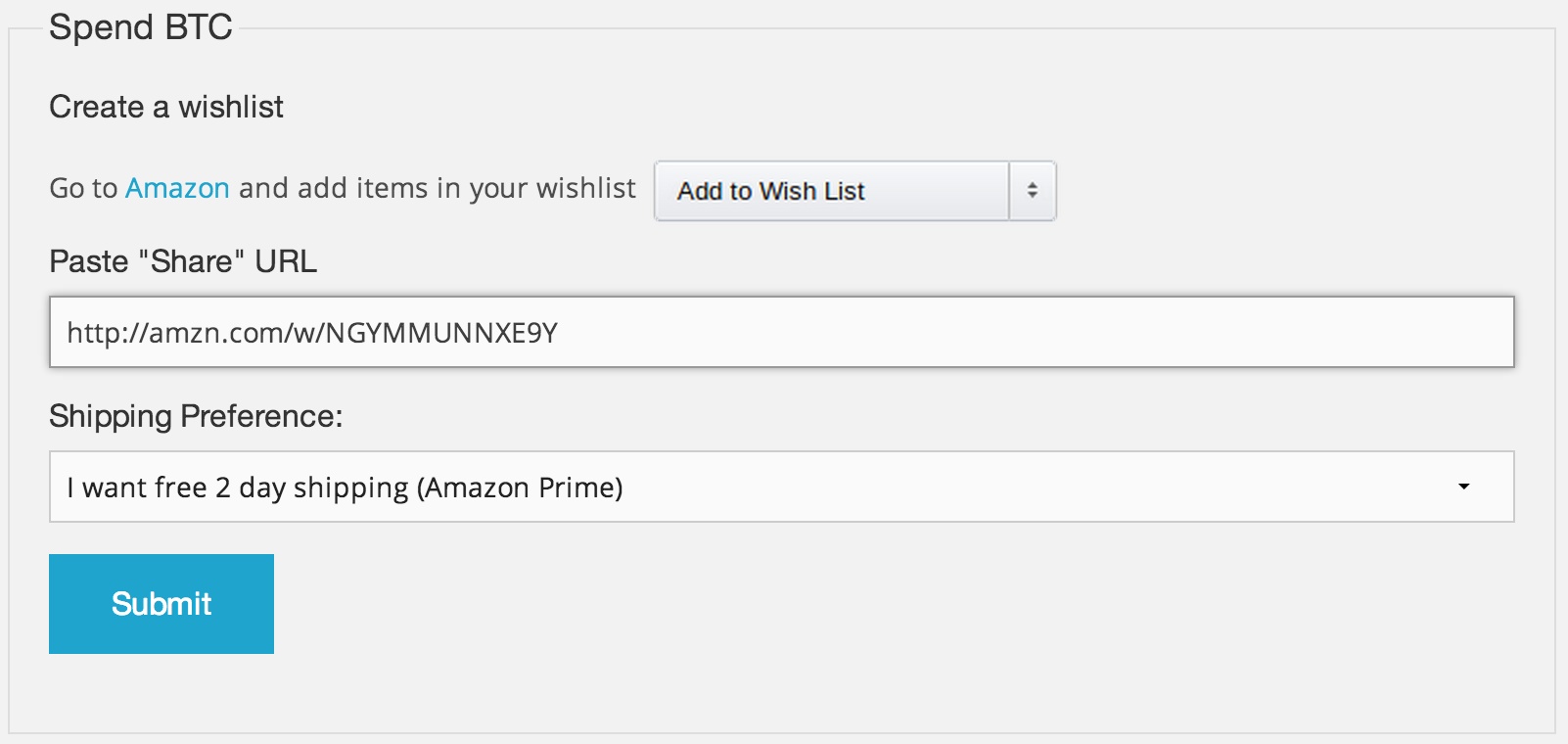
Then, using a ‘share’ URL, she imports her Amazon ‘wish list’ into Purse.io and indicates what level of discount she would like for the items.
list using a credit card. Soon after, the items are shipped to Alice. Once the items have been received, Alice notifies Purse.io, at which point her bitcoin is released from escrow and is sent to Bob (see the company’s explanatory video below).
“Anything below 15% at $500 [total price], […] will get taken.”
All about incentive
Easing bitcoin’s on-ramp
The top liquid markets for bitcoin are in USD, EUR, HKD and CNY. Source: Bitcoincharts
Spending credits
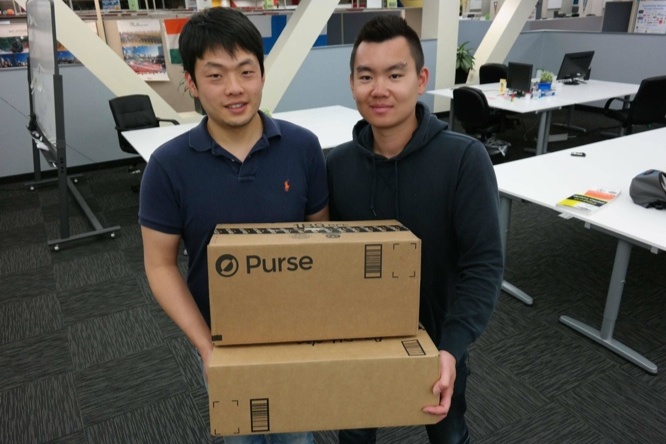
Purse.io founders Andrew Lee (left) and Kent Liu (right).
providing a service that is in demand. “We think we’re helping [Amazon],” said Lee. “They don’t want to take bitcoin now. They’re not ready for it.”
Furthermore, there is added complexity for the company compared with other retailers that currently accept the digital currency.
website are not sourced from Amazon itself, creating complexity that the likes of TigerDirect and Overstock don’t have to deal with.
Trustless escrow
“Right now, we are holding people’s money. But we don’t want to do that.”
Building a footprint
Lee and Liu have now brought in some extra hands as far as development goes and they hope to raise more funding, in addition to the seeding that Plug and Play provided.
“We’re generating that userbase as long as this Amazon window is open. At the same time, we’re continuing to develop new services we can offer to these users.”
Open your free digital wallet here to store your cryptocurrencies in a safe place.
Poland gets first Bitcoin ATM with 30 more planned
the country’s first bitcoin ATM freshly launched in the capital Warsaw
and many more soon to follow, according to the operators.
set up to act as a hub for the Warsaw’s rapidly expanding bitcoin
scene, Piotr Hetzig, the company’s chief executive, told CoinDesk.
Launching the bitcoin ATM in the heart of Warsaw was aimed to boost the
visibility of the cryptocurrency in Poland, he explained.
the company’s plans go even further than that. A second ATM is to be
made available shortly in the Polish capital, with a network of bitcoin
vending machines eventually to be rolled out across the country.
the end of this year, as many as 30 bitcoin ATMs enabling [people] to
purchase and sell bitcoins are expected to appear in various parts of
Poland,” the operator said.
wide range of services tailored for bitcoin enthusiasts, as well as for
those who want to make their first step in the world of digital
currencies, according to Hetzig.
sessions, consultancy services, meetings and events, as well as sales of
hardware for bitcoin mining. Initiatives to raise public awareness of
the cryptocurrency are also planned.
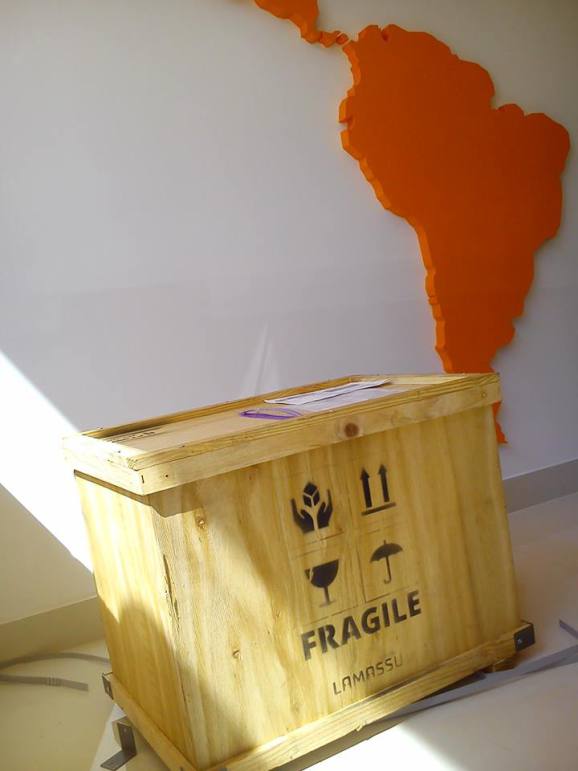
new Lamassu ATM is now open for business and can be found at Bitcoin
Embassy Warsaw on 46 Krucza street. Opening hours are currently Monday
to Friday, 10am to 6pm, but may become available 24/7 in the near
future.
Denmark gets its first bitcoin ATM
“The Dubliner is an excellent place to [site] a bitcoin ATM, since they have a
lot of customers and long opening hours. The pub is also located very
centrally near the Stork Fountain, which is the center of Copenhagen’s
shopping district.”
Bitcoin centre and ATM launch in Prague
and was set up to provide face-to-face services for those unfamiliar
with digital currencies, as well as consulting services to registered
clients.
in the country’s digital currency market, with workshops and seminars
designed to increase bitcoin’s visibility in the Czech Republic.
centre is located on the corner of Arbesovo náměstí and Elišky Peškové
street, with the Robocoin ATM available from Monday to Friday, 10am to
7pm, with a single transaction limit set at 25,000 CZK ($1,200).
Open your free digital wallet here to store your cryptocurrencies in a safe place.
NYC Bitcoin Center gives Bitcoin a touch of class
(CoinTelegraph) NYC Bitcoin Center is
fast becoming a mecca for hip Bitcoin-related events with the launch of a
contemporary art exhibition by Jenna Lash this week.
festival, the center is
branching out to an ever more diverse demographic of Bitcoin followers, and
continuing to attract some noteworthy names.
pointillist painter Lash has an international following for her work, and a
selection of those indexed under her Monetary Series collection will be
displayed in New York until September.
“The artwork in this exhibition is a visual
conversation about the exchange and aesthetic of money,” she said in a press release about the event, “The highly-charged images of currency and
how they represent personal values that become public values are the focus of
this exhibit.”
Mirroring opinion
“Highly-charged” indeed, as the Bitcoin community is making
ever more significant waves in modern opinion of traditional currency and the
structures surrounding it. “Money is an abstract concept based on
faith,” Lash continues, “…Will we continue to need vaults, gold, soldiers,
and insurers to protect that faith? Or will virtual currency be our
saving grace?”
which “run the gamut of U.S. military
scrip, a U.S. silver certificate incorporating a Native American portrait, the Australian
Dollar, the Chinese Yuan, and two British Pound Notes, to highlight only a
few,” are hardly understated, some measuring up to 48 inches by 60 inches
(122 centimeters by 152 centimeters).
Spanos said he was excited about hosting the event, as Lash and her husband had
been regular visitors in the past. “We intend to give
the exhibition of these paintings the attention, care, and seriousness that the
works themselves demand,” he continued.
launch party tomorrow (May 29), and while not offering free energy drinks or
featuring sponsorship by the New York Museum of Sex as was the case with the
center’s music festival, it will provide a less business-oriented environment
for Bitcoin and cryptocurrency education to be spread.
the exhibition can be found here.
Open your free digital wallet here to store your cryptocurrencies in a safe place.

Twenty mind-bending secrets about Bitcoin
(BitcoinMagazine) This article will introduce some of bitcoin’s Mind-Bending amazing
abilities only few people know. As you read this list, remember your
favorite so can impress your friends with your new
incredible bitcoin knowledge.
1. Fun with programmable money
- Bitcoin wallets are like personal debit cards that you can create
and assign yourself to store your bitcoin. Some new wallet versions can
be programmed with bizarre abilities. - You can program features like GPS coordinates on your phone that make the money unavailable off if your kid leaves the city.
- You can also create “treasure hunts” where coins will suddenly be
released for you to use if you find yourself in the right place at the
right time. - You may also release money by calendar dates – gifting bitcoin
money that can’t be used until their 18th birthday or Christmas. Or set
up a will that releases amounts in intervals long after your death. - Huge potential for ideas not yet imagined.
2. First purchase with bitcoin
- Bitcoin’s price wasn’t established by a committee, government, or special council.
- Florida resident Laszo Hanyez may go down in history for buying the
most expensive pizza ever recorded. He also makes history for making the
first significant purchase using bitcoin. - His 10,000 bitcoins used in June of 2010 bought two Papa John’s Pizzas worth about $30 at that time.
- Today’s equivalent price is about $5 million.
- For the first 18 months they were worthless. The pizza purchase was
the event that set the price of bitcoin at about a third of one penny
each. - Within weeks, they were being bought and sold for 8 cents, representing a price increase of over 1,000%.
3. Bitcoins to billions
- In 2013 the price of a single bitcoin went from $13 to over $1,000 for an increase over 7,000%.
- At that rate, the owner of one bitcoin today would be a millionaire in two years.
- And would become a billionaire only 18 months after that.
4. Bitcoin is not alone
- Thousands of other digital currencies have since been created once bitcoin became popular.
- Litecoin, Peercoin, Dogecoin and many more can be purchased on various online exchanges.
- Thousands of people buy altcoins, hoping the bitcoin lighting strikes twice.
5. World’s fastest supercomputer
- The current computing power protecting the Bitcoin network is over
6,000 times more powerful than the top 500 supercomputers of the world
combined. And still growing faster. - Computer power is measured in “petaflops”. One petaflop is equal to one thousand trillion calculations per second.
- Top 500 supercomputers combined can calculate 250 petaflops. (Indicated by the arrow on the graph below).
- By comparison, the bitcoin network can calculate 883,000 petaflops.
- It is roughly the equivalent in scale between eight sticks of butter verses the largest 15,000 pound African Elephant.
6. The amazing bitcoin wallet
- Before you buy bitcoin you can create your own personal bitcoin wallet before you fund it.
- The number of possible wallet IDs that can be created are roughly the same amount as atoms on the earth.
- You can create as many as you want. They are free.
- New wallets can be secured with two or more passwords.
- You can also print your wallet to make a “Paper Wallet” that allows you to store your bitcoin off-line.
7. Spend bitcoin with smart phones for everyone
- The $25 smartphone is on the way.
- It is estimated that in 2014 there will be more cellphones than people on earth.
- Many poor countries just skipped land-line telephones and went straight to cellphones.
- Where they don’t have electricity, they charge them daily using solar panels.
- Most developing countries do not have access to banking – but the bank can come to them with bitcoin and a smartphone.
- Sending digital cash has already proven to lift entire villages out of poverty.
- This opens up their entire world from which to buy and sell items rather than just a few neighbors with cash on hand.
8. Magic the Gathering and bitcoin
- The first big online bitcoin exchange was Mt. Gox. It got its start and name by trading playing cards for “Magic The Gathering Online EXchange.
- They once accounted for over 80% of all Bitcoin trades.
- They started trading bitcoins when they were worth less than a dollar.
- Unsurprisingly, when the world found out that bitcoins were worth a
lot more than playing cards, the tiny company was overwhelmed. - More than half of all first generation Bitcoin exchanges have closed down.
- Now big finance companies are creating their own exchanges in the US that are regulated and insured.
9. Say goodbye to “Bitcoin” and hello to “Bits”
- Currently, one full bitcoin is divisible down to eight decimal places.
- The Bitcoin community has started referring the the sixth decimal point from a full bitcoin where they will be called “bits.”
- Bits are part of bitcoins as pennies are to a dollar – except it would take a million of them to buy a full bitcoin.
- Calling them “nano-dimes” sounded dumb.
- Today one hundred dollars migh buy you .2 bitcoins. Or it can buy
you 200,000 bits. It’s the same amount, but which one makes you feel
richer? - At some point, we might be able to sing that song (commonly played with hand- drums). “Shave and a haircut.. 2 BITS”
10. Spy Vs Spy. Your bank in a microdot
- Future Bitcoin billionaires can include their entire banking Bitcoin
fortune – in a dot the size of a period. When you have access to any
computer or phone with Internet connection you can simply type in your
account number and password as needed. - Your account is all stored and available to you on the public ledger
available anywhere in the world with an Internet connection.
11. Forget money laundering. Your activity is recorded
- Every transaction is tracked the Bitcoin public ledger, recorded and
shared around the world. The ledger cannot be changed and it’s
continually reconciled, verified and protected by bitcoin’s world-wide
network. - Every time a bitcoin trades hands, a trail of digital breadcrumbs follows it forever.
- You may or may not allow people to know your personal wallet
information, so your bitcoin account is as secret as you want it to be. - Once bitcoin passes through widely known wallet addresses, it may be
traceable by super-secret organizations that may, or may not, rhyme
with Em- essay. - Relax, if you aren’t doing any really, really bad – it’s probably
not worth the trouble for anybody to track your every spend. Not one
bit.
12. Gambling once accounted for most transactions
- The web gambling site “Satoshidice” once accounted for about half of bitcoin transactions.
- Due to murky gambling laws in various jurisdictions, gaming on Satoshidice is currently not allowed from US-based IP addresses.
- Provably Fair (http://provablyfair.org/)
is a website that has risen to act as an independent probability odds
checker for people to validate the odds of customer bets being
mathematically fair for the computers running the gaming systems. - Many online casinos are having their computer programs independently and voluntarily certified.
- Today bitcoin use is spread over several industries in addition to gambling.
13. Watch people trade in their paper money
- The website Fiat Leak shows a world map which allows you to see which country is exchanging their native currency for bitcoin in real-time.
- The larger the coin floating up – the bigger the dollar amount.
- The amounts all accumulate over a 10 minute period, which is the
point that the ledger is reconciled and copied throughout the world for
verification. - Once you go digital, you don’t go back.
- Ask the tape recorder.
14. It might become currency for poorly run countries
- Total value of bitcoin measured in US Dollars has surpassed 100 national currencies out of 160.
- Some are
beginning to ask if it is possible to one day to scrap some smaller
national currencies that continue to fail – and use bitcoin instead.
15. Bitcoin may be more important than the internet
- Several hundred million dollars are projected to be invested into Bitcoin startups by large corporations in 2014.
- Comparisons of importance are made by experts and scientists daily,
who often talk about the importance of how this will change the world
and often compare it with the invention of the Internet itself. - Marc Andreessen, who invented Mosaic, the first web browser, is one of many technical professionals who talk about Bitcoin and
reminds him of how he and his friends changed the Internet and World
Wide Web back in 1993 when it was still considered a techie geek
technology. As a reference point, most of the US was using the internet regularly just seven years later.
16. Watch bitcoin network grow
- See the time-lapse representation of the bitcoin network build out as it assembles and grows together around the world.
- It’s not much different than watching the progress of the early internet grow.
17. Robbing money may become obsolete
- New digital wallets will require at least two signatures (passwords) or more to use.
- This might include government’s robbery of its own citizens as many countries help themselves to one’s banking funds when they want.
- One can require as many signature passwords as you like. Go nuts and
require 51 signatures… Imagine the Senate being compelled to reach
majority before spending your taxes locked in a public wallet.
18. It can stop identity theft
- As making payments with bitcoin is the equivalent of cash, there is no banking information required from a retailer.
- The hacker attack at Target, Neiman Marcus, and Michael’s (among a
host of others) that stole users banking credit card information
wouldn’t have happened if they had only accepted bitcoin payment. - Paying in bitcoin is not a promise to pay. It’s payment in full.
19. No permission required
- Over half of the world have no banking account. They can’t get
access to regular loans, credit or checking account. They can’t get
permission from the creditors. - Bitcoin doesn’t require a bank account or credit report, and you
don’t have to be of legal age for contracts. And they can buy and sell
in a world-wide market for once. They didn’t need permission from the
courts. - One doesn’t need to be a citizen, or have identification or forms to fill out to own it. It requires no government permission.
- You are your own bank. No permission required.
20. Bitcoin the currency is only the beginning
- The Bitcoin network and ledger has features that can also function
as a way to store records of ownership, titles, copyrights and
trademarks, home and car titles. - It can replace the function of a notary public.
- All records are shared and distributed in a central location shared
by the entire world copied on thousands of millions of computers. - As the Internet did to the publishing industry, Bitcoin could
similarly disrupt several other fields or even render them obsolete. - Anybody’s job it is to move funds from one account to another may
need to learn a job as those functions can now be programmed, automated
and transparent. - Bitcoin 2.0 technologies and new start-up companies have already begun.
This list is only the start. Look into the amazing bitcoin and report
back your own found mind-benders in the comments section. Then play
bitcoin trivia with your friends – they may not believe you.
Open your free digital wallet here to store your cryptocurrencies in a safe place.
10 things you should know about Bitcoin and digital currencies
cryptocurrencies, but not all of them are.
to reach a broader demographic than Bitcoin did. As of March, more than 65 billion Dogecoins have been mined, and the production schedule of this
cryptocurrency is in production faster than most.

regulations on digital currencies, but it often warns about investment schemes and fraud. The Financial Crimes Enforcement Network (FinCEN), an agency under the Department of Treasury, took initiative and published virtual currency guidelines in 2013. Many countries are still deciding how they will tax virtual currencies. The IRS is specifically concerned with virtual currencies being used for unreported income.
outline the pros and cons of Bitcoin. The hearing ended up providing a
financial boost for the currency, because US officials talked about it as a
legitimate source of money, as opposed to only discussing its role in illegal
activities.
Wallet for Android runs on your phone or tablet. To store the Bitcoins, you have three options:
doing your own backups.
are responsible for them. Mobile apps allow you to scan a QR code or tap to
pay.
anything happens on their side or it gets hacked, you run the risk of losing
the Bitcoins, so extra backups and secure passwords are suggested.
is, Bitcoins can be stolen in huge quantities, just like money, and with no
centralized bank, there’s no way to recoup the losses. There are several types of Bitcoin ATMs, which exchange Bitcoins for flat currencies. Most machines are expensive and rare, ranging from $5,000 to $2,000. Skyhook,
a Portland, Oregon-based company, demoed a $1,000, machine at a conference this month. It is the first portable, open source ATM.
specific software, which is free and open source. The most popular is GUIMiner, which searches for the special number combination to unlock a transaction. The more powerful your PC is, the faster you can mine. In the early days, it was easy to find Bitcoins, and some people found hundreds of thousands of dollars worth of the cryptocurrency using their computers. Now, though, more expensive hardware is required to find them. Each Bitcoin blockchain is 25 Bitcoin addresses, so it takes a lot of time to find them on your own. The exact amount of time ranges depending on the hardware power, but mining all day could drive your energy bill up and only mine a tiny fraction of a Bitcoin — it may take days to mine enough to purchase anything.
security issues remain, and that will continue to be a problem. In 2013, Mt. Gox, a Japanese exchange, handled 70% of all Bitcoin transactions, but they lost some 750,000 Bitcoins in February 2014 and filed for bankruptcy, and nothing has been proven in the case. Since it’s universal, it’s useful for international transactions, and could be helpful for transactions in developing countries.
Open your free digital wallet here to store your cryptocurrencies in a safe place.
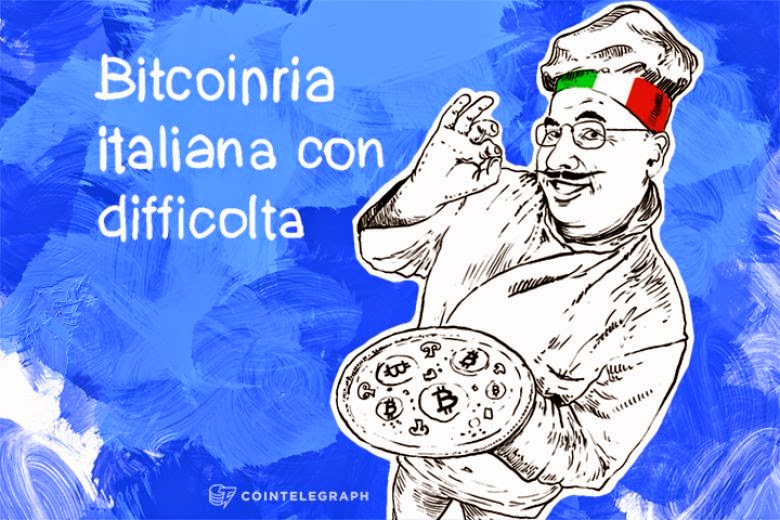
The difficulty of getting Bitcoin to catch on in Italy
first Bitcoin ATM was a Lamassu machine, installed in Udine,
a northeastern city nestled between the Alps and the Adriatic
Sea.
down the stuffed gnocchi.
anyone who needs help using the machine (it’s located in the hall of his family’s business).
He’s even had the interface translated into the local Friulian language, as
well as Italian.
his next step at this point is to install more machines around the country.
though.
Legal Obstacles
regarding Bitcoin, forcing him to operate in a grey area with which many
Bitcoin entrepreneurs are familiar.
pool of attorneys and legal experts advise him on what he could and could not
do. Italy,
they told him, does not regulate Bitcoin itself, nor are there any
know-your-customer regulations, but any transactions above 999.99 EUR need to
be reported.
“The use of electronic
currency is restricted to banks and electronic money institutions — that is,
private legal entities duly authorized and registered by the Central Bank of Italy.
Aside from these developments, Italy
does not regulate Bitcoin use by private individuals, and currently the
implementation of initiatives concerning the use of electronic currencies lies
with the EU.”
technology.
“Banca d’Italia is
studying the [Bitcoin] phenomenon, and perhaps — if they were fast — in 10-20
years we could have a law on it.”
local perception is something else entirely, Dordolo said.
“In Italy, we are at the beginning of
Bitcoin’s spreading among the population. There is an interesting Bitcoin
community [in Italy],
but it is still very hard to explain to Italian people the real value that
Bitcoin creates in the economy and the job opportunities it creates.This is because of
misinformation by the national media that actually regard it as a scam or worst
as associated with criminal deeds.Even the local Bitcoin
Foundation is not as active as it should be, so whatever can move this
situation is welcome.”
Open your free digital wallet here to store your cryptocurrencies in a safe place.
Satellite TV operator Dish Network to accept bitcoins!
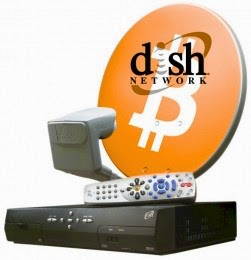
Satellite TV operator Dish Network said it would accept bitcoin payments from customers from the third quarter, joining companies such as Overstock.com Inc and Zynga Inc in accepting the digital currency.
Dish said it selected Coinbase as the payment processor for bitcoin transactions with customers who choose to pay their bills online with the bitcoin wallet of their choice. Bitcoin is a digital currency that is not backed by any government or central bank and is bought and sold on a peer-to-peer network independent of central control.
In March, it launched its Instant Exchange feature, which will be used by Dish to convert bitcoins to U.S. dollars. Dish’s third quarter starts on July 1. While bitcoins may not be an alternative to established currencies, they can cut the cost of moving money around.
“We always want to deliver choice and convenience for our customers and that includes the method they use to pay their bills,” Bernie Han, Dish’s executive vice president and chief operating officer, said in a statement. “Bitcoin is becoming a preferred way for some people to transact and we want to accommodate those individuals.”
PricewaterhouseCoopers estimates that credit card companies charge around 3 percent in transaction fees and PayPal’s commission can go as high as 4 percent. The same transactions via bitcoin is likely to be free.
Open your free digital wallet here to store your cryptocurrencies in a safe place.
On the origins of money: Darwin and the evolution of cryptocurrency
(CoinDesk) Charles Darwin first published his theory of natural selection in his book On the Origin of Species
in 1859. The result of over 30 years of research, Darwin delivered to
the world a new understanding of how modern species came to be, evolving
over generations.
The son of a wealthy English family, Darwin was not a man in need of money. Nonetheless, for On the Origin of Species and his other publications, Darwin received royalties that were most likely paid in British Sterling.
Still in existence, the British Pound has origins dating back as far as 750
A.D. making it the world’s longest-surviving active currency. At the
time, I wonder if Darwin recognized that the very currency by which he
was being compensated would one day be subject to his very theory of
natural selection?
It is a realization that would become far more evident 150 years later with the advent of blockchain technology.
For the fortunate minority throughout history, as with Darwin, a given
currency is not subject to question. It serves as the accepted means of
exchange and is recognized as such from the time one is old enough to
understand value.
In this way, currencies are not understood as subject to the laws of natural selection. For the less fortunate
majority throughout history, and likely for more fortunate generations
to come, this may not be the case.
Natural Selection
Natural Selection can be defined as the process by which specific traits become
more or less common in a population over time and it serves as the
foundation for the theory of evolution. It is the result of the relative
success or failure of these traits competing in a given environment.
Put more simply, it embodies the concept of “survival of the fittest”.
Darwin famously defended his theory by describing the various species of
finches observed on the Galapagos Islands.
He noted 13 separate species of finch within the ecosystem, each with its
own unique food supply. The key differentiating trait between each
species was the unique structure and size of beak. Darwin argued that
each specie of finch had evolved as the result of varied food supply,
where each beak was the best suited to each specific food source
available within their environment.
The law of natural selection is most often observed in nature but can also be applied outside of this
realm. Corporations are forced to continuously compete and evolve to
remain relevant and profitable. Those corporations with the necessary
traits such as the ability to innovate, adapt and comply with
regulations succeed, while many more go extinct.
Whatever the environment may be, specific traits prove advantageous while others do
not. It is in understanding which traits provide advantage and which do
not that once can better understand how the fittest survived, and
furthermore predict who the fittest will be in the future.
The Traditional Traits of Money
Before we can understand how natural selection applies to currencies, we must
first define the traditional traits that have been used to characterize
them. For the purposes of keeping in line with the language of Darwin,
we will refer to what is traditionally stated as a property of money as a trait.
Table 1.0 displays the commonly accepted traits that characterize money as well as an
estimated rating as to the ability of each specific medium, in this case
gold and fiat currencies, to fulfil these traits within the modern
environment on a scale of High, Medium, and Low.
While the ratings of these traits are subject to debate, the table below provides a relatively accurate representation.
Gold has long served as an established means of exchange as well as a
commodity. Gold coins were adopted by King Croesus around 550 BC. King
Croesus was no fool. He selected gold as it fulfilled many of the
necessary traits to act as money.
Relative to the era, it was highly fungible, non-consumable, durable and scarce. These traits were
strong enough to become a leading form of money simply because there was
nothing else around that fulfilled these requirements as well.
But why did the king not select stones or feathers? The answer is that
these forms failed to be fungible, highly divisible, secure, and scarce.
The fact that gold has remained a valued commodity for thousands of years speaks to the
importance of these specific traits. In fact, the combination of traits
possessed by gold and other precious metals eventually provided the
foundation for the next evolution in money, fiat currency.
In money’s next evolution of specie, fiat currency fulfilled several
critical traits to an even greater degree than gold. Paper was more
portable and could be more easily transacted. That is not to say it was
entirely superior. In many cases fiat currencies lacked durability, and
as we will see, would eventually become less and less scarce. In fact,
many fiat currencies have failed due to inflation; a inevitable result
of the inability of the currency to remain scarce.
As a specie of currency, fiat currencies were not perfect but nonetheless
flourished in the last millennia. But how can this be? Are the benefits
of better fungibility and transportability really that significant as to
reign as the dominant specie of currency for so long?
In reality, much of the credit for their rise, survival and success is due to the
existence of another less recognized trait. The trait of centralized
sovereignty lead to the creation and issuance of hundreds of new forms
of money. Table 2.0 displays the degree to which gold and fiat
currencies fulfill the traditionally recognized traits of money in
addition to the newly recognized trait of sovereignty.
As of May 2014, there were 193 recognized fiat currencies in circulation regularly competing in global markets.
Each of these currencies belong to the same specie, fiat. It is important to
recognize that dollars, euros and yen were not mined or extracted from
the environment. These are man-made; designed and issued by centralized
authorities.
For centuries, the specie of fiat currency has thrived as a result of this fact and that these forms of money could be
used to pay taxes. In the course of its existence fiat currency has
evolved from a hybrid, by which the currency has been backed by a valued
commodity such as gold, to a self-standing form of money with no
physical backing.
During this period of time, the most notable trait to have changed for the world’s most widely recognized fiat
standard, the US dollar, has been scarcity. Once backed by gold, the
dollar was severed from the commodity in 1971 and as a result its
scarcity is no longer a trait that the specie of fiat currency fulfills.
In fact, to the surprise of many, there no longer remains a single fiat
currency in existence that is backed by gold. This evolution, or what
could possibly be regarded as de-evolution, of fiat currency as a specie
may have significant implications on its ability to compete and survive
in an environment with dynamically changing conditions.
Cryptocurrency and the New Traits of Money
The invention of the block chain has given rise to a new specie of currency, that of cryptocurrency.
The arrival of cryptographic-based currencies has enabled key new traits
previously not possible with traditional forms of money. Furthermore,
the realization of such traits will likely have a dramatic impact on the
environment in which these currencies compete.
Table 3.0 now includes the specie of cryptocurrency when rated against the
traditional and newly realized traits of money. The two newly-realized
traits include the following:
- Decentralized:
Defined as the delegation of power from a central authority to regional
and local authorities. With regards to block chain-based
cryptocurrencies decentralization implies a trust-less and distributed
network. This trait is a dramatically new innovation as a direct result
of the invention of the blockchain and was impossible with any other
prior form of money. - Smart (Programmable): The
trait of smart currency indicates the capability to fulfill a growing
array of functions still yet to be determined. Existing innovations in
the cryptocurrency space foreshadow the potential that currencies could
be designed as such to not only act as currencies but represent other
forms of value as well.
Survival and Extinction
Extinction can most simply be described as the failure of a specie to compete in
an environment to such at a degree that it eventually ceases to exist.
The inability to compete itself may be the result of two primary causes;
increased competition from superior species or a dramatic change in
environment.
For the dinosaurs, particularly land-based species,
the traits of size and strength were essential to their rise to
prominence. Although these traits enabled them to thrive for centuries
they did not allow them to compete as a specie forever.
The advantages they enjoyed at the time also meant that they required large
consistent amounts resources, most particularly food and oxygen. As a
result, at the end of the Cretaceous Period many specie were unable to
survive what is widely believed to have been the arrival of a
earth-shaking comet known as the K-T Event.
Evidence suggests that a large comet impacted earth and darkened the sky with dust and ash.
The blocking of the sun starved sun-dependent plant life and resulted in
a sharp reduction to the supply of oxygen.
The Journal of Geophysical Research-Biogeosciences estimates that this event killed off
75% of species. The traits that had once helped dinosaurs flourish now
proved to be the traits that left them susceptible to extinction.
Meanwhile, studies show that the freshwater organisms of the time only lost 10% of
their species. The commonly accepted explanation is that the freshwater
species were already conditioned to endure annual winter freezes where
their oxygen supplies were diminished.
Their relatively limited dependence on oxygen insulated them from the effects of changes to their
environment allowing them to survive. Dramatic changes to the
conditions brought on by the K-T Event changed the paradigm and a new
combination of traits became necessary to ensure competitiveness and
survival. Meanwhile, the majority of land-based species disappeared
forever, their greatest strengths having become their greatest weaknesses.
Currency, like the dinosaurs, has already shown us that it is not always the immediately dominant specie that will survive
the test of time. In an era that has seen hundreds of highly evolved
fiat currencies go extinct, gold endures.
Charles Darwin’s theory of natural selection originated to provide an evidence based explanation
of the past. We now leverage this theory to look forward and understand
its implications on the future of currency. Given the ever-changing
conditions of the future, will gold and fiat currencies continue to compete or go the way of the dinosaur?
The New Paradigm – Currency Competition
According to a study of 775 fiat currencies by DollarDaze.org the average life expectancy of a fiat currency is 27 years. The study
also indicated the most common causes of any given currencies extinction are hyperinflation, monetary reform, war and independence.
With fiat currencies being so susceptible to failure, gold has long served as an alternative as it is more scarce and durable. In terms of scarcity, fiat currencies can be printed and inflated at the will of their authorities.
With regards to durability, the US Federal Reserve
estimates the longest average lifespan of any paper bill is 15 years
($100 bill) with the shortest lifespan being 3.7 years ($50 bill). As a
result, gold has maintained a relatively high value in the era of fiat
currency and remains the primary alternative store of value when faith
in fiat currencies waiver. In this way, these stores of value have
primarily competed based upon only two of the traits of money; scarcity
and durability.
Fiat currencies and commodities now enter a new
paradigm where money can exist that possesses even more dynamic traits.
Gold and fiat currencies are not capable of possessing the newly
inherent traits that would make them decentralized or smart
(programmable).
Cryptocurrency has arrived adding heightened
competition. To date, bitcoin is the most widely recognized
cryptocurrency, but it is not alone. In the 5 years that
cryptocurrencies have existed over 200 have been established and the
list is growing.
Furthermore, the currencies themselves are in a state of hyper-evolution
as they continue to take on a varied array of distinctive traits that
set them apart from one another within their own competitive ecosystem.
Equally as threatening to traditional forms of money, the conditions of the
environment in which currencies compete is in a constant state of
change. Undertones of growing distrust in centralized entities encourage
populations to considered alternatives stores of value.
Sovereignty,
once a trait that was necessary for the survival of a currency, may now
be falling out of favor. Centralized failures such as the US financial
crisis of 2008 or hyper-inflated fiat currencies such as Zimbabwe
dollars or Argentinian pesos compound these sentiments. The most
profound of these conditions is the growing awareness throughout the
world that decentralized trust is possible.
It is interesting to imagine what Charles Darwin would make of the current state of currency.
History would have us believe that the existence and survival of any
entity, be it plant, animal, corporation, or currency is the subject to
the laws of natural selection.
With this understanding, it is hard to imagine Darwin contesting the opinion that cryptocurrency will prove
a competitive force against traditional specie of money.
Ultimately, the real question may not be whether or not Darwin would predict the
survival of cryptocurrency, rather would he be willing exchange those
British Sterling pounds for it?
Author Bio:
Ryan Walker is an independent
consultant and cryptocurrency enthusiast based out of Denver, Colorado.
Here, he joins the dots between Darwin’s theory of evolution, fiat money
and the rise of cryptocurrencies.
Open your free digital wallet here to store your cryptocurrencies in a safe place.