
Bitcoin Society CEO: Why digital currency is a tool for global good
(CoinDesk) The weekend before last week’s Bitcoin2014 conference in Amsterdam, 22-year-old Matthew Kenahan had a choice to make – one that he said was “probably one of the most difficult decisions I’ve ever had to make”.
rewarded with not only winning the award for ‘Most Impactful Charity’, but also for ‘Bitcoin Champion’ after Andreas Antonopoulos was unable to accept the prize due to a conflict of interest.
My sincere thanks to anyone who voted for me in the blockchain awards. I apologize for not being able to accept due to conflict of interest
— AndreasMAntonopoulos (@aantonop) 16 Maggio 2014
Tool for charity
we’re trying to connect people,” Kenahan explained
“[Bitcoin] allows you to create a unique address, for a very specific cause […]
we see both the incoming and outgoing transactions, and we can see that
it’s used for a very specific cause.”
Image problem
Future plans
Open your free digital wallet here to store your cryptocurrencies in a safe place.

Bitcoin backers work to make it mainstream
geeks and enthusiasts had dreamed of: an international, decentralized,
anonymous, and transparent virtual currency that could potentially
replace inefficient traditional ones.
the Wall Street Journal, Bitcoin participation requires “a certain
faith in the benevolence of strangers.” But instead, the general public
is ambivalent at best about the virtual currency, while
many Bitcoin-related startups fight an uphill battle to convince the
world that it is at least comparable to its established counterparts, if
not better. Some retailers are pro-Bitcoin as well. Overstock.com and
TigerDirect now accept it as payment.
some time, are also bullish on the future of the digital currency and
believe there should be easier ways to invest in it. They established
their fund for people who are eager to invest in the currency, but who
don’t want to actually own bitcoins. Their first-of-its-kind
exchange-traded fund can be bought and sold on the public markets like a
stock or an index fund. Previously, people interested in trading
bitcoins as an asset class had to store the currency themselves and take
on the risk that goes with that. The brothers were recently quoted
saying their business will remove “the friction of buying…while offering
similar investment attributes to direct ownership”.
longstanding obstacles to its viability as a consumer product. It’s
likely that in the coming months new services will continue to emerge
that aim to make Bitcoin mainstream.
Open your free digital wallet here to store your cryptocurrencies in a safe place.
Andreessen sees bitcoin as the ‘big breakthrough’
Marc Andreessen, the tech entrepreneur who rose to fame as one of the founders of Netscape, takes the latter view, going as far as to say that in 20 years we will be talking about bitcoin the way we now talk about the Internet.
Andreessen argues that it has the potential to actually be a safer form of ecommerce than the credit card-based system that is currently in place.
Open your free digital wallet here to store your cryptocurrencies in a safe place.
The Rise of Cryptosponsorships
Dogecoin, the Internet meme turned cryptocurrency, has never had trouble gaining publicity. In January the Doge community sponsored the Jamaican bobsled team at the Sochi Olympics, then in March the Dogecoin subreddit sponsored NASCAR driver Josh Wise at Talladega Speedway. It was an idea, it seems, that has spawned a host of imitators.
For those who don’t know, this is an annual road race from France (this year the starting points are Paris in the north and Bordeaux in the south) down through Spain to Marrakesh, Morrocco. The race is only open to students aged 18 to 28, and they may only use Renault 4 cars. The teams have 10 days to make it from start to finish, over a course that includes 1,500 miles of harsh North African desert. Established in 1997 in Rennes, the 4L Trophy is mainly done to provide children with school supplies. This year an estimated 80 tons of school furniture was delivered by 2,648 students representing 1,324 teams from 1,460 colleges. With a market cap of less than $200K at the time of this writing, it is unclear if the KARMA team will be able to raise the funds necessary to participate in the race, With a volume of 50 billion KARMA in existence, it seems that they wish to compete with both doge and Reddcoin as the default tipping currency for the internet, so this could see the value rise as people buy KARMA to help sponsor the team.
 |
|
Image courtesy: abc.net.au
|
Another athlete being sponsored by crypto is Elsa Hammond who is attempting to row 2,400 miles across the Pacific Ocean from California to Hawaii in the first Great Pacific Race. Consisting of soloists or teams up to four, there are no sails or motors allowed, making this is a grueling test of physical and mental stamina. To help offset the cost ($336,000) Ms. Hammond, the only European contestant in the race, is asking donors for $70 (42 Pounds Sterling) per mile. In exchange Hammond will add your special woman’s name to her boat. She has also secured a sponsorship from Ultracoin whose founder has promised “substantial” amounts of Ultracoin after the completion of the event. With Ultracoin set to peak at 100 million coins the term “substantial” could really be anything, so that will be interesting to watch.
At the time of this writing Ultracoin has a market cap of over $400,000 and sell for roughly $.03 each, so the sponsorship could be significant. This would definitely be a good thing for Hammond since she plans to donate to gender equality charity The Great Initiative, as well as the Plastic Oceans Foundation.
VERTCOIN
Open your free digital wallet here to store your cryptocurrencies in a safe place.
Top 5 national altcoins available today!
of the gate and make an impression on the world. However, some digital
currencies are not intended to be used across the globe. Instead, they
are implemented within a country’s economy in order to help boost the
nation’s finances.
the concept of bitcoin, and use it locally. In most cases, national
coins are not allowed to be used outside of the country, as their is
fear that the value of such coins will fall. This alternative to using
money keeps the government separate from cash, all the while putting
power in the hands of the people.
National Altcoins
5. Swiftcoin
most national altcoins, swiftcoin can not be mined off of a
computer. Instead, swiftcoins are purchased with cash or bitcoin. They
can also be earned by selling goods and services using Oswift.com.
Uruguay, and allows locals to set up accounts, as well as buy and sell
digital coins like bitcoin and swiftcoin for cash or precious metals.
4. Isracoin
is already one of the world’s most successful national altcoins. The
digital currency allowed for public mining on March 26th, and was
airdropped to citizens on May 6th.
four phase process to get more people on board with the digital
currency. This well thought out plan will help circulate and introduce
locals to a new way of spending money.
that can also be found in bitcoin, such as low interest on deposits and
low cost transaction fees. With Isracoin, the goal is to disrupt the
current banking system of Israel.
3. Spaincoin
is ideal for Spaniards as it allows them to break free from the
shackles of the government. It was launched on March 12th, just a few
days before Isracoin.
to have its own national digital currency, with a population of over 46
million people. Spain’s economy has been in a rough spot for the past
couple of years, and with Spaincoin, there is a good chance that there
will be brighter days for the country.
of the coin will get 100 SPA each, and then the next 50,000 people will
get 50 SPA each. This will allow for a more balanced distribution.
2. Scotcoin
only allow people a chance to establish a new financial structure, but
also helps Scots gain independence from Britain and the pound.
The new coin works as a plan B to keep order in the economy in case
there is a major collapse with its already existing system.
“This
is a one-shot opportunity for Scotland to truly become an international
powerhouse if we can take back the power of our monetary issuance as
credit, as opposed to issued debt with interest from privately owned and
operated banking interests and cartels.”
1. Auroracoin
is based in Iceland, and was sent as a way to save the country’s
economy. The virtual coin is based on litecoin, and was devised
by Baldur Friggjar Odinsson.
real identity, similar to bitcoin creator Satoshi Nakamoto, the coin is a
saving grace to the people of Iceland.
potential of getting the people of Iceland out of what seems like an
endless financial rut. Success can’t truly be determined until
Auroracoin has ample time to make an impact on Iceland.
the coin a big success, citizens are going to have to be patient and not
run off selling their coins for cash at the first chance they get.
world’s economical crisis has put a large cloud over finance, but
digital coins hope to correct this issue. The planet has changed to
where everything is digital. So the obvious solution to correct the
economy could be to make money go digital as well. Whether national
altcoins or bitcoin, crypto currencies are a potential solution that the
world shouldn’t ignore.
Open your free digital wallet here to store your cryptocurrencies in a safe place.

Bitcoin transaction volume soon to surpass PayPal
Image Credit: screenmediadaily
CEO of Laureate Trust, Peter Tasca, explains:
“Whenever you have an instrument that trades over 300 million US dollars a day, it must be recognized; the digital currency works, bitcoin has greater volume transactions than Western Union and we anticipate it will overtake PayPal later this year.” According to Statistic Brain, PayPal processes just $315.3 million in transactions everyday, just slightly above the dollar amount of bitcoin’s daily transactions despite the digital currency still remaining at a relatively low percentage rate of consumer and merchant adoption.
The developer of the first biometrically protected bitcoin payment card, remains heavily leveraged in respect to bitcoin adoption; however, the company’s CEO, Chaya Hendrick, says that bitcoin’s sheer transaction volume will continue to rise at a staggering rate:
“In the next one or two years, Bitcoin can surpass the dollar transaction volumes of other established payment companies including Discover, and even American Express, MasterCard, and Visa.” While both Laureate and Hendrick see the number of bitcoin transactions climbing, Laureate, who currently manages a $5 billion hedge fund, predicts that along with increased volumes will come an increase in price, which he expects to be somewhere in the 50% range.
Increased Adoption
Meanwhile, SecondMarket CEO Barry Silbert, recently explained at the Core Club hosted forum in New York City that bitcoin currently remains in the “early majority” stage in which he refers to as the “venture capital stage”. However, the CEO and Bitcoin Investment Trust (BIT) founder says that “we’re probably just a few months away from Wall Street banks starting to trade bitcoin, starting to invest in bitcoin, and starting to create investment products for bitcoin.”
While bitcoin becomes an increasing threat to existing payment processors, in an interview with EcommerceBytes, CEO, John Donahoe, reffered to the digital currency as an exciting, new and emerging technology. “We think Bitcoin will play a very important role in the future. Exactly how that plays out, and how we can best take advantage of it and enable it with PayPal, that’s something we’re actively considering. It’s on our radar screen,” he said.
Open your free digital wallet here to store your cryptocurrencies in a safe place.

Former US Mint Chief: Bitcoin a serious challenge to government money

body responsible for producing the country’s physical coins, made waves
in the bitcoin community this week when he took to Twitter to voice his
enthusiasm for digital currencies.
$2.6B fine ‘won’t do much damage’: Credit Suisse CEO. It’s time banks got competition. Time for cryptocurrencies. http://t.co/OT3dBTDlrq
— Edmund Moy (@EdmundCMoy) May 22, 2014
However, Moy didn’t stop there. The former member of the Department of Homeland Security took to his blog on 23rd May to issue an entire post on how bitcoin is leading to “a revolution in payment systems”.
“Bitcoin,
and the ideas behind it, will be a disruptor to the traditional notions
of currency. In the end, currency will be better for it.”
full post lightheartedly addressed bitcoin and its strengths and
weaknesses, with Moy offering a perhaps surprisingly optimistic
assessment of how the technology will impact the global financial
marketplace.
Bitcoin removes government monopolies
most notably, Moy suggested that digital currencies can even help
prevent some of the more severe drawbacks associated with fiat
currencies. In particular, he predicts it will eliminate what he views
as the government monopoly on money, writing:
“It has a
low risk of collapse unlike a sovereign government’s currency (just ask
the Greeks or more broadly, the European Union).”
Bitcoin an innovative means of exchange
“As
a medium of exchange, bitcoin offers several unique innovations to
currency: global nature, infinite divisibility and easy to carry.”
today’s transaction systems “archaic”, he argued that bitcoin’s ability
to divide effortlessly would allow for new methods of monetization via
micropayments, and that it could eliminate existing barriers to global
markets.
Bitcoin will be a safe store of value
he took aim at critics of the idea who believe that government-backed
alternatives are perhaps more secure, saying that the US dollar is
driven mostly by market demand.
bitcoin could even allow governments the ability to dedicate more time
to monetary policy that could positively impact their economies should
it reach its full potential.
Open your free digital wallet here to store your cryptocurrencies in a safe place.

What Dogecoin must do to survive
Tim Swanson is an educator, researcher and the author of ‘Great Wall of Numbers: Business Opportunities and Challenges in China’. Here, he explores the mining systems of dogecoin and litecoin to show how the dogecoin economy can thrive.
(CoinDesk) The key ingredient to the success of any decentralized public ledger, such as bitcoin, is incentivizing its transactional network to simultaneously secure the network from attackers and process transactions.
In the case of bitcoin, and in the case of virtually all other cryptocurrencies, this incentivization process is handled through seigniorage. Every 10 minutes (or 2.5 minutes for litecoin, or one minute for dogecoin) a fixed amount of bitcoins is paid to the labor force called “miners.” These miners are computational systems that perform never-ending mathematical calculations dubbed hashing. This hashing in turn creates security for the network; so as long as more than 50% of the hashrate is maintained by “good” systems, bad actors are prevented from manipulating the ledger.
The other key role these miners also fill is processing and including transactions into packages called blocks. Every 10 minutes, one miner is rewarded for processing these blocks with fixed income. Last month David Evans published a good overview of how this process looks from a labor input and supply output perspective.
For some advocates, one of the purported advantages of cryptocurrencies is that their money supply creation rate is actually deflationary (or contractionary) in the long run – in the short run, bitcoin’s expansionary rate is quite high, with inflation at 11.1% this year alone. That is to say, it is a hardcoded asymptote, tapering off over a known time period. In the case of bitcoin, the wage for the labor force (miners) is split in half roughly every four years (every 210,000 blocks), for approximately the next 100 years – until its money supply is exhausted at a final 21 million bitcoins.
Roughly 12.7 million bitcoins have already been paid to miners. With dogecoin’s 100 billion dogecoins, this process is accelerated, with the mining income dividing in half every two months. While it took about five and a half years for about 60% of bitcoin’s total monetary base to be distributed, as of today 78% of dogecoin’s reward (income) has already been divvied out to its workforce in less than six months.
What now for the workforce?
While this frenetically fast money supply has provided a psychological motivation for early adopters to partake in the dogecoin ecosystem, economic law suggests that this network will probably cease to exist in its current form within the next six months probably through a 51% attack.
The reason is simple: with every block reward halving, also called “halvingday”, the labor force is faced with a 50% pay cut. The contractors (laborers) incapable of profitably providing hashrate at this level can and will leave the work force for greener pastures. This same issue has impacted other altcoins in the past, such as MemoryCoin, which died after nine months due to a combination of factors including diminished block rewards (it attempted to divvy out its entire monetary supply in two years).
Early advocates of dogecoin like to point to outlier events such as the Doge bobsled team or sponsored NASCAR driver at Talladega or even a vaunted tipping economy (which is actually just faucet redistribution) as goal posts for growth and popularity, yet after two halvingdays the actual dogecoin block chain has lost transactional volume each month over the past four months and the labor force has also left for new employment elsewhere.
This is visualized in the following two graphs.
The first chart shows dogecoin’s collective hashrate. The black lines indicate when the “halvingday” or rather “income halvingday” occurred. Because the price level of a dogecoin remained relatively constant during this time frame, there was less incentive for miners to stay and provide labor for the network. If token values increased once again, then there may be incentives in the short-term for laborers to rejoin the network. Yet based on this diagram, roughly 20-30% of the labor force left after each pay cut.
The second chart shows on-chain transactional activity. The first three months are erratic because of how mining pools (similar to lottery pools) paid their workforce (miners). Following the first halving day in February, the network transaction rate fell to roughly 40,000 transactions per day and then leveled off to around 20,000 until 28th April 2014, when another halvingday occurred and the subsequent transactional volume remained relatively flat to negative. It is currently at 12,850 transaction per day, or roughly the same level it was during the first week of its launch five months ago.
Dogecoin’s falling hashrate
Now, some readers may claim that a lot of the transactional volume such as tip services and tip bots are being conducted off-chain and thus the total number of transactions is likely higher. And they would be correct. But that would completely defeat the purpose of having a block chain in the first place – a trustless mechanism for bilateral exchange that negates the need for “trust-me” silos (as Austin Hill calls them).
Also, while this topic deserves its own series of articles, there is little literature that suggests that tipping can grow
an economy; it is not a particularly good signaling mechanism or way to grow a developing economy (i.e., “China, you need more tipping activity to grow and prosper”).
However the key issue is this: if the trend continues and the network hashrate continues to fall 20-30% after each halvingday, then within the next two to four months it will be increasingly inexpensive for competing mining pools on other ledgers to conduct a 51% attack on dogecoin’s network, destroying its credibility and utility.
For instance, the chart below is the litecoin hashrate over the past six months. Litecoin is dogecoin’s largest competitor based on its proof of work (PoW) mechanism called scrypt:
One of the reasons the litecoin hashrate is not rising or falling at a constant rate but is instead jumping up and down erratically is that miners as a whole are economically rational actors. When the cost of producing security is more than the reward (block reward income), the labor force turns towards a more profitable process such as another alternative scrypt-based “coin” (note: bitcoin’s hashing method uses SHA256d whereas litecoin and dogecoin use scrypt). The same phenomenon of hashrate jumping up and down occurs with the bitcoin network.
For the sake of simplicity, the litecoin network can be viewed as roughly 200 GH/s versus the dogecoin кошелек network which is roughly 50 GH/s. To conduct a 51% attack on dogecoin today, an entity would need to control roughly 25-26 GH/s which is roughly one eighth the processing power of the litecoin network. The current ‘market cap’ for dogecoin is $35 million, assuming marginal value equals marginal cost, ceteris parebus on paper it could cost $17.5 million in capital and operating expenses to successfully attack the dogecoin network.
The chart above shows both the hashrate of litecoin (in red) and dogecoin with the vertical black lines representing the dogecoin “halvingday.” What this shows is that while dogecoin, for roughly one month in early 2014 was more profitable to mine than litecoin, the halvingday led to an exodus of labor.
If current prices and trends continue, which they may not, in two months the litecoin collective hashrate may hit 240 GH/s and dogecoins hashrate could shrink due to halvingday by another 20% to 40 GH/s. At this rate a successful 51% attack on dogecoin would require just one twelfth of the hashing power of litecoin which at the same prices levels would entail less than $10 million in capital and operating expenses to do.
Will dogecoin survive?
While the development team could theoretically switch its proof of work algorithm (to X11 as used in Dash), the doge community is really faced with six options:
- Merge mine. Namecoin was (and is) an independent block chain, but since block 19,200 about 80-85% of its network hashrate (and block rewards) are tied to bitcoin mining pools through a process called “merged mining.” The new sidechains project from Blockstream is attempting the same process. Charlie Lee, creator of litecoin explained how dogecoin could be “merged mined” with litecoin in a series of posts last month.
- Transaction fees. Both the development team and mining community could agree to float or raise transaction fees on the doge network, similar to what Mike Hearn has been discussing for bitcoin. In practice however, even if approved, very little actual commerce, and therefore transactions, is conducted on the dogecoin network. Thus it is unlikely that this will compensate the large drop in mining income. Similarly, as Gavin Andresen pointed out in Amsterdam this past Friday, increased transaction fees reduces the participation rate. It is important to note the actual transaction costs are much higher than stated – block rewards (token dilution) are usually not factored in.
- Proof of stake. There are several variations of proof of stake. Whereas bitcoin, litecoin, dogecoin and most other cryptocurrency experiments use a “proof of work” mechanism to protect the network from malicious entities, a proof of stake system, such as that used in NXT, will randomly assign a “mining node” called a “forger” – a poor marketing term for sure – to process all the blocks for the next minute. Because all of the other nodes in the network know which miner to trust, this lowers the amount of infrastructure needed to protect the network. In theory this sounds amazing. In practice however, most proof of stake systems end up almost immediately centralized in one manner or the other. Andrew Miller, Andrew Poelstra and Nicolas Houy call it “proof of nothing”. Perhaps Stephen Reed’s version can work in the future.
- Increase in market price. This would incentivize the labor force to continue providing security of the network with the expectation that the tokens they are given in return for their labor will continually appreciate in value. This is betting on hope. Charlie Lee pointed out the uphill task this would require beginning next year when rewards fall to less than one tenth what they are today, stating last month, “At dogecoin block 600,000, only 10,000 coins will be created per block. So in order for dogecoin to keep the same amount of security as today, dogecoin price would need to go up by 25 times. And dogecoin price would need to gain on litecoin by 50 times in order to catch up on litecoin’s security. And assuming everything stays the same, the market cap of dogecoin needs to reach $1.5 billion by January of next year.” For comparison, the ‘market cap’ of dogecoin today is roughly $35 million (note: it is probably not accurate to call it a ‘market cap,’ see Jonathan Levin’s explanation).
- Migration. Dogecoin could also migrate to a platform like Counterparty and become a fully secured altcoin with a dash of proof of transaction thrown in to inflate the coin with ongoing usage that this particular community likes to embrace. It could be fully protected by the bitcoin hashrate with no further need to try to acquire miners to protect it.
- Further experimentation. While it is unlikely the dogecoin has the resources to create secure production code in the shortened time frame, Robert Sams “growthcoin” and Ferdinando Ametrano’s “stablecoin” could provide a mechanism that enables the network to live on in a different manner.
While any or all of these may be tried out, it may be too little, too late. With that said, stranger things have happened. A rising tide lifts all boats and thus in the event that “bitlicense” approved exchanges on Wall Street come online this summer and new capital actually flows into bitcoin and other alternative ledgers, perhaps similar speculative funding will flow into dogecoin as well. However, this is not something that can be known a priori.
I contacted Jackson Palmer, creator of dogecoin for his thoughts on the situation. In his view:
“It is definitely a challenge that dogecoin (and all current-gen crypto currencies) will face in the future. As we discussed recently, it’s kind of a sad reality that people are purely profit driven and these decentralized networks we’ve built are reliant on profit-mongers to power and secure their viability. I’m very concerned about the impact of centralized mining and reliance on transaction fees could hold for bitcoin as it becomes less enticing to mine – really, the network can be held at ransom to attach hefty transaction fees if the mining pools are cherry picking as they create blocks. At the end of the day, I think the viability of cryptocurrency really hinges on a move away from PoW-based mining to something new and innovative that doesn’t just stimulate an arms race and put all the power back into the hands of the fiat-wealthy. I don’t have a solution unfortunately, but hopefully someone will find one and bring about a new generation of digital currencies in the coming five to ten years. That being said, cryptocurrency as a space is very unpredictable so it wouldn’t surprise me at all if dogecoin beats the odds and overcomes these challenges in some weird, wacky way. It’s in the community’s hands, and they’re certainly passionate about seeing it reach the moon, as am I.”
Can this happen to bitcoin?
To be balanced, below is the network hashrate for the Bitcoin network following its first halvingday on November 28, 2012:
The following two months, from December 2012 through January 2013, the hashrate stayed flat and in some weeks even declined. There were three reasons why the network did not decline precipitously like dogecoin:
- Despite the fact that very little real commerce actually takes place on the bitcoin network, there was some amount that did in 2012 and does today (primarily gambling and illicit trading of wares). Thus there was external demand for the tokens beyond miners and tippers.
- The token prices rose creating appreciation expectations. The price rose from $12.35 on 28th November 2012 to $20.41 on 31st January 2012. If miners believe and expect the price to increase in value, they may be willing to operate at a short-term loss.
- The first batch of ASICs from Avalon shipped and arrived to their customers at the very end of January. These provided roughly two to four orders of magnitude per watt in performance than the top competing FPGAs and GPUs. This is equivalent of miners being given sticks of dynamite instead of pick axes to tunnel through mountains.
While more research will be conducted and published in the following months and years before the next bitcoin halvingday (estimated to occur probably before August 2016), the bitcoin network faces a similar existential hurdle, though perhaps less stark once more ASIC processes hit similar node fabrication limitations. That is to say, in the next couple of years there will no longer be performance gains measured in orders of magnitude. They will likely compete on energy costs. Since most participants do not like paying transaction fees, incentivizing miners to stay and provide security will likely be problematic for the same income reduction issues. This scenario will likely be revisited by many others in the coming months and years.
Nothing personal
From a marketing perspective Dogecoin has done more to bring fun and excitement to this sub-segment of digital currencies than most other efforts – remember, USD can also be digitized and encrypted. In turn it brought in a new diverse demographic base to block chain technology, namely women. While some of the more outlandish gimmicks will likely not be enough to on-ramp the necessary token demand which in turn leads to token appreciation, this project has not gone unnoticed.
For instance, two weeks ago I had coffee with a bank manager in the San Francisco financial district. As we were wrapping up he asked me to explain dogecoin. I mentioned that what sets doge apart from the rest was its community was much more open towards self-ridicule, self-parody, less elitist and most importantly, women actually attended meetups.
He quickly surmised, “Oh, so it’s the wingman currency. It’s the friend you bring to the bar who is willing to look goofy to help you out.”
That is probably a fair enough assessment and it will likely need a wingman to survive.
Open your free digital wallet here to store your cryptocurrencies in a safe place.
What are Bitcoin nodes and why do we need them?
peer-to-peer (P2P) network. However, what’s often lost in translation is
the sheer amount of machinery that is needed to maintain this global
infrastructure.
transactions, bitcoin requires more than a network of miners processing
transactions, it must broadcast messages across a network using ‘nodes’.
This is the first step in the transaction process that results in a
block confirmation.
network must not only provide an avenue for transactions, but also
remain secure. By using a number of randomly selected nodes, the network
can reduce the problem of double spending – when a user attempts to spend the same digital token twice.
bitcoin doesn’t just need nodes, it requires lots of fully functioning
nodes – nodes that have the bitcoin core client on a machine instance
with the complete block chain. The more nodes there are, the more secure
the network is.
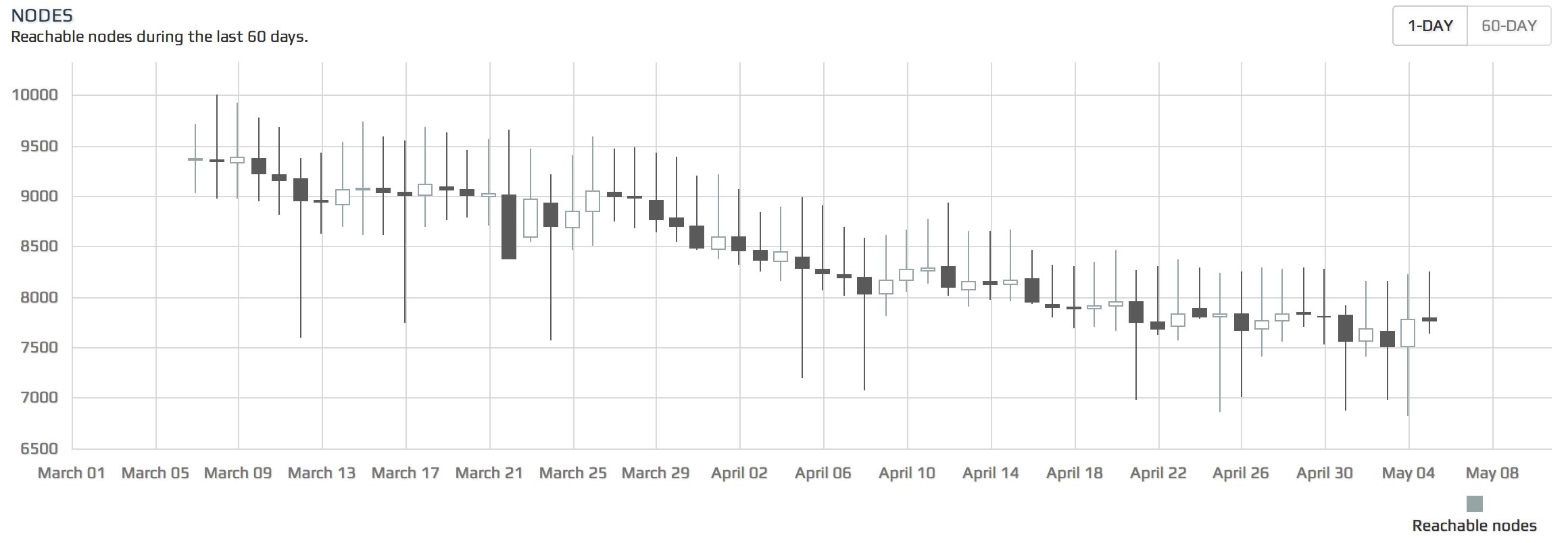
Waning support
at a 60-day chart of bitcoin nodes shows that the number has gone down
significantly. It went from 10,000 reachable nodes in early March to
below 8,000 at the beginning of May.
 |
|
Source: Bitnodes |
interesting is that during a recent 24-hour period, the number of
reachable nodes went down from 8,200 to 7,600 and back to 8,200 again.
This suggests that a portion of users running nodes are turning off
their machines at night, meaning that this contingent of nodes are being
run on desktops or laptops.
 |
|
Source: Bitnodes |
 |
|
A map based on Bitnodes data. Source: Coinviz |
Lack of incentive
running a bitcoin node does not provide any incentive. The only benefit
for someone to run a node is to help protect the network, and based on
the Bitnodes data, the number of people interested in supporting the
network with a full node is waning.
Centralization of mining
terms of supporting the bitcoin network, it used to be a lot easier for
the average user to participate. However, the advent of massive ASIC
data centres has weakened the consensual nature of mining, and by
extension providing nodes, for many people.
“As
bitcoin grows, so does the network and the computing power behind the
scenes required to run it. The majority of bitcoiners won’t be able to
support their own nodes and will be taken over by companies like KnC.”
pushing bitcoin towards a more centralized future. McKelvie also
believes that major technology companies that take interest in bitcoin
will have to put their computing resources behind the digital currency:
“I
wouldn’t be surprised if we see large tech companies like Google and
Amazon throwing resources at bitcoin as they adopt the currency.”
Feedback from nodes
sees the issue of nodes dropping from 10,000 down to under 7,000 as a
significant problem. To Hearn, the core of the issue is disinterest in
both expending computing resources and electricity toward something that
may have diminishing value.
Hearn has proposed added functionality that would allow communications
between nodes and the developers to better understand why so many are
dropping out.
is because their number will continue to decline no matter what – and
they appear to only be working when users are awake during the day.
“It
makes [the bitcoin network] ‘seem’ bigger, more robust and more
decentralised, because there are more people uniting to run it. So
there’s a psychological benefit.”
Moving forward
believes that community attention to the lack of nodes supporting the
network is what the industry needs in order to boost numbers:
“I agree we need more full nodes. I’ve long been a proponent of such calls for more nodes.”
such calls for voluntary support might not be enough motivation for
people to do so, though, so, one logical idea that has been floated is
to give nodes some sort of incentive.
feasible right now: over the past six months, miners have been
averaging a daily reward of 15.98 BTC per day, according to Blockchain.
bitcoin prices would peg that value at around $7,040 per day for the
entire network – and the growth in transaction fees has been incredibly
flat over the past six months. As a result, miners would likely be
reluctant to concede any revenue to bitcoin nodes, which don’t require
pricey ASIC hardware to run.
 |
|
Transaction fees on the network for past six months. Source: Blockchain |
of the bitcoin community seem to be losing interest in hosting full
nodes. And it’s something to pay attention to, because over time it
might mean that the major companies in the industry may have to pick up
the slack.
the network as full nodes, though, it continues to lessen the amount of
decentralization the network has at an infrastructure level.
is all down to circumstances surrounding bitcoin sentiment – the rise of
ASICs, the selloffs in China and complete collapse of Mt. Gox – plus
little in the way of incentives for someone to run a node.
Open your free digital wallet here to store your cryptocurrencies in a safe place.

Marc Andreessen: In 20 years, we’ll talk about Bitcoin like we talk about the Internet today

(WashingtonPost) The investor and Web browser pioneer Marc Andreessen thinks we’ll
all look back in 20 years and conclude that Bitcoin was as influential a
platform for innovation as the Internet itself was. He says that tech
companies think their meetings with President Obama on privacy are a
waste of time. And he calls net neutrality a “lose-lose.” In a
wide-ranging interview with The Washington Post this week, Andreessen
painted a picture of a future that’s distributed, messy and fraught
with tension. Here’s an edited transcript of our conversation.
Is there anything that Washington has built a wall against in terms of progress?
Well, the big thing right now for the tech industry is the Snowden
revelations, and the consequences of that for the American tech
industry. Specifically, in two areas: One is that the level of trust
that customers have [in] American tech companies has been seriously
damaged. And that is especially — but not exclusively — true outside the
United States. Every time another revelation comes out, like the one
this weekend about hijacking the routers on their way out of the country, or the one about hacking into the Internet companies’ backbone networks — every time one of these shoes drops, and apparently there is just an unlimited
number of shoes — every time one of these things happens, it’s a
serious blow to the credibility of these companies, especially outside
the U.S. And so there’s a really big, I mean very, very, very high level
of concern in the Valley that the American tech industry is in trouble
outside the U.S.
And then, two is this balkanization of the Internet that’s happening
now. As more revelations happen, more and more countries are saying:
“Okay, if we can’t trust the Internet, if the NSA is going to watch
everybody on the Internet all the time, we’re going to have to break off
and have our own Internet. Have our own firewalls, do what the Chinese
do, have our own private Internet or whatever the hell it’s going to
be.” This issue is being used as political cover for what these countries want to do anyway.
That brings us to, “Okay, how is the American government getting in
front of this?” And the answer is, “Not even a little bit.” The view in
the Valley is that the White House has hung the NSA out to dry. Just
like, “You’re on your own.” And there’s basically no effective
communication right now that I’m aware of between the American
government, especially the administration and American tech companies,
on like, “Okay, what happens now?”
There isn’t?
No.
Those meetings that occurred, that’s just for show?
Yeah, people come back, and they’re like, “Nothing happened.” The
Obama administration does not seem to have any real — they don’t seem to
have a plan. They seem to be in the mode of they kinda hope that it
goes away. And they hope that if they get face time with the execs they
can just mollify everybody and over time, the issue will just dissipate.
But I’m not aware of any substance that’s come out of those meetings.
I’m not aware of anybody who’s come back from those meetings saying:
“Okay, now there’s a plan. Now we know what’s going to happen.” It’s
been the opposite. It’s been people saying, “I don’t even know why I
went.”
Is there anything tech companies can do, whether on the Snowden stuff, or culturally?
These technologies escalate the power of government, but they also
escalate the power of business, and they also escalate the power of
individuals. So everyone’s been upgraded. And it’s a recalibration of
who can do what, and everybody can do new things, so everybody’s uneasy
about it. Governments are very worried about what citizens are going to
be able to do with these new technologies. Citizens are very worried
about what governments are going to do, and everybody’s worried about
what businesses are going to do. It’s this three-way dynamic that’s
playing out. And so for any of these individual issues, it’s not just
“What is one leg of this triangle going to be doing?” It’s, “What are all three of them going to be doing, and how will the tension resolve itself?”
Any thoughts on all these mergers that are being announced?
Not specifically on the mergers.
Or net neutrality?
So, I think the net neutrality issue is very difficult. I think it’s a
lose-lose. It’s a good idea in theory because it basically appeals to
this very powerful idea of permissionless innovation. But at the same
time, I think that a pure net neutrality view is difficult to sustain if
you also want to have continued investment in broadband networks. If
you’re a large telco right now, you spend on the order of $20 billion a
year on capex. You need to know how you’re going to get a return on that
investment. If you have these pure net neutrality rules where you can
never charge a company like Netflix anything, you’re not ever going to
get a return on continued network investment — which means you’ll stop
investing in the network. And I would not want to be sitting here 10 or
20 years from now with the same broadband speeds we’re getting today. So
the challenge, I think, is to accommodate both of those goals, which is
a very difficult thing to do. And I don’t envy the FCC and the
complexity of what they’re trying to do.
The ultimate answer would be if you had three or four or five
broadband providers to every house. And I think you actually have the
potential for that depending on how things play out from here. You’ve
got the cable companies; you’ve got the telcos. Google Fiber is
expanding very fast, and I think it’s going to be a very serious
nationwide and maybe ultimately worldwide effort. I think that’s going
to be a much bigger scale in five years.
So, you can imagine a world in which there are five competitors to
every home for broadband: telcos, cable, Google Fiber, mobile carriers
and unlicensed spectrum. In that world, net neutrality is a much less
central issue, because if you’ve got competition, if one of your
providers started to screw with you, you’d just switch to another one of
your providers.
There’s more and more integration between Bitcoin and the
financial services sector. But a lot of people who support Bitcoin
supported it because it was sort of disconnected from the infrastructure represented by government and everything else.
So we sort of have a theory on this, on where really disruptive
technologies come from. So the really new disruptive technologies come
from the fringe. This was true of PCs. Steve Jobs was, like, a
hippie. Internet came from the fringe. No big technology company thought
the Internet was going to be important, right up until basically 1995
or 1996.
Bitcoin is the classic instance of that. Bitcoin didn’t come from
Citibank; it didn’t come from the Federal Reserve; it didn’t come from
Visa. It came from the fringe. And now Bitcoin is in the early stages of
mainstreaming today. And the signs that it’s in the early stages of
mainstreaming are mainstream venture capital firms funding mainstream
startups, employing mainstream engineers to build services that’ll be
used by mainstream people. You’ve got big companies that are not yet
doing a lot with it, but are looking very seriously at it. So every big
bank has people that are trying to figure out what to do with Bitcoin;
every big e-commerce company has people that are trying to figure out
Bitcoin. You have mainstream regulators figuring it out; you’ve got
people at the Federal Reserve, and the Treasury Department and IRS that
are figuring it out. At the state level, people are engaged on it. And
so, it’s in the early stages of mainstreaming.
It’s already happening.
Anybody who thinks Bitcoin makes it easier to do transactions that aren’t
tracked by the government is 100 percent wrong. The transactions all
happen in public view. Anybody can look at the entire ledger and verify
who owns what. So if you’re a law enforcement agency or an intelligence
agency, this is a much easier way to track the flow of money than cash.
So I think actually law enforcement and intelligence agencies are going
to wind up being pro-Bitcoin, and libertarians are going to wind up
being anti-Bitcoin.
For [journalists], the big challenge has been explaining what
Bitcoin is to people. And I think we’ve always explained it as a
currency, but does that — now that people know about it in terms of a
currency, does that prevent them from [grasping Bitcoin’s full
potential]?
I have a lot of friends who are programmers. The programmers have always gone like, “Those [Bitcoin] guys are crazy.”
And then, almost 100 percent of the time, they sit down, read the paper,
read the code — it takes them a couple weeks — and they come out the
other side. And they’re like: “Oh my god, this is it. This is the big
breakthrough. This is the thing we’ve been waiting for. He solved all
the problems. Whoever he is should get the Nobel prize — he’s a genius.
This is the thing! This is the distributed trust network that the
Internet always needed and never had.”
So, one of the challenges is you take people who aren’t
professional programmers or mathematicians and then you expect them to
understand it from a standing start. And it’s daunting. And so then it
gets a word attached to it, like “currency” or whatever you want to call
it, and then people think that it is something it isn’t. And you have a
sense of this, but it’s a much deeper concept than currency. It’s the
idea of distributed trust.
So the business opportunity posed by this “distributed trust
network” — as an investor, what do you see that you could potentially —
Hundreds or thousands of applications and companies that could get built on top.
Is this, like, a billions-of-dollars kind of industry?
Yeah.
Trillions…?
Yeah! (Laughs, steeples his fingers Mr. Burns-style). Yeeeah… (Laughs) I have the haircut, I can do it.
Digital stocks. Digital equities. Digital fundraising for companies.
Digital bonds. Digital contracts, digital keys, digital title, who owns
what — digital title to your house, to your car. Like for example, you
get a digital title on a car, attached to a digital key, where you own
your car on the Bitcoin blockchain and on your smartphone. The key for
opening your car and starting your car is tied to that title. And if I
sell you my car, automatically you get title, and you get the key that
lets you operate the car, and it’s all digital, and it’s all unique, and
it can’t be cracked. You’ve got digital voting, digital contracts,
digital signatures. You’ve got unique pieces of digital content. If you
guys wanted to know exactly who had every piece of content you ever
made, you can track that. It’s this long list. And then every aspect of
financial services: insurance contracts, insurance derivatives, currency
exchange, remittance — on and on and on. It gives you a chance to
basically go after this very broad category of online business in a new
way. And, by the way, if we had had this technology 20 years ago, we
would’ve built it into the browser.
E-commerce would’ve gotten built on top of this, instead of getting
built on top of the credit card network. We knew we were missing this;
we just didn’t know what it was. There is no reason on earth for anybody
to be on the Internet today to be typing in a credit card number to buy
something. It’s insane, because — which is why you have all these
security problems, the Target hack and all this crazy…. And these high
fees, this high fraud rate. It doesn’t make sense online to have a
payment mechanism that requires you to hand over your credentials to
make a payment. That’s just an invitation to fraud and identity theft.
It’s just stupid.
But we didn’t have the better way of doing it. So we didn’t know what
else to do, and now we have the better way of doing it. Now, it’s going
to take time. We’re quite confident that when we’re sitting here in 20
years, we’ll be talking about Bitcoin the way we talk about the Internet
today. We just need time for it to play out.
Open your free digital wallet here to store your cryptocurrencies in a safe place.