Author Archives: Satoshi

Japan’s ruling party says won’t regulate bitcoin for now

A man walks past a building where Mt. Gox, a digital marketplace operator, is housed in Tokyo February 25, 2014. REUTERS/Toru Hanai
A man walks past a building where Mt. Gox, a
digital marketplace operator, is housed in Tokyo February 25, 2014.
Japan’s leading Liberal Democratic Party said it decided against regulating bitcoin for the time being, after the collapse of Tokyo-based bitcoin exchange Mt.Gox prompted them to consider more scrutiny of the virtual currency.
Mt.Gox, once the world’s biggest bitcoin exchange, filed for bankruptcy in February after saying hackers stole 750,000 bitcoins belonging to its customers.
Basically, we concluded that we will, for now, avoid a move towards legal regulation,” Takuya Hirai, an LDP lawmaker who leads the party’s internet media division, said on Thursday, adding that a final decision would be made after hearing more opinions on the subject
The use of electronic currencies has drawn the attention of governments around the world who are unsure whether, and how, to regulate them. U.S. agencies ranging from the New York bank regulator to the Commodity Futures Trading Commission have also been looking into possible regulation.
A task force of U.S. state regulators is also working on the first bitcoin rulebook, hoping to protect users of virtual currency from fraud without smothering the fledgling technology.

Open your free digital wallet here to store your cryptocurrencies in a safe place.

Satoshi
92ffdacc ae22 4e5d a0a6 eb685454289b 460x276

Privatise the pound and replace it with bitcoin, says free-market thinktank

Institute
of Economic Affairs says governments should allow competition on a
level playing field between all alternative forms of money.
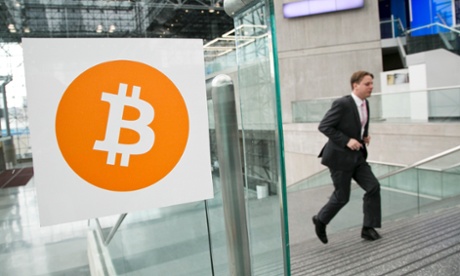
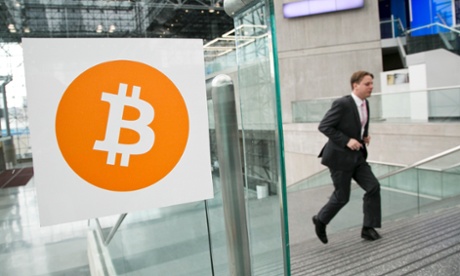
A man enters a bitcoin conference in New York.
A man enters a bitcoin conference in New York. Photograph: Mark Lennihan/AP
(TheGuardian) UK should privatise the pound and replace it with a
cryptocurrency like bitcoin, according to a paper published Wednesday by
the free-market Institute of Economic Affairs.
Kevin Dowd, a
professor of finance and economics at Durham University, says that
although bitcoin isn’t the first example of private money, it is the
first that governments can’t shut down. Therefore, he says, authorities
should admit that it’s here to stay, and allow competition on a level
playing field between all alternative forms of money.
That might
include allowing taxes to be payed in cryptocurrencies such as bitcoin
and dogecoin, or even fully privatising the pound, selling off the right
to mint the currency to the highest bidder.
“Let’s suppose that
bitcoin became a very prominent currency,” Dowd told the Guardian. “[To
ensure a level playing field], the government itself would accept
bitcoin in tax payments. So, in effect, the government should not be
favouring its own currency, or any particular currency, through any of
its unique powers. Nor have regulations against them.
“The natural
analogy is with some of the old, bad, monopolies like British Gas or
British Telecom. Telecom is a very good example: for a long time, we had
a government monopoly, which stifled innovation, and the service was
poor. Once that got opened up, competition opened, new innovation
prospered, and we got all sorts of innovation that we couldn’t possibly
anticipate, and we’re a lot better off for it.”
Dowd places
bitcoin at the pinnacle of a historical trend of government crackdowns
on attempts to create private money. The Liberty Dollar, a physical,
gold-based private mint, and e-gold, a digital, gold-based e-currency,
both ended up with their creators and proprietors in court, the former
on charges of counterfeiting, and the latter over allegations of money
laundering.
But Dowd argues the charges were
politically-motivated protectionism. “Counterfeit 101 is that you try
make the fake look like the real thing,” he says, “and the whole
business model was predicated on saying that [the Liberty Dollar] is
superior to US currency.”
Because Bitcoin is decentralised, it’s
significantly harder to crack down on using the courts – “you could shut
the whole web down, but they can’t do that,” Dowd adds – and so
governments can’t stop its rise. If it does become popular, they will
have to deal with it some other way.
There’s a lot standing in the
way of cryptocurrencies before they reach that success, however. For
one thing, Dowd writes, “to displace existing state currency they not
only have to perform the basic functions of money at least as well as
state money, they probably also need qualities that transcend the way in
which state money works.”
For some advocates of bitcoin, as well
as for Dowd himself, those qualities come in the form of protection
from inflation: the cryptocurrency will only ever have 21m coins
created, ensuring that it will always “hold its value” (though also,
critics claim, rendering the bitcoin economy prone to deflationary
slumps).
For others, they come from the purely digital nature of the currency. Venture capitalist Marc Andreessen describes it
as the financial equivalent of the internet, saying “The internet was a
new way to transmit data. Bitcoin’s a new way to transmit money. It’s
going to take a long time. The good news it’s a big opportunity. Money
is a very big deal, and so if you can build a new way to deal with
money, it’s very important and valuable. It just takes time.”

Open your free digital wallet here to store your cryptocurrencies in a safe place.
Satoshi
Close up of Sweden Flag

Swedish central bank acknowledges benefits of cryptocurrencies

Close up of Sweden Flag(CoinDesk) Sveriges Riksbank, Sweden’s central bank, has published a brief economic commentary on the impact of digital currencies on the retail payments market.
The document outlines the basics behind digital currencies and focuses on bitcoin, but it also mentions some altcoins such as litecoin and dogecoin. Aside from a relatively basic introduction to digital currencies and background information for novices, the document also sheds light on the state of bitcoin in Sweden and the bank’s attitude towards bitcoin and other cryptocurrencies.

Take-up remains limited

The Sveriges Riksbank report found that the use of digital currencies in Sweden remains very limited. The authors point out that it is particularly difficult to obtain accurate information on the use of digital currencies in different countries, hence most analyses are usually limited to the total issue value and global usage. The report tries to isolate Sweden and examine transactions limited to Swedish krona (SEK) exchanges. Even so, the data may not be complete, as it only deals with transactions involving SEK.
“On average, around 212 bitcoins per day were converted to or from SEK during the period December 2012 to May 2014 at an average value of just over SEK 266,000. However, the daily value varied substantially, between SEK 2,500 and SEK 2.5 million, depending on the exchange rate and the number of bitcoins exchanged,” the report notes.
The authors caution that the statistics are incomplete, as there is no data on transactions between private persons and other movements of funds that could be relevant. Therefore, they concede, the exchange statistics may underestimate the use of bitcoin in Sweden. However, the report concludes that the values involved in cryptocurrency transactions pale in comparison to traditional transactions. This is how bitcoin stacks up:

“Households make daily payments using cards and cash totalling 8 million in volume and to a total value of over SEK 3 billion. Even if the use of bitcoin in Sweden were to be much larger than the average exchange value of just over SEK 266,000, this is a relatively low value in relation to other types of payment. At present, there only seem to be around 25 swedish companies accepting Bitcoin.”

Risky but innovative

Although the report contains the usual set of caveats found in most central bank statements involving digital currencies, it also includes some relatively positive commentary. The report states that digital currencies are one of many innovations in the Swedish payments market and like other innovations, digital currency is essentially positive:

“It can contribute to meeting new payment needs and to making payments cheaper and more secure. Those who choose to use a particular payment service can be expected to do so because it gives them an added value in relation to other payment services. This also applies to virtual currencies, which can for instance make some cross-border payments simpler, faster and cheaper. Another advantage is if the payer does not need to share sensitive information, such as card number or bank account number, with the payee.”

Cryptocurrencies may also be better suited for micropayments made via websites, the report further notes. Disadvantages associated with digital currency platforms include lack of clear regulation, lack of consumer protection regulation, volatility, security risks and the risk of using digital currencies for illicit transactions. The report concludes that the impact of any innovation depends on how much it is used. The use of digital currencies is “very limited” both in terms of the number of users, the number of transactions and the value involved in said transactions. Therefore both the positive and negative effects of digital currencies on the payment market in Sweden are currently negligible.

Open your free digital wallet here to store your cryptocurrencies in a safe place.

Satoshi
Schermata 2014 06 17 alle 18.22.47

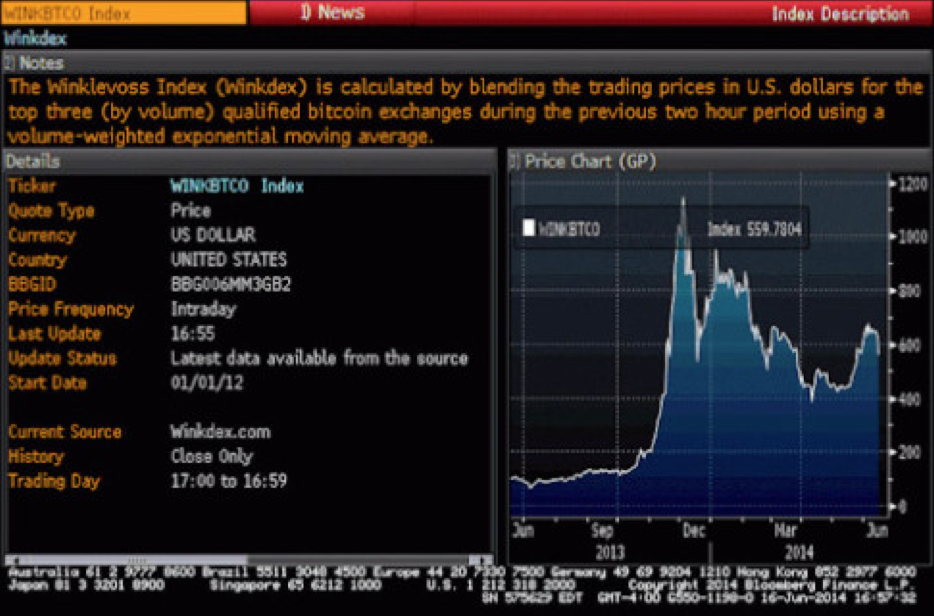
WinkDex price gets added to Bloomberg

(newsBTC) Ah, the WinkDex. It’s the brain child of both Cameron and Tyler Winklevoss, two of the bitcoin community’s most prominent entities.
This simple but effective bitcoin price composite is the official
price measure of the Winklevoss’ bitcoin ETF, currently awaiting
regulatory approval by the United States Securities and Exchange
Commission.

And according to a post made on the Winklevoss Capital website,
the price data is now available on Bloomberg in a move some suggest may
further legitimize the digital currency in the eyes of traditional
financiers.
“We are honored to be working with Bloomberg to bring a blended
bitcoin price index to their wide-reaching investor community,” the post
read, adding that some new features (of which include an API) will be
unveiled in the weeks upcoming.

According to the announcement, the ticker for the WinkDex is very apt: WINKBTCO.

The Bloomberg terminal is a professional service used by financial
professionals. Each license to the service costs upwards of $20,000 per year.

For more information on the WinkDex, visit their official website.

Open your free digital wallet here to store your cryptocurrencies in a safe place.
Satoshi

Bitcoin, Dogecoin, and the Blockchain

The prevalent idea of modern day cryptographic currencies originated when Bitcoin launched in 2009. With Bitcoin, for the first time in history, the world had access to a completely decentralized medium of exchange. This medium of exchange reliably transfers value from one entity to another in a hostile, trust less environment by solving a problem that previously necessitated centralized entities, such as financial banks, to arbiter value exchanges. The main role of the centralized entity was to assure the recipient that the money has been taken from the sender, and given to the recipient, and the sender could no longer spend the same money (i.e., double spend it). The problem of double spending can be modeled under an abstract Byzantine Generals’ Problem that focuses on achieving majority consensus in a decentralized network.
The Byzantine Generals’ Problem is a topic that deserves its own blog post. For now, let’s just remember that the problem of double spending was thought impossible to solve in a decentralized manner before Bitcoin solved it. This solution was implemented in what is now called the Blockchain.

What is the Blockchain?

In simple terms, the Blockchain is a book of accounts that is divided into batches of transactions, or blocks, which are naturally a collection of transactions. Bitcoin uses a number of technologies that came before it, including decentralized file sharing (see: BitTorrent), Public Key Cryptography, and Proof of Work Hashing (see: Hashcash). Bitcoin introduced a new technology: the Blockchain. Most subsequent cryptographic currencies, such as Dogecoin, use the same technology with minor changes (e.g., a different Proof of Work hashing algorithm).
The Blockchain facilitates reliable transfer of units of account (later on referred to as values) between certain cryptographically valid entities. In Bitcoin, the total units of account that will ever exist is 2.1 Quadrillion Satoshis, or 21 Million Bitcoin. In Dogecoin, this is 100 Billion Dogecoin until March 2015, and 5 Billion additional Dogecoin annually after that. Dogecoin and Bitcoin consist of two separate networks of peer-to-peer nodes. Each Bitcoin or Dogecoin portefeuille tries to keep its local copy of the book of accounts up-to-date.
In order to make use of the power of the Blockchain and its fast, decentralized, low-fee transactions, one must understand what constitutes a transaction:
A transaction is simply a cryptographically verifiable instruction from the sender to transfer value the sender owns to one or more valid recipients. The sender(s), and receiver(s), have cryptographically verifiable identities, known as addresses (see: Public Key Cryptography).
In the Blockchain, here’s what a (simplified) transaction looks like:


{
    "txid": <a unique transaction identifier>
    "inputs": <an array of inputs>
    "outputs": <an array of outputs>
    "tx_hex": <transaction content as a hexcode string>

    "blockhash": <a unique block identifier this transaction belongs to>
    "time": <the time this transaction's block was processed>
    "confirmations": <number of blocks that confirmed this transaction>
}

The very basic parts to understand in the above snippet are: a transaction has inputs, and outputs. The inputs are specifications of which values to transfer from the sender’s address(es), and the outputs are specifications of how much of the total input value each recipient’s address(es) receives. Inputs in this transaction were outputs in a previous transaction, with the exception of when the network generates new coins.
New coins are generated by the Dogecoin network as rewards for miners for solving a block (example), i.e., miners work hard to find the correct hash for a batch of transactions, also known as a block (see: Hashcash, Proof of Work). If the total input values are higher than the total output values, the difference is paid to miners of the block as a transaction fee. Total input value is never less than the total output value in a single transaction.
When a miner finds a new block, they confirm all the transactions contained within it as valid. However, a block does not exist on its own — it is linked to blocks previously solved in a chain of blocks all the way to the Genesis Block. The Genesis Block was created when Bitcoin or Dogecoin networks were created (see: Dogecoin Genesis Block). Therefore, where a block is solved, and appended to a chain of previously found blocks, it confirms the transactions within it, as well as the transactions in all the previous blocks in its chain. Hence the name: Blockchain.
So, what is the Blockchain? In very concise terms, it is a chain of blocks!

Open your free digital wallet here to store your cryptocurrencies in a safe place.

Satoshi

The single most profitable illegitimate mining operation: 500 Million Dogecoins mined!

(CoinDesk) An unknown hacker has reaped an estimated 500 million dogecoins – worth nearly $200,000 at today’s prices – by hacking into a series of data storage hubs for computer networks, according to SecureWorks, an information services subsidiary of personal computing giant Dell.
The SecureWorks report revealed that the hacker targeted network attached storage (NAS) boxes made by Taiwan-based Synology Inc. and used its computing power to mine dogecoin through a private pool. The action caused problems for Synology’s customers, some of whom reported poor performance on Facebook in February.
SecureWorks called the months-long intrusion unprecedented, saying:
“To date, this incident is the single most profitable, illegitimate mining operation.”
Following reports of an issue, the investigators ultimately discovered a folder entitled ‘PWNED’ that contained the mining software CPUMiner and the capacity to conceal the program.
The address the mined dogecoins were being sent to was also identified,
revealing the accumulation of more than 400 million dogecoins. Along
with another wallet, the hacker generated roughly 500 million dogecoins
between January and April.
In
addition to exploring the technical aspects of the hack attack,
SecureWorks delved into the possible identity of the assailant,
suggesting that “the findings strongly indicate that the threat actor is
of German descent”.

Hacker used private pool

The
configuration file of the software that was infecting Synology’s NAS
boxes pointed to the presence of hidden mining software.
CPUMiner,
the program used, had been modified to run on the boxes and was
connecting to a dogecoin pool not associated with any public mining
group, SecureWorks said. Each NAS box acted as an individual miner,
connecting to the pool and generating dogecoins.
SecureWorks
accessed the data being sent to the NAS boxes, which allowed them to
ascertain the dogecoin wallet address holding the fraudulently mined
dogecoins, as well as the possible identity of the hacker.
Dubbed
“foilo.root3″ in the configuration file, the user appears to have a
connection with accounts on GitHub and BitBucket, although it remains
unclear whether the name is unique to a single person.

Mining malware gains

The
dogecoin mining attack represents one of the more creative approaches
to generating digital currency through fraudulent means. Other recent
attempts have found wrongdoers using unique means to upload software to
mine bitcoin, but in nearly all cases, the program was designed to
conceal itself and its operations.
Last month, unknown hackers attempted to distribute bitcoin mining malware through a modified torrent file of the video game Watch Dogs. This attack was notable as it targeted another form of online piracy.
A
more unusual concealed attempt to create mining botnets out of mobile
phones was uncovered in April. At the time, a group of wallpaper apps
listed on the Google Play app store were discovered to contain bitcoin mining programs.
Image via Dig Doge

Open your free digital wallet here to store your cryptocurrencies in a safe place.

Satoshi
Bitcoin Price to 10000 300x185

Bitcoin will surpass PayPal in US Dollar transactions, according to BVI Hedge Fund

(SBWIRE) Laureate sees the current dip in price at US$522.57 as an opportunity to buy the alternative currency that could increase 50 per cent in price in the near-term as it threatens to overtake PayPal in transactional volume for the first time 2014.
According to bitcoinwatch.com the daily average of bitcoins trading in US dollar transactions is nearly US$300 million.
CEO Peter Tasca of Laureate Trust states, “Whenever you have an instrument that trades over 300 million US dollars a day, it must be recognized. The digital currency works, Bitcoin has greater volume transactions than Western Union and we anticipate it will overtake PayPal later this year.” “In the next one or two years, Bitcoin can surpass the dollar transaction volumes of other established payment companies including Discover, and even American Express, MasterCard, and Visa,” stated SmartMetric CEO Chaya Hendrick.
Laureate Trust provides expert portfolio management that achieves optimal results. The proven trading strategies are based on four principles: diversification, technical analysis, trend following and risk management, which combined have the potential to profit from any economic situation. In 2013 this multiple platform strategy returned +23.01% net of all fees which has outperformed the Barron’s Top 100 Hedge Fund Average, Barclayhedge Fund Index Average and the S&P 500 Total Return Average.

Open your free digital wallet here to store your cryptocurrencies in a safe place.
Satoshi

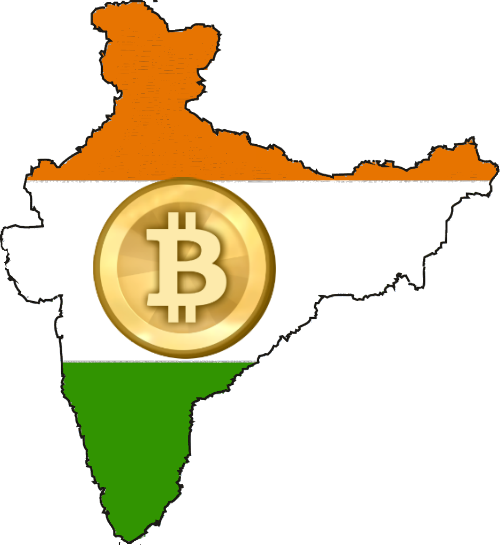
Bitcoin can stabilise volatile market in India

(TimesOfIndia) At a time when the country has suffered devaluation of rupee against
dollar, inflation and fuel price volatility in exchange market, two
students of Fellow Programme in Management (FPM) at Indian Institute of
Management, Indore (IIM-I) have rekindled hopes to address the problems
through introduction of ‘Bit Coin’ currency system.

Bitcoin is
a crypto currency which currently has market capitalisation of $8.1
billion. The recognition is mainly because of its introduction during
financial crisis, when trust on government and policy makers was low. It
is an alternative to card networks and money transfer system.

Khadija Vakeel and Nitya Saxena of IIM-I in their study found out that
at a time, when the country is struggling to achieve a respectable
position on matters of financial inclusion, Bit Coin can be a game
changer.

Bitcoin can also lead to a new industry and challenge
for IT youths and can address the problem of brain drain. While
Singapore is pro bit coin, China stands against it. India is yet to take
a side. Users having Bit Coin can enter into virtual goods and services
exchange. The study states that inflation is simply a rise in prices
over a period of time, which is generally the result of the devaluation
of currency.

This is a function of supply and demand. Given the
fact that the supply of bit coins is fixed at a certain amount, unlike
fiat money, the only way for inflation to get out of control is for
demand to disappear.

Open your free digital wallet here to store your cryptocurrencies in a safe place.

Satoshi
etukuva1

Estonia bank to study benefits of integrating Bitcoin technology

etukuva[1]

(CoinDesk) Estonia-based bank LHV has announced a new project that will explore
the legal framework and potential uses of bitcoin’s block chain
technology in banking so it might develop bank services for bitcoin and
other digital currencies.
“We are interested in the technological
side of digital currencies as we hope it could make bank services more
simple and efficient,” Priit Rum, head of communications at LHV, told
CoinDesk.
The project manager will examine all digital currencies, not limiting itself to bitcoin.
For
now, the bank won’t engage in trading bitcoin, Rum said, but more
likely, could develop its payments system using block chain technology.
The company claims to be the first bank in the world to implement such a program, stating:

“We
have been aware of crypto currencies for some time now […] we decided
last month that establishing a side project to explore the block chain
technology and analyse possibilities of cryptocurrencies would be a good
opportunity to stay with the innovation.”

Regulatory uncertainty remains

While the news of this action by a major bank is perhaps encouraging, in Estonia, bitcoin is tangled in regulatory uncertainty.
Earlier this year, the country’s central bank issued a warning
against bitcoin and digital currencies calling it a Ponzi scheme,
saying “virtual currency schemes are an innovation that [deserve] some
caution”, but that it would continue to monitor their development.
Shortly after, local bitcoin trading site BTC.ee put a halt on trades, coming under pressure from Estonian authorities who challenged the site’s compliance with the Money Laundering and Terrorist Financing Prevention Act.
Said Rum:

“LHV
is a regulated bank and we take all the regulations and guidelines very
seriously […] For us, all the questions about ‘know your customer’ and
concerns of money laundering have to be dealt with before we can really
develop new bank services using new technology.”

Local enthusiasm grows

Estonians have been enthusiastic about bitcoin for some time, despite the regulatory difficulties the domestic ecosystem faces.
The
country’s capital Talinn had a successful week-long bitcoin showcase
last month, during which bitcoin advocates came together to educate
those new to the digital currency and boost its popularity.
For more on the latest developments in the eastern European economy, read our most recent report.

Open your free digital wallet here to store your cryptocurrencies in a safe place.

Satoshi

How a 15-Year-old’s $1,000 Bitcoin investment led to startup success

finman, entreprenuer
Erik Finman
(CoinDesk) A well-timed investment of $1,000 in bitcoin has earned a 15-year-old
Idaho entrepreneur more than $100,000 and allowed him to found his own
education startup.
Erik Finman took $1,000 he received as a gift
from his grandmother and invested it in bitcoin back in 2012, according
to a report by Mashable. After holding his BTC for one year, Finman sold his bitcoins for $100,000.
Finman ultimately decided to reinvest his earnings into Botangle.com,
an online video tutoring service that “allows students and tutors
access to a diverse array of resources that just do not exist in a
normal classroom setting”, according to its official website.
Notably, Finman pays his employees in bitcoin. He told Mashable that he enjoys “sharing the wealth of bitcoin”, saying:

“I have no doubt it will be huger [sic] than anyone can imagine right now. Bitcoin is like the Internet in the ’90s.”

Early bitcoin supporter

During a question-and-answer session that he took part in last month on the Entrepreneur subreddit, Finman explained how he first came to learn about bitcoin, writing:

“I
owe a lot to my older brother. He told me about bitcoins and help[ed]
me get set up with 0.2 bitcoins that he gave me. And my grandmother just
out of the blue gave me a $1,000 check for Easter.”

He
continued by saying that he accrued more bitcoins “so I can trump my
brother in how many bitcoins he had”, adding that he first learned about
bitcoin in 2010.
Luckily for Finman, he sold his stash of bitcoins when the price hovered around $1,200 per bitcoin.
Though
entrepreneurs may not be able to replicate Finman’s success, they can
learn from those who have entered the industry through more conventional
in-roads. For more on how today’s bitcoin startups are making gains
despite the tribulations of an emerging market, read our most recent report.

Open your free digital wallet here to store your cryptocurrencies in a safe place.

Satoshi