
Litecoin network hashrate tripled in two months
At the end of April, mining hardware manufacturing company started shipping a whole stack of their products. It was the same time when the Litecoin hashrate was somewhere around 173,225 MH/s. The increasing exposure of Scrypt ASICs mining machines further influences other manufactures as well. In just two months since April, the Litecoin hashrate went up to 200$, while its mining difficulty also tripled.
The next Scrypt ASICs to hit the market will have the hashing power between 200 and 400 MH/s; indicating the possible surge in Litecoin mining difficulty and network hashrate as well. Some companies are also building hardware that can sustain hashing power up to 650 MH/s. As many believes, these events will somewhat impact the Litecoin standings in the market. The question however is, in which way?
The Litecoin community seems to have divided on this question. There is a section which believes that the increasing hashrate will have a fruitful impact on Litecoin prices, citing Bitcoin as a key instance; while another section does not acknowledge any relation between the Litecoin prices and its hashrate.
Explanations are coming from both sides, each with a unique perspective. The ones that support the prediction of Litecoin’s escalation believe it to be the network’s strength that will multiply by over 1,000 times in future. It is the economics of scale in mining that will play a major role in boosting the Litecoin’s stand in the market.
On the other hand, there are those who do not support this theory even in thoughts. They outright rubbish the history that certifies increasing hashrate proportional to the coin’s market cap. Their logic dictates a scenario in which miners are faced with increased selling pressures in order to cover their investments on such expensive mining hardware. This aims at a lower demand and higher supply rate that will eventually cause a huge drop in Litecoin prices. They event say that the current imbalance of Litecoin market is caused by such selling pressures.
Considering both the sections, we believe that market conditions have changed a lot since the launch of new cryptocurrencies in the market. The reason why BTC did so well after the increased hashrate was it being used only for trading. Litecoin too cashed only because of the bubble fuelled by China. The moment these coins were introduced to the real merchant world, its basics changed completely. Seeing today’s scenario, Bitcoin is backed by multiple major organizations while Litecoin is still far away from reaching this point. In short, the continual acceptance of BTC over LTC thickens the latter chances to repeat history. Hashrate increased or decreased, it won’t hold any meaning until Litecoin grabs some major investments from big players.
Open your free digital wallet here to store your cryptocurrencies in a safe place.

Polish Finance Ministry says Bitcoin can be used as financial instrument

document confirming that under the country’s existing financial
regulations, bitcoin can be considered a financial instrument.
opposition member of Parliament for the liberal Twoj Ruch (Your
Movement) party. At the time, Pacholski asked Poland’s Ministry of
Finance to explain the legal status of bitcoin transactions.
Specifically, his query focused on whether or not “options and futures
contracts can be considered as a financial instrument” if they are
denominated in a digital currency.
“Options or futures contracts which are based on
[bitcoin] as a base instrument can be considered as derivative
instruments, and as such, they can be considered as financial
instruments, according to the bill on financial instruments.”
Bitcoin’s legal status clarified
recognized currency in Poland. He said in the policy document:
“An analysis of national regulations allows to conclude
that bitcoin … is not a legally defined and universally accepted
currency, because it cannot be classified as either a national currency …
or a foreign currency.”
possibility of issuing options and futures contracts in the form of
derivatives based on bitcoin market indexes. These issuances, he said,
would be similar to the derivatives which are based on stock market
indexes.
available to Polish investors. This, the Finance Ministry said, is in
accordance with the country’s banking services regulations.
Regulators accept bitcoin usage
derivatives markets suggests the continued evolution of government
policy toward digital currencies in Poland. While bitcoin can be used as
a medium of exchange and financial tool, it remains unrecognized as a
legal currency by regulators.
Szymon Wozniak, a Finance Ministry representative, said that the
ministry does not consider bitcoin to be illegal, but it does not
consider it to be a legal currency either. He remarked:
“What is not forbidden is permitted. However, we certainly cannot consider bitcoin to be a legal currency.”
Open your free digital wallet here to store your cryptocurrencies in a safe place.
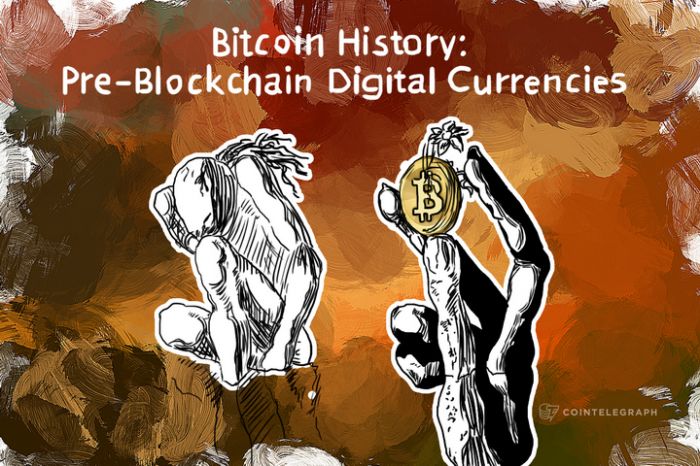
Bitcoin history: pre-blockchain digital currencies
(CoinTelegraph) For anyone not involved in
mid-90s cypherpunk scenes or early e-cash projects, the term “digital
currency” probably never came up in conversation until quite recently,
after the advent of Bitcoin.
But Satoshi’s white paper
did not invent digital money; that’s an idea as old as mainstream
internet usage itself. Bitcoin, and the altcoins it spawned, just
happened to be so revolutionary that all those electronic currencies
pre-2009https://holytransaction.com/page/before-bitcoin get overshadowed.
It’s like the Christian calendar. There is before-Bitcoin (BB), and then there is the current era, (AB).
Let’s take a look at some pre-Bitcoin technologies to get an idea of how far cryptocurrencies have come since.
1990: DigiCash
In 1982, cryptographer David Chaum applied the idea of blind signatures to money in his paper “Blind Signature for Untraceable Payments.”
Eight years later, he took these cryptographic protocols to market with
DigiCash, a company that ultimately went bankrupt in 1998.
1996: E-Gold
E-Gold sounded like a fine idea at the time: Create an account, send
in your gold or silver, and your accounted would be credited. Those
credits could then be easily transferred among accounts. The company
slowly built a successful operation through the late 90s.
By 2001, E-Gold was running into problems, however. The US Patriot
Act, first of all, tightened regulations on businesses that could be
classified as money transmitters. Gaining money transmitter licenses for
all 50 states proved too big of a hassle for E-Gold and its
competitors.
Furthermore, a campaign began to grow against E-Gold that marked it
as the currency of money launderers and child pornographers. A federal
indictment followed in 2005, which marked the end of E-Gold as a
meaningful alternative currency.
1998: Beenz.com
Beenz was a currency created to incentivize behavior such as visiting
specific websites, logging on through specific ISPs or shopping at
certain stores. This was back before the dot-com bubble burst, when
bored teenagers could take online quizzes, and marketing companies would
send them free stuff in the mail.
But the fetten Jahren ran their course, and Beenz.com was gone by 2001.
1999: Flooz.com
Flooz had a similar name and similar model to Beenz: Users were
rewarded for activity with flooz, which served as a medium of exchange
among its network of partners. Like Beenz, also, Flooz went bust in the
dot-com crash.
1999: InternetCash.com
InterenetCash.com filed a number of patents to protect its monetary
system based on prepaid cards, and it also relied on a network of
participating merchants where that cash could be redeemed. The company
ultimately raised $10 million in funding and had a staff of about 70
employees before the dot-com crash forced the company to close in August
2001.
After 2001, when economic realities hit many internet startups hard,
digital money never really caught on again, beyond some niche users,
until Nakamoto published the Bitcoin white paper in 2008. Of course, it
took a few years for most of us in the cryptocurrency community to catch
on, at which point cryptocurrencies took off far beyond what their
predecessors did.
We asked some community experts what present feature or
present reality in cryptocurrency tech today we will find funny and
old-fashioned in 15 years or so?
Aleksey Bragin:
“So many useless (or sometimes funny, as DogeCoin for example) alt
cryptocurrency clones emerged so quickly. That would go out of fashion
quicker than within 15 years, I suppose.”
Gideon Gallasch (coinsulting.eu): “I think mining – so much power and electricity is not sustainable long term.”
Lech Wilczyński (Co-Founder/CEO / Developer at InPay S.A.): “Centralized exchanges.”
J. Ryan Conley (CEO & Founder at Ryan Conley
Marketing & Training and CEO & Founder at Team Extreme
Worldwide): “That the banks were last to catch on to this awesome
concept! Staged viral video marketing platform.”
Patrick Dugan (CIO of Crypto Currency Concepts): “Centralized exchanges for sure, mining possibly.”
Lech Wilczyński (InPay.pl): “Bitcoin payment gateway.”
Open your free digital wallet here to store your cryptocurrencies in a safe place.
New Zealand central banker: cryptocurrencies could supplant cash
Advantages and drawbacks
“[Bitcoin] is a very low cost payment method with strong security features and usable for cross-border transactions, making it advantageous in some regards relative to more traditional payment mechanisms.”
“Key attributes of trust (that the ‘money’ gives rise to settlement of the obligation) and anonymity (it is often efficient for the sale/purchase parties not to have to identify one another) must be met, but if these can be accomplished reliably and sustainably, new technologies could supplant cash as we know it in years to come.”
Banks need to keep up
Apart from the carefully worded statement, regulators have taken any measures to curb or control the development of the bitcoin economy in the region.
Open your free digital wallet here to store your cryptocurrencies in a safe place.
“The current proof of work system that is in place incentivizes centralization,” says BlackCoin Foundation
As Bitcoin’s first-mover momentum spreads the digital currency’s adoption, the “proof of work” model it uses to confirm transactions is coming under scrutiny within the crypto-community.
The proof of work algorithm rewards the individuals, called miners, who confirm blocks of transactions in exchange for an amount of the digital currency. Individual miners join pools to mine collectively as a group, increasing the computing power available to confirm Bitcoin transactions.
This model seems to benefit by encouraging a large number of participants, but it is vulnerable to what is called a 51% attack. A miner or pool that holds 51% of the total computing power could in theory control the blockchain, which is the public ledger of Bitcoin transactions. This control could enable double-spending bitcoins as well as blacklisting certain users or computing equipment. Until recently, the 51% attack was widely considered an unrealistic threat.
“The proof of work algorithm is robust and has been resilient in the face of continuous attacks for the past five years,” says Andreas Antonopoulos, a technologist and entrepreneur who is active in the Bitcoin community. But a mining pool called Ghash.io gave the community a scare when it took over 51% of the network for 12 hours on June 13.
If a pool used its control for nefarious purposes it would only hurt Bitcoin’s use and, in turn, its price. This result would hurt any miners who become attackers, since they are rewarded for their mining efforts in Bitcoin and likely hold a generous amount of the digital currency. Since the incident, Ghash control has decreased substantially, hovering now at around 35%.
“Certainly miners didn’t sign up for unfair play and they would abandon that pool,” lowering the percentage of its control, Antonopoulos says. The 51% attack “is a theoretical attack that’s narrow in scope and goes against the incentives for the miners and owners of the pool.“
Last year, Ghash said it would try to prevent itself from capturing 51% of the network power and that it would not do any damage even if it did reach this level of control. And since the power is split over the many individuals who mine in the Ghash pool, it’s unlikely the pool could reach a consensus among its members to damage the network.
Nevertheless, some in the Bitcoin community are calling for a splintering, or “fork,” in the Bitcoin blockchain, and the forked version of Bitcoin would add features that discourage pooled mining. Others are talking about the benefits of a “proof of stake” algorithm, which secures cryptocurrency networks by asking users to show ownership of a certain amount of the currency.
BlackCoin is an alternative digital currency that uses a pure proof of stake model. It was created about five months ago and has generated enough support to be integrated into CoinKite’s merchant point of sale system.
“A user chooses to ‘stake’ his coins to generate the next block in the chain, and his chance of doing so is proportional to the weight of his own coins,” says Adam Kryskow, U.S. representative for the BlackCoin Foundation.
Proof-of-stake algorithms enable faster payments. BlackCoin transactions confirm in under a minute, whereas Bitcoin transactions usually take about 10 minutes. And proof of stake is also more eco-friendly, consuming far less energy than proof of work algorithms.
 |
| Image: Peercointalk.org |
Peercoin is one of the most recognized altcoins that uses a hybrid proof of stake/proof of work model. New coins are awarded to miners who do work to authenticate transactions, but are also given to users who hold a higher stake in the system.
“The current proof of work system that is in place incentivizes centralization,” says Kryskow. “Specifically as mining payouts decrease, small mining operations will be forced to close up shop. With little to no incentive to continue mining, network power will fall dangerously low and security will be severely threatened.“
But proof of stake has its own vulnerabilities. Kryskow admits that since proof of stake algorithms are not completely decentralized, they are susceptible to a “nothing at stake” attack, where older coins could be used to fork the blockchain to create a competing one.
The proof of stake model hasn’t been stress-tested enough over a long period of time, and it worries Antonopoulos when proponents argue that the nascent mining algorithm is better than Bitcoin’s proof of work.
Bitcoin has survived a number of attacks over the years, says Antonopoulos. “There is much better monitoring and tracking [of the network]…a lot of DDoS protections and countermeasures built into the core client because of Bitcoin‘s experience with widespread attacks over the years,” he says.
Proof of stake was created in 2011 with the launch of Peercoin. “It was attacked and beaten; bugs were found, security issues were rampant and countless vulnerabilities were exposed,” Kryskow says. That’s when Peercoin moved to the hybrid proof of stake/proof of work model.
BlackCoin‘s developer argues that, like Bitcoin’s proof of work, proof of stake will be stress-tested in real-world use. BlackCoin “is a great proof of stake experiment,” Kryskow says.
Antonopoulos agrees that the development of new proof models is advantageous. “I don’t think we’ve found the perfect solution yet,” he says. “Everything comes with compromises…so you just have to identify which ones are the good compromises to make.” Other algorithms include “proof of burn,” in which a small portion of a cryptocurrency is destroyed to create value through scarcity; and “proof of resource,” which takes a resource, such as bandwidth, and assigns it a certain value for sharing.
“The real issue, though, is until we see a problem in Bitcoin that impacts the price, knowledge of Bitcoin is so much higher than [all other altcoins] that any other solution out there will be irrelevant,” says Tim Sloane, vice president of payments innovation at Mercator Advisory Group.
Sloane doesn’t expect everyone using the Bitcoin protocol to switch over to another digital currency just because there’s a threat
of disaster. But it may happen if a disaster actually strikes.
“As Bitcoin gets bigger and bigger, the problem gets bigger and bigger,” he says.
Open your free digital wallet here to store your cryptocurrencies in a safe place.
Next Bitcoin Core Version to Include ‘Smarter’ Transaction Fees
details of new floating transaction fees to be included in the code of
the next Bitcoin Core release.
stated that the updated code will enable “smarter” fees that account
for the length of time it takes to confirm transactions on the bitcoin
network. Ultimately, the new code will determine transaction priority,
making sure that transactions confirm more efficiently.
code as the reason for the update. These complications result in
inconsistent and time-consuming confirmation periods. He wrote:
“Instead of using hard-coded rules for what fees to pay,
the [new] code observes how long transactions are taking to confirm and
then uses that data to estimate the right fee to pay so the transaction
confirms quickly – or decides that the transaction has a high enough
priority to be sent for free but still confirm quickly.”
how much priority they want their transaction to receive. In some cases,
users may opt to have as many as six blocks pass before the first
confirmation is received.
Systemic fee problems addressed
send large bitcoin transactions. As Andresen explained, the new code
eliminates some of the hurdles that slowed down transactions in excess
of 1,000 bytes in size.
framework. The code that determines priority for free transactions
automatically places them at a disadvantage in the network. This results
in a significant increase in confirmation times.
“The current situation is even worse for free,
high-priority transactions: the hard-coded ‘high-priority’ constant is
much too low, so transactions sent for free can take a very long time to
confirm.”
more effective transaction fee determinations within the bitcoin
network.
Future updates possible
fees, citing the behavior of miners – and their preference for high-fee
transactions – as reasons to avoid such an approach. Notably, he said
there was no desire within the bitcoin development community to
institute fixed fees.
“I expect to see transaction fees rise until a good
solution for optimizing the propagation of blocks across the network is
deployed, because I expect transaction volume to increase and I don’t
think miners will include more transactions in their blocks until
somebody fixes the ‘bigger blocks take longer to broadcast’ problem.”
develop new code that enables a more efficient and healthy transaction
process.
Open your free digital wallet here to store your cryptocurrencies in a safe place.
Why Bitcoin may re-write banking practice
(BusinessTech) Bitcoin has grown from an experiment in digital cash to a vibrant, global economy supporting multi-million dollar companies with a market cap of $10 billion.
“While the road has been bumpy, and quite a rollercoaster ride, it is still nascent and holds immense promise to change the world in unprecedented ways,” said Simon de la Rouviere, speaking at the recent Nedgroup Investments Cash Solutions Treasurers Conference.
“In 2013, the hockey-stick growth often found in the technology space kicked off for Bitcoin, seeing adoption increase worldwide.” De la Rouviere, a technology entrepreneur who develops cryptocurrency applications, believes that Bitcoin’s global, public, distributed asset ledger is a fundamental innovation that could upset various industries – from banking to public records. “Any business in the field of recording information fit into a ledger that charges fees to be a middleman is at risk of becoming obsolete,” he said. As copy of Bitcoin’s ledger exists on every network participant’s computer, and is continually updated, reconciled and synchronized in real-time. Each member can make entries into the ledger, which records transactions of a certain amount of currency from one participant to another. Each entry is propagated to the network, so that every copy on every computer is updated near simultaneously and all copies of the ledger remain synchronized. “This blockchain technology could easily be adopted to work with title deeds, physical keys, private equity, derivatives, escrow, dispute mediation, passports, wills, domain names, and sim cards – to name but a few,” De la Rouviere said.
The future
Looking farther ahead, the technology could potentially bring about a new apolitical reserve currency that allows programs and machines to own forms of value without the requirement of human intervention.
This could herald an almost sci-fi era, where machines earn their keep by providing services to humanity at an even more cost-efficient, break-even level than currently possible, De la Rouviere said.
“By thinking of Bitcoin not as a currency, but as a single solution to a previously unsolved algorithmic problem in distributed systems, colloquially known as the Byzantine Fault Tolerance, humanity can create global systems of consensus powered by mathematics.” Bitcoin is a grand experiment, currently at the forefront of showing the equalizing force that the internet brought about. “It might still one day fail,” he added, “but rest assured, it is spurring innovative thinking across the board.” Sean Segar, head of cash solutions at Nedgroup Investments, said that while the bank believes in staying abreast of trends or fads that may affect the industry, “we have no plans to launch a Bitcoin fund”.
Open your free digital wallet here to store your cryptocurrencies in a safe place.
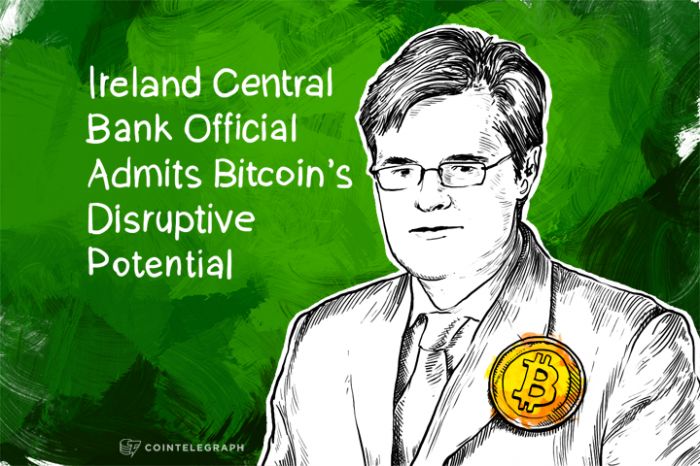
Virtual and digital currencies can challenge the sovereignty of states

official. At a recent digital money conference in Dublin, he mentioned
that rivals are interfering with a bank’s ability to sway the price of
credit for the entire economy. Murphy warned that there might be
considerable threat to the finances of a country if increasingly more
transactions for services and goods fade away from the tax system due to
the use of crypto currencies such as Bitcoin. He added:
“Central banks, [out] of necessity, have monopolized the exercise
of these functions. Virtual currencies pose new challenges to central
banks’ control over these important functions.”
Bitcoin conference. It gathers the brightest minds in finance,
payments, banking, and business. The goal is to host fearless debates on
the risks and opportunities involved with decentralized currencies.
Bitfin (Bitcoin Finance) wants to shape
the future of corporate strategy, commerce, and economic policy in the
current industry of peer-to-peer digital money. “Bitcoin Finance is the
digital money conference you’ve been waiting for,” the official press
release reads.
trigger significant drops in economic activity. The Central Bank has
constantly emphasized that it doesn’t recognize digital currencies such
as Bitcoin in Ireland. Nonetheless, those who choose to use Bitcoin anyway won’t have consumer protection.
Murphy is well aware that virtual currencies could offer a great option
for people looking to buy and sell different services and goods. He
added that in these circumstances, the anti-money laundering rules will
be thoroughly tested. Failure of settlement infrastructure and
payments, or any sort of “financial plumbing,” could have a great impact
on the country’s economic activity and consumer confidence. Murphy
said:
“In effect, economic activity is the aggregate of domestic
transactions in the ‘euro-denominated economy’ and the ‘virtual currency
economy.’”
institutions and banks will most likely feel the effects. Other major
financial institutions don’t see Bitcoin as a threat to their
operations. However, in Murphy’s view, these institutions would be
foolish to have this kind of attitude towards the technology,
mentioning:
“This is likely to have a profound operational impact on these firms and their regulatory risk profile.”
economic challenges. Digital currencies defy the way these institutions
calibrate exchange rates, monetary policy and set price of credit.
Supporting Bitcoin and encouraging its growth would have to be
attentively monitored. Gareth Murphy added:
“The existence of a ‘euro-denominated economy’ and a ‘virtual
currency economy’ raises the prospect of an internal balance of payments
between two sub-economies where suppliers may prefer one currency over
another as a means of payment (for different goods and services).”
the most frequently used on a global scale. Bitcoin undermines a
central bank’s ability on matters such as economic analysis, data
collection, supervision, policy formation, enforcement and resolution,
so these sort of implications can’t be overlooked.
shouldn’t take things for granted and assume its actions will keep
falling under US and Switzerland regulations. He did mention that
Bitcoin should be used to support indefinite innovations that may come
from a wiser use of the technology:
“We should not presume that current regulations are
future-proof. It is possible that further innovations will mean that
these regulations may no longer apply. This suggests that new
regulations may ultimately be needed which are based on new legal
concepts with a clear scope which must stand the test of time.”
because they’re offering lower fees, commissions, greater convenience
etc. Bitcoin might gain control over the most important functions of
exchange rate and monetary policy. In spite of the currency’s relative
instability, more people are turning their attention to Bitcoin, and the
more publicity it receives the higher chances it has to become
ubiquitous in our everyday lives.
Open your free digital wallet here to store your cryptocurrencies in a safe place.
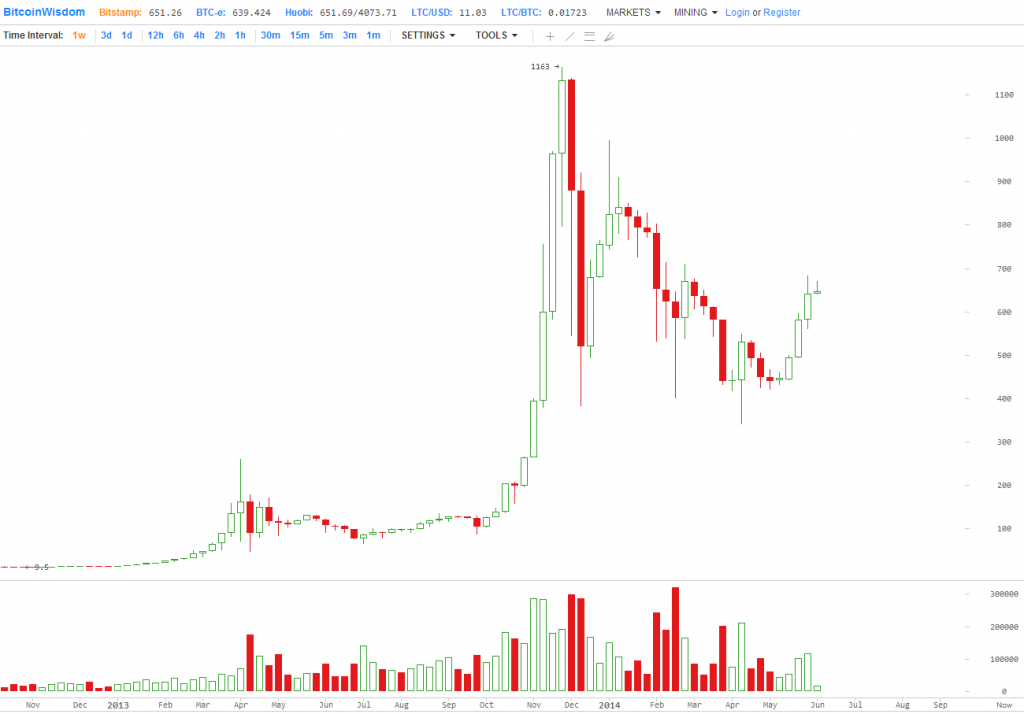
Four charts that suggest Bitcoin value could be at 10,000 USD next year
The chart below shows us the Bitcoin/USD value over the same 2013-2104 period on a logarithmic scale.
Google Trends on Bitcoin
“Bitcoin is still in the earliest phases of industry development. The first years of Bitcoin were about building the infrastructure. Bitcoin entrepreneurs were busy setting up the most basic but fundamental aspects, including wallet and mining services. Today, Bitcoin is just starting to enter the investment phase, where venture capitalist, hedge funds and other financial firms are starting to invest money and capital into this nascent technology. Bitcoin isn’t quite ready for the consumer phase, where end users begin to utilize the services. If the entire history of Bitcoin was a clock, we’re still in the very early time. I would say were maybe in the second second of the entire history.” Nicholas Cary, CEO of Blockchain.info (source)
Disclaimer: The (funny) definition of an economist is “Someone that can use economic theory today to explain why he got all his predictions wrong yesterday“. The market is unpredictable and I can’t always be right
Open your free digital wallet here to store your cryptocurrencies in a safe place.
Nick Szabo (Bitcoin founder Satoshi Nakamoto?) Breaks his Silence with a Tweet
to bitcoin, the person who coined the term smart contracts in 1993, and
believed by many to be Satoshi himself, published a one line blog post
today which simply contained a link to his twitter account.
2013, almost seven months ago, leaving many to wonder whether he would
ever post again. The seven months silence seems to have followed
increasing attention on Nick Szabo after numerous suggestions that he might be Satoshi.
In April 2014, researches from Aston University’s Centre for Forensic
Linguistics claimed that forensic analysis of Bitcoin’s White Paper
suggests that Nick Szabo was the author of the paper.
that he is Satoshi and many argue that it is highly unlikely that he is
the author of the white paper. Nick seems to have been focused on
bitgold, writing a blog post about bitgold two months after Satoshi
announced bitcoin.
pictures of him, no verifiable details of his age, location, profession
or education. Previously, in a Wikipedia article, it was claimed that he
was a law professor at George Washington University, but reporters claim
that after contacting the University they found no record of a person
named Nick Szabo ever being a professor at that university, although
there was one record of a person having studied at that university under
that name. The name therefore might be a pseudonym, a pen name.
Nick Szabo Highlights the Dangers of Centralized Currencies
retweet of a statement by Proton Mail complaining that their PayPal
account had been frozen, blocking access to $275,000 of funds. In a
statement in their blog Proton Mail details what happened:
details, he questioned whether ProtonMail is legal and if we have government approval to encrypt emails.”
Paypal froze $215K in encrypted email startup, @ProtonMail‘s account over “government approval to encrypt emails”? https://t.co/VoqpHSTrEE
— lilia (@liliakai) July 1, 2014
intermediaries as emphasized by both Nick Szabo in his blog post and
Satoshi in his announcement on bitcointalk. We need to trust that our
accounts will not be blocked, our funds will not be tampered, our
government will not arbitrarily take funds, or that our banks will not
bankrupt our country as they did in Greece and Cyprus.
need no such trust. There is no authority that can block our private
keys to interact with our public keys, so accessing our wealth and using
it in whatever way we alone see fit.
Open your free digital wallet here to store your cryptocurrencies in a safe place.