Author Archives: Satoshi

European Central Bank hacked, personal data stolen

(RT) Hackers have stolen personal information from the European Central Bank (ECB) in what seems to be a blackmail scheme. The stolen data includes email addresses and contact information taken from the organization’s database.
“There had been a breach of the security protecting a database serving its public website,” ECB said in a statement on Thursday. “This led to the theft of email addresses and other contact data left by people registering for events at the ECB.” 
Around 20,000 email addresses were stolen, according to media reports. 
The hacked database serves the public website and gathers registrations for conferences and other visits. It is “physically separate from any internal ECB systems.” 
The bank was not aware of the theft, and only found out about the stolen data after the perpetrator sent an anonymous email, demanding a reward in exchange for the information. 
The ECB refused to go along with the scheme and did not reveal how much money was requested. 
The majority of the stolen information was encrypted, such as data on downloads from the ECB website. But personal information, such as email addresses, phone numbers, and home addresses were not protected by an encryption. 
The bank will contact people whose data might have been stolen. Meanwhile, “all passwords have been changed on the system as a precaution” and “security experts have addressed the vulnerability.” 
The cyber attack did not compromise internal systems or market sensitive data, according to the statement. 
German police have opened an investigation into the matter.

Open your free digital wallet here to store your cryptocurrencies in a safe place.
Satoshi
blockchain 1

Think the Internet’s disruptive? Hold tight for blockchain!

Wonder what all the fuss is about Bitcoin? A growing number of technology watchers are becoming increasingly excited about the peer-to-peer system on which the digital currency is built.
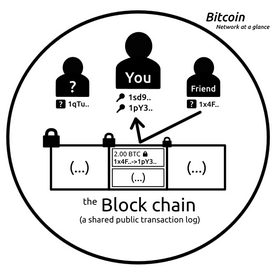
(Diginomica) The blockchain, this is the distributed, encrypted record that Bitcoin uses to record every transaction. An article in the Telegraph last week by Matthew Sparkes explained how the blockchain works:
The idea is that each and every transaction is broadcast by the person initiating it. Rather than telling the bank we want to spend [$5], we tell the world. That transaction is bundled up with thousands of others and cryptographically bound into a ‘block’ by ‘miners’ …
To quote the wiki dictionary maintained by ‘the Bitcoin community’ — perhaps the nearest you can get to an official explanation — ‘mining is intentionally designed to be resource-intensive and difficult so that the number of blocks found each day by miners remains steady … The primary purpose of mining is to allow Bitcoin nodes to reach a secure, tamper-resistant consensus.’

This matters because, as Sparkes sets out under his provocative headline of The coming digital anarchy,
this is a system that can be applied not just to money but to any kind of transaction, from domain name registration to legal arbitration or public elections. In between those two extremes, it could completely overturn the way enterprises organize themselves and tout for business.

The fifth protocol
To better understand the impact on business, it’s worth going back to a longform blog post from April by Angellist CEO and co-founder Naval Ravikant, in which he states that cryptocurrencies will create a fifth protocol layer powering the next generation of the Internet:
The Four Layers of the Internet Protocol Suite are constantly communicating. The Link Layer puts packets on a wire. The Internet Layer routes them across networks. The Transport Layer persists communication across a given conversation. And the Application Layer delivers entire documents and applications.
This chatty, anonymous network treats resources as ‘too cheap to meter.’ It’s a giant grid that transfers data but doesn’t transfer value. DDoS attacks, email spam, and flooded VPNs result. Names and identities are controlled by overlords — ICANN, DNS Servers, Facebook, Twitter, and Certificate ‘Authorities’.
Where’s the protocol layer for exchanging value, not just data?
Where’s the distributed, anonymous, permission-less system for chatty machines to allocate their scarce resources? Where is the ‘virtual money’ to create this ‘virtual economy?’ …
Cryptocurrencies are an emergent property of the Internet — almost a fifth protocol in the Internet suite. If [Bitcoin creator] Satoshi Nakomoto did not exist, it would still be necessary to invent them.
Someday, they will be used by the machines in our network, on our desk, in our garage, and in our pocket to exchange value and achieve consensus at blinding speeds, anonymously, and at minimal cost.

What Ravikant is really describing here is not Bitcoin per se but the work of the blockchain, providing a trusted, shared transaction record that allows machines to own and exchange value without human intervention. Although in strict engineering terms it’s not really a protocol, its impact is potentially as huge as any of these other building blocks of the Internet.

Effectively, Ravikant is arguing the blockchain is how the Internet of Things will exchange value — not just monetary value, but also many of those other components of business transactions that we currently find much harder to quantify, such as trust and reputation.

blockchain blocksAutonomous things

Now back to Sparkes, who recounts a scenario imagined by Mike Hearn, an ex-Googler who now works on Bitcoin:

Jen wants a taxi. She tells her smartphone where she’s heading and it immediately starts gathering bids from nearby taxis and ranking them based on price and user reviews. This system on which requests and offers bounce around is called TradeNet, and it would be based on blockchain technology.
The strange thing about these vehicles is not that nobody drives them, as self-driving cars will have become commonplace decades before, but that nobody even owns them. They are what Hearn calls ‘autonomous agents’, independent machines which earn their own money through fares, pays for their own fuel and repair and operates utterly without outside control.

Far-fetched it may be, but this is the kind of scenario that is getting venture investors excited about blockchain right now — and you can understand why.

Open your free digital wallet here to store your cryptocurrencies in a safe place.

Satoshi

Bitcoin like the Internet In 1995

At only five years old, bitcoin
is receiving more venture capital investment than early stage Internet
companies were in 1995. Remember what the Internet was like in 1995?
If you have 27 minutes to refresh your memory, YouTube has a Computer Chronicle video showing what the 1995 Internet
looked like. If not, the piece discusses how hard it was to stream
video, how there was no safe way to process credit cards, how ugly the
websites looked and how slow the Internet was.
Things seemed so grim. In 1995 Newsweek ran a piece: “Why the Internet will Fail.”
Sound familiar? These are the same arguments against bitcoin: hardly
anyone uses it, it isn’t safe, and it is hard to use. However digital
currencies are so much cheaper, more convenient and more powerful than
their analog counterparts that, like the Internet, their widespread
adoption seems assured.
Which digital currency will triumph? Hundreds or even thousands of
competing digital currencies have entered the market. So far none has a
clear shot at overtaking bitcoin. Bitcoin’s network effect is growing at
a fast rate, making its dominance even more likely.

Open your free digital wallet here to store your cryptocurrencies in a safe place.

Satoshi

A little altcoin sanity: Peercoin

(CoinReport) Litecoin, Namecoin, and Peercoin are the three you consistently would hear referred to when people talked about alts. It probably helped that BTC-e, one of the early altcoin hubs, added them all, giving them greatly increased prominence in the community. In looking at these four cryptocurrencies — Bitcoin, Namecoin, Litecoin, and Peercoin — it’s interesting to consider them in terms of how they differ from the original. Namecoin is the least distinct from Bitcoin: The only real distinction is the additional name-capturing feature. Litecoin is distinct in a few ways: block timing, total coins, and hashing algorithm (Scrypt). Still, neither of these were really all THAT different.
Peercoin actually IS different on a fundamental level. It introduced a concept now relatively commonplace within altcoins: Proof-of-Stake. Before we go anywhere, though, specs:
– Developed by Sunny King and Scott Nadal
– Announced well in advance of release on August 12th, 2012
– Mixed proof-of-work and proof-of-stake network security
– No maximum coins, eventually maintains 1% inflation through Proof-of-Stake
– 10-minute confirmations, like Bitcoin
So what exactly IS Proof-of-Stake (from here on out, PoS, no giggling please)? It’s the use of coins held in wallets to secure the blockchain. On a very basic level (and apologies in advance for an analogy which distorts the situation, I only have so much space), pretend you’re trying to account for all the gold in the world. You have a list of everyone who had some gold last time you checked. You ask all of those people “Hey, how much gold do you have?” and they all send you proof of exactly how much they have. So you can cross those people off your list — you only need to go find the as-yet-unknown gold owners. Much less work. As a reward to those gold owners (Peercoin-owners) they get a tiny bit more Peercoin, distributed based on how many Peercoins they own. This is essentially the basics of PoS: Instead of using electrical power to compute hashes to continuous prove ownership of coins and ensure network security, the PoS model just looks backwards in time to check and make sure proper ownership was verified, and that the coins have remained in that person’s wallet since that last check. If both of those are the case, no more work is needed to be done.
So why would anyone want to use a PoS system? More directly, what are the advantages?
First, it incentivizes owners of coins to own them. Generating 1% interest per year is a neat little benefit — not so much that it is a major problem for currency stability, or that it benefits holding coins so much that it promotes severe deflation, but just a little bit.
Second, it ends the possibility of some of the exploits the Bitcoin network needs to fear, such as the 51% attack. A 51% attack is essentially nonsensical when considered in terms of PoS, where an attacker would need to own 51% of the coins in order to perform it. I don’t even want to consider what the market capitalization of Peercoin would have to reach for one entity to buy up half of the coins, but suffice it to say that it would be the most expensive act of cutting off one’s nose to spite one’s face any of us had ever bore witness to.
Finally, since PoS replaces a significant portion of the role played by PoWork for securing the Peercoin blockchain, it is far more energy-efficient. No need to be running a huge amount of hashpower — those rooms full of Bitcoin mining ASICs don’t have a place in Peercoin. This is relevant for exactly the reason you would think: If you can achieve the same result (secure blockchain) with less expended resources (less energy), why wouldn’t you? Or, to quote from the end of the Peercoin White Paper: “…we expect proof-of-stake designs to become a potentially more competitive form of peer-to-peer crypto-currency to proof-of-work designs due to the elimination of dependency on energy consumption, thereby achieving lower inflation/lower transaction fees at comparable network security levels.”
Anytime resources must be expended in pursuit of a goal, the end-user must pay for those resources. The end-user of a cryptocurrency is its owners; why pay miners unless you have to? As Bitcoin did to banks and the fiat money system, so can Peercoin do to Bitcoin, at least in theory.
But there’s still one very unanswered question: How do we value Peercoin?
Unfortunately, for once, I’m going to have to tell you all something a little embarrassing: I have no idea. I understand what value it adds to the world (a blockchain which is cheaper to run than a purely PoWork model), but it’s hard to say how that added value can be understood in terms of market capitalisation. Essentially, though, there are two potential options:
1. Bitcoin and Peercoin coexist. Bitcoin is used as the “reserve currency” of the cryptocurrency world; the asset in relation to which all others are considered. Bitcoin is not commonly used for simple transactions due to high costs of exchange. Peercoin portefeuille, being cheaper to use thanks to PoS, is used instead.
2. Bitcoin’s first mover advantage is somehow lost (or a black swan takes flight), and cheaper methods of curating the blockchain, such as PoS, take over. Peercoin takes on the role of reserve currency thanks to its competitive advantage over PoW, and due to its first-mover advantage relative to other PoS systems.
And, of course, option three: Peercoin loses and becomes an unremarkable footnote to history. It is worth noting that option three is the path most altcoins are very likely to follow. I simply don’t often discuss it, because the role of an investor is to look for potential value; if you spend all your time pointing at things you expect will fail, you’re just wasting time.

Open your free digital wallet here to store your cryptocurrencies in a safe place.

Satoshi
shutterstock 113057557 630x402

Under the microscope: conclusions on the costs of Bitcoin

Hass McCook is a chartered engineer and freshly minted Oxford MBA. He has been researching bitcoin over the past several months and recently joined the Lifeboat Foundation’s New Money Systems advisory board.
This, the final instalment in his five-part series, evaluates the relative sustainability of the bitcoin network against the costs of gold production, the printing and minting of physical currency and the legacy banking system.
Under the Microscope has aimed to cast a critical eye over the social, environmental and economic impacts of the way we currently transact and transfer wealth, be it through legacy systems like gold and fiat currencies, or through newer digital cryptographic ones.
The series has also endeavoured to give readers a clearer idea of the human and environmental impacts associated with both current and future monetary systems, and allow them to draw their own conclusions on the relative sustainability of the old and new systems when viewed from a holistic “triple-bottom-line” approach.
Although it is not necessarily fair to compare bitcoin to the entire legacy banking system, there was doubt in the community about the impact of the legacy banking system, and thus, it has been quantified for completeness.
It should be noted that the only thing involved in bitcoin mining is electricity use, and as the world moves towards clean and renewable energy, Bitcoin will have even less of an impact on the environment (See Koomey’s and Moore’s Laws). There is also much larger scope for energy efficiency improvements in integrated circuits and computing than there are in gold recycling.
As can be conclusively seen, the relative impact of the bitcoin network does not even register on the radar of the fiat and gold-based monetary systems, representing a very conservative relative environmental impact of just over 0.13%, and a relative economic impact of just under 0.04%. When one considers Koomey’s Law, we can expect energy/GH to continue to half every 18 months until 2048.
This means that we can expect our current industry best efficiency of 0.733 W/GH to reach 0.0000000873804 W/GH. Thus – armchair academics take note – in the event that bitcoin scales to a million times its current size and market cap over the next 30 years, it’s environmental impact will still be insignificant compared to existing systems.
When considering Moore’s Law, we can expect $/GH to continue to half every 18 months until at least 2020. When we consider the advent of decentralised emission-free renewable energy, we can expect tCO2/GH, and possibly even $/kWh, to tend towards zero.
The more agile and dynamic bitcoin companies can take advantage of these trends, but the sluggish, inert and over-encumbered incumbents simply cannot. As time goes on, bitcoin only becomes more sustainable, while legacy systems continue to bloat year-on-year.
There are no negative social externalities as a result of bitcoin proliferation, and any money laundering and shadow economy dealings that currently happen on the network will reduce drastically in proportion as adoption grows and regulations firm up on the on-and-off ramps into the bitcoin economy.
Rome wasn’t built in a day, and the crypto-currency space will take time to evolve to ensure that the issues faced and created by our legacy monetary systems do not continue to plague us for the next century and beyond.
It has been demonstrated that institutional fraud is a problem systemic to humans, and not to monetary systems. However, transactional fraud is only a problem in legacy systems due to the infallibility of the fact that 2 + 2 will always equal 4.
Although this paper has shied away from all of the ideological and philosophical debates surrounding bitcoin, what is clear is that the argument that bitcoin is superior monetary system – from the benefits and protections it provides to merchants and consumers, to the relative lack of negative impact it has on our planet and humanity in general – is a strong one.
The world is currently crippled by several issues, and the human race faces several existential threats such as climate change, the global ageing population demographic crisis and wealth and income inequality.
It is also unacceptable in 2014 to still have tens of millions of people forced into labour, and current monetary systems are somewhat responsible for several of the social ills brought about by corruption, money laundering and the black market.
For those who are willing to back their principles and morals with their money, bitcoin provides the opportunity for socially, environmentally and economically conscious global citizens to choose to no longer participate in the fragile and rotten legacy monetary system, and voluntarily participate in the open and wondrous bitcoin ecosystem.
Due to the several benefits and significantly reduced burden on our planet and society, there is a certain feeling of inevitability about digital currencies, whether it be bitcoin, or a future currency that proves to be even more sustainable and beneficial for humanity.
You can read Hass McCook’s paper ‘An Order-of-Magnitude Estimate of the Relative Sustainability of the Bitcoin Network‘ (on which this series is based) in full here.

Open your free digital wallet here to store your cryptocurrencies in a safe place.

Satoshi

Bitcoin: Education can make a difference

(TheHill) Every so often, a transformative new technology emerges that has the potential to affect everyone on the planet. But whether the technology’s potential is realized or or not depends heavily on public opinion. Positive coverage can encourage people to embrace innovation, while negative stories can make them avoid something new — or even encourage governments to legislate against it.
We’ve seen such controversies around issues like stem cell research or genetically modified foods. Some people praise their potential for curing diseases or feeding billions of people. Other people warn that these allegedly unsafe and untested technologies could be hugely damaging.
A similarly polarized dynamic has now arisen around Bitcoin, a new technology that has the potential to become a global money for a global economy. Bitcoin combines the advantages of instant online payment (like PayPal) with being a store of value (like gold). At its core is a powerful cryptographic technology called the “blockchain,” which Jeff Garzik, one of the Bitcoin protocol’s core developers, describes as an elegant and unexpected solution to distributed systems: how computers talk to each other, and how to keep them coordinated.
Many people believe that Bitcoin can make our financial system cheaper, faster, and safer. Yet, coverage rarely focuses on these benefits. Instead, stories about money laundering, drug trading, exploded exchanges, and price crashes predominate the news cycle, to the point where many people are inclined to see Bitcoin as an undesirable phenomenon. A recent Reason-Rupe poll shows that although only a small minority (8 percent) of people say that they really understand Bitcoin, the majority (56 percent) want the government to ban it.
So why are some people so positive, and others so negative?
Support for Bitcoin often comes from tech visionaries. Paul Graham, a prominent venture capitalist, refers to Bitcoin as a paradigm shift that is unfortunately “derided as a toy, just like microcomputers.” Entrepreneur Marc Andreessen has written that the potential of Bitcoin today is analogous to personal computers in 1975 and the Internet in 1993. Today, it’s the preoccupation of “nerds,” but tomorrow it can change the life of everyone. Indeed, Bitcoin is already starting to become a mainstream phenomenon, with tangible benefits for ordinary people.
Bitcoin’s critics commonly mention its role in money laundering and corruption, epitomized by the infamous underground online market Silk Road. But they often fail to mention that any currency can be used for socially undesirable purposes. In theory, Bitcoin is easier to track and regulate than paper cash, so we have legitimate reason to believe that Bitcoin’s wide adoption would lead to less criminal activity, not more.
Consider, too, that there are 2.5 billion unbanked people in the world, equivalent to eight times the population of the United States. Just by giving them access to a cell phone and Bitcoin, we have potentially added 2.5 billion people to the global economy. Furthermore, with Bitcoin, people can send money anywhere in the world, without crippling bank fees or fear of government extortion. When we consider that the World Bank expects migrants to send $436 billion in remittances to their home countries this year, the advantages could be enormous.
On top of this, you can now use Bitcoin at an increasing number of retailers. Seemingly every week, a new brand-name retailer is added to the list of merchants who accept Bitcoin, which now includes the likes of Overstock, Expedia, and OkCupid. This makes Bitcoin a credible and desirable currency in the developed world, as well.
In response to the fearmongering and lack of credible information about Bitcoin, I started an educational platform called “Bitcoin Girl” — but that’s really just the start of what we should be doing. If we want to prevent negative public opinion and uninformed legislation from crippling Bitcoin in its infancy, we need to educate the people who understand humans better than computers.

Open your free digital wallet here to store your cryptocurrencies in a safe place.

Satoshi

Bitcoin: the future of payments

The implications of bitcoin’s effect on consumer finance, investment and banking are not fully understood, a new report from Innopay suggests.
(CoinDesk) The payments and transaction service consulting firm explored the nature of digital currency and its impact on a broad range of market sectors, tapping everyone from European central bankers to core members of the bitcoin community for insight. At its heart, the Innopay report points to a broad awakening within the global economy to the benefits of bitcoin and its underlying technology, but acknowledges that ignition remains held back by and large.
Apprehension about the security and stability of bitcoin, especially among banks, large companies and a broader subset of consumers keeps the clear benefits of digital currencies from achieving mainstream usage. The experts interviewed by Innopay agree that bitcoin will deeply affect how people transact with one another, but remained split on how digital currency technology will manifest in the years ahead.
Economist and CoinDesk contributor Tuur Demeester told Innopay:
“Just like the Internet has broken open the information market, one can expect the same paradigm shift to occur with cryptocurrencies on the financial market.”
Digital currencies were also seen through the lens of regional financial crises, consumer technology and the future of the internet. The rules of global finance, the Innopay report explores, could be fundamentally rewritten by the likes of bitcoin and other currencies.

Payments networks revisioned with bitcoin

One area explored in the report is the concept that bitcoin can change how businesses and consumers pay one another. At the center of this, Innopay notes, is the change in how financial parties trust one another. The evolving nature of this trust structure carries the potential for significant benefits – and complications.
As Demeester remarked, the number of bitcoin transactions continues to grow steadily but this fact does not preclude traditional payments networks from maintaining a significant role by comparison. However, he said that many of the core services offered by banks may be facilitated more cheaply and efficiently with digital currencies, suggesting that banks are at risk of market loss for their inaction.
He said:
“The traditional financial system is being challenged to step up their game in terms of efficiency because the bitcoin environment is removing middlemen.”
Others who spoke with Innopay were less convinced.
Kim Gunnink, an official with the Dutch Central Bank’s Payments Systems Policy Department, said that the central bank views bitcoin usage today as “a fad”. Gunnink argues that bitcoin’s performance as a type of money is poor overall, citing its fluctuating value as a critical flaw that makes it ineffective as both a unit of account and a store of value. As well, the official said that the future of bitcoin transaction fees could pose a long-term issue.
On the other hand, Gunnink noted the growing influence of digital economies among businesses and consumers, leaving the door open for the technology to grow in usage. Gunnink added that the addition of new services and avenues for digital currency acquisition would ease adoption, saying:
“Cryptocurrencies could be gaining ground in the field of cross-currency payments, as a growing payment method for global online purchases or peer-to-person payments. To what extent this growth will become a reality is still unclear.”

Why bitcoin is held back

Innopay’s report also confirmed what many other observers have said about the barriers to bitcoin’s success. A mixture of uncertain regulation, poor consumer information and complicated means to acquire bitcoin makes it difficult for broader use to take off.
Dave Birch, a director for IT advisory firm Consult Hyperion, remarked that governments remain cautious about passing definitive legislation about bitcoin because they both lack understanding of its underlying technology and fear missing out on future tax revenue. However, he predicted that governments will eventually see bitcoin’s potential to create “a dynamic and efficient economy”.
A lack of bank participation makes the situation even more untenable, but according to the report, bitcoin technology may one day find a strong ally in the global banking sector. Owing to the need to update legacy money networks worldwide – and the possible erosion of their core services – banks may have little choice but to embrace bitcoin.
However, it’s likely that this shift will manifest in the utilization of the protocol itself rather than bitcoin or another digital currency. But this isn’t necessarily a problem for bitcoin, as Innopay itself notes in the report’s conclusion:
“The quest to find better ways to do transactions often leads to innovations that open up opportunities, like we have seen in other industries and with other technologies.”

Open your free digital wallet here to store your cryptocurrencies in a safe place.

Satoshi

Google update now supports Bitcoin price in search results!

Following suit of Microsoft’s Bing, Google, the world’s most popular search engine, has now added live bitcoin prices into its search results for the digital currency.
The update, which was confirmed just hours ago by a member of the Google team, also provides functionality to mobile users on their smart phones and tablets as well:
The Google spokesperson told CoinDesk:
You can also ask Google to do conversions – if you have the Google Search app on your smartphone, for example, ask it, ‘How many bitcoin are in 500 U.S. dollars?’ and you’ll get the answer in a handy conversion tool.”
Google’s decision to add a live bitcoin price to its general search results for the digital currency comes just several weeks after both Yahoo Finance and Bing decided to add the price into their results. Though Bing was the first to do so, adding the result into its query back in mid-February.
FEATURES
Now, with the simple query of the keyword “bitcoin price,” you can quickly catch up to the minute results on the digital currency’s latest value.
The feature takes it one step further, allowing users to punch in different amounts of the digital currency, working as a bitcoin calculator so to speak. Google’s bitcoin price results also include a price chart, going as far back as to 2011 in displaying the digital currency’s progression throughout the years.
Google’s latest upgrade does; however, come with a disclaimer as does many of its price charts, disclosing that in terms of real-time results, investors should not solely rely on the indicator and should always seek outside advice or guidance before making investment decisions.

Open your free digital wallet here to store your cryptocurrencies in a safe place.

Satoshi

The line between fiat and cryptocurrency is getting fuzzier.

(BitcoinMagazine) The line between fiat and cryptocurrency is getting fuzzier. With the advent of Bitcoin 2.0 technology, we can now use cryptocurrency to exchange stocks, property, commodities, and even state-backed money. But if the whole point of cryptocurrency was to decentralize the financial system, what’s the point of a dollar-backed coin?

Dollar-backed digital coins have been attempted many times before. The Canadian government even tried to get in on the action, and unsurprisingly failed. Some claim that the first cryptocurrency to attempt this was Coinaaa, but this is technically incorrect. Coinaaa sells premined coins, and does invest a lot of the revenue in Norwegian krone, but their intention is to maintain a stable value independent of any state-backed currency. The company invests their earnings, and uses some of the money to buy back coins when the price drops, or sell coins when it rises.

The company promises 0% transaction fees, but at the cost of a centralized mining system. While this fails to represent actual kroner one could trade in a decentralized manner, it does serve as a great transactional currency. This is theoretically possible without having to rely on humans–decentralized autonomous software could do this by adjusting block rewards or destroying transaction fees in response to price fluctuations–but if they make the right investments, it functions for now.

Given the possible and existing options available, one might then wonder why Brock Pierce chose to introduce Realcoin, the first cryptocurrency backed by US dollars. Although they claim to hold US dollars in “conservative investments,” this probably means they’re doing the same thing Coinaaa is with your money. The major difference is that they aren’t trying to maintain a stable value: Realcoin claims they will maintain a fully-auditable 1-to-1 reserve of US dollars, which can be redeemed for their coins. This is all enabled by the Mastercoin protocol (Omni Layer) on the existing Bitcoin blockchain.

This will cause Realcoin to fluctuate with the value of the dollar, for better or for worse. It will inflate with time, as all fiat money does, meaning you won’t want to keep your savings in it–Bitcoin would be a better choice. A good transactional currency should be neither inflationary nor deflationary, so Coinaaa is clearly the superior choice for daily use; both will likely make their profit by trading and investing with your money, and require very similar amounts of trust.

Why, then, create Realcoin? Although the Coinaaa company will definitely hold some kroner, a Coinaaa will not represent the value of a Norwegian krone. This means that if you want to do FOREX trading involving Norwegian currency, you have no choice but to return to centralized exchanges. Even if you don’t want to hold or use kroner, there’s profit to be had in exchanging it.

Realcoin, therefore, represents an opportunity to speculate with fiat currency for the first time. If you have reason to believe its price will move for or against a digital currency on the market, now you can take advantage of that. Given that the Mastercoin protocol will almost certainly contain a decentralized exchange, Realcoin allows you to trade in US dollars without ever touching a traditional financial institution. The state is just like any other company, issuing money that you can choose to use–or not.

Open your free digital wallet here to store your cryptocurrencies in a safe place.

Satoshi
urlhttpmedia.coindesk.com201407Screen Shot 2014 07 14 at 4.38.21 PM 600x370

LinkedIn co-founder: Bitcoin is in my five-year Investment plan

LinkedIn co-founder, early Facebook investor and Greylock Partners partner Reid Hoffman has declared his enthusiasm for bitcoin in a new interview with CNBC’s ‘Squawk Alley’.
The interview aimed to assess Hoffman’s current opinion of opportunities in the market given his experience and success in early social media.
Notably, despite the suggestions by show hosts that such industries as wearable technology, healthcare and home automation were areas that investors should be considering for investment over the next three-to-five years, Hoffman suggested he is increasingly focused on bitcoin.
Indicating that the ecosystem has piqued his interest in the last six to 12 months, Hoffman lauded bitcoin, saying:
“I think it’s an incredible system that’s created a ledger that is across – a distributed ledger across the whole world for it can be money but it can also be other things.”
Hoffman recently joined the board of directors at secure bitcoin wallet startup Xapo, an announcement that was made when the company reported $20m in new financing from firms including Greylock Parnters.
Bitcoin ownership.
In the interview, Hoffman discussed his personal experience with bitcoin, confirming that he has purchased “a few bitcoins” to date in addition to his investment in Xapo.
Hoffman also dismissed suggestions that he may be worried about the price of bitcoin given the volatility that this indicator has experienced so far in 2014.
He added:
“I don’t check [the price] every day. It’s more a question of a three- to five-year horizon, not a daily horizon.”
Despite this, Hoffman cautioned investors, echoing the familiar refrain that investors shouldn’t put any money into bitcoin directly unless they are “willing to lose the money”.
Platform for innovation
Hoffman further stressed that bitcoin’s true innovation will be its platform, which he called its “most interesting layer”.
Citing smart contracts as one such example of the innovation bitcoin entrepreneurs have yet to fully unlock, Hoffman said:
“You can have bitcoin stand for something that isn’t just a bitcoin. […] It could mean your car. So then your car could be accounted for on a general ledger that is then – you know, can let you do electronic contracts. you could put liens against it, moving it all into the electronic age.”
For more on bitcoin and its potential applications in the field of smart property, read coindesk report here.

Open your free digital wallet here to store your cryptocurrencies in a safe place.

Satoshi