

Tag Archives: blockchain

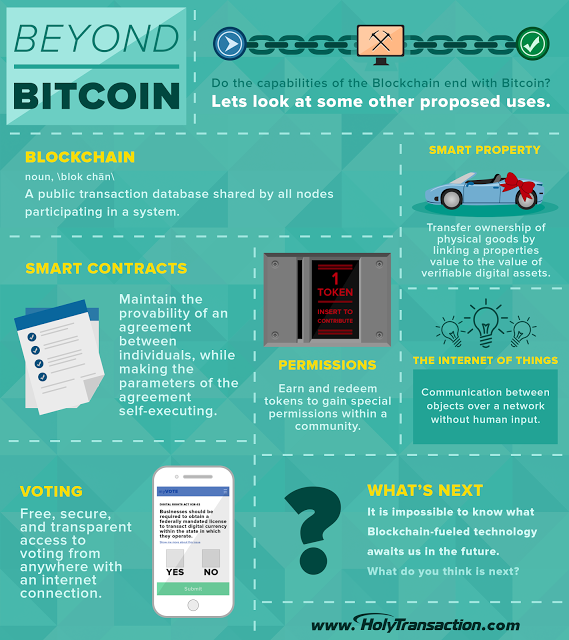
Infographic: Do the capabilities of the Blockchain end with Bitcoin?

Capabilities of Blockchain Bitcoin Infographic HolyTransaction

Do the capabilities of the Blockchain end with Bitcoin?

Open your free digital wallet here to store your cryptocurrencies in a safe place.

jorge
tumblr inline nsqh78t2MG1t3ciw3 500

HolyTransaction partners with RibbitRewards to further Blockchain-based rewards programs

HolyTransaction is thrilled to announce its integration with the Blockchain-based coalition rewards platform, RibbitRewards. This partnership represents a year of interaction between our two companies, beginning in 2014, and underscores our desire to continue working together for many years to come.
RibbitRewards is the first coalition rewards program built using Blockchain technology. Their platform allow companies to recognize the loyalty of their customers by awarding points that can be spent, saved, or shared with others. Additionally, RibbitRewards stands prominently out from the crowd as a result of their dedication to philanthropy; a percentage of all RibbitRewards created are donated to charity.
Ribbit.me uses extensive HolyTransaction API to make invoicing and payment processing. It will make life much easier for users with HolyTransaction account and will give ability to get new HolyTransaction account instantly for those who do not have it yet. All of this gives the users seamless experience on both platforms.
HolyTransaction multi-currency wallet users have access to storage for Bitcoin, Litecoin, Dogecoin, Dash, Blackcoin, and Mastercoin (Omni Layer). Today, we add RibbitRewards to this list.
Users will be able to receive, store, and spend their rewards via their HolyTransaction wallet, as well as exchange them instantly with one of our accepted digital currencies, as listed above. Our integration improves the experience of all users across both platforms, and we are dedicated to providing new and exciting experiences for our community and to continuing the proliferation of Blockchain technology.

Open your free digital wallet here to store your cryptocurrencies in a safe place.

Satoshi
blockchain 1

Think the Internet’s disruptive? Hold tight for blockchain!

Wonder what all the fuss is about Bitcoin? A growing number of technology watchers are becoming increasingly excited about the peer-to-peer system on which the digital currency is built.
(Diginomica) The blockchain, this is the distributed, encrypted record that Bitcoin uses to record every transaction. An article in the Telegraph last week by Matthew Sparkes explained how the blockchain works:
The idea is that each and every transaction is broadcast by the person initiating it. Rather than telling the bank we want to spend [$5], we tell the world. That transaction is bundled up with thousands of others and cryptographically bound into a ‘block’ by ‘miners’ …
To quote the wiki dictionary maintained by ‘the Bitcoin community’ — perhaps the nearest you can get to an official explanation — ‘mining is intentionally designed to be resource-intensive and difficult so that the number of blocks found each day by miners remains steady … The primary purpose of mining is to allow Bitcoin nodes to reach a secure, tamper-resistant consensus.’

This matters because, as Sparkes sets out under his provocative headline of The coming digital anarchy,
this is a system that can be applied not just to money but to any kind of transaction, from domain name registration to legal arbitration or public elections. In between those two extremes, it could completely overturn the way enterprises organize themselves and tout for business.

The fifth protocol
To better understand the impact on business, it’s worth going back to a longform blog post from April by Angellist CEO and co-founder Naval Ravikant, in which he states that cryptocurrencies will create a fifth protocol layer powering the next generation of the Internet:
The Four Layers of the Internet Protocol Suite are constantly communicating. The Link Layer puts packets on a wire. The Internet Layer routes them across networks. The Transport Layer persists communication across a given conversation. And the Application Layer delivers entire documents and applications.
This chatty, anonymous network treats resources as ‘too cheap to meter.’ It’s a giant grid that transfers data but doesn’t transfer value. DDoS attacks, email spam, and flooded VPNs result. Names and identities are controlled by overlords — ICANN, DNS Servers, Facebook, Twitter, and Certificate ‘Authorities’.
Where’s the protocol layer for exchanging value, not just data?
Where’s the distributed, anonymous, permission-less system for chatty machines to allocate their scarce resources? Where is the ‘virtual money’ to create this ‘virtual economy?’ …
Cryptocurrencies are an emergent property of the Internet — almost a fifth protocol in the Internet suite. If [Bitcoin creator] Satoshi Nakomoto did not exist, it would still be necessary to invent them.
Someday, they will be used by the machines in our network, on our desk, in our garage, and in our pocket to exchange value and achieve consensus at blinding speeds, anonymously, and at minimal cost.

What Ravikant is really describing here is not Bitcoin per se but the work of the blockchain, providing a trusted, shared transaction record that allows machines to own and exchange value without human intervention. Although in strict engineering terms it’s not really a protocol, its impact is potentially as huge as any of these other building blocks of the Internet.

Effectively, Ravikant is arguing the blockchain is how the Internet of Things will exchange value — not just monetary value, but also many of those other components of business transactions that we currently find much harder to quantify, such as trust and reputation.

blockchain blocksAutonomous things

Now back to Sparkes, who recounts a scenario imagined by Mike Hearn, an ex-Googler who now works on Bitcoin:

Jen wants a taxi. She tells her smartphone where she’s heading and it immediately starts gathering bids from nearby taxis and ranking them based on price and user reviews. This system on which requests and offers bounce around is called TradeNet, and it would be based on blockchain technology.
The strange thing about these vehicles is not that nobody drives them, as self-driving cars will have become commonplace decades before, but that nobody even owns them. They are what Hearn calls ‘autonomous agents’, independent machines which earn their own money through fares, pays for their own fuel and repair and operates utterly without outside control.

Far-fetched it may be, but this is the kind of scenario that is getting venture investors excited about blockchain right now — and you can understand why.

Open your free digital wallet here to store your cryptocurrencies in a safe place.

Satoshi

Bitcoin, Dogecoin, and the Blockchain

The prevalent idea of modern day cryptographic currencies originated when Bitcoin launched in 2009. With Bitcoin, for the first time in history, the world had access to a completely decentralized medium of exchange. This medium of exchange reliably transfers value from one entity to another in a hostile, trust less environment by solving a problem that previously necessitated centralized entities, such as financial banks, to arbiter value exchanges. The main role of the centralized entity was to assure the recipient that the money has been taken from the sender, and given to the recipient, and the sender could no longer spend the same money (i.e., double spend it). The problem of double spending can be modeled under an abstract Byzantine Generals’ Problem that focuses on achieving majority consensus in a decentralized network.
The Byzantine Generals’ Problem is a topic that deserves its own blog post. For now, let’s just remember that the problem of double spending was thought impossible to solve in a decentralized manner before Bitcoin solved it. This solution was implemented in what is now called the Blockchain.

What is the Blockchain?

In simple terms, the Blockchain is a book of accounts that is divided into batches of transactions, or blocks, which are naturally a collection of transactions. Bitcoin uses a number of technologies that came before it, including decentralized file sharing (see: BitTorrent), Public Key Cryptography, and Proof of Work Hashing (see: Hashcash). Bitcoin introduced a new technology: the Blockchain. Most subsequent cryptographic currencies, such as Dogecoin, use the same technology with minor changes (e.g., a different Proof of Work hashing algorithm).
The Blockchain facilitates reliable transfer of units of account (later on referred to as values) between certain cryptographically valid entities. In Bitcoin, the total units of account that will ever exist is 2.1 Quadrillion Satoshis, or 21 Million Bitcoin. In Dogecoin, this is 100 Billion Dogecoin until March 2015, and 5 Billion additional Dogecoin annually after that. Dogecoin and Bitcoin consist of two separate networks of peer-to-peer nodes. Each Bitcoin or Dogecoin portefeuille tries to keep its local copy of the book of accounts up-to-date.
In order to make use of the power of the Blockchain and its fast, decentralized, low-fee transactions, one must understand what constitutes a transaction:
A transaction is simply a cryptographically verifiable instruction from the sender to transfer value the sender owns to one or more valid recipients. The sender(s), and receiver(s), have cryptographically verifiable identities, known as addresses (see: Public Key Cryptography).
In the Blockchain, here’s what a (simplified) transaction looks like:


{
    "txid": <a unique transaction identifier>
    "inputs": <an array of inputs>
    "outputs": <an array of outputs>
    "tx_hex": <transaction content as a hexcode string>

    "blockhash": <a unique block identifier this transaction belongs to>
    "time": <the time this transaction's block was processed>
    "confirmations": <number of blocks that confirmed this transaction>
}

The very basic parts to understand in the above snippet are: a transaction has inputs, and outputs. The inputs are specifications of which values to transfer from the sender’s address(es), and the outputs are specifications of how much of the total input value each recipient’s address(es) receives. Inputs in this transaction were outputs in a previous transaction, with the exception of when the network generates new coins.
New coins are generated by the Dogecoin network as rewards for miners for solving a block (example), i.e., miners work hard to find the correct hash for a batch of transactions, also known as a block (see: Hashcash, Proof of Work). If the total input values are higher than the total output values, the difference is paid to miners of the block as a transaction fee. Total input value is never less than the total output value in a single transaction.
When a miner finds a new block, they confirm all the transactions contained within it as valid. However, a block does not exist on its own — it is linked to blocks previously solved in a chain of blocks all the way to the Genesis Block. The Genesis Block was created when Bitcoin or Dogecoin networks were created (see: Dogecoin Genesis Block). Therefore, where a block is solved, and appended to a chain of previously found blocks, it confirms the transactions within it, as well as the transactions in all the previous blocks in its chain. Hence the name: Blockchain.
So, what is the Blockchain? In very concise terms, it is a chain of blocks!

Open your free digital wallet here to store your cryptocurrencies in a safe place.

Satoshi

An Internet of Blockchains

The blockchain is a hard concept to wrap one’s head around because it describes a system for which no analog exists today, and it runs counter to everything we know about how trust works. In today’s world, trust can only be assigned or transmitted by an individual or organization. The idea that one could safely send money from point A to point B, and have that transaction fascilitated by potentially millions of agents without you knowing who those agents are, what motives they might have vis-a-vis your money, whether they are nefarious or not, is an anathoma. But that is exactly what the blockchain helps enable.

With the blockchain, trust stems not from the reputation of an actor or collection of actors, or from a process or set of controls that abstracts power and authority away from individuals. Nor does trust get transmitted through a graph of friends, or from an external auditor who can vouch for a claim. Instead, we place trust in a design pattern. But what does that mean, to trust in a design pattern? To answer that, let’s look at another decentralized system we have all grown to trust so much that it has transcended the need for trust entirely, and just is: the Internet. The Internet has no governing body or centralized authority. There is no mastermind responsible for making sure some secret collection of computers are plugged in and working. There is no facility that if compromised could “take down the Internet.” No, the Internet works because of a design pattern that dictates that data should move the same way between networks, as it does within networks. So if a network wants to take advantage of the access and opportunity afforded by the Internet, all it has to do is connect, and in so doing it begins contributing it’s own resources to the benefit of the whole, further decentralizing it, making it faster, and making it more resilient.

We take all of this for granted without knowing how this system works. But if you look back to your own history, assuming you were around when the Internet had it’s tipping point, I bet you will find a moment where you had to take a leap of faith. A moment when you had to drop AOL for a generic Internet Service Provider who provided no information services of their own. Of course, the later you made this leap of faith the easier the choice was to make because you were entering an increasingly useful and utilitarian landscape of services – companies like CNet, Excite, Yahoo!, Excite, and others. And the more companies that began building their businesses ontop of this infrastructure, the less and less people cared about the fundamentals of how it worked. The proof was in the pudding.

The blockchain today is operating in a time not that dissimilar to the Internet in the 1990’s. Consumers are baffled and confused by how a decentralized finance system could even function, while a growing number of people led by technologists, futurists and entreprenuers see the potential for ideas and companies that heretofore had been impossible due to the economics of a centralized system. But slowly, as more and more people take their own personal leap of faith, more and more people will stop caring about how it works, and just accept that it does. By then we will no longer be talking about “a blockchain,” but rather an Internet of Blockchains. And no longer will our computers simply connect to the Internet, they will contribute their computing cycles to an untold number of micro-economies that will power far more than even they are aware of.

Open your free digital wallet here to store your cryptocurrencies in a safe place.

Satoshi
blockchain_healthcare

A Network analyst’s view of the Blockchain

Martin Harrigan is a computer scientist and software developer. He is the founder of QuantaBytes, an Irish startup developing a suite of tools for analyzing and visualising bitcoin’s block chain. He is also the co-author of one of the earliest academic papers to study the network properties of the block chain and its implications for anonymity.

abstract network
(CoinDesk) The
block chain is a decentraliced, consensus-driven ledger of every
successful bitcoin transaction to date. As of the 300,000th block, the
ledger includes over 38 million transactions.
Aside from being a
monumental technical achievement, the block chain is a fascinating
dataset. We can use it to create a transaction network that models the
flow of bitcoins from the creation of the genesis block to the present
day.
In this network, every node represents a transaction, and
every (directed) edge represents a flow of bitcoins from an output of
one transaction to an input of another. This large, complex network has
over 38 million nodes and 85 million edges.
transaction network
The transaction network represents the flow of bitcoins between transactions over time.
Network science
Network
science is the study of complex networks. It provides theories,
techniques and tools that help us understand the structure and evolution of a network.
The bitcoin transaction network is a prime example. Its basic building
block, the transaction, can be combined to produce complex transfers of
value. This is reflected in the topological structure of the transaction
network.
The network as a whole is too large and complex for most
network visualisation tools. However, we can measure various structural
properties of the network. For example, transactions can be
characterised by their varying numbers of inputs and outputs. But how
are these numbers distributed in practice? In the transaction network,
we can analyse the in- and out-degrees of the nodes. We can plot the in-
and out-degree distributions. They show, for each possible degree, the
number of times they occur in the network.
The in-degree distribution of the transaction network
The in-degree distribution of the transaction network.
The out-degree distribution of the transaction network.
In
both cases, we observe inverse relationships between these numbers. The
lower the degree, the more frequently the nodes with that degree occur;
the higher the degree, the less frequently they occur. There are many
outliers. The outlier in the out-degree distribution with out-degree
equal to two is due to an abundance of transactions with exactly two
outputs.

Giant connected component

Suppose we were able to
visualise the entire bitcoin transaction network. It would probably
resemble a “hairball”. These visualisations suffer from cluttering and
over-plotting to an extreme that makes them unusable for any practical
purposes. However, they do provide one key piece of information. Are we
dealing with one large connected component or several smaller connected
components?
Many visualizations of large networks are "hairballs".
Many visualizations of large networks are “hairballs”.
A
connected component is a group of nodes and edges that are all
connected to each other, either directly or indirectly. If a network has
a giant connected component, this means that almost every node is
reachable from almost every other node. If we ignore the direction of
the edges in the bitcoin transaction network, then it does indeed
contain a giant connected component covering over 99.9% of all nodes.
The second largest connected component has just 71 nodes.

Fourteen degrees of separation

Six
degrees of separation is the theory that everyone on the planet is
connected to everyone else through a chain of acquaintances with no more than six hops.
In network science terminology, this translates to the theory that the
social network of the human race has diameter six. Facebook reported that the effective diameter (covering 90% of all pairs of users) of its social network is five and is decreasing with time.
The
equivalent number for the bitcoin transaction network is fourteen and
is increasing with time. That is, across 90% of all pairs of
transactions, the shortest path between them in the transaction network,
ignoring directionality, is at most fourteen hops. The increasing value
is likely due to the fact that, unlike the Facebook social network,
there is no preferential attachment.
New nodes are connected to existing nodes whose corresponding
transactions are not yet fully redeemed. In other words, the transaction
network is growing at the frontier only.

The first currency with a ledger

Surprisingly,
bitcoin is not the first currency with a ledger from which we can model
the transfer of value. The Tomamae-cho community currency was
introduced into the Hokkaido Prefecture in Japan for a three-month
period during 2004-05 in a bid to revitalise the local economy. The
Tomamae-cho system involved gift certificates that were reusable and
legally redeemable into yen. There was an entry space on the reverse of
each certificate for recipients to record transaction dates, their names
and addresses, and the purposes of use, up to a maximum of five
recipients.
Researchers collected these certificates in order to
derive a network structure that represented the flow of currency during
the period. They showed, for example, that the network had small world properties.
A network representation of the transfer of value with a community currency.
Source: Network Analyses of the Circulation Flow of Community Currency
The
block chain is a digital equivalent to the Tomamae-cho certificates. It
does not contain information such as names and addresses or the
purposes of use. However, it has other properties that make it suitable
for analysing the transfer of value including its accuracy, size, and
completeness.
The application of network analysis to the block
chain is an under-explored, yet fascinating area. There are a handful of
academic studies but very little in the way of software and tools to
open it up to a wider audience. QuantaBytes  is an Irish startup, founded by the author,
developing a suite of tools for analysing and visualising bitcoin’s
block chain. By understanding the structure and evolution of the block
chain, we can better understand bitcoin’s usage patterns, economy, and
the growth of the system as a whole.
Network image via Shutterstock

Open your free digital wallet here to store your cryptocurrencies in a safe place.

Satoshi
urlhttpgraphics8.nytimes.comimages20140122businessdbpix marc andreessendbpix marc andreessen articleInline

Why Bitcoin Matters

(NYTimes.com) A mysterious new technology emerges, seemingly out of nowhere, but actually the result of two decades of intense research and development by nearly anonymous researchers.Political idealists project visions of liberation and revolution onto it; establishment elites heap contempt and scorn on it.

On the other hand, technologists – nerds – are transfixed by it. They see within it enormous potential and spend their nights and weekends tinkering with it.

Eventually mainstream products, companies and industries emerge to commercialize it; its effects become profound; and later, many people wonder why its powerful promise wasn’t more obvious from the start.

What technology am I talking about? Personal computers in 1975, the Internet in 1993, and – I believe – Bitcoin in 2014.

One can hardly accuse Bitcoin of being an uncovered topic, yet the gulf between what the press and many regular people believe Bitcoin is, and what a growing critical mass of technologists believe Bitcoin is, remains enormous. In this post, I will explain why Bitcoin has so many Silicon Valley programmers and entrepreneurs all lathered up, and what I think Bitcoin’s future potential is.

First, Bitcoin at its most fundamental level is a breakthrough in computer science – one that builds on 20 years of research into cryptographic currency, and 40 years of research in cryptography, by thousands of researchers around the world.

Bitcoin is the first practical solution to a longstanding problem in computer science called the Byzantine Generals Problem. To quote from the original paper defining the B.G.P.: “[Imagine] a group of generals of the Byzantine army camped with their troops around an enemy city. Communicating only by messenger, the generals must agree upon a common battle plan. However, one or more of them may be traitors who will try to confuse the others. The problem is to find an algorithm to ensure that the loyal generals will reach agreement.”

More generally, the B.G.P. poses the question of how to establish trust between otherwise unrelated parties over an untrusted network like the Internet.

The practical consequence of solving this problem is that Bitcoin gives us, for the first time, a way for one Internet user to transfer a unique piece of digital property to another Internet user, such that the transfer is guaranteed to be safe and secure, everyone knows that the transfer has taken place, and nobody can challenge the legitimacy of the transfer. The consequences of this breakthrough are hard to overstate.

What kinds of digital property might be transferred in this way? Think about digital signatures, digital contracts, digital keys (to physical locks, or to online lockers), digital ownership of physical assets such as cars and houses, digital stocks and bonds … and digital money.

All these are exchanged through a distributed network of trust that does not require or rely upon a central intermediary like a bank or broker. And all in a way where only the owner of an asset can send it, only the intended recipient can receive it, the asset can only exist in one place at a time, and everyone can validate transactions and ownership of all assets anytime they want.

How does this work?

Bitcoin is an Internet-wide distributed ledger. You buy into the ledger by purchasing one of a fixed number of slots, either with cash or by selling a product and service for Bitcoin. You sell out of the ledger by trading your Bitcoin to someone else who wants to buy into the ledger. Anyone in the world can buy into or sell out of the ledger any time they want – with no approval needed, and with no or very low fees. The Bitcoin “coins” themselves are simply slots in the ledger, analogous in some ways to seats on a stock exchange, except much more broadly applicable to real world transactions.

The Bitcoin ledger is a new kind of payment system. Anyone in the world can pay anyone else in the world any amount of value of Bitcoin by simply transferring ownership of the corresponding slot in the ledger. Put value in, transfer it, the recipient gets value out, no authorization required, and in many cases, no fees.

That last part is enormously important. Bitcoin is the first Internetwide payment system where transactions either happen with no fees or very low fees (down to fractions of pennies). Existing payment systems charge fees of about 2 to 3 percent – and that’s in the developed world. In lots of other places, there either are no modern payment systems or the rates are significantly higher. We’ll come back to that.

Bitcoin is a digital bearer instrument. It is a way to exchange money or assets between parties with no pre-existing trust: A string of numbers is sent over email or text message in the simplest case. The sender doesn’t need to know or trust the receiver or vice versa. Related, there are no chargebacks – this is the part that is literally like cash – if you have the money or the asset, you can pay with it; if you don’t, you can’t. This is brand new. This has never existed in digital form before.

Bitcoin is a digital currency, whose value is based directly on two things: use of the payment system today – volume and velocity of payments running through the ledger – and speculation on future use of the payment system. This is one part that is confusing people. It’s not as much that the Bitcoin currency has some arbitrary value and then people are trading with it; it’s more that people can trade with Bitcoin (anywhere, everywhere, with no fraud and no or very low fees) and as a result it has value.

It is perhaps true right at this moment that the value of Bitcoin currency is based more on speculation than actual payment volume, but it is equally true that that speculation is establishing a sufficiently high price for the currency that payments have become practically possible. The Bitcoin currency had to be worth something before it could bear any amount of real-world payment volume. This is the classic “chicken and egg” problem with new technology: new technology is not worth much until it’s worth a lot. And so the fact that Bitcoin has risen in value in part because of speculation is making the reality of its usefulness arrive much faster than it would have otherwise.

Critics of Bitcoin point to limited usage by ordinary consumers and merchants, but that same criticism was leveled against PCs and the Internet at the same stage. Every day, more and more consumers and merchants are buying, using and selling Bitcoin, all around the world. The overall numbers are still small, but they are growing quickly. And ease of use for all participants is rapidly increasing as Bitcoin tools and technologies are improved. Remember, it used to be technically challenging to even get on the Internet. Now it’s not.

The criticism that merchants will not accept Bitcoin because of its volatility is also incorrect. Bitcoin can be used entirely as a payment system; merchants do not need to hold any Bitcoin currency or be exposed to Bitcoin volatility at any time. Any consumer or merchant can trade in and out of Bitcoin and other currencies any time they want.

Why would any merchant – online or in the real world – want to accept Bitcoin as payment, given the currently small number of consumers who want to pay with it? My partner Chris Dixon recently gave this example:

“Let’s say you sell electronics online. Profit margins in those businesses are usually under 5 percent, which means conventional 2.5 percent payment fees consume half the margin. That’s money that could be reinvested in the business, passed back to consumers or taxed by the government. Of all of those choices, handing 2.5 percent to banks to move bits around the Internet is the worst possible choice. Another challenge merchants have with payments is accepting international payments. If you are wondering why your favorite product or service isn’t available in your country, the answer is often payments.”

In addition, merchants are highly attracted to Bitcoin because it eliminates the risk of credit card fraud. This is the form of fraud that motivates so many criminals to put so much work into stealing personal customer information and credit card numbers.

Since Bitcoin is a digital bearer instrument, the receiver of a payment does not get any information from the sender that can be used to steal money from the sender in the future, either by that merchant or by a criminal who steals that information from the merchant.

Credit card fraud is such a big deal for merchants, credit card processors and banks that online fraud detection systems are hair-trigger wired to stop transactions that look even slightly suspicious, whether or not they are actually fraudulent. As a result, many online merchants are forced to turn away 5 to 10 percent of incoming orders that they could take without fear if the customers were paying with Bitcoin, where such fraud would not be possible. Since these are orders that were coming in already, they are inherently the highest margin orders a merchant can get, and so being able to take them will drastically increase many merchants’ profit margins.

Bitcoin’s antifraud properties even extend into the physical world of retail stores and shoppers.

For example, with Bitcoin, the huge hack that recently stole 70 million consumers’ credit card information from the Target department store chain would not have been possible. Here’s how that would work:

You fill your cart and go to the checkout station like you do now. But instead of handing over your credit card to pay, you pull out your smartphone and take a snapshot of a QR code displayed by the cash register. The QR code contains all the information required for you to send Bitcoin to Target, including the amount. You click “Confirm” on your phone and the transaction is done (including converting dollars from your account into Bitcoin, if you did not own any Bitcoin).

Target is happy because it has the money in the form of Bitcoin, which it can immediately turn into dollars if it wants, and it paid no or very low payment processing fees; you are happy because there is no way for hackers to steal any of your personal information; and organized crime is unhappy. (Well, maybe criminals are still happy: They can try to steal money directly from poorly-secured merchant computer systems. But even if they succeed, consumers bear no risk of loss, fraud or identity theft.)

Finally, I’d like to address the claim made by some critics that Bitcoin is a haven for bad behavior, for criminals and terrorists to transfer money anonymously with impunity. This is a myth, fostered mostly by sensationalistic press coverage and an incomplete understanding of the technology. Much like email, which is quite traceable, Bitcoin is pseudonymous, not anonymous. Further, every transaction in the Bitcoin network is tracked and logged forever in the Bitcoin blockchain, or permanent record, available for all to see. As a result, Bitcoin is considerably easier for law enforcement to trace than cash, gold or diamonds.

What’s the future of Bitcoin?

Bitcoin is a classic network effect, a positive feedback loop. The more people who use Bitcoin, the more valuable Bitcoin is for everyone who uses it, and the higher the incentive for the next user to start using the technology. Bitcoin shares this network effect property with the telephone system, the web, and popular Internet services like eBay and Facebook.

In fact, Bitcoin is a four-sided network effect. There are four constituencies that participate in expanding the value of Bitcoin as a consequence of their own self-interested participation. Those constituencies are (1) consumers who pay with Bitcoin, (2) merchants who accept Bitcoin, (3) “miners” who run the computers that process and validate all the transactions and enable the distributed trust network to exist, and (4) developers and entrepreneurs who are building new products and services with and on top of Bitcoin.

All four sides of the network effect are playing a valuable part in expanding the value of the overall system, but the fourth is particularly important.

All over Silicon Valley and around the world, many thousands of programmers are using Bitcoin as a building block for a kaleidoscope of new product and service ideas that were not possible before. And at our venture capital firm, Andreessen Horowitz, we are seeing a rapidly increasing number of outstanding entrepreneurs – not a few with highly respected track records in the financial industry – building companies on top of Bitcoin.

For this reason alone, new challengers to Bitcoin face a hard uphill battle. If something is to displace Bitcoin now, it will have to have sizable improvements and it will have to happen quickly. Otherwise, this network effect will carry Bitcoin to dominance.

One immediately obvious and enormous area for Bitcoin-based innovation is international remittance. Every day, hundreds of millions of low-income people go to work in hard jobs in foreign countries to make money to send back to their families in their home countries – over $400 billion in total annually, according to the World Bank. Every day, banks and payment companies extract mind-boggling fees, up to 10 percent and sometimes even higher, to send this money.

Switching to Bitcoin, which charges no or very low fees, for these remittance payments will therefore raise the quality of life of migrant workers and their families significantly. In fact, it is hard to think of any one thing that would have a faster and more positive effect on so many people in the world’s poorest countries.

Moreover, Bitcoin generally can be a powerful force to bring a much larger number of people around the world into the modern economic system. Only about 20 countries around the world have what we would consider to be fully modern banking and payment systems; the other roughly 175 have a long way to go. As a result, many people in many countries are excluded from products and services that we in the West take for granted. Even Netflix, a completely virtual service, is only available in about 40 countries. Bitcoin, as a global payment system anyone can use from anywhere at any time, can be a powerful catalyst to extend the benefits of the modern economic system to virtually everyone on the planet.

And even here in the United States, a long-recognized problem is the extremely high fees that the “unbanked” — people without conventional bank accounts – pay for even basic financial services. Bitcoin can be used to go straight at that problem, by making it easy to offer extremely low-fee services to people outside of the traditional financial system.

A third fascinating use case for Bitcoin is micropayments, or ultrasmall payments. Micropayments have never been feasible, despite 20 years of attempts, because it is not cost effective to run small payments (think $1 and below, down to pennies or fractions of a penny) through the existing credit/debit and banking systems. The fee structure of those systems makes that nonviable.

All of a sudden, with Bitcoin, that’s trivially easy. Bitcoins have the nifty property of infinite divisibility: currently down to eight decimal places after the dot, but more in the future. So you can specify an arbitrarily small amount of money, like a thousandth of a penny, and send it to anyone in the world for free or near-free.

Think about content monetization, for example. One reason media businesses such as newspapers struggle to charge for content is because they need to charge either all (pay the entire subscription fee for all the content) or nothing (which then results in all those terrible banner ads everywhere on the web). All of a sudden, with Bitcoin, there is an economically viable way to charge arbitrarily small amounts of money per article, or per section, or per hour, or per video play, or per archive access, or per news alert.

Another potential use of Bitcoin micropayments is to fight spam. Future email systems and social networks could refuse to accept incoming messages unless they were accompanied with tiny amounts of Bitcoin – tiny enough to not matter to the sender, but large enough to deter spammers, who today can send uncounted billions of spam messages for free with impunity.

Finally, a fourth interesting use case is public payments. This idea first came to my attention in a news article a few months ago. A random spectator at a televised sports event held up a placard with a QR code and the text “Send me Bitcoin!” He received $25,000 in Bitcoin in the first 24 hours, all from people he had never met. This was the first time in history that you could see someone holding up a sign, in person or on TV or in a photo, and then send them money with two clicks on your smartphone: take the photo of the QR code on the sign, and click to send the money.

Think about the implications for protest movements. Today protesters want to get on TV so people learn about their cause. Tomorrow they’ll want to get on TV because that’s how they’ll raise money, by literally holding up signs that let people anywhere in the world who sympathize with them send them money on the spot. Bitcoin is a financial technology dream come true for even the most hardened anticapitalist political organizer.

The coming years will be a period of great drama and excitement revolving around this new technology.

For example, some prominent economists are deeply skeptical of Bitcoin, even though Ben S. Bernanke, formerly Federal Reserve chairman, recently wrote that digital currencies like Bitcoin “may hold long-term promise, particularly if they promote a faster, more secure and more efficient payment system.” And in 1999, the legendary economist Milton Friedman said: “One thing that’s missing but will soon be developed is a reliable e-cash, a method whereby on the Internet you can transfer funds from A to B without A knowing B or B knowing A – the way I can take a $20 bill and hand it over to you, and you may get that without knowing who I am.”

Economists who attack Bitcoin today might be correct, but I’m with Ben and Milton.

Further, there is no shortage of regulatory topics and issues that will have to be addressed, since almost no country’s regulatory framework for banking and payments anticipated a technology like Bitcoin.

But I hope that I have given you a sense of the enormous promise of Bitcoin. Far from a mere libertarian fairy tale or a simple Silicon Valley exercise in hype, Bitcoin offers a sweeping vista of opportunity to reimagine how the financial system can and should work in the Internet era, and a catalyst to reshape that system in ways that are more powerful for individuals and businesses alike.

Open your free digital wallet here to store your cryptocurrencies in a safe place.

Satoshi