





Tag Archives: bitcoin

An Internet of Blockchains

The blockchain is a hard concept to wrap one’s head around because it describes a system for which no analog exists today, and it runs counter to everything we know about how trust works. In today’s world, trust can only be assigned or transmitted by an individual or organization. The idea that one could safely send money from point A to point B, and have that transaction fascilitated by potentially millions of agents without you knowing who those agents are, what motives they might have vis-a-vis your money, whether they are nefarious or not, is an anathoma. But that is exactly what the blockchain helps enable.

With the blockchain, trust stems not from the reputation of an actor or collection of actors, or from a process or set of controls that abstracts power and authority away from individuals. Nor does trust get transmitted through a graph of friends, or from an external auditor who can vouch for a claim. Instead, we place trust in a design pattern. But what does that mean, to trust in a design pattern? To answer that, let’s look at another decentralized system we have all grown to trust so much that it has transcended the need for trust entirely, and just is: the Internet. The Internet has no governing body or centralized authority. There is no mastermind responsible for making sure some secret collection of computers are plugged in and working. There is no facility that if compromised could “take down the Internet.” No, the Internet works because of a design pattern that dictates that data should move the same way between networks, as it does within networks. So if a network wants to take advantage of the access and opportunity afforded by the Internet, all it has to do is connect, and in so doing it begins contributing it’s own resources to the benefit of the whole, further decentralizing it, making it faster, and making it more resilient.

We take all of this for granted without knowing how this system works. But if you look back to your own history, assuming you were around when the Internet had it’s tipping point, I bet you will find a moment where you had to take a leap of faith. A moment when you had to drop AOL for a generic Internet Service Provider who provided no information services of their own. Of course, the later you made this leap of faith the easier the choice was to make because you were entering an increasingly useful and utilitarian landscape of services – companies like CNet, Excite, Yahoo!, Excite, and others. And the more companies that began building their businesses ontop of this infrastructure, the less and less people cared about the fundamentals of how it worked. The proof was in the pudding.

The blockchain today is operating in a time not that dissimilar to the Internet in the 1990’s. Consumers are baffled and confused by how a decentralized finance system could even function, while a growing number of people led by technologists, futurists and entreprenuers see the potential for ideas and companies that heretofore had been impossible due to the economics of a centralized system. But slowly, as more and more people take their own personal leap of faith, more and more people will stop caring about how it works, and just accept that it does. By then we will no longer be talking about “a blockchain,” but rather an Internet of Blockchains. And no longer will our computers simply connect to the Internet, they will contribute their computing cycles to an untold number of micro-economies that will power far more than even they are aware of.

Open your free digital wallet here to store your cryptocurrencies in a safe place.

Satoshi

How we know Bitcoin is not a bubble

The Value of Money

(NakamotoInstitute) No matter how many times Bitcoin grows by orders of magnitude,
holdouts still remain who argue that it is a bubble destined to fail. To
address this claim, I will describe a theory that describes how to
appraise Bitcoin according to the Austrian theory of money.
In Austrian economics, money is valuable because it is liquid. This
means that a given value of money is demanded everywhere and can easily
be traded for goods. For example, say I had enough bitcoins to buy a
100-oz gold bar. In late 2010, this would have been worth around one to
two million bitcoins and would have been impossible to sell on the open
market without drastically affecting the price. By contrast, in early
2014, 100 ounces of gold was worth about 100 bitcoins, and this amount
could easily have been traded quickly on one of the major exchanges
without affecting the price noticeably. Thus, in early 2014 Bitcoin was
more liquid than in late 2010, and was therefore a better currency.
Unfortunately, this insight about the value of money does not give us
a means of appraising it because the liquidity cannot be separated from
the price. This is kind of a problem—it sounds like a circular argument
because it says that Bitcoin’s value is caused by its price! This
allows for no way to detect whether Bitcoin is overvalued or
undervalued.
In order to prevent this model from being causally circular, a time
element is required. Our observations about money come from the past,
whereas our judgments about its value are about the immediate future.
This makes the value of money into a positive feedback loop. If the
network is growing, then it will tend to continue to grow, whereas if it
is shrinking, it will tend to continue to shrink.
This model of money has no independent quantity that estimates
anything like an underlying value. Any price is as good as any other—the
only thing that matters is the direction it is moving. This is not
really an appraisal after all—but it is still the right way to
understand Bitcoin’s price.

Bubbles

In the short term, there is money to be made by buying anything whose
price is showing an upward trend if one spots the trend early enough.
In other words, if one can predict that other people are likely to
appraise a good more highly in the future, regardless of whether that
appraisal is rational or irrational, then it makes sense to buy into the
change of sentiment. If lots of people begin to think this way, then
they can create a positive feedback among one another and bid up the
good beyond any rational appraisal of it. This is a bubble.
A bubble bursts because eventually people have to get around to using
a good for its ultimate purpose. Once it is understood that the people
who actually use the good are being bid out of the market, then the
price crashes because people stop predicting higher and higher
appraisals to the price.
Money, however, need not have any ultimate use. It may only ever
passed around from person to person, without ever being consumed. A
stock is valued by the sum of its interest-adjusted dividends. A bond is
valued by its redemption value adjusted by the interest rate and the
risk of default. A commodity is valued by the value of the goods it can
be used to produce. However, for money, there is no independent quantity
to provide a reality check. All money is like a bubble that never
bursts.

Metcalfe’s Law

Some of the theory of money can be understood in terms of Metcalfe’s law
from computer networking. Metcalfe’s law says that the value of a
network is proportional to the square of the number of nodes. The
rationale is that the network should be valued according to the number
of connections it supports, which is approximately proportional to n2 (for large n).
Consequently, as the network grows, it presents a better and better
opportunity for new members. As new members enter, the network improves
for all its present members.
Metcalfe’s law must be adjusted slightly to apply to media of
exchange because some nodes in the trade network will be more valuable
than others. Those who have a lot of the medium are potentially able to
spend more than those who have little. Therefore, use the market cap of
the medium of exchange as n instead of the number of people.
Similarly, some transactions are also worth more than others, so it
makes sense to use the transaction volume rather than the number of
transactions.
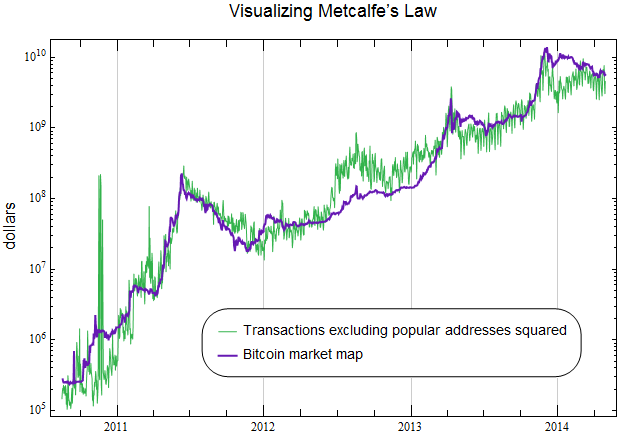
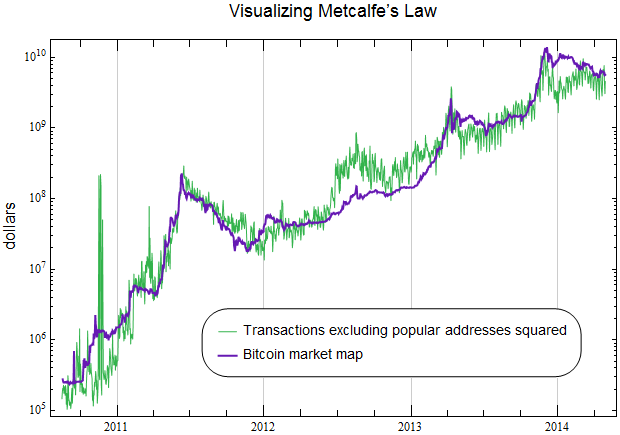
A striking test of Metcalfe’s law in Bitcoin recently appeared on the Bitcointalk forums, created by Peter R. I have made my own chart here.
Metcalfe's Law
This chart plots the market cap in blue and the square of the
transaction volume excluding popular addresses in green. The axis on the
is the price in dollars. Exactly as Metcalfe’s law predicts, the
transaction volume increases very neatly as the square root of the size
of the network. The correspondence is beautiful. I wish I had thought to
make it first!
I would like, however, to criticize the interpretation of the
diagram. On the original Bitcoin Talk, thread, the green plot has been
labeled as the “Metcalfe Value”, as if it is an appraisal of the Bitcoin
that estimates what it could cost.
This interpretation is incompatible with the theory of the value of
money I presented above. In my theory, the value causes the
transactions, whereas in the diagram, the transactions cause the value.
However, it is only potential transactions that cause the value. Past
transactions are of no value to anybody. The present size of the
network and the consequent opportunities is likely to provide tomorrow
will motivate people to buy and sell today.
This may seem like hair-splitting, but a confusion of cause and
effect can have serious consequences. For example, many people believe
that it is necessary to spend bitcoins and increase the transaction
volume in order to make Bitcoin more valuable. Of course this is
nonsense; all this does is fill up the network with transactions for
things that nobody actually wanted. That does not present a good value
for a newcomer because he will want a network that presents him with real
opportunities, not just ways of artificially increasing transaction
volume. The more that the Bitcoin network is focused on artificially
increasing the transaction volume to make it look good, the more it
resembles a Ponzi scheme. Rather, to make the network more valuable, we should be hoarders. This is more likely to present newcomers with lots of potential uses for Bitcoin as a medium of exchange.

Appraising Bitcoin

A real good, of course, can have value due to a network effect and some productive use. Gold, for example, can be money and used as components in electronics. If there were ever a time when gold were used only
for electronics, but were then to acquire use as money once a network
effect formed around their price, an investor might be excused to call
the price an unsustainable bubble. However, it would turn out to be a sustainable bubble that inflates until it fills the entire economy. At least until Bitcoin came along.
This brings us to Bitcoin. To what extent is Bitcoin’s price a
rational appraisal or an investment bubble? The answer is easy, much
easier than with a commodity like gold. Bitcoins have almost no use
other than as a medium of exchange. Thus, the fact Bitcoin has any
price at all is evidence that there is a real network effect. It is
much easier to prove that Bitcoin acts like money than that gold does,
in fact.
Each step in Bitcoin’s growth follows the same pattern. Any demand
for Bitcoin at all is enough to make it function as a medium of
exchange. If demand continues to grow, then it becomes a better medium
of exchange. There is no end to this process because the primary value
of Bitcoin is the network effect surrounding it, not any final
productive use.
Thus, Bitcoin is not a bubble. Its growth is like a self-fulfilling
prophesy: as more people believe in it as a medium of exchange and
become willing to buy it, they create the very conditions required of it
to make it more useful. There is nothing irrational, therefore, in
treating Bitcoin’s price as the cause of its value and no reason to
expect the momentum in its exponential upward trend to cease.1

Conclusion

Every time you buy Bitcoin, a fairy gets its wings. Now clap your
hands, click your heels together three times, and believe in Bitcoin! It
will only take faith the size of a mustard seed.
  1. This analysis leaves something to explain—if the value of a medium of
    exchange is just the market cap, why does Bitcoin go through hype
    cycles? Every time Bitcoin goes up in price, that is an increase in its
    underlying value, so why does its price ever crash? I don’t know the
    answer, but I think I have a reasonable hypothesis: the network takes
    time to adjust to the enormous number of newcomers during each hype
    cycle. Each member of the network adds value, but this takes time—the
    members of the network must learn something about one another before the
    value they add to the network is more fully realized. If this effect is
    real, then the price could temporarily rise more rapidly than the
    growth that the network can support.

Open your free digital wallet here to store your cryptocurrencies in a safe place.

Satoshi
coinSummit

Third CoinSummit to be held in London

The Third CoinsSummit is to be held in London this July. San Francisco was the acting ground of the previous CoinSummit convention that was held in March; as the second convention presented, this next summit will feature a series of panel discussions and speeches from bitcoin enthusiasts, hedge fund professionals, VC and angel investors, and experienced cryptocurrency entrepreneurs.

The information posted on the CoinSummit official site:

“CoinSummit London is a two-day event connecting virtual currency entrepreneurs, angel and VC investors, hedge fund professionals and others who are looking to learn and network in the virtual currency industry. CoinSummit will take place on July 10-11 2014 at the East Wintergarden London.”

Some notable speakers include Silk Road Equity co-founder Matthew Roszak, new Bitcoin Foundation board of director Brock Pierce, angel investor Roger Ver, and Maidsafe CEO David Irvine. Some of the others participants include Megabigpower founder David Carlson, Lamassu CEO Zach Harvey, eToro CEO Yoni Assia, and many others.

This 3rd CoinSummit, organizers are presenting a new set. Besides the usual structure, a special platform is being organized for a few startup companies. Coinsummit has informed at their site, that ten startups will be given the chance to present in front of the entire CoinSummit audience and will be chosen on the basis of the size and charm of the opportunity they are designing, the strength of the team, and their traction / metrics / achievements.

The summit is organized by Pamir Gelenbe, a strongly firmed crypto currencies entrepreneur and partner at Hummingbird Ventures. After the last summit in March, Gelenbe has stated:

“We hope to bring together entrepreneurs, VC investors and folks from hedge funds who want to learn about bitcoins as an asset class…we really want to focus on the business side of Bitcoin as we don’t think there has been an event like this before.”

CoinSummit has been the leading hand on taking Bitcoin discussion to higher grounds by cementing the bonds between the Bitcoin communities around the world and relaying trustworthy information to the media and business investors.

CoinSummit London 2014, will be held at the East Wintergarden and take place on July 10-11. Entrance to the conference is invite-only. Digital currency enthusiasts and entrepreneurs who wish to attend the event can request an invitation on the summit’s official site; applying for the presentation is free and the deadline to register is June 20.

Open your free digital wallet here to store your cryptocurrencies in a safe place.

Satoshi
images

Bitcoin 2014: Building the Digital Economy

(CoinReport) Heads up folks! Bitcoin 2014: Building the Digital Economy conference is being held in Amsterdam from May 15 to 17.

Bitcoin 2014

Bitcoin 2014 is an “annual international forum, exhibition and networking conference organized by the Bitcoin Foundation for the fintech industry.”
It will be a meeting place for investors, technologists, regulators,
executives, entrepreneurs, developers, and policymakers to gather and
discuss the future of digital currency around the world.
The first bitcoin 2013 conference
was held in Silicon Valley in San Jose California. The conference had a
spectacular turnout of over 1,200 attendees, speakers, and exhibitors.
It featured bitcoin investors Cameron and Tyler Winklevoss as keynote
speakers.One of the topmost fintech hubs in Europe, Amsterdam serves as a great place for this year’s momentous event to take place.
https://bsidebtc.com/


Open your free digital wallet here to store your cryptocurrencies in a safe place.

Satoshi
bitcoinindipendance

The Declaration of Bitcoin’s Independence

(BitcoinMagazine)  We have been brought to a point where it has become necessary to dissolve the bond between currency and institution. We are not required to declare the causes which impel us to push for the separation, but we will oblige.
But we are in an age of appropriation, and nothing is immune. Today bitcoin is not only volatile in its value, but in its very essence. Bitcoin is in the crucial stages of development. Its code can evolve in several directions. It’s under threat from those who don’t understand it; it’s under threat from those who do understand it, but fear it. We hold these truths to be self-evident. We have been cyclically betrayed, lied to, stolen from, extorted from, taxed, monopolized, spied on, inspected, assessed, authorized, registered, deceived, and reformed. We have been economically disarmed, disabled, held hostage, impoverished, enervated, exhausted, and enslaved. And then there was bitcoin.
The crusade to absorb bitcoin into the seams of the State has begun. There is a conscious effort to co-opt. The goal is to swallow bitcoin, process it, integrate it, devolve it, and keep it stagnant in the gears of a failed operating system. Bitcoin’s potential is being hijacked. They have their own idea of what they want bitcoin to be. They have their own plan for its potential, and they have an investment in that plan. But our consent is withdrawn and the power of our ideas is too strong.
Do not underestimate DNA; nothing is born completely neutral. Follow the protocol: it has anarchistic implications. Bitcoin is inherently anti-establishment, anti-system, and anti-state. Bitcoin undermines governments and disrupts institutions because bitcoin is fundamentally humanitarian. There’s an elimination of 3rd party intrusion. It’s purely peer-to-peer. The blockchain is free speech. It’s decentralized, voluntary, and non-aggressive. Bitcoin is not supposed to work within our current mechanisms. Bitcoin needs not entities of authority to acknowledge it, incorporate it, regulate it, and tax it. Bitcoin does not pander to power structures, it undermines them.
Bitcoin is an animal of anonymity. Bitcoin basks in shadow. Satoshi’s facelessness is symbolic of this. Privacy is the point. Bitcoin is meant to function outside of regulatory systems. It is not a cog.
Bitcoin means to channel economic power directly through the individual. This is reflected by Satoshi’s symbolic birthday, which falls on the same day that Roosevelt signed the 6102 Executive Order, which forbade the hoarding of gold. We repeat. Bitcoin is not intended to be integrated; it’s intended to be a ghost outside the machine.
The voices of the people who are working to preserve the purity of bitcoin’s ethos are being drowned out. But actions speak louder than words. Bitcoin is utility. The cypherpunks are building anonymous systems. The crypto-anarchists are making institutions arbitrary. The internet is anarchy. And cryptocurrencies are the printless fingers of the internet.
Bitcoin is not just a currency, a commodity, or a convenience. Just like the internet gave information back to the people, Bitcoin will give financial freedom back to the people. But that’s only the first step. There will be a shift in the structure of enterprise, in the way we interact, in the way we voice our opinions, and in the way we fuel our action. Bitcoin will allow us to shape the world without having to ask for permission. We declare bitcoin’s independence. Bitcoin is sovereignty. Bitcoin is renaissance. Bitcoin is ours. Bitcoin is.

Open your free digital wallet here to store your cryptocurrencies in a safe place.

Satoshi
mining farm

Why Bitcoin miners are moving to tiny towns in Washington state

(Gizmodo.in) There’s not much in rural Washington, but there are lot of dams. And dams mean hydroelectric power. Following the lure of cheap electricity, Bitcoin miners and their power-hungry server farms are making out for sleepy little towns in the Pacific Northwest. Although Bitcoin is a digital currency, mining it still has a gigantic physical footprint. That’s because computers “mine” Bitcoin by solving a cryptographic equation. To mine more Bitcoin, you need more computing power. Or you can just have more computers. This is what a “multi-GPU mining rig”-basically a bunch of processors hacked together-looks like.
Powering up and cooling all those processors requires a lot of –you guessed it– electricity. Last year, Bitcoin miners were sucking up an estimated 1 million kilowatt-hours per day. That’s a hefty electric bill right there. But Washington has some of the lowest electricity rates in the country-less than 2 cents per kilowatt-hour for industrial customers in certain area. The average U.S. household pays something more like 12 cents a kilowatt-hour.
Big tech companies running big data centers have been in on the state’s cheap electricity for a while now. Dell, Yahoo, Microsoft, and Intuit all run data centers in Grant County, Washington. But Bitcoin mining’s reliance on intense computing power means even a small operation-relative to a behemoth like Microsoft, at least-needs a giant building full of servers. MegaBigPower, which has considered itself the largest Bitcoin-mining business in the U.S., has a Washington outpost.
Grant County says it has two Bitcoin mining companies operating, with five more to come. The engineers who first built Washington’s dams could not have possibly anticipated Bitcoin mania, yet those dams are now drawing some of the currency’s biggest backers. This is a modern gold rush, shaped by the electric infrastructure we built long ago.

Open your free digital wallet here to store your cryptocurrencies in a safe place.

Satoshi
blockchain_healthcare

A Network analyst’s view of the Blockchain

Martin Harrigan is a computer scientist and software developer. He is the founder of QuantaBytes, an Irish startup developing a suite of tools for analyzing and visualising bitcoin’s block chain. He is also the co-author of one of the earliest academic papers to study the network properties of the block chain and its implications for anonymity.

abstract network
(CoinDesk) The
block chain is a decentraliced, consensus-driven ledger of every
successful bitcoin transaction to date. As of the 300,000th block, the
ledger includes over 38 million transactions.
Aside from being a
monumental technical achievement, the block chain is a fascinating
dataset. We can use it to create a transaction network that models the
flow of bitcoins from the creation of the genesis block to the present
day.
In this network, every node represents a transaction, and
every (directed) edge represents a flow of bitcoins from an output of
one transaction to an input of another. This large, complex network has
over 38 million nodes and 85 million edges.
transaction network
The transaction network represents the flow of bitcoins between transactions over time.
Network science
Network
science is the study of complex networks. It provides theories,
techniques and tools that help us understand the structure and evolution of a network.
The bitcoin transaction network is a prime example. Its basic building
block, the transaction, can be combined to produce complex transfers of
value. This is reflected in the topological structure of the transaction
network.
The network as a whole is too large and complex for most
network visualisation tools. However, we can measure various structural
properties of the network. For example, transactions can be
characterised by their varying numbers of inputs and outputs. But how
are these numbers distributed in practice? In the transaction network,
we can analyse the in- and out-degrees of the nodes. We can plot the in-
and out-degree distributions. They show, for each possible degree, the
number of times they occur in the network.
The in-degree distribution of the transaction network
The in-degree distribution of the transaction network.
The out-degree distribution of the transaction network.
In
both cases, we observe inverse relationships between these numbers. The
lower the degree, the more frequently the nodes with that degree occur;
the higher the degree, the less frequently they occur. There are many
outliers. The outlier in the out-degree distribution with out-degree
equal to two is due to an abundance of transactions with exactly two
outputs.

Giant connected component

Suppose we were able to
visualise the entire bitcoin transaction network. It would probably
resemble a “hairball”. These visualisations suffer from cluttering and
over-plotting to an extreme that makes them unusable for any practical
purposes. However, they do provide one key piece of information. Are we
dealing with one large connected component or several smaller connected
components?
Many visualizations of large networks are "hairballs".
Many visualizations of large networks are “hairballs”.
A
connected component is a group of nodes and edges that are all
connected to each other, either directly or indirectly. If a network has
a giant connected component, this means that almost every node is
reachable from almost every other node. If we ignore the direction of
the edges in the bitcoin transaction network, then it does indeed
contain a giant connected component covering over 99.9% of all nodes.
The second largest connected component has just 71 nodes.

Fourteen degrees of separation

Six
degrees of separation is the theory that everyone on the planet is
connected to everyone else through a chain of acquaintances with no more than six hops.
In network science terminology, this translates to the theory that the
social network of the human race has diameter six. Facebook reported that the effective diameter (covering 90% of all pairs of users) of its social network is five and is decreasing with time.
The
equivalent number for the bitcoin transaction network is fourteen and
is increasing with time. That is, across 90% of all pairs of
transactions, the shortest path between them in the transaction network,
ignoring directionality, is at most fourteen hops. The increasing value
is likely due to the fact that, unlike the Facebook social network,
there is no preferential attachment.
New nodes are connected to existing nodes whose corresponding
transactions are not yet fully redeemed. In other words, the transaction
network is growing at the frontier only.

The first currency with a ledger

Surprisingly,
bitcoin is not the first currency with a ledger from which we can model
the transfer of value. The Tomamae-cho community currency was
introduced into the Hokkaido Prefecture in Japan for a three-month
period during 2004-05 in a bid to revitalise the local economy. The
Tomamae-cho system involved gift certificates that were reusable and
legally redeemable into yen. There was an entry space on the reverse of
each certificate for recipients to record transaction dates, their names
and addresses, and the purposes of use, up to a maximum of five
recipients.
Researchers collected these certificates in order to
derive a network structure that represented the flow of currency during
the period. They showed, for example, that the network had small world properties.
A network representation of the transfer of value with a community currency.
Source: Network Analyses of the Circulation Flow of Community Currency
The
block chain is a digital equivalent to the Tomamae-cho certificates. It
does not contain information such as names and addresses or the
purposes of use. However, it has other properties that make it suitable
for analysing the transfer of value including its accuracy, size, and
completeness.
The application of network analysis to the block
chain is an under-explored, yet fascinating area. There are a handful of
academic studies but very little in the way of software and tools to
open it up to a wider audience. QuantaBytes  is an Irish startup, founded by the author,
developing a suite of tools for analysing and visualising bitcoin’s
block chain. By understanding the structure and evolution of the block
chain, we can better understand bitcoin’s usage patterns, economy, and
the growth of the system as a whole.
Network image via Shutterstock

Open your free digital wallet here to store your cryptocurrencies in a safe place.

Satoshi

What is Bitcoin and how can it change the world?

(Virgin) When you type a website
address into a browser you might have noticed that the letters ‘http’ appear at
the front. ‘Http’ stands for Hypertext Transfer Protocol. In typing a web
address you are actually sending an HTTP command to transmit that website to
you. Hypertext Transfer Protocol is the means by which information is shared
across the Web.
Similarly, when setting up
an email account, you might have noticed the letters ‘smtp’ – for example,
‘smtp.gmail.com.’ SMTP stands for Simple Mail Transfer Protocol. SMTP is the protocol
by which we send emails to each other.
A protocol is the means by
which information is shared across a network. Bitcoin – with a capital ‘B’
– is another protocol. The function of the protocol is to send and receive
payment. The unit of money on the protocol is the ‘bitcoin’ – with a small
‘b’.
You earn a bitcoin by
doing or selling something in exchange for bitcoins – just as you would earn
normal money. If I do this job for you, you pay me in bitcoins. You buy
bitcoins just as you would buy and sell foreign currency. You pay some money to
someone, usually at a Bitcoin exchange, for which you receive some
bitcoins. And you can make your own bitcoins by mining them – more on that
another day.
Image from gettyimages
You keep your bitcoins in
a wallet. There are hundreds of places to get a wallet, just as there are
hundreds of places to get an email account (blockchain.info is as good a place
to start as anywhere). Often people will have more than one wallet – one on
their computer, another with a Bitcoin service provider.
So how can Bitcoin change
the world?
The reason the Bitcoin
technology is potentially so disruptive and transformative is that it’s a new,
efficient form of money. And money, which has been, inexplicably, ignored by
mainstream economists for so long, is, of course, at the heart of almost
everything we do. Bitcoin could change the way the way we make and receive
payment, it could change the way we store money; it even has the potential to
change the actual money we use.
Think about the
possibilities of that for a second. We no longer need banks to store our
money – we store it on our computer with a Bitcoin service provider. We no
longer need banking networks to send or receive money – we just send money as
we would send an email. We no longer need governments to issue our money.
Forget pounds and dollars, we’ll use bitcoins instead. The social implications
of governments and banks losing control of money are considerable. This is
all very well in theory. What will make Bitcoin irresistible in practice is its
sheer efficiency.
Goldman Sachs IT analyst,
Roman Leal, has calculated the savings that Bitcoin could have made in
electronic payment in 2013, if Bitcoin had been used. Let’s start with simple
money transfer – sending money from one person to another.
Consumers currently pay a
fee of about 10% of the total amount transferred if they use a traditional
money transfer network such as Western Union. This fee covers agents’
commissions, forex and access to the network. With Bitcoin, that fee would be
zero – or 1% if you use a Bitcoin service provider. There
were $550 billion of remittances in 2013 generating $49 billion of transaction
fees. With Bitcoin those fees fall by 90% to just $5.5 billion. That would
mean an extra $43 billion actually makes it into people’s pockets.
Image from gettyimages
As for electronic payments
in retail, currently retailers pay from about 2.5% to 3% in fees. In 2013,
global transaction fees were $260 billion on over $10 trillion of sales. Had
Bitcoin been used (again using a 1% estimated figure) the number would be $104
billion – a saving of almost $150 billion.
Leal notes that all
‘merchants would realize sizable savings’ by using Bitcoin, but small merchants
will benefit most. They ‘can reduce their payment processing fees by at least
half’. For a business that runs on low margin that is a compelling
number. These kinds of savings are irresistible.

Then there are those who
are currently shut out of the current financial system. 53% of the world’s
population is still ‘unbanked’ – they have no use of formal or semi-formal
financial services. Most of them will have a mobile phone before they have a
bank account. With Bitcoin – and other forms of digital payment – these people suddenly
have means to make and receive payment over distance. How much untapped
potential is there waiting to be freed when the unbanked start to get access to
basic financial services?
We’re not there yet
The core protocol of
Bitcoin is sound. In fact, it has unprecedented reliability and security. The
edges, however, are vulnerable. Third parties, such as Mt. Gox, have not
figured out how to act like proper financial institutions. Certain operating
systems using the protocol are insecure, rendering bitcoins vulnerable to
theft. There are also issues with programmers who have failed to understand how
the blockchain – the Bitcoin central database – works.
But these are all issues
that will be dealt with as the technology develops. The point is the core
protocol is sound. It – or some replication of it – could send banks to the
same forgotten part of town that the Internet has sent newspapers, as well as
freeing up the possibility for many millions of people to better their lot
through trade and exchange.

Open your free digital wallet here to store your cryptocurrencies in a safe place.

Satoshi
bitcoin_in_2016

Bitcoin’s promise goes far beyond payments

(HarvardBusinessReview) Digital currencies like Bitcoin have captured the attention of
the media, entrepreneurs, and regulators. The coverage has described
exchange meltdowns, price volatility, and government crackdowns.
However, the focus on Bitcoin as a currency may distract businesses and
governments from its disruptive impact: as a technology.
Bitcoin is more than just a new way to make purchases. It is a
protocol for exchanging value over the internet without an intermediary.
Bitcoin is based on a public ledger system, known as the blockchain,
which uses cryptography to validate transactions. Bitcoin users gain
access to their balance through a password known as a private key. As a
result, Bitcoin is peer-to-peer and open, yet secure and nearly
frictionless. Much has been written about the payment applications of
Bitcoin, including remittances, micropayments, and donations.
However, Bitcoin could disrupt other systems that rely on
intermediaries with a similarly open, peer-to-peer system, including
property, contracts, and identity management.
Anywhere a transaction between two parties has traditionally required
third party validation, Bitcoin may be applicable. Consider these three
common actions:

Transfer of property. The Bitcoin protocol could
simplify complex asset transfers, revolutionizing the services that
support this industry. Currently, the transfer of large assets requires
significant time and resources. For example, in order to purchase a car
from an individual seller, one has to engage a third party to transfer
the title. Additionally, one has to use services like Carfax to learn
about the car’s accident and inspection history. And who doesn’t like to
spend a Saturday at the DMV updating a car registration?
The blockchain could change all of this. Bitcoins can be qualified in
such a way that they represent real-world assets. Bitcoin entrepreneurs
at companies like Colored Coin
are already working on ways to use small portions of Bitcoin to denote
physical property. A fraction of a Bitcoin would publicly identify who
currently owns that property, and could include a record of both past
ownership and other history about the property. When purchasing the car,
one would be able to verify all accidents and inspections over the
blockchain and transfer the title on site. Similarly, real estate and
financial instrument transactions could all be executed over Bitcoin.
This could soon create efficiencies and reduce friction by allowing
individuals to directly transfer property without the use of a broker,
lawyer, or notary to sign-off on the transfer.

Execution of contracts. Bitcoin could similarly be
used to structure contracts, bringing new efficiency and transparency.
Contracts are typically developed by lawyers on a case-by-case basis
with significant time and resources devoted to negotiation, development,
and enforcement. Additionally, markets based on contracts, including
certain financial derivatives markets, lack transparency, which
complicates regulation.
Traditional contracts could be replaced by code, executing themselves
when a triggering event occurs. In a simple example, a financial
instrument, like an option, could be developed and executed over the
blockchain. In addition to reducing legal fees, this could bring new
transparency to financial markets, as regulators could use the public
ledger to understand the market without forcing individual actors to
reveal their specific positions. It is possible that new
crypto-currencies will emerge to serve these niche purposes.
New ventures, like Ethereum, are creating these capabilities today. Ethereum is developing a network to serve as both the registry and escrow to execute the conditions of a contract automatically through checkable rules.

Identity management. Bitcoin’s cryptography could also transform identity management. Much of identity management, including passports, still operates on a paper-based system.
These documents are frequently forged and stolen. Interpol’s database
currently lists 39 million stolen travel documents. Instead of carrying
paper documents, what if there was a way to create a unique, verifiable
key that was impossible to forge?
A cryptographic network similar to but separate from Bitcoin could be
used to verify individuals’ identities and monitor movement across
borders. When a person travels through a checkpoint at a border
crossing, instead of showing and scanning a paper passport, she could
present her private Bitcoin key. A network privately maintained by the
government could verify the key and register the entry into the ledger.
This system, based on cryptography instead of paper documents, would
simultaneously increase mobility and security. If Bitcoin can be used
for travel documents, it could also be used for other forms of identity
management like social security numbers, tax identification numbers, or
even driver’s licenses.
Property, contracts, and identity management are only a few examples
of how a peer-to-peer, open, and frictionless system could change how we
conduct business in the future. In order to achieve this wider
adoption, Bitcoin will need to address significant questions around
trust, ease of use, and operability. However, the Bitcoin community has
shown remarkable adaptability and is already working to mitigate these
problems. In the next decade, we can expect significant innovation
around the Bitcoin network. Much of that will revolve around payments,
particularly early on. The real value, though, lies beyond.

Open your free digital wallet here to store your cryptocurrencies in a safe place.

Satoshi
BobbyLee brockPierce

Bobby Lee, Brock Pierce Join Bitcoin Foundation’s Board of Directors

(CoinDesk) Bobby Lee and Brock Pierce have joined the Bitcoin Foundation’s board
of directors, after coming top in a second round of votes cast by the
organisation’s industry members.
The run-off election featured three candidates, including BTC China CEO Bobby Lee, venture capitalist Brock Pierce and CEO of mobile gift card provider Gyft, Vinny Lingham.
The results were particularly close, with Lee receiving 79% approval
and Pierce scoring 65% – just 2% above Lingham, who received 63%.
With the announcement, Lee and Pierce join a board that includes executive director Jon Matonis, bitcoin chief scientist Gavin Andresen, Bitcoin Magazine’s Elizabeth Ploshay and Ribbit Capital’s Micky Malka, alongside founder and chairman Peter Vessenes.
This news follows the 1st May results of an initial round of voting, which ended with none of the original 15 candidates reaching the necessary vote threshold to win a seat.
These industry seats have been vacant since the resignation of two founding members – former BitInstant CEO Charlie Shrem and Mt. Gox CEO Mark Karpeles – earlier this year.

Open your free digital wallet here to store your cryptocurrencies in a safe place.

Satoshi