Category Archive: Articles

The line between fiat and cryptocurrency is getting fuzzier.

(BitcoinMagazine) The line between fiat and cryptocurrency is getting fuzzier. With the advent of Bitcoin 2.0 technology, we can now use cryptocurrency to exchange stocks, property, commodities, and even state-backed money. But if the whole point of cryptocurrency was to decentralize the financial system, what’s the point of a dollar-backed coin?

Dollar-backed digital coins have been attempted many times before. The Canadian government even tried to get in on the action, and unsurprisingly failed. Some claim that the first cryptocurrency to attempt this was Coinaaa, but this is technically incorrect. Coinaaa sells premined coins, and does invest a lot of the revenue in Norwegian krone, but their intention is to maintain a stable value independent of any state-backed currency. The company invests their earnings, and uses some of the money to buy back coins when the price drops, or sell coins when it rises.

The company promises 0% transaction fees, but at the cost of a centralized mining system. While this fails to represent actual kroner one could trade in a decentralized manner, it does serve as a great transactional currency. This is theoretically possible without having to rely on humans–decentralized autonomous software could do this by adjusting block rewards or destroying transaction fees in response to price fluctuations–but if they make the right investments, it functions for now.

Given the possible and existing options available, one might then wonder why Brock Pierce chose to introduce Realcoin, the first cryptocurrency backed by US dollars. Although they claim to hold US dollars in “conservative investments,” this probably means they’re doing the same thing Coinaaa is with your money. The major difference is that they aren’t trying to maintain a stable value: Realcoin claims they will maintain a fully-auditable 1-to-1 reserve of US dollars, which can be redeemed for their coins. This is all enabled by the Mastercoin protocol (Omni Layer) on the existing Bitcoin blockchain.

This will cause Realcoin to fluctuate with the value of the dollar, for better or for worse. It will inflate with time, as all fiat money does, meaning you won’t want to keep your savings in it–Bitcoin would be a better choice. A good transactional currency should be neither inflationary nor deflationary, so Coinaaa is clearly the superior choice for daily use; both will likely make their profit by trading and investing with your money, and require very similar amounts of trust.

Why, then, create Realcoin? Although the Coinaaa company will definitely hold some kroner, a Coinaaa will not represent the value of a Norwegian krone. This means that if you want to do FOREX trading involving Norwegian currency, you have no choice but to return to centralized exchanges. Even if you don’t want to hold or use kroner, there’s profit to be had in exchanging it.

Realcoin, therefore, represents an opportunity to speculate with fiat currency for the first time. If you have reason to believe its price will move for or against a digital currency on the market, now you can take advantage of that. Given that the Mastercoin protocol will almost certainly contain a decentralized exchange, Realcoin allows you to trade in US dollars without ever touching a traditional financial institution. The state is just like any other company, issuing money that you can choose to use–or not.

Open your free digital wallet here to store your cryptocurrencies in a safe place.

Satoshi
urlhttpmedia.coindesk.com201407Screen Shot 2014 07 14 at 4.38.21 PM 600x370

LinkedIn co-founder: Bitcoin is in my five-year Investment plan

LinkedIn co-founder, early Facebook investor and Greylock Partners partner Reid Hoffman has declared his enthusiasm for bitcoin in a new interview with CNBC’s ‘Squawk Alley’.
The interview aimed to assess Hoffman’s current opinion of opportunities in the market given his experience and success in early social media.
Notably, despite the suggestions by show hosts that such industries as wearable technology, healthcare and home automation were areas that investors should be considering for investment over the next three-to-five years, Hoffman suggested he is increasingly focused on bitcoin.
Indicating that the ecosystem has piqued his interest in the last six to 12 months, Hoffman lauded bitcoin, saying:
“I think it’s an incredible system that’s created a ledger that is across – a distributed ledger across the whole world for it can be money but it can also be other things.”
Hoffman recently joined the board of directors at secure bitcoin wallet startup Xapo, an announcement that was made when the company reported $20m in new financing from firms including Greylock Parnters.
Bitcoin ownership.
In the interview, Hoffman discussed his personal experience with bitcoin, confirming that he has purchased “a few bitcoins” to date in addition to his investment in Xapo.
Hoffman also dismissed suggestions that he may be worried about the price of bitcoin given the volatility that this indicator has experienced so far in 2014.
He added:
“I don’t check [the price] every day. It’s more a question of a three- to five-year horizon, not a daily horizon.”
Despite this, Hoffman cautioned investors, echoing the familiar refrain that investors shouldn’t put any money into bitcoin directly unless they are “willing to lose the money”.
Platform for innovation
Hoffman further stressed that bitcoin’s true innovation will be its platform, which he called its “most interesting layer”.
Citing smart contracts as one such example of the innovation bitcoin entrepreneurs have yet to fully unlock, Hoffman said:
“You can have bitcoin stand for something that isn’t just a bitcoin. […] It could mean your car. So then your car could be accounted for on a general ledger that is then – you know, can let you do electronic contracts. you could put liens against it, moving it all into the electronic age.”
For more on bitcoin and its potential applications in the field of smart property, read coindesk report here.

Open your free digital wallet here to store your cryptocurrencies in a safe place.
Satoshi
urlhttpwww.wired .comwp contentuploadsblogswiredenterprisewp contentuploads201311bitcoin illo

The great unknown Bitcoin killer app

It’s cliched at this point to say that bitcoin now is the internet in 1995 or cell phones in 1998 or the television in 1950. Many people have made the prediction that the exponential growth of bitcoin is about to come and I happen to agree. What’s interesting about the current state of bitcoin isn’t merely that there is huge growth ahead, it’s that we have no idea what the growth is going to look like.
Take, for instance, the internet. Around 1994, the people that did anything on the internet at all were using it mostly for email. Some more savvy users maybe participated in newsgroups. A few very bleeding-edge people made web pages. You could have foreseen that there would be better versions of those things. What you couldn’t foresee was stuff like VOIP, Bittorrent, video on demand or social networks. These are all technologies built on top of the internet and currently take up a large part of the traffic that goes through it.
Email for most people in the 90′s was the first great killer app. It allowed people to communicate with each other without sending letters or making phone calls. Most people that knew about the internet in the early 90′s pointed to the post office as the first industry to get disrupted by the internet and to some degree they were right. What most people didn’t see back then was that the internet would also disrupt the music store, the video rental store and to some degree, even the book store. In the same way, for most people bitcoin is a way to send money easily, so they point to Western Union and other money transmission businesses as the ones that will get disrupted. To a large degree they’re right, but it’s not the only one that’ll get disrupted.
Think about the cell phone. It was fairly obvious that it would disrupt the corner telephone booth. But it’s also disrupted the low end camera/camcorder industry, the watch industry, the mobile gaming industry, the audio book industry, etc. Cell phones are so much more than a phone these days.
In the same way, bitcoin is much more than a convenient method to transfer money. There will be applications that nobody has thought of yet that will make bitcoin incredibly useful. Furthermore, these new applications will cause further adoption.

Open your free digital wallet here to store your cryptocurrencies in a safe place.

Satoshi

A cashless society, in three years ATMs in all majot cities will accepting cryptocurrencies

The consumer financial services company based in North Palm Beach, Florida, Bankrate, predicts that within three years, ATMs in all major cities will accepting digital currencies such as bitcoin.

The report, which assesses the future functionalities likely to be provided by the ATMs of tomorrow, focuses on how mobile payment solutions will play a significant role in terms of the next generation of banking.

With ATMs becoming increasingly flexible when its comes to meeting the needs of customers, Senior Vice President Tom Ormseth of the Chicago-based bank holding company Wintrust Financial says that “banks now need to think like Google, they’ve got to quit being slow adopters.”

INNOVATION ON THE RISE
The ATMs of today now let you talk to a teller on video, make cash withdrawals via your smartphone, and in many cases let you withdrawal as littles a $1. In essence, the need for physically located banks are becoming less necessary with time, which is why many are saying that the ATMs of tomorrow could replace banks all together. A threat that the advent of bitcoin has only made greater.According to Jay Weber, vice president of debit and ATM product solutions at the Jacksonville, Fla ATMs have long been viewed as nothing more than a tool for withdrawing cash on the fly; however, he says that now, the technology is being driven by a younger, more tech-savvy demographic.

The emergence of cardless ATMs, for instance, which are starting to pop-up in major cities throughout the world thanks to the Chicago-based Wintrust Financial group, allow customers to withdrawal cash through your phone without the need for a physical debit card.

Working much like the emerging bitcoin ATMs, you simply request a withdrawal, then within eight seconds, your money is there waiting for you at your local ATM.
THE DIGITAL DIVIDE

According to Frank Natoli, chief innovation officer at Diebold, the banking industry, once seen as a conservative sector is quickly moving ahead. He further predicts, that thanks to the emergence of mobile banking alternatives, using your smartphone to transact will become even more seamless.

Acording to Natoli:
“Within three years, ATMs in major cities also will accept alternative currencies like bitcoin […] a digital currency that exists only in cyberspace, [that] already is starting to get its own ATMs worldwide. And mobile transactions are more appealing to bitcoin users.”

Natoli tells Bankrate that these ATMs are going to play a major role in the next generation of banking, and according to him, will aid in the progression towards “branchless banks.”While Natoli points out that today’s ATMs can only do 70% percent of what a teller can do, he predicts that this is a void destined to be filled by the new waves of ATMs.

The incentives are all there, as on the banks behalf, the expense of running a physical network of branches can be virtually eliminated with the adoption of this new technology. According to the report:“As consumers increasingly bank on mobile devices and online, more branches will be shuttered, leaving ATMs to do more daily heavy lifting.”

As the senior analyst at Aite Group, David Albertazzi explains, “it’s about rethinking and redefining the branch network.”

A CASHLESS SOCIETY
As Wintrust’s Ormseth explains:
“These futuristic ATMs are destined to become bank must-haves. Better security measures such as voice recognition or even biometrics, where you can use your fingerprint to prove your identity, will become commonplace at ATMs too.”As for whats at stake, echoing Ormseth’s predictions, Maclyn Clouse, professor of finance at the University of Denver also believes that given the separation between new technology and old, banks, especially smaller local banks, could soon be left behind. “A lot of transactions will be done on the ATM, which big banks can roll out more profitably than smaller banks,” he told Bankrate.

What will the ATMs of tomorrow look like? According to Clouse — cashless.

Open your free digital wallet here to store your cryptocurrencies in a safe place.
Satoshi

Bitcoin vs. banking: an infographic

There’s no denying that Bitcoin is changing the way we think about the financial market and investors are finally getting on board.
Companies that specialize in buying and selling gold have made announcements that they will be expanding into Bitcoin. According to Richard Waters, a writer in the Financial Times, reported A-Listers in Silicon Valley are climbing onto the bitcoin bandwagon.
Perhaps even more notable is what Hikmet Ersek, the CEO of Western Union, had to say during an interview with Bloomberg. Mr. Ersek expressed a willingness to accept Bitcoin into Western Union’s portfolio if, and that’s a big if, bitcoin becomes regulated like other currencies.
Right now Bitcoin transactions are equal to only 0.7% of the credit card transaction in the U.S alone.
There is still plenty of room for cryptocurrency to grow into. In 2013, there were $11.2 billion dollars worth of transactions in the U.S per day, compared to bitcoins $78.2 million worldwide. That number is up 183% from last year and a whopping 437% from two years ago.
Credit Cards go through four processes before a transaction is approved while bitcoins go through only three. If you store your money in a traditional bank, you risk bank runs, inflation and deflation due to government actions. Bitcoins main concern for risk is someone breaking into a wallet without proper preventative measures, such as encrypting your wallet, and your coins being taken.
All this information and numbers can get confusing and are difficult to find. Thank to Visual Capitalist, you can have it all in one place. Visual Capitalist merge art, data and storytelling to create a coherent and continuous infographic. Recently the people at Visual Capitalist have created an infographic that explores and explains the difference between Bitcoin and traditional banking. The infographic is entitled “Bitcoin vs. Banking” and sports the bold subheading, “How cryptocurrency can and will disrupt the current financial system”.
That’s not the only infographics that the people over at Visual Capitalist have made regarding the subject of Bitcoin. Back in February of this year Visual Capitalist released an infographic entitled, “The Definitive History of Bitcoin” which explores the history of Bitcoin ranging from; the Bitcoin design paper by Satoshi Nakamoto that was published back in October of 2008, the first real transaction with bitcoins, the rise and downfall of Mt.Gox, and ends in December when China announced they would not allow banks to handle bitcoins.
Regardless of how much you do or do not know about Bitcoin, these infographics are helpful for everyone. The majority of us are visual learners and infographics like this help bring information and statistics to us in a visually appealing and memorable way. You can share their infographics via Facebook and Google+, tweet or pin it. For myself, I will be forwarding these onto my friends who keep asking the same question every time, “So what is a Bitcoin?”
Check out Bitcoin vs. Banking below:
bitcoin-disrupt-financial-system-infographic-3

Open your free digital wallet here to store your cryptocurrencies in a safe place.
jorge
Bitcoin Trends 630x392

How the Bitcoin landscape is evolving in 2014

The bitcoin landscape is evolving so rapidly that it’s hard to believe we’re already halfway through the year.

(CoinDesk) Like any new industry, there are so many areas to explore in the bitcoin space that sometimes make a week’s worth of developmentsit feel like a month or two have gone by.

Bitcoin has certainly seen a lot of action in 2014. The collapse of Mt. Gox, hefty venture capital investments in bitcoin startups and the US government auction of 30,000 bitcoins seized from the Silk Road all generated buzz in the mainstream media.
CoinDesk’s recent State of Bitcoin Q2 2014 report highlights some of the key developments that have influenced bitcoin’s journey over the past few months, providing context for the digital currency’s ever-changing position in society.
While only time will tell what’s in store for bitcoin’s future, a number of trends have emerged in the industry this year that could shape the direction and velocity of bitcoin’s growth.
Here are five bitcoin trends that have emerged in the first half of 2014:

1. Big-name retailers jumping on board

The year started with a bang when Overstock became the first major retailer to accept bitcoin. News of Overstock’s success with the digital currency served as a signal for other large companies to follow suit.
Electronics retailer TigerDirect integrated bitcoin as a payment option by the end of January, and other household names like the Sacremento Kings, Lord & Taylor and REEDS Jewelers got on board soon after.
By the end of June, three companies with at least $2b in annual revenue had begun accepting bitcoin: DISHExpedia and Newegg.
With smaller businesses also continuing to accept bitcoin at a fervent pace, we estimate that around 100,000 merchants will accept bitcoin by the end of 2014:

State of Bitcoin Q2 2014

2. A warming regulatory climate

While it certainly hasn’t been all smooth sailing between governments and bitcoin this year, it seems like tides are changing and regulators around the world are starting to take a more open-minded approach to the digital currency.
In the beginning of 2014, China’s stance on bitcoin was ambiguous at best. By April, China’s Central Bank Governor said that banning bitcoin was “out of the question,” referring to it as more of an asset than a currency.
Russia, after releasing stern warnings about bitcoin early this year, recently reconsidered its stance on the digital currency.
Gerogy Luntovsky, the deputy chairman of Bank of Russia, explained that his agency is going to take time to examine bitcoin as the industry continues to evolve:
“At this stage, we need to watch how the situation develops with these kinds of currencies. These instruments should not be rejected.”
Progress has also been made in places like California, where Governor Jerry Brown has granted bitcoin ‘legal money’ status, and Switzerland, where similar ‘legal money’ regulations are being considered.
Regulators seem increasingly willing to hold off on impulsive legislation in favor of working with the bitcoin community to find the best resolutions to prevent money laundering and fraud without stifling innovation.

3. VC firms keep betting big

Not everybody is as slow as governments to embrace bitcoin.
Serious venture capital investments in bitcoin companies were already taking place in 2013, but VCs have certainly kicked it up this year, with a total of $150m having already been invested in 2014.
With 2014′s Q2 VC investments reaching $73m (up from $57m in Q1), CoinDesk estimates that by the year’s end, 2014 VC investments in bitcoin companies will have surpassed 1995 VC investments in Internet companies:
Bitcoin VC Investment Compared to the Early Internet

State of Bitcoin Q2 2014

The venture capital flowing into the bitcoin space supports the industry’s infrastructure both explicitly and implicitly: startups gain access to resources that allow them to build much-needed products and services around the Bitcoin protocol, and the investors’ confidence in the digital currency brings legitimacy to bitcoin’s reputation.

4. Building on the block chain

Most people who take the time to really learn about bitcoin realize that the true genius in Satoshi Nakamoto’s invention is not the coins themselves, but rather the block chain.
The term ‘Bitcoin 2.0′ is often used to describe applications that use the technology of the block chain to address issues like smart contracts and identity verification that were once impossible to solve in a decentralized way on the Internet.
Jeff Garzik, one of the bitcoin protocol’s core developers, described the significance of the block chain beyond the scope of digital currencies:
“As a computer scientist, and in computer science in general, when you talked about building distributed systems, there tended to be a purely theoretical view about how computers would talk to each other, how to keep them coordinated. Satoshi and the blockchain really solved that problem in an elegant and unexpected way.”
Block chain-focused startups like BlockScore and BlockCypher have already secured funding this year from investors. As 2014 rolls on, expect to see new uses of the block chain technology solving problems in a uniquely decentralized manner.

5. New emphasis on transparency

The collapse of Mt. Gox, once the biggest bitcoin exchange in the market, was a wake-up call to many in the community.
The former exchange’s CEO Mark Karpeles was notoriously opaque in the months leading to its bankruptcy, causing confusion among users who held bitcoins on Gox.
Ultimately many people lost BTC through the course of Mt. Gox’s downfall. Outcries from the community started pouring in, demanding other big exchanges prove their solvency with professional audits.
Exchanges like BitstampKraken and Coinbase all agreed to be audited in the aftermath of Mt. Gox’s liquidation.
The demand for more transparency in the industry doesn’t stop at exchange audits, though. Revered bitcoin evangelist Andreas Antonopoulos recently took to Twitter to announce his departure from the Bitcoin Foundation, citing a lack of transparency as a primary concern:
If the first half of 2014 proves anything, it’s that the technology underlying bitcoin is resilient even under catastrophic circumstances (Mt. Gox), and that the community is willing to rally together in bringing bitcoin to mass adoption.
There’s a reason people call it the “honey badger of money.

Open your free digital wallet here to store your cryptocurrencies in a safe place.
Satoshi
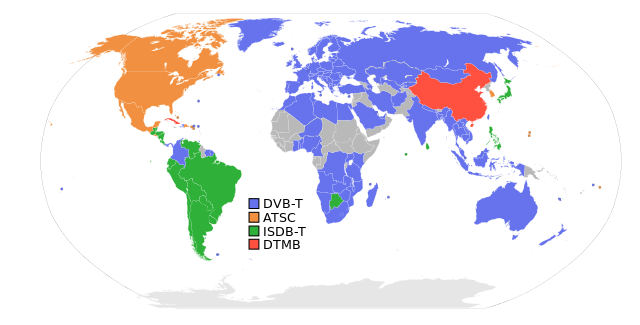
640px Digital broadcast standards

Kryptoradio: Connect to the bitcoin network from anywhere – even without the Internet!

What is Kryptoradio?

Kryptoradio is a bitcoin data transmission system that
  • transmits bitcoin transactions, blocks, and currency exchange data,
  • does all this in real-time,
  • uses terrestrial television (DVB-T) transmitters around the world.
  • Bitcoins in the air, literally speaking.
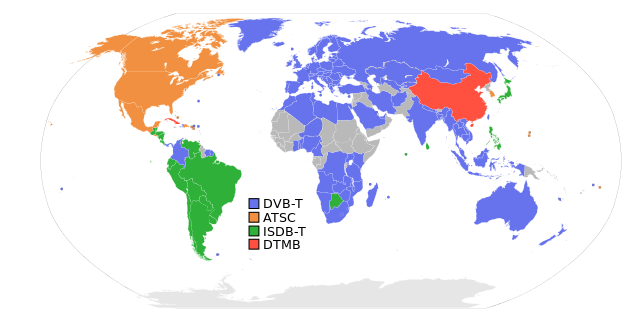
Any unidirectional digital transmission path with a sufficient error correction is suitable for this project. In addition to DVB-T there are many other possible ways to transmit Bitcoin stream like subcarriers of FM radio transmission, amateur radio, and DAB. They chose DVB-T for our pilot project because of its flexibility and wide support in most parts of the world, shown in blue in the map below (source: Wikipedia).

Why?

The primary motivators are
  • creating unprecedented devices and applications,
  • making the bitcoin network more resistant to attacks,
  • promoting bitcoin as a viable payment platform, and of course
  • because they can!
There has been many attempts to make bitcoin less dependent of the public Internet. For example Bitcoin core developer Greg Maxwell has advocated that. One approach is to use Tor network to hide bitcoin traffic from the public Internet. Unfortunately this does not make bitcoin more accessible to new users. The better approach is to go beyond Internet and use public infrastructure for broadcasting transactions of the bitcoin network.

“Alternative blockchain transports are critical to the success and survivability of the Bitcoin system.”

Bitcoin core developer – Greg Maxwell

This scheme makes it easy to construct affordable receivers that do not need mobile data connections in order to follow bitcoin traffic and to react to the received bitcoin payments. This would make it possible to build bitcoin counterpart for cash payment terminals, anything from a cash register to a coin operated self-service laundry. If the receiver application follows only transactions relevant to itself, it will be possible to build it using even an ARM microcontroller.
Also, it allows an alternative way to access the bitcoin network in cases where only a very low speed Internet connection is available. And, for all the tin foil hat wearers out there, this is a way to connect to bitcoin network without a trace! You only need online access when you want to make transactions yourself.
The data stream can contain other information, such as exchange rates between bitcoins and traditional currencies.

What happens next?

They have found a partner who is able to cover costs for the pilot stage. The pilot stage will start in 1st of September,
2014
and last for 2 months. The broadcast area covers 95% of Finnish population, approximately 5 million
people. More information in the press release.
There is plan to start regular broadcasting soon after the pilot stage. A single month of broadcasting on current distribution area
including maintenance costs is about € 2000 per month (VAT included). They are currently looking for partners to that stage.
They have had a quick look at bitcoin crowdfunding. Our first impression is that the available platforms are not very good either
technologically or by the number of users. If someone has ideas how to collect funds for this project, please contact us!

How to contribute

In Finland they have this thing called Money Collection Act which means that it is not legal to ask money
without compensation. However, in this case the compensation is the radio broadcast.

All funds sent to the project’s bitcoin address will be used for covering regular broadcasting costs. If the project gets cancelled, all extra funds will be returned to their sending addresses. In addition to financial support you are welcome to join the team if you are capable of helping me with the software, to improve web pages, or anything else. Please contact them by e-mail.
You are also welcome to join #bitcoinradio IRC channel at FreeNode.

Open your free digital wallet here to store your cryptocurrencies in a safe place.
Satoshi

Analysts: Winklevoss Bitcoin ETF to pass SEC approval

As the Winklevoss twin’s highly-anticipated, not to mention first of its kind bitcoin exchange traded fund, inches its way towards becoming a reality, ETF analysts are weighing on the likeliness of the fund securing the SEC’s approval. 
Chief Investment Officer of ETF.com, Dave Nadig, tells International Business Times
“I don’t see very much in the way of impediments to it at this point, “everything I see in the Bitcoin filing is by the book so it would be a surprise if they officially deny it. If they pocket veto it and kind of ignore it for a while… that’s a possibility.”
The Winklevoss twins, who have claimed to own as many as 1% of all bitcoins in circulation, recently revealed in their fourth filing since the ETF’s initial proposal that the fund will trade on the NASDAQ under the ‘COIN’ symbol.
The twins’ bitcoin ETF seeks to appeal to investors who want to get in on the digital currency under regulated conditions, which further opens the door to large institutional investors who cannot yet hold bitcoin directly on brokerage statements. Furthermore, the fund hopes to mitigate the risk often associated with storing the digital currency while providing a template for tax reporting. 
ETFtrends web editor, Todd Shriber explains: 
“If the Bitcoin ETF is classified as a commodity ETF, the rate of tax they’ll be paying will much higher than if they bought a currency ETF.”
ETFtrends.com editor and president of Global Trends Investments, Tom Lydon says that given the twins’ openness about the status of the ETF, which can only go so far due to SEC laws and procedures, the likeness of it securing approval is highly likely: 
“I would feel strongly it’s going to happen it may not be as soon as people would hope, I wouldn’t imagine they would continue talking about it and making progress if in fact it would not come to fruition.”
Lydon tells IBT that the largest impediment in terms of acquiring investors will lie in the education of those interested parties. However, thankfully, he adds, “they’re pretty good at explaining what Bitcoin is.”

Open your free digital wallet here to store your cryptocurrencies in a safe place.

Satoshi

Cryptocurrency: Fundraising Evolved

(BitcoinMagazine) If you read my previous articles about energy companies in the crypto space and a bank-free investment company, you might have noticed a growing trend. Most of the energy companies were using cryptocurrency to enhance fundraising efforts, and I also talked about crowdfunding. Although Bitcoin was inarguably designed to revolutionize currency, its initial appeal was largely as an investment, and cryptocurrency developers continue to focus on new fundraising applications.
The ability to raise money on a massive scale was actually one of mankind’s most important inventions. Before the development of financial systems, the most efficient way to finish monumental projects was by forced labor, either as the result of capture or misdeed, or regular service required by many or all members of society. While ancient wonders have been built this way, it was at great expense, and humans didn’t undertake large projects regularly until the invention of financial systems. Paid work forces are better motivated and trained, but the money was stolen, either as conquests of war, or as taxes from their own people. Seldom was it allocated appropriately.
Ethical musings aside, the main problem was that they couldn’t get as much money as they needed: whether levied at a flat rate or as a percentage of a subject’s wealth, taxation leaves massive amounts of potential funding untouched. Peasants and members of the lower class would starve if their remaining income were taken, and skilled craftsmen or merchants might hide it or flee. Those with money to spare needed to be convinced to part with it willingly, in return for something other than religious reward or nationalism.
Investment itself is at least as old as Hammurabi of Babylon, invented when the first farmer accepted seeds with the promise to repay in crops. It wasn’t until around the time of the Renaissance that merchants started doing this in a large and organized fashion. Eventually, competing monarchs began to encourage these enterprises as sources of tax revenue, and in 1602, the first stock exchange was born. The first public companies sailed the high seas, exploring and colonizing the globe for profit, and then paved the way for the Industrial Revolution.
Stock markets still rule the investment world, and were necessary for all of the technology and infrastructure we have, today. They’ve come a long way from men shouting on the exchange floor, but while automated trading is now a reality, it still has its limitations. Due to the continued reliance on human traders and bureaucrats, we often can’t trade on weekends, and fees are unnecessarily high. Moving funding onto and off of an exchange should be an equally trivial affair. The stock market was revolutionary because it made investment more fluid, inclusive and open, but at the cost of the centralization of the investment business.
Cryptocurrency will bring about the next evolution of fundraising. Bitcoin is already alleviating many of the aforementioned problems, by promoting 24/7 exchanges with speedy and nearly free deposit and withdrawal. Notable exchanges like CAVirtEx have been lowering their fiat trading fees as competition rises, and trading Bitcoin for another cryptocurrency is negligibly cheap, with less inherent restrictions. Better still, Bitcoin has been eroding the monopoly on large-scale charitable projects, previously held by governments and international organizations. Crowdfunding on platforms like Indiegogo has already begun to change this, but Bitcoin will make that easier with low transaction fees, as well as instantaneous donations that can be made on a whim. Pseudo-anonymity also makes it easier to support causes without suffering political repercussions, and Bitcoin-centric crowdfunding websites have emerged left and right.
The upcoming Satoshi Vote is a demonstrable example of such a platform. It has all the bonuses of any other Bitcoin crowdfunding site, with relative anonymity, negligible payment fees and overhead, and the ease of clicking a button. Extreme utilization of Bitcoin’s low transaction fees has enabled a new way to support projects: rather than making a one-time donation, it relies on small ongoing donations over time. Charities that do this already rely on a few donors willing to contribute a significant amount per month, but phrase it as a daily donation. Due to Bitcoin’s revolution of microtransactions, however, it is now possible to send pennies a day, or pennies a month if a large enough crowd of people are ready to contribute. As a bonus, you can cease contributing if and when the charity or project becomes undesirable.
Despite all of these improvements, Bitcoin alone doesn’t solve the larger issue, which is that the fundraising platforms are still centralized. Even if we trust a Bitcoin-based investment vehicle or exchange, they are still in control. Some emerging cryptocurrencies like NoirShares hope to cut out the middleman by going straight to the consumer: NRS is redeemable for equity in the decentralized autonomous projects they’re working on, in addition to being transferable as a normal cryptocurrency. It’s notable for it’s hybrid PW/PoS mining system, in which proof of work is gradually phased out as the network gains strength to conserve energy. As NoirGroup develops more and more profitable decentralized autonomous software, NoirShares becomes more useful.
Developers have also designed coins for non-profit fundraising. CharityCoin gives 10% of all mined coins to democratically-selected charities, which benefit more as the coins increase in value. SwarmCoin lies somewhere in-between, being intended for decentralized crowdfunding in general–holders of swarm coins vote upon which projects to launch on the SwarmCoin network, and Swarm enables those project managers or organizations to launch a coin of their own with no programming knowledge. SwarmCoin holders receive the transaction fees applied to these coins in the form of more SWARM, and can directly exchange those coins for project-specific coins. This would cause a project’s coin to go up in value, making them analogous to stocks or equity, and SwarmCoin not unlike a stock exchange communally owned by those with swarm coins.
These coins effectively represent equity in their associated projects–if more people want them than the issuer and others are selling, the price goes up, along with the value of the issuer’s remaining stash. This leaves one final problem: where do we buy NoirShares or SWARM, or any of the aforementioned cryptocurrency? What if we want to exchange between them? Swarm itself is hosted by another protocol called Counterparty, a next-generation addition to the Bitcoin blockchain that allows a variety of new functions. In addition to the ability to create new coins on the Bitcoin network, Counterparty allows the virtual representation of any currency, asset or equity, and a decentralized way to exchange them with no central authority involved, all on the blockchain. Traditional stock and currency exchanges are now obsolete.
Counterparty’s intermediary currency, XCP, can be directly acquired with Bitcoin, using a process known as “proof of burn.” One might think this could lead to a Bitcoin/XCP monopoly, but Counterparty is only one of many next-generation blockchain applications. Mastercoin (Omni Layer) is also built on top of the Bitcoin protocol, and also allows for decentralized exchange in addition to virtual property. Ethereum is based on its own blockchain, and promises an even wider variety of features, but it’s hard to know which ones will last in the myriad of emerging platforms. Rest assured that Bitcoin 2.0 is coming, and fundraising will never be the same.

Open your free digital wallet here to store your cryptocurrencies in a safe place.

Satoshi
sf scavenger hunt e1405097078567

Someone is giving away Bitcoin in San Francisco

The Hidden Cash treasure hunt phenomenon has gone digital.
Image: CoinDesk
(BusinessInsiderIn May, someone started hiding envelopes of cash all over San Francisco, and now someone is leaving bitcoin wallets around the city, sending people on a digital scavenger hunt.
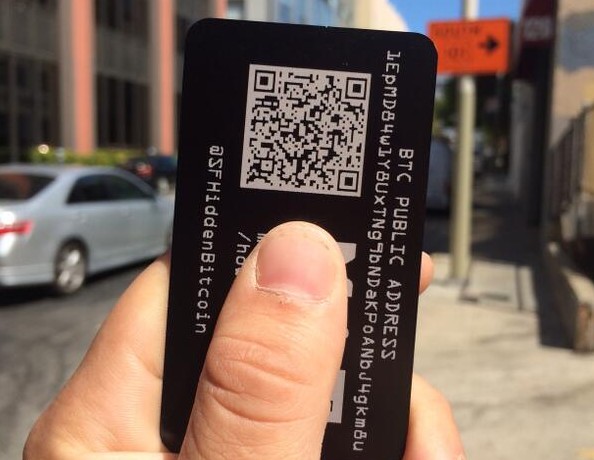
The hunt is appropriately called @SFHiddenBitcoin
The wallets are aluminum cards, with a bitcoin address and corresponding private key that can be imported to the wallet of the person who finds the card. Each card is worth around $20, according to Coinbrief. But there’s no telling whether the prizes will remain consistent. 
The hunt will continue around the city at least for the entire month of July
Just like the original, Hidden Bitcoin leaves clues through its Twitter account. Once a wallet is found, it’s announced on Twitter and people have to wait till another clue is given.
And the bitcoin wallets are hidden all over the city — including, it appears, at Facebook CEO Mark Zuckerberg’s house:
This isn’t the only scavenger hunt going on in the Bay Area right now, either. This weekend people with a valid medical marijuana card can participate in Quest Hunt, a cannabis scavenger hunt where the prize is, you guessed it, marijuana. 

Open your free digital wallet here to store your cryptocurrencies in a safe place.

Satoshi