Author Archives: Satoshi

What is Bitcoin and why should you care?

(BitcoinMagazine) Bitcoin is freedom for money. Let me explain: Bitcoin is third “democratization” that I’ve had the privilege of living through.

The first was the Internet of course, the democratization of
communication. No longer did you need a printing press, runners, trucks,
call boys in order to make your voice heard. Now all you needed is
WordPress and a good story. Look at Matt Drudge. He has singlehandedly revolutionised political reporting. His influence is at times stronger
than the New York Times. And it’s just him and an assistant and a very,
very simple website.
The second democratization is 3d printing, or “additive
manufacturing”. It is the democratization of manufacturing and its in
full swing. You no longer need a factory to make a product. You can
already manufacture in plastic from your desk. In less than 10 years
you’ll be able to do it in metal, in color with moving parts.
Bitcoin is the third democratization, the democratization of money.
Right now, your money, the money you worked for, saved and earned isn’t
really yours. The banks charge you fees for holding it (and sometimes
lose it). Governments have confiscated it at times (remember Cyprus?).
If you want to move it, there are restrictions as to how much and when,
and if you want to spend large amounts of it, you must account for how
you got it.Bitcoin, and crypto currencies in general solve this problem. They
are in essence a “trusted distributed public transaction ledger”.
Imagine a hotel register. Guests sign in, date, room, etc … That is a
transaction ledger. Distributed means that the machines that process
that ledger, the “book” if you will, are spread throughout the world
with many different ownership hands so that it is very, very difficult
for them to collaborate to cheat. Public, because it is open for anyone
to inspect.

And trusted, because that is the most important thing of all. Do I
trust that you really have the money? That you haven’t spent it already,
maybe even a second ago? Ensuring all of that is what the “mining”
machines really do. The miners are the unseen heroes of Bitcoin. Without
miners there is no coin.
The adoption of Bitcoin will drastically reduce the amount of
financial control anyone can exert over your money. And without that
control they can’t tax you and if they can’t tax you they can’t control
you. They know this, they are scared and they should be.
With Bitcoin there are no borders to money. It flows as easily as
water from a spilled cup upsetting the plans of the bankers to monitor,
control, restrict, tax and otherwise devalue YOUR money.

Bitcoin is freedom for money. Switch to Bitcoin, free your money!

Open your free digital wallet here to store your cryptocurrencies in a safe place.

Satoshi
urlhttpgraphics8.nytimes.comimages20140122businessdbpix marc andreessendbpix marc andreessen articleInline

Why Bitcoin Matters

(NYTimes.com) A mysterious new technology emerges, seemingly out of nowhere, but actually the result of two decades of intense research and development by nearly anonymous researchers.Political idealists project visions of liberation and revolution onto it; establishment elites heap contempt and scorn on it.

On the other hand, technologists – nerds – are transfixed by it. They see within it enormous potential and spend their nights and weekends tinkering with it.

Eventually mainstream products, companies and industries emerge to commercialize it; its effects become profound; and later, many people wonder why its powerful promise wasn’t more obvious from the start.

What technology am I talking about? Personal computers in 1975, the Internet in 1993, and – I believe – Bitcoin in 2014.

One can hardly accuse Bitcoin of being an uncovered topic, yet the gulf between what the press and many regular people believe Bitcoin is, and what a growing critical mass of technologists believe Bitcoin is, remains enormous. In this post, I will explain why Bitcoin has so many Silicon Valley programmers and entrepreneurs all lathered up, and what I think Bitcoin’s future potential is.

First, Bitcoin at its most fundamental level is a breakthrough in computer science – one that builds on 20 years of research into cryptographic currency, and 40 years of research in cryptography, by thousands of researchers around the world.

Bitcoin is the first practical solution to a longstanding problem in computer science called the Byzantine Generals Problem. To quote from the original paper defining the B.G.P.: “[Imagine] a group of generals of the Byzantine army camped with their troops around an enemy city. Communicating only by messenger, the generals must agree upon a common battle plan. However, one or more of them may be traitors who will try to confuse the others. The problem is to find an algorithm to ensure that the loyal generals will reach agreement.”

More generally, the B.G.P. poses the question of how to establish trust between otherwise unrelated parties over an untrusted network like the Internet.

The practical consequence of solving this problem is that Bitcoin gives us, for the first time, a way for one Internet user to transfer a unique piece of digital property to another Internet user, such that the transfer is guaranteed to be safe and secure, everyone knows that the transfer has taken place, and nobody can challenge the legitimacy of the transfer. The consequences of this breakthrough are hard to overstate.

What kinds of digital property might be transferred in this way? Think about digital signatures, digital contracts, digital keys (to physical locks, or to online lockers), digital ownership of physical assets such as cars and houses, digital stocks and bonds … and digital money.

All these are exchanged through a distributed network of trust that does not require or rely upon a central intermediary like a bank or broker. And all in a way where only the owner of an asset can send it, only the intended recipient can receive it, the asset can only exist in one place at a time, and everyone can validate transactions and ownership of all assets anytime they want.

How does this work?

Bitcoin is an Internet-wide distributed ledger. You buy into the ledger by purchasing one of a fixed number of slots, either with cash or by selling a product and service for Bitcoin. You sell out of the ledger by trading your Bitcoin to someone else who wants to buy into the ledger. Anyone in the world can buy into or sell out of the ledger any time they want – with no approval needed, and with no or very low fees. The Bitcoin “coins” themselves are simply slots in the ledger, analogous in some ways to seats on a stock exchange, except much more broadly applicable to real world transactions.

The Bitcoin ledger is a new kind of payment system. Anyone in the world can pay anyone else in the world any amount of value of Bitcoin by simply transferring ownership of the corresponding slot in the ledger. Put value in, transfer it, the recipient gets value out, no authorization required, and in many cases, no fees.

That last part is enormously important. Bitcoin is the first Internetwide payment system where transactions either happen with no fees or very low fees (down to fractions of pennies). Existing payment systems charge fees of about 2 to 3 percent – and that’s in the developed world. In lots of other places, there either are no modern payment systems or the rates are significantly higher. We’ll come back to that.

Bitcoin is a digital bearer instrument. It is a way to exchange money or assets between parties with no pre-existing trust: A string of numbers is sent over email or text message in the simplest case. The sender doesn’t need to know or trust the receiver or vice versa. Related, there are no chargebacks – this is the part that is literally like cash – if you have the money or the asset, you can pay with it; if you don’t, you can’t. This is brand new. This has never existed in digital form before.

Bitcoin is a digital currency, whose value is based directly on two things: use of the payment system today – volume and velocity of payments running through the ledger – and speculation on future use of the payment system. This is one part that is confusing people. It’s not as much that the Bitcoin currency has some arbitrary value and then people are trading with it; it’s more that people can trade with Bitcoin (anywhere, everywhere, with no fraud and no or very low fees) and as a result it has value.

It is perhaps true right at this moment that the value of Bitcoin currency is based more on speculation than actual payment volume, but it is equally true that that speculation is establishing a sufficiently high price for the currency that payments have become practically possible. The Bitcoin currency had to be worth something before it could bear any amount of real-world payment volume. This is the classic “chicken and egg” problem with new technology: new technology is not worth much until it’s worth a lot. And so the fact that Bitcoin has risen in value in part because of speculation is making the reality of its usefulness arrive much faster than it would have otherwise.

Critics of Bitcoin point to limited usage by ordinary consumers and merchants, but that same criticism was leveled against PCs and the Internet at the same stage. Every day, more and more consumers and merchants are buying, using and selling Bitcoin, all around the world. The overall numbers are still small, but they are growing quickly. And ease of use for all participants is rapidly increasing as Bitcoin tools and technologies are improved. Remember, it used to be technically challenging to even get on the Internet. Now it’s not.

The criticism that merchants will not accept Bitcoin because of its volatility is also incorrect. Bitcoin can be used entirely as a payment system; merchants do not need to hold any Bitcoin currency or be exposed to Bitcoin volatility at any time. Any consumer or merchant can trade in and out of Bitcoin and other currencies any time they want.

Why would any merchant – online or in the real world – want to accept Bitcoin as payment, given the currently small number of consumers who want to pay with it? My partner Chris Dixon recently gave this example:

“Let’s say you sell electronics online. Profit margins in those businesses are usually under 5 percent, which means conventional 2.5 percent payment fees consume half the margin. That’s money that could be reinvested in the business, passed back to consumers or taxed by the government. Of all of those choices, handing 2.5 percent to banks to move bits around the Internet is the worst possible choice. Another challenge merchants have with payments is accepting international payments. If you are wondering why your favorite product or service isn’t available in your country, the answer is often payments.”

In addition, merchants are highly attracted to Bitcoin because it eliminates the risk of credit card fraud. This is the form of fraud that motivates so many criminals to put so much work into stealing personal customer information and credit card numbers.

Since Bitcoin is a digital bearer instrument, the receiver of a payment does not get any information from the sender that can be used to steal money from the sender in the future, either by that merchant or by a criminal who steals that information from the merchant.

Credit card fraud is such a big deal for merchants, credit card processors and banks that online fraud detection systems are hair-trigger wired to stop transactions that look even slightly suspicious, whether or not they are actually fraudulent. As a result, many online merchants are forced to turn away 5 to 10 percent of incoming orders that they could take without fear if the customers were paying with Bitcoin, where such fraud would not be possible. Since these are orders that were coming in already, they are inherently the highest margin orders a merchant can get, and so being able to take them will drastically increase many merchants’ profit margins.

Bitcoin’s antifraud properties even extend into the physical world of retail stores and shoppers.

For example, with Bitcoin, the huge hack that recently stole 70 million consumers’ credit card information from the Target department store chain would not have been possible. Here’s how that would work:

You fill your cart and go to the checkout station like you do now. But instead of handing over your credit card to pay, you pull out your smartphone and take a snapshot of a QR code displayed by the cash register. The QR code contains all the information required for you to send Bitcoin to Target, including the amount. You click “Confirm” on your phone and the transaction is done (including converting dollars from your account into Bitcoin, if you did not own any Bitcoin).

Target is happy because it has the money in the form of Bitcoin, which it can immediately turn into dollars if it wants, and it paid no or very low payment processing fees; you are happy because there is no way for hackers to steal any of your personal information; and organized crime is unhappy. (Well, maybe criminals are still happy: They can try to steal money directly from poorly-secured merchant computer systems. But even if they succeed, consumers bear no risk of loss, fraud or identity theft.)

Finally, I’d like to address the claim made by some critics that Bitcoin is a haven for bad behavior, for criminals and terrorists to transfer money anonymously with impunity. This is a myth, fostered mostly by sensationalistic press coverage and an incomplete understanding of the technology. Much like email, which is quite traceable, Bitcoin is pseudonymous, not anonymous. Further, every transaction in the Bitcoin network is tracked and logged forever in the Bitcoin blockchain, or permanent record, available for all to see. As a result, Bitcoin is considerably easier for law enforcement to trace than cash, gold or diamonds.

What’s the future of Bitcoin?

Bitcoin is a classic network effect, a positive feedback loop. The more people who use Bitcoin, the more valuable Bitcoin is for everyone who uses it, and the higher the incentive for the next user to start using the technology. Bitcoin shares this network effect property with the telephone system, the web, and popular Internet services like eBay and Facebook.

In fact, Bitcoin is a four-sided network effect. There are four constituencies that participate in expanding the value of Bitcoin as a consequence of their own self-interested participation. Those constituencies are (1) consumers who pay with Bitcoin, (2) merchants who accept Bitcoin, (3) “miners” who run the computers that process and validate all the transactions and enable the distributed trust network to exist, and (4) developers and entrepreneurs who are building new products and services with and on top of Bitcoin.

All four sides of the network effect are playing a valuable part in expanding the value of the overall system, but the fourth is particularly important.

All over Silicon Valley and around the world, many thousands of programmers are using Bitcoin as a building block for a kaleidoscope of new product and service ideas that were not possible before. And at our venture capital firm, Andreessen Horowitz, we are seeing a rapidly increasing number of outstanding entrepreneurs – not a few with highly respected track records in the financial industry – building companies on top of Bitcoin.

For this reason alone, new challengers to Bitcoin face a hard uphill battle. If something is to displace Bitcoin now, it will have to have sizable improvements and it will have to happen quickly. Otherwise, this network effect will carry Bitcoin to dominance.

One immediately obvious and enormous area for Bitcoin-based innovation is international remittance. Every day, hundreds of millions of low-income people go to work in hard jobs in foreign countries to make money to send back to their families in their home countries – over $400 billion in total annually, according to the World Bank. Every day, banks and payment companies extract mind-boggling fees, up to 10 percent and sometimes even higher, to send this money.

Switching to Bitcoin, which charges no or very low fees, for these remittance payments will therefore raise the quality of life of migrant workers and their families significantly. In fact, it is hard to think of any one thing that would have a faster and more positive effect on so many people in the world’s poorest countries.

Moreover, Bitcoin generally can be a powerful force to bring a much larger number of people around the world into the modern economic system. Only about 20 countries around the world have what we would consider to be fully modern banking and payment systems; the other roughly 175 have a long way to go. As a result, many people in many countries are excluded from products and services that we in the West take for granted. Even Netflix, a completely virtual service, is only available in about 40 countries. Bitcoin, as a global payment system anyone can use from anywhere at any time, can be a powerful catalyst to extend the benefits of the modern economic system to virtually everyone on the planet.

And even here in the United States, a long-recognized problem is the extremely high fees that the “unbanked” — people without conventional bank accounts – pay for even basic financial services. Bitcoin can be used to go straight at that problem, by making it easy to offer extremely low-fee services to people outside of the traditional financial system.

A third fascinating use case for Bitcoin is micropayments, or ultrasmall payments. Micropayments have never been feasible, despite 20 years of attempts, because it is not cost effective to run small payments (think $1 and below, down to pennies or fractions of a penny) through the existing credit/debit and banking systems. The fee structure of those systems makes that nonviable.

All of a sudden, with Bitcoin, that’s trivially easy. Bitcoins have the nifty property of infinite divisibility: currently down to eight decimal places after the dot, but more in the future. So you can specify an arbitrarily small amount of money, like a thousandth of a penny, and send it to anyone in the world for free or near-free.

Think about content monetization, for example. One reason media businesses such as newspapers struggle to charge for content is because they need to charge either all (pay the entire subscription fee for all the content) or nothing (which then results in all those terrible banner ads everywhere on the web). All of a sudden, with Bitcoin, there is an economically viable way to charge arbitrarily small amounts of money per article, or per section, or per hour, or per video play, or per archive access, or per news alert.

Another potential use of Bitcoin micropayments is to fight spam. Future email systems and social networks could refuse to accept incoming messages unless they were accompanied with tiny amounts of Bitcoin – tiny enough to not matter to the sender, but large enough to deter spammers, who today can send uncounted billions of spam messages for free with impunity.

Finally, a fourth interesting use case is public payments. This idea first came to my attention in a news article a few months ago. A random spectator at a televised sports event held up a placard with a QR code and the text “Send me Bitcoin!” He received $25,000 in Bitcoin in the first 24 hours, all from people he had never met. This was the first time in history that you could see someone holding up a sign, in person or on TV or in a photo, and then send them money with two clicks on your smartphone: take the photo of the QR code on the sign, and click to send the money.

Think about the implications for protest movements. Today protesters want to get on TV so people learn about their cause. Tomorrow they’ll want to get on TV because that’s how they’ll raise money, by literally holding up signs that let people anywhere in the world who sympathize with them send them money on the spot. Bitcoin is a financial technology dream come true for even the most hardened anticapitalist political organizer.

The coming years will be a period of great drama and excitement revolving around this new technology.

For example, some prominent economists are deeply skeptical of Bitcoin, even though Ben S. Bernanke, formerly Federal Reserve chairman, recently wrote that digital currencies like Bitcoin “may hold long-term promise, particularly if they promote a faster, more secure and more efficient payment system.” And in 1999, the legendary economist Milton Friedman said: “One thing that’s missing but will soon be developed is a reliable e-cash, a method whereby on the Internet you can transfer funds from A to B without A knowing B or B knowing A – the way I can take a $20 bill and hand it over to you, and you may get that without knowing who I am.”

Economists who attack Bitcoin today might be correct, but I’m with Ben and Milton.

Further, there is no shortage of regulatory topics and issues that will have to be addressed, since almost no country’s regulatory framework for banking and payments anticipated a technology like Bitcoin.

But I hope that I have given you a sense of the enormous promise of Bitcoin. Far from a mere libertarian fairy tale or a simple Silicon Valley exercise in hype, Bitcoin offers a sweeping vista of opportunity to reimagine how the financial system can and should work in the Internet era, and a catalyst to reshape that system in ways that are more powerful for individuals and businesses alike.

Open your free digital wallet here to store your cryptocurrencies in a safe place.

Satoshi

Canada and Israel take a different approach to Bitcoin

(SiliconAngle) Bitcoin gained a lot of momentum in 2013, as many people
experimented with it for the first time. It’s not surprising that 2014
also started with a bang for Bitcoin, when its value hit close
to $1,000. Some online shops have started accepting the cryptocurrency
as a form of payment, online sites use it so people can send donations,
and the Chicago Sun-Times has begun experimenting with it to raise funds for the Taproot Foundation.

Though the digital currency is clearly gaining traction,
many governments aren’t too keen about accepting it as a legal tender
just yet. Both India and China
have both warned against Bitcoin in recent weeks, resulting in some
significant fluctuation of its value. But even though there’s been some
strong opposition in these countries, it seems that most others are open
to the possibility of Bitcoin becoming a legal currency in the future.
Two countries are currently keeping an eye on Bitcoin,
monitoring what others are doing about it before coming up with a plat
as to how to approach the cryptocurrency.
Canada’s stand on Bitcoin
In a statement this weekend, Canada’s finance department
clarified that only Canadian bank notes and coins are considered as
legal tender. It doesn’t consider Bitcoin as a legal tender, but that
doesn’t mean that the Canadian government doesn’t see its potential,
reports The Verge.
For now, Canadians can use Bitcoin to pay for online goods,
but not for paying taxes, and businesses will not be required to accept
it as a form of payment.
“Smaller, stand-alone payment systems for which there are
many substitutes — like Bitcoin — should generally require much less
intensive oversight and regulation because they pose much less risk to
the Canadian financial system as a whole,” said Bank of Canada
spokesperson Alexandre Deslongchamps.
Israel’s Wait and See approach
Israel is taking the same stand as Canada, waiting to see
how it all unfolds, but this policy may change in the near future.
 Currently, some financial institutions in Israel are already engaged in
Bitcoin transactions, but regulators haven’t said a thing about it yet,
reports CoinDesk.
The problem with this scenario is that it could attract
that wrong kind of attention. Bitcoin could be used to dodge tax
payments and can even be useful for money laundering, but regulators
feel like they don’t currently need to take a stand regarding any form
of digital currency, since they are still trying to figure out what the
rest of the world will do with it.
“People who want to get their hands on bitcoin will always
succeed, and it would be a pity if it were to occur in the shadows and
not under the supervision of the banking system,” Attorney Shiri Shaham,
who specializes in banking law, stated.

Open your free digital wallet here to store your cryptocurrencies in a safe place.

Satoshi

US senator demands regulatory clarification on digital currencies

(CoinDesk) US Senator Tom Carper yesterday called on the Commodity Futures Trading Commission (CFTC) to clarify its position on digital currencies.
Carper is a Delaware Democrat and he currently heads up the Homeland Security and Governmental Affairs Committee.
It should be noted that Delaware is home to many credit card companies
in the US, thanks to business-friendly regulations that have attracted
numerous financial institutions to the state.
According to Bloomberg,
Carper’s staff are already working on a report on digital currencies,
scheduled for release sometime in the spring. Carper’s email to the CFTC
was a response to an earlier letter from former CFTC chair Gary
Gensler. He, in turn, was responding to an inquiry on digital currencies
filed by Senator Tom Coburn of Oklahoma.

The tone of Carper’s email is
interesting: “Given that we read about a new venture in the digital
currency space nearly every day, it is important that our government
agencies respond appropriately and in a timely manner with thoughtful
policy and oversight.”

“Those willing to take risks and play by the rules should have the opportunity to thrive without the fog of uncertainty.”

It appears that Carper isn’t looking for a clampdown on digital currencies – he merely wants to eliminate any ambiguities.

Open your free digital wallet here to store your cryptocurrencies in a safe place.

Satoshi

People’s Bank of China doesn’t intend to “suppress or discriminate against Bitcoin”

00080286e07514406df734
(BitcoinExaminer) China’s central bank addressed Bitcoin in a press conference
headed by the chief of its financial survey and statistics department.
Sheng Song Cheng transmitted the official stance given by the Chinese
authorities: “we don’t want to suppress or discriminate against Bitcoin, we are simply saying it is not a currency”.
The decision revealed during the
conference held this Wednesday (15) is being welcomed by the Bitcoin
community as a positive development in China’s apparent war against
digital money. The meeting was focused on the country’s 2013 financial
statistics, but Bitcoin popped up as the journalists started asking
questions about it.

“We took a look at Bitcoin and it
doesn’t have the characteristics of a currency. As far as I know, the
vast majority of countries does not recognize Bitcoin as a currency”,
Sheng Song Cheng answered.
Before confirming cryptocurrency’s
status in China as a “virtual good”, he also added that the “People’s
Bank and the relevant departments will continue to focus on Bitcoin and its associated risks,
strengthen the monitoring and analysis and guide the public to
establish a correct concept of money and investment philosophy”.
The authorities’ posture regarding
cryptocurrency falls under Sheng Song Cheng’s public opinion about
Bitcoin. Recently, he wrote an article
saying that “it would be difficult to see how Bitcoin could ever be
considered a currency in the future”. The English edition of the
newspaper Global Times even quoted Sheng as the author of a powerful
sentence: “Bitcoin is merely a utopia for technology supremacists and
absolute liberalists”.
Still, according to the opinion of some
Bitcoiners, this means that China is legitimizing Bitcoin, despite the
country’s successive warnings about the high risks of dealing with
the digital coin. For now, the authorities aren’t banning Bitcoin –
neither do they plan to do it -, only tightening the regulation and keeping an eye on the users and exchanges.
Coincidence or not, the price of Bitcoin in China has registered a slight improvement on BtcChina in the last few hours, surpassing the ¥5,000 mark.

Open your free digital wallet here to store your cryptocurrencies in a safe place.

Satoshi
Chris Dixon a16z site 315x472

Silicon Valley VC thinks a single bitcoin will be worth $100,000

(Wired) — Just a
year ago, a bitcoin was worth $13. And today, the same piece of digital
currency is valued at more than $800 on popular online money exchanges.
But Chris Dixon believes that’s still a serious bargain.
Dixon, a partner with the big-name
Silicon Valley venture capital firm Andressen Horowitz, is adamant that
bitcoin could become the primary means of making payments on the
internet, and if that happens, the price of a bitcoin will skyrocket. “I
think it could be easily worth $100,000,” he says.

 Venture Capitalist Believes Bitcoin Will Hit $100000

That may seem crazy, but Dixon is not
alone. Many among the bitcoin faithful believe that current bitcoin
prices are on the low side compared to what they will become. You see,
there are only a limited number of bitcoins — the worldwide software
system that drives the digital currency will stop minting money sometime
in the next century, when there are about 21 million in circulation —
and this means that a spike in popularity will likely drive a huge
increase in price.
Still not convinced? Dixon points to
what has happened with another scarce but widely used internet resource.
“Domain names are an analogy,” he says. “It would have been absurd to
say in 1993 that domain names were worth $10 million each.” But now, that’s a reality.
Sure, $10 million domains aren’t the
norm. But according to Dixon, the startups funded by Andressen-Horowitz
typically pay a “couple of hundred grand” for a domain name that
includes a no-more-than-average word. “Probably the best investment in
computer history would have been buying domain names in 1993,” he says.
“Better than Amazon. Better than Google.”

Open your free digital wallet here to store your cryptocurrencies in a safe place.

Satoshi

A word from Jeffrey Tucker: Bitcoin is not a monetary system

(BitcoinMagazine) Libertarian leader Jeffrey Tucker, CEO of Liberty.me and
publisher of Laissez Faire Books, shared with Bitcoin Magazine his views
on how Bitcoin is NOT a monetary system.

Bitcoin Is Not a Monetary System By Jeffrey Tucker

Every since I started writing about cryptocurrency last
Spring, my inbox has become a hub for Bitcoin questions. I completely
understand – even to me it’s still the most implausible idea ever that
some code-slinging, nameless geek somewhere could somehow invent a new
currency made from 1s and 0s, throw it out there on an open forum, and
(in a mere five years), it would obtain a market capitalization worth
nearly $10 billion.
What does it all mean? Well, it took me some serious study
to figure out how all the technologies hang together and why.
Understanding Bitcoin requires knowledge of monetary theory, open-source
programming, distributed networks, cryptography, and process-oriented
software development — and that’s quite a big undertaking. This accounts
for why people are so confused as to how a protocol could become the
basis of a new global monetary order.
However, I actually don’t think that a lack of technical
knowledge really accounts for why even some very smart people are having
a hard time making sense of the success of Bitcoin. A hint  towards the
answer came in an email from a correspondent who asked me a particular
question about how contracts and accounting will work once Bitcoin “is
implemented as a currency.”
I got stuck on the word “implemented.” That’s the core of
the fallacy; and, again, it is completely understandable. Hayek wrote in
1974 that governments have owned and managed monetary systems for many
hundreds of years, even back to the ancient world: the coin of the realm
has been seen as a government responsibility. In the 19th century, all
governments were expected to implement a system that best met the needs
of the population.
In the 20th century, government took this idea much
further. It would not just print the money, it would not just oversee
the system and determine what constituted money, no – it would use
‘science’ to find the optimal money-creation rate and cartelize the
banking system to make sure that it was exactly as it should be. Every
aspect of the money system — and we are talking about half of every
economic transaction — would be overseen by the state in conjunction
with private partners in industry.
And so it has been for all these years. No living person
remembers a time when money had any existence outside public management.
In effect, all governments of the world made money a socialistically
owned good. And what happened? It became a tool of politics; it declined
in quality, buying less and less in terms of goods and services; in
effect, it became the main means of funding the expansion of power over
liberty.
The emergence of cryptocurrency smashes that paradigm
entirely. “Satoshi Nakamoto” never asked for anyone’s permission to
release his code-based model for the ideal currency, he didn’t submit a
working paper to the National Bureau of Economic Research, he didn’t
meet with Federal Reserve economists, testify to the Senate Banking
Committee, or get the ear of the chairman of the Fed. He went straight
to the public.

He bypassed the entire structure of power and released it
on a distributed network. He invited the world to participate. In other
words, he was not proposing a system at all, it is not a top-down plan
for monetary reform. We’ve seen scads of those — thousands upon
thousands — emerge over the last hundred years. None of them have come
to anything. You can talk about monetary rules, policy reforms, audits,
and exchange rate fixes all you want, but here is the grim reality:
government owns the money and it will use it to serve its ends.

That’s why a totally different approach was necessary: the
free market. The free market is not a system, it is not a policy
dictated by anyone in particular, it is not something that Washington
implements, it does not exist in any legislation, law, bill, regulation,
or book. It is what you get when people act on their own, entirely
without central direction, and with their own property, and within human
associations of their own creation and in their own interest. It is the
beauty that emerges in absence of control.
Does that sound like anarchy? It struck Karl Marx that way.
What he did not understand was the central insight of the liberal
revolution of the 18th century: society can manage itself and create its
own beautiful order without any central control. Bitcoin is a
paradigmatic example, but only one of a million now emerging all over
the world.

Who or what is chronicling these revolutionary developments and
plotting to push them further as a means of achieving greater freedom in
our own lives, and therefore in society as a whole? Liberty.me. Our
purpose is to invite everyone into a close engagement with the wonderful
upheavals going on right now.

Open your free digital wallet here to store your cryptocurrencies in a safe place.

Satoshi
101298903 167511937r.530x298

Bitcoin’s four steps to Wall Street acceptance

(YahooFinance) Bitcoin’s resiliency-as well as
its recent rise above the $1,000 mark-is gaining it additional converts
to the belief that the cryptocurrency is for real.


One of the latest skeptics-turned-believers is Ty Danco, a respected
market veteran who has worked up one side of Wall Street and down the
other. Danco once oversaw more than $60 billion of assets and now is the
CEO at a trading firm called BuysideFX.


In an essay for the subscription-only Tabb Forum,
he outlines what he sees as the future for bitcoin, the digital
currency that last was trading at one unit equaling more than $900.


“The media thoroughly covered its meteoric rise in market value as a
currency, but the bigger story is that high-profile investors have
placed significant bets on Bitcoin-related businesses this year,
including Li-Ka Shing, Union Square Ventures, and Andreessen-Horowitz,”
Danco wrote. “Given their involvement, bitcoin demands a serious look.”

(Read more: Do you really know bitcoin? Here are 11 myths )


While acceptance for bitcoin continues to grow-gaming website Zynga (ZNGA)
this week said it would accept bitcoins for payment-Danco said it faces
four challenges before gaining Wall Street’s acceptance:


1. Clear regulation


It seems bitcoin’s path to legitimacy runs straight through government
and regulatory agencies, quite likely the Commodity Futures Trading
Commission. Says Danco:


Early signs from regulators are more promising than I initially
expected, but we still have a long way to go. CFTC: Bitcoin most likely
falls in your lap, whether as a commodity, currency, or derivative. Take
a stand!


2. A) More adult supervision, and B) Big endorsements.

Bitcoin indeed needs to shed its image as a toy created by hobbyists
and nerds. After all the leading bitcoin exchange is Mt.Gox, which is
not an abbreviation for “Mount Gox” but rather an acronym for Magic The
Game: Online Exchange, where folks used to trade cards for a Dungeons
& Dragons-esque game.

I can’t see Prudential Insurance, Vanguard or the Monetary Authority of
Singapore trusting their assets with these kids. Those of you running
Bitcoin exchanges, dump the rhetoric, go hire some pros from SWIFT, the
major credit card companies, central banks, the FSA, etc.

On 2B, bitcoin already has gotten some pretty weighty
endorsements-hedge fund titan Mike Novogratz, for instance-but could
use a little more heft, Danco said.


To get broad buy-in of its legitimacy, Bitcoin needs some sponsorship
by big players. Some well-known VCs have jumped in, but we need one or
two mammoth banks like JPMorgan (JPM) or Deutsche Bank (XETRA:DBK-DE) to come onboard; not shady entities based out of the Caymans

3. Establishing two-way transactions and delivery vs. payment (DVP).

DVP is another byway on the way to legitimacy. It ensures that users of
bitcoin aren’t going to get ripped off on the other end as it requires
payment at the time of delivery for the goods in question.


When a DVP and security registration can be automated via a
decentralized P2P process, Bitcoin takes the banking world by storm.


4. A clearer identity.


Danco explains:


Finally, to become institutional, Bitcoin requires optional and
verifiable identity opt-ins. Identity for securities settlement
instructions is going to be known in advance before diving into
anonymous-looking alphanumeric strings of private and public keys. (An
exception may be made for dark pool transactions.) My guess is that
institutional “wallets” (read:custody accounts for bitcoin) may have
some identifiable and consistent beginning, then unique and
cryptographic back ends.

While achieving the
four steps will be difficult, it also is very doable, rendering bitcoin
skeptics increasingly into the shadows.

It’s hard
to go against 30 years of habit, but this old dog has converted from
Krugmanesque bitcoin hating to being optimistic about virtual
currencies. It will be time for new tricks soon, but bitcoin needs to
check a few boxes before it’s ready for primetime.

Tomohiro Ohsumi | Bloomberg | Getty Images

Open your free digital wallet here to store your cryptocurrencies in a safe place.

Satoshi

1 millionth Bitcoin wallet created on Blockchain.info

(CoinDesk) Blockchain.info has reached the biggest milestone in its history – it now boasts over a million wallets. A year ago it had fewer than 100,000 users and by late October the company announced that it had created 500,000 wallets, so it is evident that things are picking up.

A Blockchain representative told CoinDesk that the company plans to celebrate the latest milestone with some big prizes. Back in October, the lucky
user who created the 500,000th wallet was rewarded with 10 BTC, so the stakes are high. Blockchain acknowledged that reaching the one million mark is a major accomplishment for any service, especially in the bitcoin space. A company spokesman said:

The year 2013 has been an unforgettable one for Blockchain. As the number of wallets has doubled from 500,000 since November, the world’s most popular bitcoin website is proud to announce reaching 1,000,000 wallets for their wallet service.

Blockchain started 2013 with around 100,000 users. By contrast, 2014 is kicking off with more than a million users. The company said: “The growth seen over the past year has happened during a pivotal time for bitcoin. Blockchain plans to build this milestone into an outreach opportunity for bitcoin newbies and enthusiasts.
Blockchain.info added that its leadership role in the bitcoin economy is “only just beginning,” so we can expect a lot more over the next few months.
It is also keen to emphasise that it is nearly a “100% bitcoin” business, as it pays its employees and most of its services in bitcoin. It also closes its business deals in bitcoins, including the recent acquisition of ZeroBlock, the most popular iOS/Android app for bitcoin.
If, by chance, you did open a Blockchain account over the last few hours, it might be a good idea to check whether you were the lucky one-millionth user.

Open your free digital wallet here to store your cryptocurrencies in a safe place.

Satoshi

Google and Wikipedia: Bitcoin is one of the most researched words of 2013

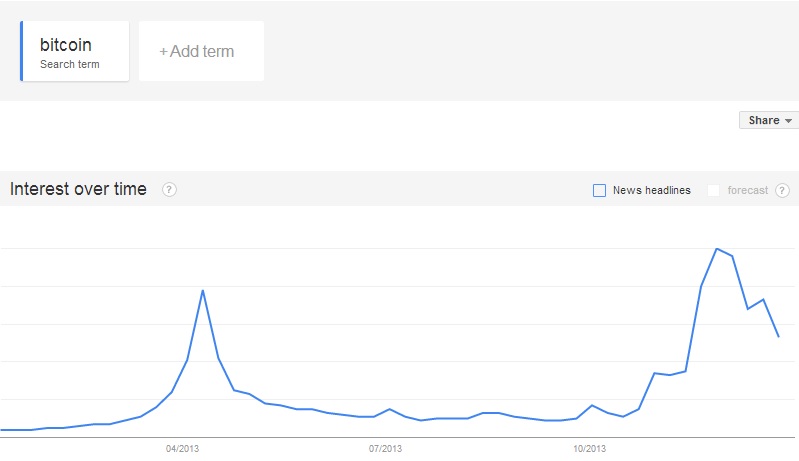
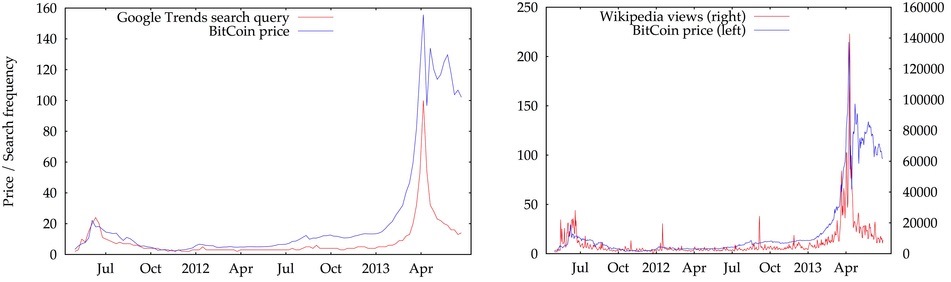
(BitcoinExaminer) This last year was definitely a great one for Bitcoin and 2014 promises even more good news. In 2013, Bitcoin became one of the most researched words across the world in platforms like Google or Wikipedia and there’s already a study made by a well-known economist that shows how the
people’s curiosity exponentially grows when cryptocurency’s price goes up.

According to the economist Ladislav Krištoufek, from Charles University in Prague, understanding Bitcoin demand is an essential step to properly analyze the virtual currency. And an important part of demand (and its evolution) is the number of people interested in knowing more.
That is why Krištoufek, quoted by Forbes, used Google Trends and Wikipedia to determine how many times people searched for the term ‘Bitcoin’ during the past year. The biggest peak was achieved in November, when cryptocurrency climbed to its maximum price ever, around $1,200.
dfdfg
The second peak happened months before, between April 7 and 13, when the first big crash happened and Bitcoin’s price went from a bit over $200 to a value around $60. In his study “Bitcoin meets Google Trends and Wikipedia: Quantifying the relationship between phenomena of the Internet era”, Ladislav Krištoufek analyzes the research data according to the price of cryptocurrency. There’s obviously an influence in these peaks of interest.
2
The recently released Google Zeitgeist 2013 report confirms this trend: “What is Bitcoin” was considered the tenth most popular search in the United States, at least under the “What is …” category.
According to Digital Trends, the world’s most famous cryptocurrency made it to the top 10, ranking behind the winner “what is twerking” and other examples like “what is gluten” or “what is Snapchat”.

Open your free digital wallet here to store your cryptocurrencies in a safe place.

Satoshi