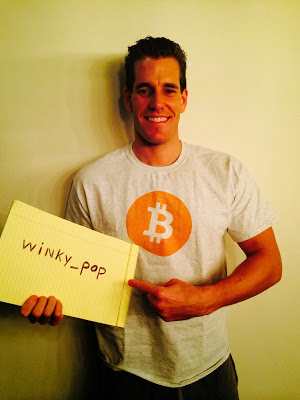
Winklevoss twin says Bitcoin valuation will top $40k
(TheNextWeb) Cameron Winklevoss, one half of the notorious twin brothers who once
battled Mark Zuckerberg over the origin of Facebook, took to Reddit to host an AMA this weekend to discuss the duo’s big interest: Bitcoin.
The Winklevoss twins were early Bitcoin advocates but have never revealed their total holding — though it was said to be worth
$11 million in April, when the crypto-currency peaked at $266. Given
today’s price ($875 average on Mt. Gox, at the timing of writing) and
Cameron’s admission that he is yet to sell a single Bitcoin, it could
now be worth as much as $35 million.
The twins are in the process of setting up the Winklevoss
Bitcoin Trust, a listed fund to manage their Bitcoin wealth and bring
greater legitimacy to the virtual currency. Papers for the initial
public offering were filed in July, but the final decision is still
pending. Due to regulations, Cameron was unable to discuss the trust in
the AMA.
The brothers are unsurprisingly bullish on Bitcoin. Cameron’s conservative
bet is that its US dollar valuation will surpass $40,000 per coin — a
potentially colossal figure — as he explained in a response to one
Reddit user:
dollar market cap, so 40,000 USD a coin, but I believe it could be much
larger. When this will happen, if it happens, I don’t know, but if it
happens, it will probably happen much faster than anyone imagines.

In another answer, Cameron played down the significance of the closure of The Silk Road
— the underground market place for illicit goods that many saw as a key
outlet for Bitcoin — instead arguing it is positive for the virtual
currency:
The Silk Road closure, and resulting price gains
demonstrate how the demand for BTC has little to do with illicit
transactions. If anything, Silk Road was holding Bitcoin back by
disproportionately dominating its narrative in a negative way.
It is estimated that the volume of bitcoin transacted on Silk Road
only represented ~4% of the total volume of bitcoins transacted on the
Block chain over the same period of time.
Bitcoin’s growth has seen interest in other alternate currencies — such as Litecoin and Quarkcoin – but Cameron says he and his brother have no interest in anything other than Bitcoin:
Do you see BTC ‘replacing’ currencies we have today, or being used alongside them?
Have you invested in any altcoins, if so, which and why?
I view BTC more as an alternative to fiat currencies than a replacement.
I have not invested in any altcoins because I don’t believe that any
of the “problems” or issues that they address can’t be addressed by
Bitcoin itself.
You can see the full range of answers — which include mentions of
rowing (the brothers represented the US at the Olympic Games) and the
Simpsons — at the thread here.
Given their background and early adoption of Bitcoin, the twins’
opinions and predictions for the future are interesting. They have both
predicted that there will be some form of regulation for the currency in
the future. They see it as an ‘answer’ to many fiscal problems and are
keen to help take it more mainstream.
Open your free digital wallet here to store your cryptocurrencies in a safe place.
What is the true value of Bitcoin?
Open your free digital wallet here to store your cryptocurrencies in a safe place.
BTC China in discussion with regulators over Bitcoin recognition
(CoinDesk) The world’s busiest bitcoin exchange, BTC China, has been in talks with regulators to approve bitcoin as an official currency, according to Bloomberg Businessweek.
While there have been some ‘lower-level’ discussions, the company has not yet had any success arranging high-level meetings, said BTC China CEO, Bobby Lee.
This isn’t surprising, given the reluctance of governments worldwide to make official statements about the currency’s legal status.
To grant official approval would likely cause a spike in activity, with many fearing activity on such a grand scale could undermine one of government’s key economic powers: overseeing fiat currencies. This hasn’t stopped a recent flurry of interest from high-level government officials, as bitcoin’s value soars too high to ignore. At the time of writing, the bitcoin price on BTC China was 6,267 CNY, or $1,027. Mt. Gox’s price was $1,050, and it was around $990 on the Coindesk BPI. The upper echelons of government feature many opinions on bitcoin, including some that have shifted over the years. Senator Chuck Schumer, who in 2011 described bitcoin as “an online form of money laundering,” and called for a crackdown, recently tweeted that the cryptocurrency had “significant potential”. Deputy governor of China’s People’s Bank, Yi Gang, hinted at a personal (unofficial) approval of bitcoin exchanges and people’s ability to trade in and out of digital currencies, but also said it would be impossible for the central bank to recognise bitcoin “in the near future”.
BTC China has taken Gang’s comments on board, and Lee has continued to hold discussions with local regulators. He has also answered questions about how bitcoin should be regulated, remaining optimistic about the long-term, describing bitcoin’s current status as:
“Not on the black list and not on the white list. It’s in the grey area.”
In the bitcoin universe, anything short of a call for blacklisting can be taken as progress. But while its “grey area” status allows exchanges and payment processors to function reasonably well at the moment, many think some form of recognition and subsequent regulation is necessary for bitcoin to gain widespread acceptance.
Open your free digital wallet here to store your cryptocurrencies in a safe place.
Bitcoin-Litecoin ratio returns to historic norm, Peercoin climbs 200%
to record highs, reaching as high as $1,141 on Bitstamp, it is joined in
growth by a number of alternative digital currencies. The most visible
has been litecoin, which has returned to what might be considered a
normal trading range relative to bitcoin. Litecoin is not alone in its
gains, with others like Peercoin and Namecoin making similar gains.
over the past week, surprising many with its meteoric gains and
crossing of one billion dollars of market capitalization. Yet, the
dynamics in which it is actually traded are often overlooked,
particularly its relationship to bitcoin. On BTC-e, the leading litecoin
exchange by volume, the bitcoin-litecoin currency pair is traded with
as much or more volume as litecoin-dollar. It also regularly dictates
movement as visible through a series of technical factors.
litecoin and bitcoin are beginning to show signs of trading in a manner
similar to gold and silver. In particular, maintenance of a banded
price ratio is a dynamic well known to the precious metals and once
again proving its potential applicability to digital currencies. While
the original research on the matter explains in more detail, those
watching the ratio may well consider the latest litecoin-dollar gains to
be an expected correction. Having fallen out of range amid bitcoin’s
800% climb in the past month, it has since normalized.
alternative mining implementation based not only on bitcoin’s
proof-of-work scheme, but also a proof-of-stake. The proof-of-stake
system distributes new coins based on holdings rather than just finding
correct hashes. While PPC / BTC remains the dominant currency pair for
the altcoin so far, PPC / USD was recently added on BTC-e, leading to a
massive jump in its exchange rate.
Open your free digital wallet here to store your cryptocurrencies in a safe place.

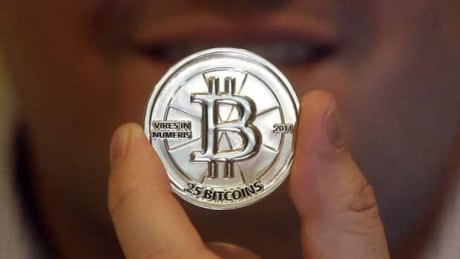
British Island wants to make physical Bitcoins with UK Royal Mint deal
(CoinDesk) A tiny island in the English Channel, Alderney, wants to mint physical bitcoins as part of a larger campaign to become one of the world’s first financial services centers devoted to digital currency.
The Financial Times reported
that Alderney, just three miles long with a population of 1,900, wants
to become known as an international center for bitcoin transactions.
Intended to be fully compliant with anti money-laundering and other
financial regulations, it would offer merchant payment services,
exchanges, and a bitcoin storage vault of some kind.
The physical
bitcoins, like other such tokens, would be collectors’ items rather than
circulated, and would likely have a gold content (apparently around
£500 worth) to further their appeal and allow them to retain value
should bitcoin’s price crash.

They would also serve as promotional
tokens for the more ‘serious’ bitcoin payment and exchange services.
Alderney’s
coins would hopefully be minted in a collaboration with the UK’s Royal
Mint as part of a commemorative collection. Rather than having a private
key sealed inside, like the popular Casascius physical bitcoins
and their contemporaries, the Alderney bitcoins would be exchangeable
for the more useful digital kind by its holder paying a visit to the
island. They would not be official legal tender otherwise.
Production
would be overseen by an independent company, who would also take the
hit if bitcoin’s value vanished. The same company would also hold the
coins’ keys in an escrow service. If the deal goes ahead, The Royal Mint
would handle orders and take some of the money from sales.
With current bitcoin values hovering around $1,100 on CoinDesk’s BPI
(over $1,200 on Mt. Gox) and seeming to jump higher with each passing
day, more daring segments of the financial world are sensing an
opportunity to create a whole new industry. The high values, including
not only bitcoin’s but those of other digital currencies
as well, are wrenching the concept out of the hands of tech-savvy
entrepreneurs and delivering it to people more accustomed to
billion-dollar movements.
Bitcoin and digital currencies, despite
occasional murmurings and investigations by authorities, still have no
legal recognition as currencies in any major jurisdiction. No
legislation has been tabled specifically for digital currencies, though
exchanges and payment processors generally fall under the same
know-your-customer (KYC) and anti-money laundering (AML) regulations as other ‘money transmitters’.
The
Channel Islands, just off the coast of France, are ‘Crown Dependencies’
and not officially part of the UK. This special legal status has
traditionally made them a hub for offshore financial services, with most
of the activity happening on larger Guernsey and Jersey.
Alderney falls under the jurisdiction of the Bailiwick of Guernsey
but has been looking for ways to gain more financial independence from
its neighbors. The island has long produced stamps and minted its own
coins, called the Alderney pound, pegged 1:1 to UK pound sterling. The
coins are produced in denominations of £1, £2 and £5 in ordinary
cupro-nickel as well as gold and silver versions, and are also aimed
primarily at collectors.
Open your free digital wallet here to store your cryptocurrencies in a safe place.
China’s third-largest mobile network now accepts Bitcoin!
(CoinDesk) Consumers in China can now purchase smartphones with bitcoin from a
major carrier, after a local division of China Telecom announced a
promotional offer for new Samsung phones this week.
China Telecom’s subsidiary Jiangsu Telecom, in Jiangsu province on the east coast of the country, posted the offer on its website. Translated details were scarce, but it appears customers have the chance to use bitcoin instead of yuan to pre-order Samsung’s 2014 clamshell form-factor Android phone.

Any business newly accepting bitcoin, even in a small way, is
guaranteed to gain disproportionate attention in these times. So on the
surface, many recent stories of bitcoin acceptance from China seem more
promotional than revolutionary. Indeed, this is a limited offer for one
model phone from a local provider and not a major announcement of
large-scale bitcoin adoption.
However, it’s also a sign large state owned enterprises in China, or at least
certain divisions of them, are more open to experimentation with bitcoin
than their overseas counterparts.As of this month, most bitcoin
acceptance in other parts of the world remains limited to owner-operated
small businesses and startups. A division of Chinese internet search
giant Baidu also announced recently it would accept bitcoin as payment.
Jiangsu
Telecom’s offer also strikes a more positive note than previous reports
from China earlier in 2013, which suggested China Telecom was trying to block
bitcoin-related traffic from its services. China Telecom is China’s
largest fixed-line provider and its third-largest mobile carrier.
If
bitcoin can be used as a promotional tool to attract younger and more
technology-aware consumers, it also indicates the Chinese market itself
is more ready for alternate forms of payment.
Open your free digital wallet here to store your cryptocurrencies in a safe place.
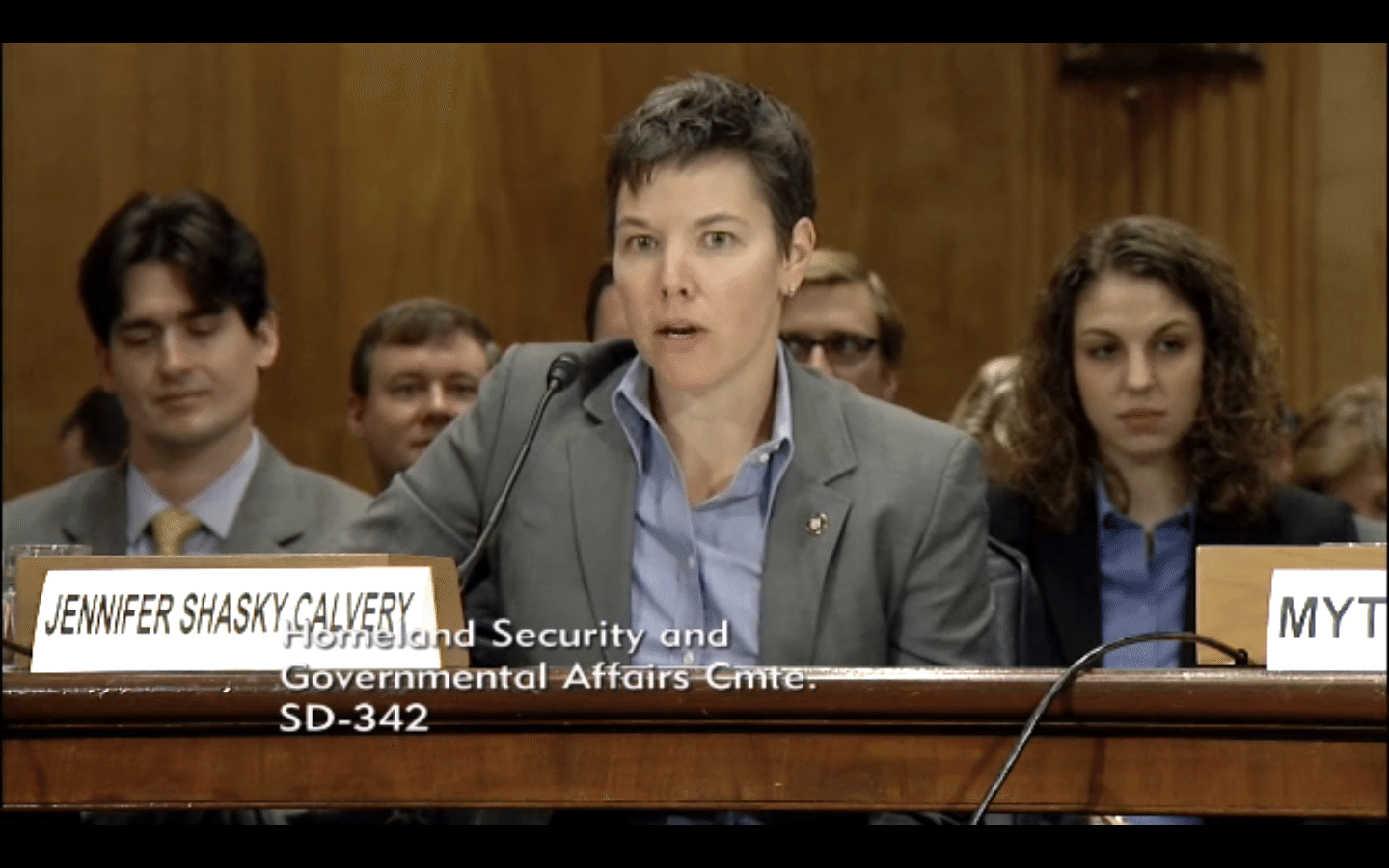
This Senate hearing is a Bitcoin lovefest
(WashingtonPost) The Senate Committee on Homeland Security and Governmental Affairs,
chaired by Sen. Tom Carper (D-Del.), is holding the first congressional
hearing on the future of Bitcoin. The first panel features senior
figures from the Obama administration. And their comments about Bitcoin
have been remarkably positive.
After the officials gave their opening statements, Carper’s first
question drew a parallel to the Internet. He pointed out that in the
early days of the Internet revolution, many people raised concerns about
illicit use of Internet technologies. Yet in the long run, he argued,
the Internet has had a hugely beneficial effect on peoples lives, making
possible previously unimagined services like Facebook and YouTube.
Carper wanted to know if the witnesses saw Bitcoin in the same light.
 Jennifer Calvery, director of the Financial Crimes Enforcement
Network, agreed with Carper. “Innovation is a very important part of our
economy. It’s something for us to be proud of,” she said.
“We are attuned to the criminal use,” added Mythili Raman of the
Justice Department. But “there are many legitimate uses. These virtual
currencies are not in and of themselves illegal.”
“There is good reason for us to remain watchful” about Bitcoin being
used for illicit purposes, Raman added. “But we also intend to balance
that against the need for legitimate users” to use the technology.
Later in the same panel, Edward Lowery of the Secret Service
testified that cyber criminals “have not by and large gravitated toward
peer-to-peer cryptocurrencies.” Rather, they “have by and large
gravitated toward centralized digital currencies that are based in a
locale that may have less regulatory guidelines and less aggressive law
enforcement.”
That’s been the tenor of the entire hearing so far. All three Obama
administration officials expressed concern about Bitcoin being used for
illicit uses. But they also stressed that Bitcoin has important
legitimate uses and that regulators need to be careful not to stifle
innovation in virtual currencies. And they seemed to believe that the
situation was under control, and none asked for new regulatory powers to
crack down on illicit uses of the currency.
Open your free digital wallet here to store your cryptocurrencies in a safe place.
Bitcoin couple travels the world using virtual cash
“In bitcoin,” Austin Craig repeated to the young woman behind the
counter at the Lean Crust Pizza parlor in the Fort Greene neighborhood
of Brooklyn, N.Y. “Can we pay in bitcoin?”
“In what?” came the reply.
Mr. Craig, 30
years old, was struggling to convince Nadia Alamgir of the existence of
the virtual currency that has gained traction across the world, and
whose value—after months of wild swings—on Wednesday reached records
around $400 per bitcoin.
It was midway through a tricontinental
odyssey taken with his wife, Beccy Bingham-Craig, 29, and a film crew
documenting their travails, which started in Provo, Utah. Their mission:
to live on bitcoin alone.
“It’s been consistently inconvenient
and occasionally frustrating,” Mr. Craig said outside Lean Crust, “but
never impossible.” Lean Crust advertised itself as bitcoin-friendly but
hadn’t seen much virtual foot traffic. Ms. Alamgir eventually contacted
the store’s owner, who arrived and processed the transaction, allowing
Mr. Craig to munch on several slices.
Lean Crust, though, is one
of a tiny but growing number of stores, travel agents and online
merchants starting to accept the once-obscure digital currency as a
means of payment. Bitcoin doesn’t exist, except in the virtual world,
and can only be passed from one person to another electronically. Its
origins are murky: Conventional wisdom says a man or group of people
going by the name Satoshi Nakamoto created bitcoin in 2009, stoking
demand by making it obtainable only through complicated algorithmic
searches by powerful computers.
But in the past 12 months, the
bitcoin zeitgeist has taken on a life of its own. The currency is
discussed at investing conferences now. The Winklevoss twins, known for
their fight with Facebook Inc. founder Mark Zuckerberg, have started a
bitcoin fund. It also has gained the attention of regulators who worry
it can be used to launder money.
For the Craigs, bitcoin represented a chance at adventure—and an underground movie career.
They
began their trek in October by driving east from Provo in Ms.
Bingham-Craig’s 2004 Volkswagen Jetta. After arriving in New York on
Oct 17, they flew to Stockholm, Berlin and Singapore before eventually
returning to Provo. In the end, they lasted 101 days, from July 23 to
Nov 1.
The Craigs weren’t part of the bitcoin underground when
they began the project. Mr. Craig said he first heard of the currency in
2011 and then came up with the plan to live and travel solely on
bitcoin.
“I’m really excited about bitcoin and its future,” Mr. Craig said. “It’s a reimagining of money.”
Starting
July 23, the day they returned from their honeymoon, the Craigs paid
for everything with bitcoin, from rent to food to gas. At that time, one
bitcoin was worth about $98, based on trading at the Tokyo-based Mt.
Gox exchange, a primary exchange bitcoin enthusiasts have tracked.
the trip, they had to not only introduce a number of people to the
fledging currency but to persuade them to use it. After a few weeks of
prodding, their landlord, Justin James, agreed to the plan—with the
sweetener of a small premium over the rent—and set up his own bitcoin
account.
“In the end,” Mr. James said, “it hasn’t been as much of
an inconvenience as I thought it would be.” While he hasn’t become a
convert, he did say he thought the experiment sounded like fun and was
“happy to be a part of it.”
Open your free digital wallet here to store your cryptocurrencies in a safe place.
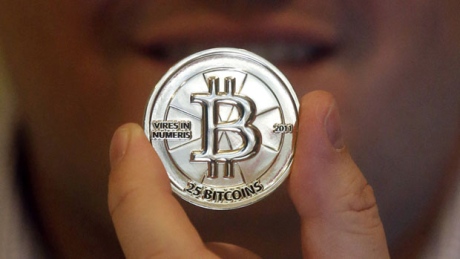
Canada has decided to reveal some of its plans for virtual currencies
Open your free digital wallet here to store your cryptocurrencies in a safe place.
Richard Brown, executive architect, IBM thinks the future for crypto-currencies looks very bright.
Bitcoin, the world’s first decentralised digital currency, entered mainstream consciousness this year: Bitcoin-focused startups are accessing venture capital and industry commentators talk about it as an important international payment mechanism of the future. But are we interpreting its significance too narrowly? In this video, Richard Brown, IBM Executive Architect for Banking and Financial Markets Industry Innovation, argues that Bitcoin’s true significance lies in its potential as a global digital asset register and in the lessons it teaches us for design of complex distributed systems. He also explains why recent law-enforcement action against operators of illegal websites that transacted in Bitcoin will help accelerate adoption by legitimate businesses.”
Open your free digital wallet here to store your cryptocurrencies in a safe place.