
Category Archive: bitcoin

People’s Bank of China doesn’t intend to “suppress or discriminate against Bitcoin”

00080286e07514406df734
(BitcoinExaminer) China’s central bank addressed Bitcoin in a press conference
headed by the chief of its financial survey and statistics department.
Sheng Song Cheng transmitted the official stance given by the Chinese
authorities: “we don’t want to suppress or discriminate against Bitcoin, we are simply saying it is not a currency”.
The decision revealed during the
conference held this Wednesday (15) is being welcomed by the Bitcoin
community as a positive development in China’s apparent war against
digital money. The meeting was focused on the country’s 2013 financial
statistics, but Bitcoin popped up as the journalists started asking
questions about it.

“We took a look at Bitcoin and it
doesn’t have the characteristics of a currency. As far as I know, the
vast majority of countries does not recognize Bitcoin as a currency”,
Sheng Song Cheng answered.
Before confirming cryptocurrency’s
status in China as a “virtual good”, he also added that the “People’s
Bank and the relevant departments will continue to focus on Bitcoin and its associated risks,
strengthen the monitoring and analysis and guide the public to
establish a correct concept of money and investment philosophy”.
The authorities’ posture regarding
cryptocurrency falls under Sheng Song Cheng’s public opinion about
Bitcoin. Recently, he wrote an article
saying that “it would be difficult to see how Bitcoin could ever be
considered a currency in the future”. The English edition of the
newspaper Global Times even quoted Sheng as the author of a powerful
sentence: “Bitcoin is merely a utopia for technology supremacists and
absolute liberalists”.
Still, according to the opinion of some
Bitcoiners, this means that China is legitimizing Bitcoin, despite the
country’s successive warnings about the high risks of dealing with
the digital coin. For now, the authorities aren’t banning Bitcoin –
neither do they plan to do it -, only tightening the regulation and keeping an eye on the users and exchanges.
Coincidence or not, the price of Bitcoin in China has registered a slight improvement on BtcChina in the last few hours, surpassing the ¥5,000 mark.

Open your free digital wallet here to store your cryptocurrencies in a safe place.

Satoshi
Chris Dixon a16z site 315x472

Silicon Valley VC thinks a single bitcoin will be worth $100,000

(Wired) — Just a
year ago, a bitcoin was worth $13. And today, the same piece of digital
currency is valued at more than $800 on popular online money exchanges.
But Chris Dixon believes that’s still a serious bargain.
Dixon, a partner with the big-name
Silicon Valley venture capital firm Andressen Horowitz, is adamant that
bitcoin could become the primary means of making payments on the
internet, and if that happens, the price of a bitcoin will skyrocket. “I
think it could be easily worth $100,000,” he says.

 Venture Capitalist Believes Bitcoin Will Hit $100000

That may seem crazy, but Dixon is not
alone. Many among the bitcoin faithful believe that current bitcoin
prices are on the low side compared to what they will become. You see,
there are only a limited number of bitcoins — the worldwide software
system that drives the digital currency will stop minting money sometime
in the next century, when there are about 21 million in circulation —
and this means that a spike in popularity will likely drive a huge
increase in price.
Still not convinced? Dixon points to
what has happened with another scarce but widely used internet resource.
“Domain names are an analogy,” he says. “It would have been absurd to
say in 1993 that domain names were worth $10 million each.” But now, that’s a reality.
Sure, $10 million domains aren’t the
norm. But according to Dixon, the startups funded by Andressen-Horowitz
typically pay a “couple of hundred grand” for a domain name that
includes a no-more-than-average word. “Probably the best investment in
computer history would have been buying domain names in 1993,” he says.
“Better than Amazon. Better than Google.”

Open your free digital wallet here to store your cryptocurrencies in a safe place.

Satoshi

A word from Jeffrey Tucker: Bitcoin is not a monetary system

(BitcoinMagazine) Libertarian leader Jeffrey Tucker, CEO of Liberty.me and
publisher of Laissez Faire Books, shared with Bitcoin Magazine his views
on how Bitcoin is NOT a monetary system.

Bitcoin Is Not a Monetary System By Jeffrey Tucker

Every since I started writing about cryptocurrency last
Spring, my inbox has become a hub for Bitcoin questions. I completely
understand – even to me it’s still the most implausible idea ever that
some code-slinging, nameless geek somewhere could somehow invent a new
currency made from 1s and 0s, throw it out there on an open forum, and
(in a mere five years), it would obtain a market capitalization worth
nearly $10 billion.
What does it all mean? Well, it took me some serious study
to figure out how all the technologies hang together and why.
Understanding Bitcoin requires knowledge of monetary theory, open-source
programming, distributed networks, cryptography, and process-oriented
software development — and that’s quite a big undertaking. This accounts
for why people are so confused as to how a protocol could become the
basis of a new global monetary order.
However, I actually don’t think that a lack of technical
knowledge really accounts for why even some very smart people are having
a hard time making sense of the success of Bitcoin. A hint  towards the
answer came in an email from a correspondent who asked me a particular
question about how contracts and accounting will work once Bitcoin “is
implemented as a currency.”
I got stuck on the word “implemented.” That’s the core of
the fallacy; and, again, it is completely understandable. Hayek wrote in
1974 that governments have owned and managed monetary systems for many
hundreds of years, even back to the ancient world: the coin of the realm
has been seen as a government responsibility. In the 19th century, all
governments were expected to implement a system that best met the needs
of the population.
In the 20th century, government took this idea much
further. It would not just print the money, it would not just oversee
the system and determine what constituted money, no – it would use
‘science’ to find the optimal money-creation rate and cartelize the
banking system to make sure that it was exactly as it should be. Every
aspect of the money system — and we are talking about half of every
economic transaction — would be overseen by the state in conjunction
with private partners in industry.
And so it has been for all these years. No living person
remembers a time when money had any existence outside public management.
In effect, all governments of the world made money a socialistically
owned good. And what happened? It became a tool of politics; it declined
in quality, buying less and less in terms of goods and services; in
effect, it became the main means of funding the expansion of power over
liberty.
The emergence of cryptocurrency smashes that paradigm
entirely. “Satoshi Nakamoto” never asked for anyone’s permission to
release his code-based model for the ideal currency, he didn’t submit a
working paper to the National Bureau of Economic Research, he didn’t
meet with Federal Reserve economists, testify to the Senate Banking
Committee, or get the ear of the chairman of the Fed. He went straight
to the public.

He bypassed the entire structure of power and released it
on a distributed network. He invited the world to participate. In other
words, he was not proposing a system at all, it is not a top-down plan
for monetary reform. We’ve seen scads of those — thousands upon
thousands — emerge over the last hundred years. None of them have come
to anything. You can talk about monetary rules, policy reforms, audits,
and exchange rate fixes all you want, but here is the grim reality:
government owns the money and it will use it to serve its ends.

That’s why a totally different approach was necessary: the
free market. The free market is not a system, it is not a policy
dictated by anyone in particular, it is not something that Washington
implements, it does not exist in any legislation, law, bill, regulation,
or book. It is what you get when people act on their own, entirely
without central direction, and with their own property, and within human
associations of their own creation and in their own interest. It is the
beauty that emerges in absence of control.
Does that sound like anarchy? It struck Karl Marx that way.
What he did not understand was the central insight of the liberal
revolution of the 18th century: society can manage itself and create its
own beautiful order without any central control. Bitcoin is a
paradigmatic example, but only one of a million now emerging all over
the world.

Who or what is chronicling these revolutionary developments and
plotting to push them further as a means of achieving greater freedom in
our own lives, and therefore in society as a whole? Liberty.me. Our
purpose is to invite everyone into a close engagement with the wonderful
upheavals going on right now.
Open your free digital wallet here to store your cryptocurrencies in a safe place.

Satoshi
101298903 167511937r.530x298

Bitcoin’s four steps to Wall Street acceptance

(YahooFinance) Bitcoin’s resiliency-as well as
its recent rise above the $1,000 mark-is gaining it additional converts
to the belief that the cryptocurrency is for real.


One of the latest skeptics-turned-believers is Ty Danco, a respected
market veteran who has worked up one side of Wall Street and down the
other. Danco once oversaw more than $60 billion of assets and now is the
CEO at a trading firm called BuysideFX.


In an essay for the subscription-only Tabb Forum,
he outlines what he sees as the future for bitcoin, the digital
currency that last was trading at one unit equaling more than $900.


“The media thoroughly covered its meteoric rise in market value as a
currency, but the bigger story is that high-profile investors have
placed significant bets on Bitcoin-related businesses this year,
including Li-Ka Shing, Union Square Ventures, and Andreessen-Horowitz,”
Danco wrote. “Given their involvement, bitcoin demands a serious look.”

(Read more: Do you really know bitcoin? Here are 11 myths )


While acceptance for bitcoin continues to grow-gaming website Zynga (ZNGA)
this week said it would accept bitcoins for payment-Danco said it faces
four challenges before gaining Wall Street’s acceptance:


1. Clear regulation


It seems bitcoin’s path to legitimacy runs straight through government
and regulatory agencies, quite likely the Commodity Futures Trading
Commission. Says Danco:


Early signs from regulators are more promising than I initially
expected, but we still have a long way to go. CFTC: Bitcoin most likely
falls in your lap, whether as a commodity, currency, or derivative. Take
a stand!


2. A) More adult supervision, and B) Big endorsements.

Bitcoin indeed needs to shed its image as a toy created by hobbyists
and nerds. After all the leading bitcoin exchange is Mt.Gox, which is
not an abbreviation for “Mount Gox” but rather an acronym for Magic The
Game: Online Exchange, where folks used to trade cards for a Dungeons
& Dragons-esque game.

I can’t see Prudential Insurance, Vanguard or the Monetary Authority of
Singapore trusting their assets with these kids. Those of you running
Bitcoin exchanges, dump the rhetoric, go hire some pros from SWIFT, the
major credit card companies, central banks, the FSA, etc.

On 2B, bitcoin already has gotten some pretty weighty
endorsements-hedge fund titan Mike Novogratz, for instance-but could
use a little more heft, Danco said.


To get broad buy-in of its legitimacy, Bitcoin needs some sponsorship
by big players. Some well-known VCs have jumped in, but we need one or
two mammoth banks like JPMorgan (JPM) or Deutsche Bank (XETRA:DBK-DE) to come onboard; not shady entities based out of the Caymans

3. Establishing two-way transactions and delivery vs. payment (DVP).

DVP is another byway on the way to legitimacy. It ensures that users of
bitcoin aren’t going to get ripped off on the other end as it requires
payment at the time of delivery for the goods in question.


When a DVP and security registration can be automated via a
decentralized P2P process, Bitcoin takes the banking world by storm.


4. A clearer identity.


Danco explains:


Finally, to become institutional, Bitcoin requires optional and
verifiable identity opt-ins. Identity for securities settlement
instructions is going to be known in advance before diving into
anonymous-looking alphanumeric strings of private and public keys. (An
exception may be made for dark pool transactions.) My guess is that
institutional “wallets” (read:custody accounts for bitcoin) may have
some identifiable and consistent beginning, then unique and
cryptographic back ends.

While achieving the
four steps will be difficult, it also is very doable, rendering bitcoin
skeptics increasingly into the shadows.

It’s hard
to go against 30 years of habit, but this old dog has converted from
Krugmanesque bitcoin hating to being optimistic about virtual
currencies. It will be time for new tricks soon, but bitcoin needs to
check a few boxes before it’s ready for primetime.

Tomohiro Ohsumi | Bloomberg | Getty Images

Open your free digital wallet here to store your cryptocurrencies in a safe place.

Satoshi

1 millionth Bitcoin wallet created on Blockchain.info

(CoinDesk) Blockchain.info has reached the biggest milestone in its history – it now boasts over a million wallets. A year ago it had fewer than 100,000 users and by late October the company announced that it had created 500,000 wallets, so it is evident that things are picking up.

A Blockchain representative told CoinDesk that the company plans to celebrate the latest milestone with some big prizes. Back in October, the lucky
user who created the 500,000th wallet was rewarded with 10 BTC, so the stakes are high. Blockchain acknowledged that reaching the one million mark is a major accomplishment for any service, especially in the bitcoin space. A company spokesman said:

The year 2013 has been an unforgettable one for Blockchain. As the number of wallets has doubled from 500,000 since November, the world’s most popular bitcoin website is proud to announce reaching 1,000,000 wallets for their wallet service.

Blockchain started 2013 with around 100,000 users. By contrast, 2014 is kicking off with more than a million users. The company said: “The growth seen over the past year has happened during a pivotal time for bitcoin. Blockchain plans to build this milestone into an outreach opportunity for bitcoin newbies and enthusiasts.
Blockchain.info added that its leadership role in the bitcoin economy is “only just beginning,” so we can expect a lot more over the next few months.
It is also keen to emphasise that it is nearly a “100% bitcoin” business, as it pays its employees and most of its services in bitcoin. It also closes its business deals in bitcoins, including the recent acquisition of ZeroBlock, the most popular iOS/Android app for bitcoin.
If, by chance, you did open a Blockchain account over the last few hours, it might be a good idea to check whether you were the lucky one-millionth user.

Open your free digital wallet here to store your cryptocurrencies in a safe place.

Satoshi

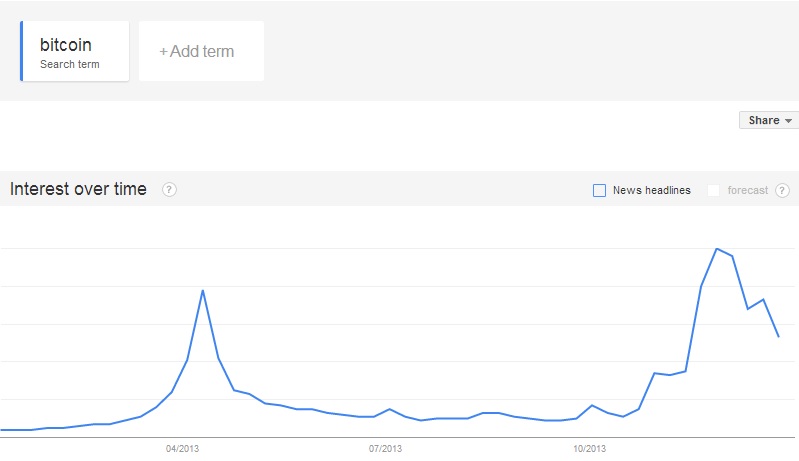
Google and Wikipedia: Bitcoin is one of the most researched words of 2013

(BitcoinExaminer) This last year was definitely a great one for Bitcoin and 2014 promises even more good news. In 2013, Bitcoin became one of the most researched words across the world in platforms like Google or Wikipedia and there’s already a study made by a well-known economist that shows how the
people’s curiosity exponentially grows when cryptocurency’s price goes up.

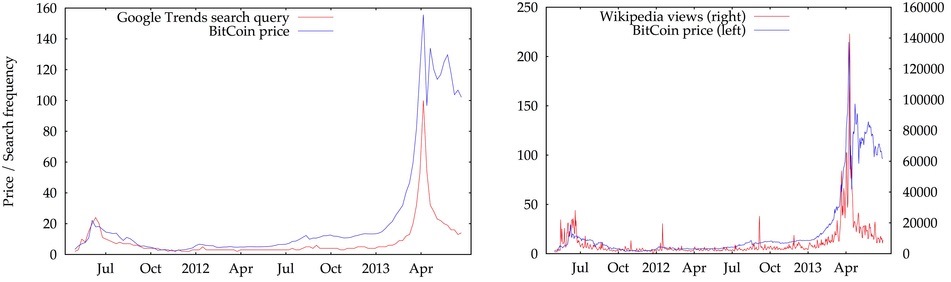
According to the economist Ladislav Krištoufek, from Charles University in Prague, understanding Bitcoin demand is an essential step to properly analyze the virtual currency. And an important part of demand (and its evolution) is the number of people interested in knowing more.
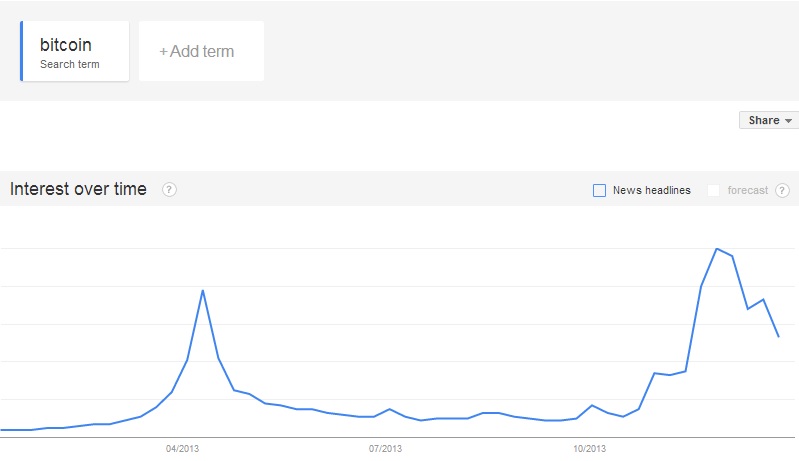
That is why Krištoufek, quoted by Forbes, used Google Trends and Wikipedia to determine how many times people searched for the term ‘Bitcoin’ during the past year. The biggest peak was achieved in November, when cryptocurrency climbed to its maximum price ever, around $1,200.
dfdfg
The second peak happened months before, between April 7 and 13, when the first big crash happened and Bitcoin’s price went from a bit over $200 to a value around $60. In his study “Bitcoin meets Google Trends and Wikipedia: Quantifying the relationship between phenomena of the Internet era”, Ladislav Krištoufek analyzes the research data according to the price of cryptocurrency. There’s obviously an influence in these peaks of interest.
2
The recently released Google Zeitgeist 2013 report confirms this trend: “What is Bitcoin” was considered the tenth most popular search in the United States, at least under the “What is …” category.
According to Digital Trends, the world’s most famous cryptocurrency made it to the top 10, ranking behind the winner “what is twerking” and other examples like “what is gluten” or “what is Snapchat”.

Open your free digital wallet here to store your cryptocurrencies in a safe place.

Satoshi
bitcoinbaubles 600x370

Five things to do with those Christmas Bitcoins

1. Store them securely

(CoinDesk) Which brings us to the first thing that you’re going to want to do with your
new bitcoins: keep them safe. If you’ve never received bitcoins before,
the chances are that you’ve been given them by someone who created a
bitcoin address for you, sent some coins to it, and then gave you the
address somehow. It may have come as a long number pasted into an email,
or potentially on a piece of paper.

How you store the bitcoins will depend on what you want to do with them. If you’re going to spend
them immediately, then you’ll want to put them into what’s called a ‘hot
wallet’. This is a wallet either on your smartphone, your desktop
computer, or a website, and it allows you to spend your coins straight
away.

But you may also be planning on keeping the bitcoins for longer. The currency’s price is pretty volatile, and some analysts think
that it will bounce far higher than it has already. If you want to keep
your bitcoins for a while, then consider putting them in cold storage.
This is a bitcoin wallet that doesn’t connect to the Internet. No one on
the Internet can steal it because it isn’t stored on your computer, or
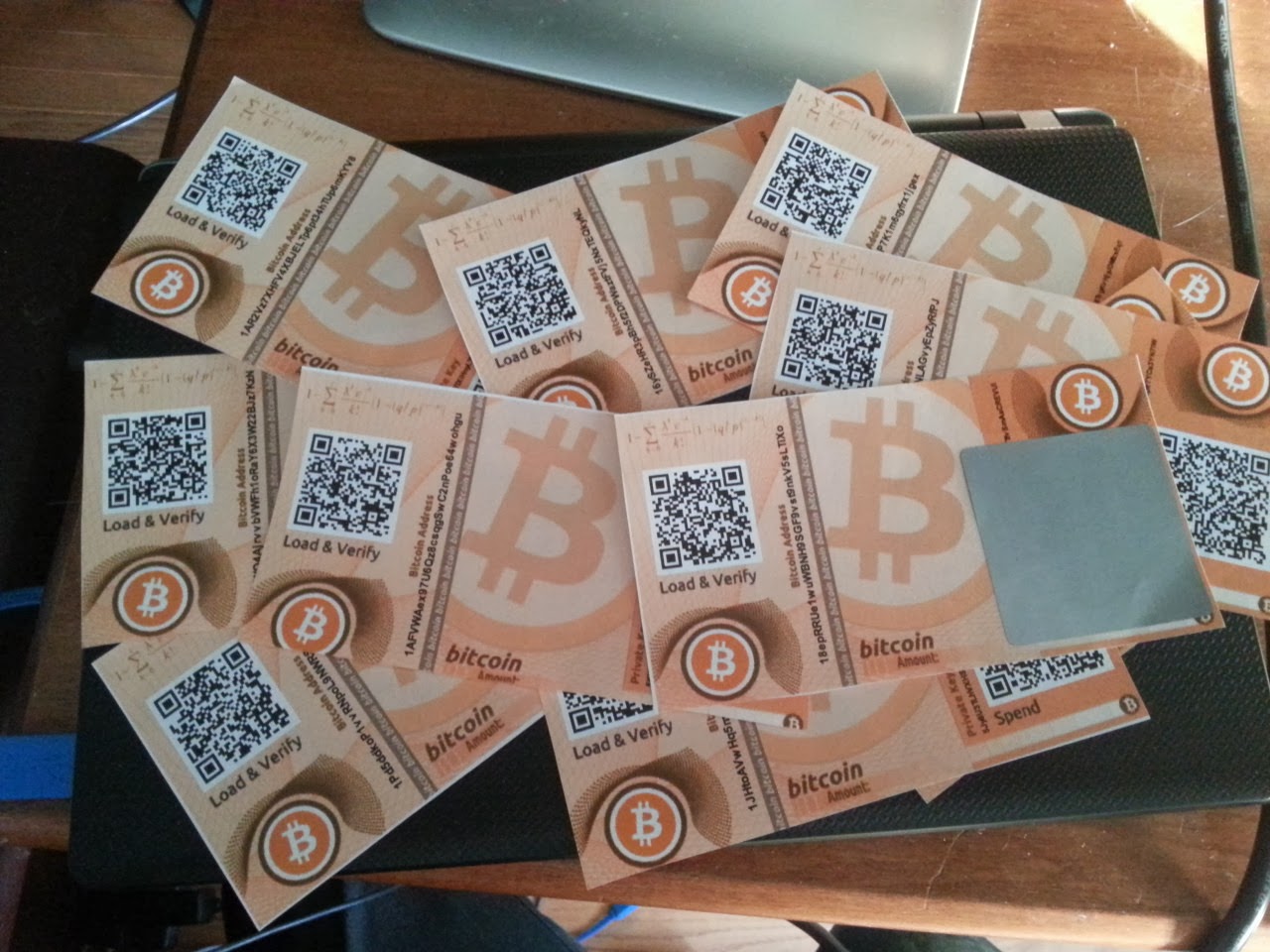
on a remote website. The easiest way to do this is with a paper wallet.
If the bitcoin address isn’t on a piece of paper, or the gift giver has
promised you some coins but hasn’t sent them yet, then you can create a
paper wallet at various websites. One site that you can use to produce
excellent paper wallets is Bitcoin Paper Wallet. Another example is BitAddress.org.
Sites like these will generate a bitcoin address for you. The address has two
components: a public key (which you show to everyone else when you want
to receive bitcoins to that address), and a private key (which you use
to send the coins). The bitcoin address will be printed out onto a paper
wallet for you to keep. Show the public key to the person sending the
bitcoins. They will scan the address and send the coins along using
their own wallet. It is important that you then keep that piece of paper
safe – because if you lose it or show it to someone malicious (like
Johnson did), then your bitcoins will be gone.
When you wish to spend these bitcoins, you can import your private key to a hot wallet of
your choice. There are many to choose from, each with their own
strengths and weaknesses. Some, like blockchain.info, store your bitcoin private keys both online, and on a mobile app. Others, like Kryptokit,
restrict storage to your desktop computer only. The wallet will have a
way for you to input or scan your paper wallet’s private key,
transferring it into hot storage so that it is ready to spend. At this
point, it effectively has an Internet-connected copy of that paper
wallet, meaning that the paper wallet can’t be considered as cold
storage anymore.
Check out our handy guide to bitcoin storage.

2. Give them away

So, now you’ve secured your coins. What next? In the spirit of Christmas,
we thought we list the most obvious option near the top: giving them
away. There are several organizations that take bitcoin donations listed
here, one of which is Connie Gallippi’s BitGive Foundation.
It is a respected organization, with members of the Bitcoin Foundation
on its board, which takes bitcoin donations to build up a charitable
investment fund. It makes financial contributions to charities that
focus on public health and the environment. Most recently, it raised
$4,850 for Save the Children.

3. Gamble them

Giving bitcoins to charity might be the right thing to do, but if there is a
devil sitting on your shoulder, he may advise you to gamble it away
instead. If you fancy a flutter and don’t fancy making the trip to
Vegas, then you can do it from the comfort of your armchair, in between
Turkey-induced catatonia and rounds of rum and eggnog.
There is no shortage of gambling-related sites. SatoshiDice
is perhaps one of the most famous. Akin to a large, Internet-based
penny slot machine, it works by publishing a variety of bitcoin
addresses. Players their bitcoins to one of them, and the site’s
computers evaluate them to see if you won or lost, sending back your
original bet multiplied by a prize multiplier if you are successful.
‘Dice’ sites like these allow you to verify the payout either by using the
bitcoin block chain, or by using pre-defined numbers which can help you
to check that your payout was fair. But for those wanting a more
conventional game, there are several bitcoin poker sites up and running,
including Satoshi Poker, and Bits Poker. Players do so at their own risk, however. Another poker site, Seals with Clubs, just lost 42,000 hashed passwords in a hacking attack.

4. Spend them

If you are just itching to spend your new virtual currency, there are many
places where you can buy goods and services online. We’re still not at
the point where you can hand them over the counter at your local boxing
day sale, but you can spend them online, and at selected physical
merchants. There is a big list of individual merchants organized by
category here, but you can also find bitcoin-based vendors on some online marketplace sites like Etsy.
Bitdazzle is an online marketplace for vendors of all kinds that accept bitcoin,
which will enable you to magically turn your satoshis into that bar of
lavender and oatmeal goat milk soap you always wanted.
Alternatively, use a service that will enable you to purchase pretty much anything with bitcoins. All4BTC will
take your bitcoins and use them to pay pretty much any e-commerce
vendor on your behalf. Or, you can buy a gift card from over 200 popular
high street retailers, by sending your newly-gifted coins to Gyft.
For more details on your spending options, check out our in-depth guide here.

5. Sell them

Still have no idea what to do with those precious coins? Then flog them. If
there is a bitcoin ATM near you, you may be able to sell them there. You
can sometimes find bitcoin-related Meetup groups in your area, where people will lurk looking for bitcoins to buy, or items to sell in exchange for them.
You can also take advantage of direct person-to-person sales via sites such as LocalBitcoins.com,
where you can find people to trade with online, or in person (be
sensible and safe when doing the latter). Or, if you’re in the mood to
organize a whole bunch of paperwork over the holiday, you can register
yourself on one of the many bitcoin exchanges (there will probably be a
local one for your country) and then deposit your bitcoins there. This
will enable you to sell the bitcoins to a buyer offering a given asking
price.

Whatever you decide to do with your new bitcoins, call the person that gave them
to you, and give them a happy New Year’s greeting from us at CoinDesk.
We like people that think outside the box. And aren’t bitcoins a much
more interesting present than a pair of socks?

Open your free digital wallet here to store your cryptocurrencies in a safe place.

Satoshi

How to create a Bitcoin Paper Wallet


What you need?

  • Computer
  • Printer
  • DVD with latest version of Ubuntu
  • USB Pen Drive
  • Papers
  • Smartphone
  1. Download .zip of bitaddress: https://github.com/pointbiz/bitaddress.org and move it in your USB pen drive.
  2. Download Ubuntu at http://www.ubuntu-it.org/download and burn it on dvd
  3. Boot your computer with Ubuntu’s dvd and choose to run “Live”, without installing.  Now that Ubuntu is ready to use, disable internet connection.
  4. Insert your USB pen drive. Open the file bitcoinaddress.org.html and click on Paper Wallet tab. Remove your USB pen drive.
  5. Connect your printer.
  6. Go back to bitaddress and generate the address.
    – Addresses per page: 1
    – Print!
    – Turn off your computer and printer.
  7. On your smartphone you need a QRcode scanner.
  8. Scan your Bitcoin Address (or public key).
  9. Send the public key to your email.
  10. Boot your computer without Ubuntu’s dvd inside. Check your email and double-check if the Bitcoin Address is correct. To finish copy-paste the address and in your wallet and send the desired amount to the paper wallet!

Open your free digital wallet here to store your cryptocurrencies in a safe place.

Satoshi
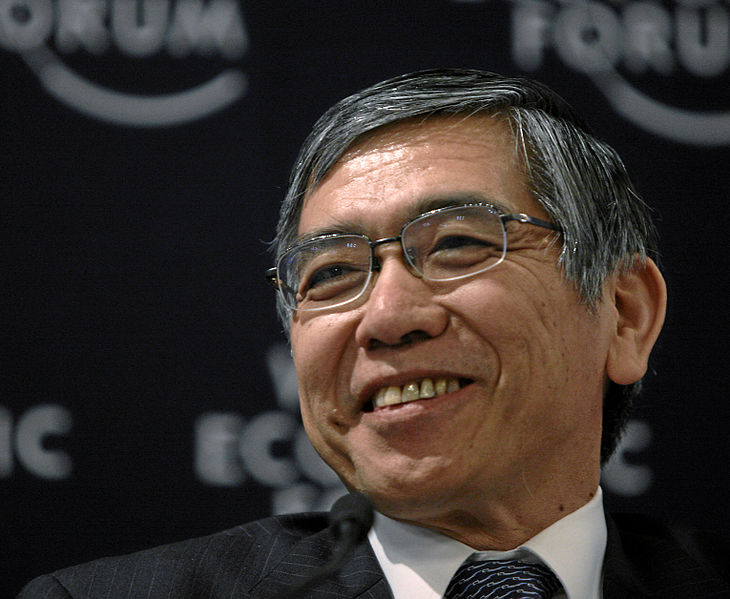
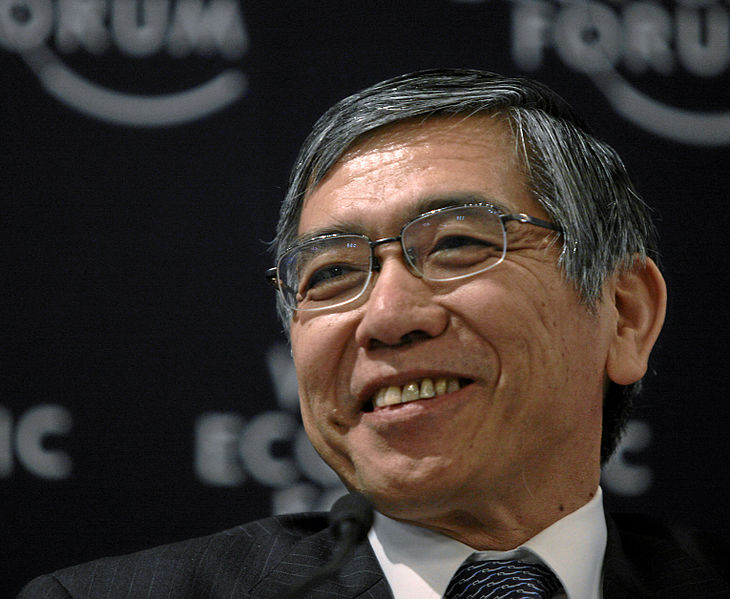
730px Haruhiko Kuroda   World Economic Forum Annual Meeting Davos 2010

Governor says Bank of Japan is “very interested” in cryptocurrency

Haruhiko Kuroda Davos 2010(BitcoinExaminer) The governor of the Bank of Japan recently said that the institution is “very interested” in Bitcoin. Haruhiko Kuroda talked about cryptocurrency during a news conference, according to the site Jiji Press.

Compared to traditional ways of money transfer and existing electronic money, Bitcoin has both similar and different aspects”, Kuroda said about the digital coin that is currently being studied by the central bank’s Institute of Monetary and Economic Studies.
The interest might be there, but Kuroda – ranked by Forbes as the 39th most powerful person in the world -, also said the Bank of Japan doesn’t plan to take any action regarding Bitcoin in a near future.Despite the fact that the Bank of Japan is known as a conservative institution, Haruhiko Kuroda is known for supporting a looser monetary policy in the country. Back in February, the former president of the Asian Development Bank, said that “there is plenty of room for monetary easing” in Japan.

Open your free digital wallet here to store your cryptocurrencies in a safe place.

Satoshi
US Senate hearing bitcoin testimony 600x370

A deep dive into the regulatory requirements for Bitcoin companies

(OnBitcoin) Marco Santori is a senior associate at New York-based Nesenoff & Miltenberg, LLP,
and very familiar with the nuances of Bitcoin regulation. In a
presentation at the Inside Bitcoins conference in Las Vegas, Mr. Santori
provided a thorough overview of money transmission regulation on the
federal and state levels.

Money services businesses (MSBs) are regulated by FinCEN, whose goal is to prevent money laundering.

MSBs are required to register with FinCEN on a federal level. While
it’s a free, online process to register, there are an assortment of
requirements, such as:

  • Collect, verify, record report customer information
  • Check identities against watch lists (terrorists, criminal, enemies of the state)
  • Deny service for some customers
  • Sometimes secretly report transaction activitiy to fincen and continue servicing the customer
  • Undergo yearly audits

Bitcoins Political Donations

In March 2013 FinCEN published regulatory guidance surrounding
Bitcoin. While this guidance left some confused, the overall takeaway
was that Bitcoin is not inherently illegal and Bitcoin companies are
fine to operate as long as they comply with applicable laws.

Santori provided examples of businesses that would be under the veil of regulation:

  • Hosted wallets that permit exporting private keys
  • Paper wallets
  • Exchange digital currency for government currency
  • Exchange one digital currency for another
  • Mine digital currency and convert to government currency
  • Accept value from person A and give to person B
  • Accept value from person A and give to person A at another time or place

While it’s easy to register on the federal level, it’s another story
on the state level. There are 48 states that provide licenses for money
transmission. The states regulate money transmitters separately from the
federal government. So, for a company to operate in the United States,
they need to separately attain 48 licenses, which is a timely and costly
endeavor.

While it’s more complex to apply for licenses in 48 states, the scope
of regulation appears to be slightly less cumbersome. The states have
not adopted all of FinCEN’s categories of money transmitter.
Specifically, only these two categories are relevant:

  • Accept value from person A and give to person B
  • Accept value from person A and give to person A at another time or place

Given the ambiguity and cost of regulation, what should a startup do?

Circle Internet Financial, a company formed by serial entrepreneur
Jeremy Allaire, publicly stated that they will be seeking licenses in
all states and raised $9 million in venture capital to fund that
initiative.

However, there are a plethora of startups that don’t have the funds
or capabilities to attain licenses. Here are some other options.

First, a company could send a “no action” or “request for ruling”
letter, which explains the nature of the business and why it should not
require a license. Drafting this letter can be costly due to legal fees
but can also result in certainty if authorities respond.

There are also avoidance strategies. You can incorporate overseas and
geofilter IP addresses to block US customers. By documenting this
process and having appropriate policies in place, a company can protect
themselves from regulatory backlash if some US customers get through.
For example, a company should check if the customer registers a US bank
account, makes transfers to US accounts or subsequently accesses the
company’s service from US IP addresses.

Santori said that most companies restructure their companies to
either fit into an exception in the regulation. Exceptions include:

  • Providing network services to a money transmitter
  • White label exchange
  • Physically transporting value that substitutes for currency
  • Operating a settlement business between MSBs
  • Performing payment processing services

If a company wants to get a state license, how long does it take to
get approved? For a regular business, just a few weeks. But for a
Bitcoin business, it’s not clear.

Open your free digital wallet here to store your cryptocurrencies in a safe place.

Satoshi