Category Archive: bitcoin

What is Bitcoin and how can it change the world?

(Virgin) When you type a website
address into a browser you might have noticed that the letters ‘http’ appear at
the front. ‘Http’ stands for Hypertext Transfer Protocol. In typing a web
address you are actually sending an HTTP command to transmit that website to
you. Hypertext Transfer Protocol is the means by which information is shared
across the Web.
Similarly, when setting up
an email account, you might have noticed the letters ‘smtp’ – for example,
‘smtp.gmail.com.’ SMTP stands for Simple Mail Transfer Protocol. SMTP is the protocol
by which we send emails to each other.
A protocol is the means by
which information is shared across a network. Bitcoin – with a capital ‘B’
– is another protocol. The function of the protocol is to send and receive
payment. The unit of money on the protocol is the ‘bitcoin’ – with a small
‘b’.
You earn a bitcoin by
doing or selling something in exchange for bitcoins – just as you would earn
normal money. If I do this job for you, you pay me in bitcoins. You buy
bitcoins just as you would buy and sell foreign currency. You pay some money to
someone, usually at a Bitcoin exchange, for which you receive some
bitcoins. And you can make your own bitcoins by mining them – more on that
another day.
Image from gettyimages
You keep your bitcoins in
a wallet. There are hundreds of places to get a wallet, just as there are
hundreds of places to get an email account (blockchain.info is as good a place
to start as anywhere). Often people will have more than one wallet – one on
their computer, another with a Bitcoin service provider.
So how can Bitcoin change
the world?
The reason the Bitcoin
technology is potentially so disruptive and transformative is that it’s a new,
efficient form of money. And money, which has been, inexplicably, ignored by
mainstream economists for so long, is, of course, at the heart of almost
everything we do. Bitcoin could change the way the way we make and receive
payment, it could change the way we store money; it even has the potential to
change the actual money we use.
Think about the
possibilities of that for a second. We no longer need banks to store our
money – we store it on our computer with a Bitcoin service provider. We no
longer need banking networks to send or receive money – we just send money as
we would send an email. We no longer need governments to issue our money.
Forget pounds and dollars, we’ll use bitcoins instead. The social implications
of governments and banks losing control of money are considerable. This is
all very well in theory. What will make Bitcoin irresistible in practice is its
sheer efficiency.
Goldman Sachs IT analyst,
Roman Leal, has calculated the savings that Bitcoin could have made in
electronic payment in 2013, if Bitcoin had been used. Let’s start with simple
money transfer – sending money from one person to another.
Consumers currently pay a
fee of about 10% of the total amount transferred if they use a traditional
money transfer network such as Western Union. This fee covers agents’
commissions, forex and access to the network. With Bitcoin, that fee would be
zero – or 1% if you use a Bitcoin service provider. There
were $550 billion of remittances in 2013 generating $49 billion of transaction
fees. With Bitcoin those fees fall by 90% to just $5.5 billion. That would
mean an extra $43 billion actually makes it into people’s pockets.
Image from gettyimages
As for electronic payments
in retail, currently retailers pay from about 2.5% to 3% in fees. In 2013,
global transaction fees were $260 billion on over $10 trillion of sales. Had
Bitcoin been used (again using a 1% estimated figure) the number would be $104
billion – a saving of almost $150 billion.
Leal notes that all
‘merchants would realize sizable savings’ by using Bitcoin, but small merchants
will benefit most. They ‘can reduce their payment processing fees by at least
half’. For a business that runs on low margin that is a compelling
number. These kinds of savings are irresistible.

Then there are those who
are currently shut out of the current financial system. 53% of the world’s
population is still ‘unbanked’ – they have no use of formal or semi-formal
financial services. Most of them will have a mobile phone before they have a
bank account. With Bitcoin – and other forms of digital payment – these people suddenly
have means to make and receive payment over distance. How much untapped
potential is there waiting to be freed when the unbanked start to get access to
basic financial services?
We’re not there yet
The core protocol of
Bitcoin is sound. In fact, it has unprecedented reliability and security. The
edges, however, are vulnerable. Third parties, such as Mt. Gox, have not
figured out how to act like proper financial institutions. Certain operating
systems using the protocol are insecure, rendering bitcoins vulnerable to
theft. There are also issues with programmers who have failed to understand how
the blockchain – the Bitcoin central database – works.
But these are all issues
that will be dealt with as the technology develops. The point is the core
protocol is sound. It – or some replication of it – could send banks to the
same forgotten part of town that the Internet has sent newspapers, as well as
freeing up the possibility for many millions of people to better their lot
through trade and exchange.

Open your free digital wallet here to store your cryptocurrencies in a safe place.

Satoshi
bitcoin_in_2016

Bitcoin’s promise goes far beyond payments

(HarvardBusinessReview) Digital currencies like Bitcoin have captured the attention of
the media, entrepreneurs, and regulators. The coverage has described
exchange meltdowns, price volatility, and government crackdowns.
However, the focus on Bitcoin as a currency may distract businesses and
governments from its disruptive impact: as a technology.
Bitcoin is more than just a new way to make purchases. It is a
protocol for exchanging value over the internet without an intermediary.
Bitcoin is based on a public ledger system, known as the blockchain,
which uses cryptography to validate transactions. Bitcoin users gain
access to their balance through a password known as a private key. As a
result, Bitcoin is peer-to-peer and open, yet secure and nearly
frictionless. Much has been written about the payment applications of
Bitcoin, including remittances, micropayments, and donations.
However, Bitcoin could disrupt other systems that rely on
intermediaries with a similarly open, peer-to-peer system, including
property, contracts, and identity management.
Anywhere a transaction between two parties has traditionally required
third party validation, Bitcoin may be applicable. Consider these three
common actions:

Transfer of property. The Bitcoin protocol could
simplify complex asset transfers, revolutionizing the services that
support this industry. Currently, the transfer of large assets requires
significant time and resources. For example, in order to purchase a car
from an individual seller, one has to engage a third party to transfer
the title. Additionally, one has to use services like Carfax to learn
about the car’s accident and inspection history. And who doesn’t like to
spend a Saturday at the DMV updating a car registration?
The blockchain could change all of this. Bitcoins can be qualified in
such a way that they represent real-world assets. Bitcoin entrepreneurs
at companies like Colored Coin
are already working on ways to use small portions of Bitcoin to denote
physical property. A fraction of a Bitcoin would publicly identify who
currently owns that property, and could include a record of both past
ownership and other history about the property. When purchasing the car,
one would be able to verify all accidents and inspections over the
blockchain and transfer the title on site. Similarly, real estate and
financial instrument transactions could all be executed over Bitcoin.
This could soon create efficiencies and reduce friction by allowing
individuals to directly transfer property without the use of a broker,
lawyer, or notary to sign-off on the transfer.

Execution of contracts. Bitcoin could similarly be
used to structure contracts, bringing new efficiency and transparency.
Contracts are typically developed by lawyers on a case-by-case basis
with significant time and resources devoted to negotiation, development,
and enforcement. Additionally, markets based on contracts, including
certain financial derivatives markets, lack transparency, which
complicates regulation.
Traditional contracts could be replaced by code, executing themselves
when a triggering event occurs. In a simple example, a financial
instrument, like an option, could be developed and executed over the
blockchain. In addition to reducing legal fees, this could bring new
transparency to financial markets, as regulators could use the public
ledger to understand the market without forcing individual actors to
reveal their specific positions. It is possible that new
crypto-currencies will emerge to serve these niche purposes.
New ventures, like Ethereum, are creating these capabilities today. Ethereum is developing a network to serve as both the registry and escrow to execute the conditions of a contract automatically through checkable rules.

Identity management. Bitcoin’s cryptography could also transform identity management. Much of identity management, including passports, still operates on a paper-based system.
These documents are frequently forged and stolen. Interpol’s database
currently lists 39 million stolen travel documents. Instead of carrying
paper documents, what if there was a way to create a unique, verifiable
key that was impossible to forge?
A cryptographic network similar to but separate from Bitcoin could be
used to verify individuals’ identities and monitor movement across
borders. When a person travels through a checkpoint at a border
crossing, instead of showing and scanning a paper passport, she could
present her private Bitcoin key. A network privately maintained by the
government could verify the key and register the entry into the ledger.
This system, based on cryptography instead of paper documents, would
simultaneously increase mobility and security. If Bitcoin can be used
for travel documents, it could also be used for other forms of identity
management like social security numbers, tax identification numbers, or
even driver’s licenses.
Property, contracts, and identity management are only a few examples
of how a peer-to-peer, open, and frictionless system could change how we
conduct business in the future. In order to achieve this wider
adoption, Bitcoin will need to address significant questions around
trust, ease of use, and operability. However, the Bitcoin community has
shown remarkable adaptability and is already working to mitigate these
problems. In the next decade, we can expect significant innovation
around the Bitcoin network. Much of that will revolve around payments,
particularly early on. The real value, though, lies beyond.

Open your free digital wallet here to store your cryptocurrencies in a safe place.

Satoshi
BobbyLee brockPierce

Bobby Lee, Brock Pierce Join Bitcoin Foundation’s Board of Directors

(CoinDesk) Bobby Lee and Brock Pierce have joined the Bitcoin Foundation’s board
of directors, after coming top in a second round of votes cast by the
organisation’s industry members.
The run-off election featured three candidates, including BTC China CEO Bobby Lee, venture capitalist Brock Pierce and CEO of mobile gift card provider Gyft, Vinny Lingham.
The results were particularly close, with Lee receiving 79% approval
and Pierce scoring 65% – just 2% above Lingham, who received 63%.
With the announcement, Lee and Pierce join a board that includes executive director Jon Matonis, bitcoin chief scientist Gavin Andresen, Bitcoin Magazine’s Elizabeth Ploshay and Ribbit Capital’s Micky Malka, alongside founder and chairman Peter Vessenes.
This news follows the 1st May results of an initial round of voting, which ended with none of the original 15 candidates reaching the necessary vote threshold to win a seat.
These industry seats have been vacant since the resignation of two founding members – former BitInstant CEO Charlie Shrem and Mt. Gox CEO Mark Karpeles – earlier this year.

Open your free digital wallet here to store your cryptocurrencies in a safe place.

Satoshi
michael novograts 2

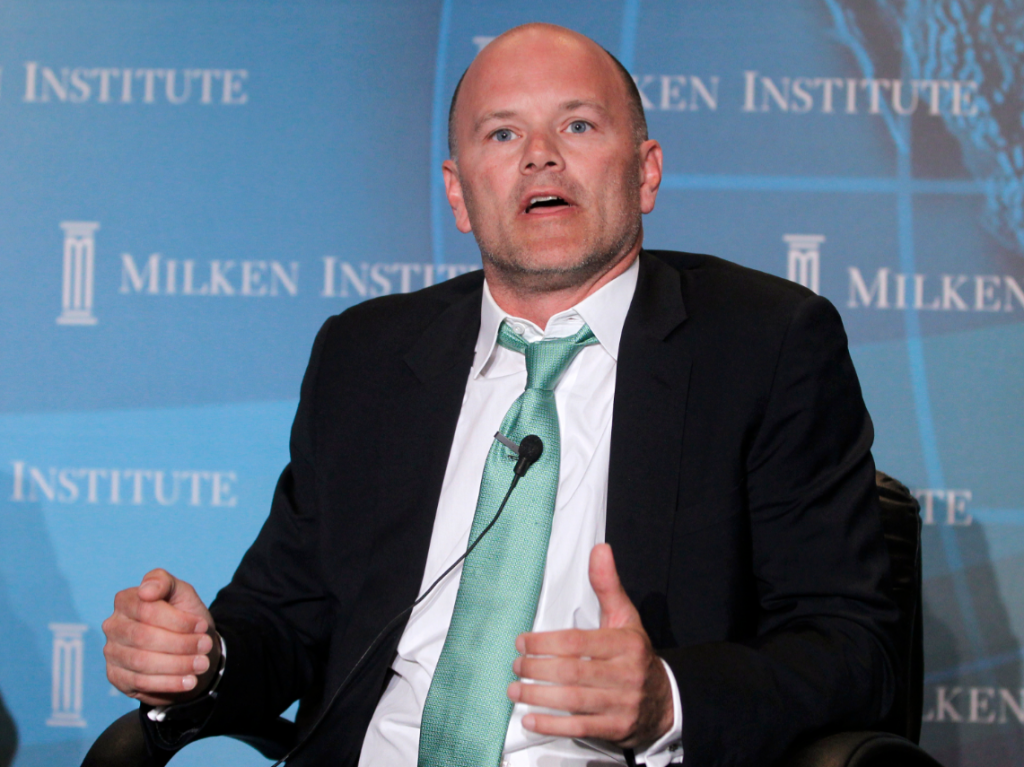
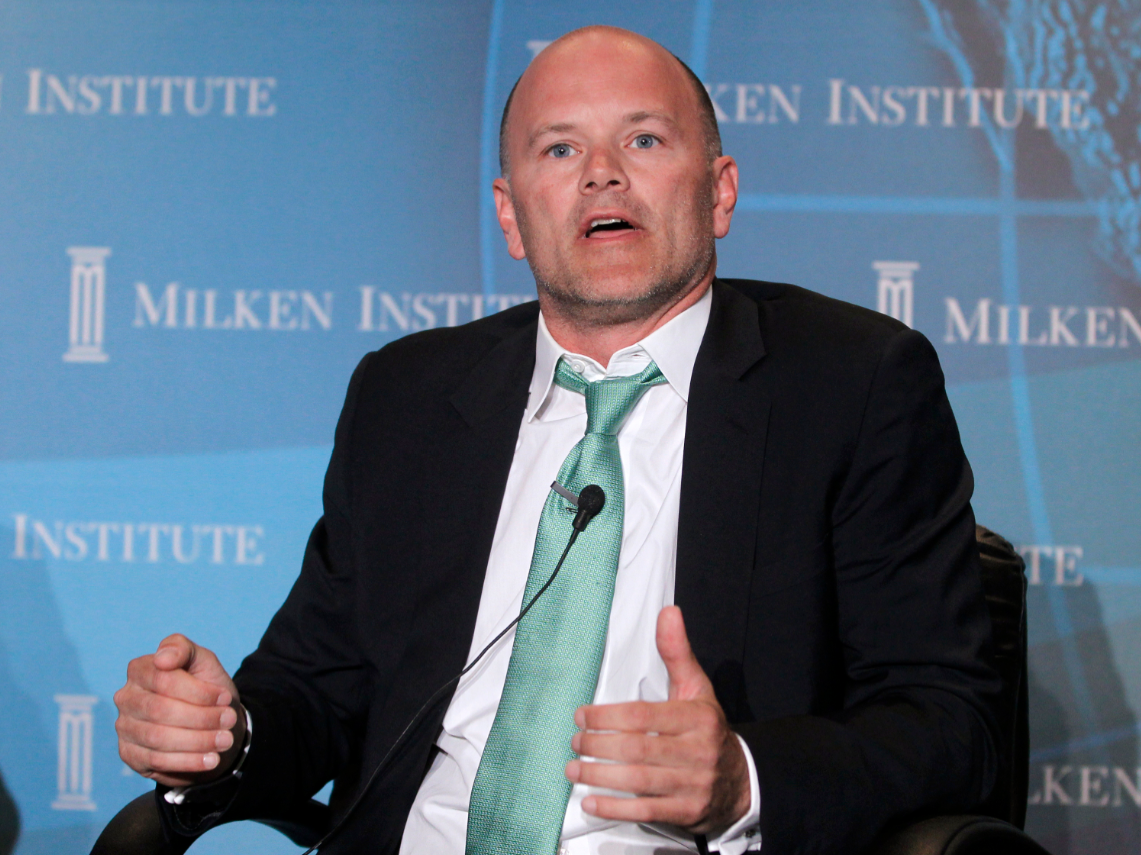
Investor Mike Novogratz has a very simple argument for why he’s bullish on Bitcoin

(BusinessInsider) Former Goldman Sachs partner and current Fortress Investment Group CIO
Michael Novogratz says the smartest guys in the room have all turned
their attention to Bitcoin.
In an interview Monday with Bloomberg Television’s Stephanie Ruhle at
the 2014 Sohn investing conference, Novogratz explained how Bitcoin has
grown to capture the imaginations of programmers from its libertarian
roots:

There are in best estimates somewhere
30,000 individual programmers working on Bitcoin. My college roommate
lives down in Barbados. He was the smartest guy that we went to school
with [Novogratz graduated from Princeton — ed.]. He full time works on
derivatives of Bitcoin. So there’s this open source community where
there’s huge brain power, let alone all the VC money that’s going in.
And so from Marc Andreessen and his company to Benchmark… there’s lots
of smart money going in. I’ve never seen a small project with more human
capital going into it, and so I kind of want to bet just on that
alone.”

Ruhle pressed him on whether Bitcoin could simply flame out.
Novogratz responded by saying it would lead to the “democratization of
finance.”

I think you’re going to see things like
peer-to-peer lending. The banks are – their biggest I think threat is
the same thing that’s happened in so many other industries now happening
to the finance industry, right? The Internet disintermediates large
players and I think Bitcoin is just one of the threats that the finance
industry the way we know it has coming against it.

Fortress is sitting on $13 million-worth of bitcoins. In February, the firm became the first publicly-traded company to file Bitcoin holdings (they were listed as losses).

Open your free digital wallet here to store your cryptocurrencies in a safe place.

Satoshi

What is a Bitcoin address and how do you sign it?

(BitcoinMagazineShort Answer: A Bitcoin address is a unique number that “holds” bitcoin currency. You use the address to receive and send bitcoins.
 
Medium Sized Answer: A Bitcoin address is the publickey half of the public-private key pair that enables the validation of ownership of that address. WHOAH there, what in tarnation does that mean??
Bitcoin addresses are created as part of a key generation process that creates a pair of keys. They are a matched set, where one is public and the other is private. When you “sign” a bitcoin address you are running the public and private keys through an algorithm that checks to see that those keys belong together. Usually signing is talked about in the context of a message. Someone sends you a signed message and you can verify that the message came from the genuine person. You can verify the
message because it was signed with their private key and you match it to their public key. When sending bitcoins the signed message is a portion of the bitcoin transaction and you do not explicitly see the message, it is just part of the transaction. This lets you validate the ownership of the address. The transaction (the transfer of value) was signed with the owner’s private key and you check that it’s valid using their public key.
A little diversion – public key cryptography is a really cool technology developed in the mid 1970′s. The amazing thing about
public-private key pairs is that everyone can know the public key and the owner of the private key can prove that he is the owner of the message sent with the associated public key. For more information on PKI (Public Key Infrastructure) upon which much of bitcoin’s security is based see Mike Hearn’s (a core bitcoin developer) great description of many issues in “Why you think the PKI sucks…but can’t do any better“.


A Longer Story: Let look at the sequence of actions to create and then use the key pairs. First we need to generate the key pair, which will result in two keys the public and private keys. The Bitcoin address is actually a form of the public key (it’s a hash of the public key).
From the Bitcoin protocol specification at: https://en.bitcoin.it/wiki/Protocol_specification#Signatures
A bitcoin address is in fact the hash of a ECDSA public key. Since anyone can know the public key and really the Bitcoin address is the public key, it’s perfectly OK to give out the Bitcoin address.
So now we have a Bitcoin address, what’s next?
Let’s say that I want to get paid for something, say writing this article! I can advertise a Bitcoin address, and since you are all so
thrilled to read this, you have an overwhelming urge to send me some coins. You would open up your Bitcoin wallet, enter my address as the address to send bitcoins to; click send; and I would happily receive some bitcoins.
Recall that I and only I have the private key matching the public key (address) which enables me to be the only person that could spend the bitcoins I just received.
If you wanted to double check that I was actually the owner of the address before you sent me coins you could ask that I send a signed message associated with address proving it’s mine. I could create a message and sign the address. You would then take the message I sent, and put it into your wallet along with my address to prove that I am the “owner” of the address. Bitcoin wallets usually contain this message signing and verification functionality.
An address is used to “hold” bitcoins, however the concept of an address holding bitcoins or that you are the “owner” of a Bitcoin address is a misnomer. Recall that the address is one half of a public-private keypair. The reason you “own” an address and have control over the coins associated with that address is simply that you also know the other half of the public-private key pair, the private key. If someone else learns the private key to an address then that person has just as much control and “ownership” over the address, as you. In other words that person can spend your bitcoins. The solution is quite simple, make sure you and only you control the public keys to your bitcoin addresses. From a practical point of view this means that you create a good, not easy to guess, Bitcoin wallet password, and/or keep it in a safe place. Some excellent security practices are outlined at the Bitcoin Foundation’s site at: https://bitcoin.org/en/secure-your-wallet.
Since Bitcoin addresses are one of the cornerstones to using Bitcoin, it is instructive to play around with addresses to get a better understanding of just what exactly a Bitcoin address is all about. A particularly good website to play around with is bitaddress.org. After generating a new Bitcoin address play around with the various options and observe the public and private keys it generates. Just don’t go putting real bitcoins into an address while also displaying the private key. Keep the private key private!

Open your free digital wallet here to store your cryptocurrencies in a safe place.

Satoshi

The roads to innovation in cryptocurrencies

Research

(BITSLOG) Once upon a time there was Bitcoin
and nothing else. History was being written by Satoshi and a few
illuminated minds that posted the most interesting ideas in the
Bitcointalk forums and IRC channels. Almost every cryptocurrency idea
I’ve heard of had a seed in some of these heated online discussions.
During 2009 improving every part of Bitcoin seemed to at the reach of
the hand: changing the scripting system, the proof-of-work function, the
block format and more. Then the conservative era begun: Bitcoin value
had risen considerably and much more money was at stake. So there was no
room for destabilizing changes anymore. During 2010 ideas were still
discussed, but not implemented. But as powerful ideas cannot be
contained so during 2011 alt-coins came into existence. Apart from Namecoin,
which was something different than a mere cryptocurrency, the first
alt-coin code changes were all minor; only the economic constants, such
as the money supply, were changed (Devcoin, lxcoin, l0coin). Multicoin
allowed simultaneous management of multiple block-chains, mainly to
experiment with different economic constants. Soon other more extensive
changes appeared, such as using another proof-of-work function (Tenebrix, FairBrix, Litecoin).
All these projects changed no more than a hundred lines of the parent
Bitcoin fork. During 2012 cryptocurrencies started making deeper changes
in the code, using proof-of-stake instead of proof-of-work (PPCoin, NovaCoin, PeerCoin).
But still no cryptocurrency took more than a month of work to be
programmed, since there was no business model that could pay for the
development of entire new codebases.   Pre-mining was seen as a scam
rather than an investment in the development team, since no profound
innovation had been achieved and no codebase had been started from
scratch.
The first non-Bitcoin based currencies were created during 2013 (Ripple, Nxt, MasterCoin, Counterparty). Three promising new cryptocurrencies will be launched during 2014:  NimbleCoin, BitSharses and Ethereum.
With the exception of NimbleCoin, all non-Bitcoin based currencies
adopted either an IPO business model or the pre-mine business model to
pay the founders and support the development after launch. NimbleCoin
seems to be the only one that still tries to bootstrap based on an
equal opportunity for all members of the community. Some of these
currencies (often called “2.0″) add new features not related to
payments: Smart contracts, betting, prediction markets, shares,
distributed exchanges, user defined assets, contracts for difference,
dividends, Decentralized Autonomous Organizations (DAOs), distributed
storage and gaming. Innovation seems to have been primary directed to
provide a more extensible cryptocurrency and more features. Nevertheless
this may not be what users require today. To be accepted world-wide,
users will demand cryptocurrencies to satisfy their everyday needs in
term of usability. They will demand the cryptocurrency to allow them buy
some croissants in the local shop with a standard smartphone in a few
seconds so they can keep walking without even worrying about transaction
confirmation time. Also, considering the deflationary properties of
Bitcoin, and the expected rise in fees, users will soon demand lower
transaction fees, which is also strongly tied to better scalability and
lower mining energy waste. Energy efficiency will also be demanded for
ecological reasons. More experience users will demand higher transaction
privacy and more politicized users will demand higher decentralization.
As I see the ecosystem right now, these are the main improvements users
will demand, more than any new embedded financial instrument. Here is
my wish list in order of importance:

  1. More merchants accepting the coins (specially retail stores)
  2. Lower price volatility
  3. Faster payment confirmations
  4. Lower fees (more transactions per second)
  5. Less energy waste in mining
  6. More decentralized
  7. More private
  8. More features
  9. More extensible

It’s interesting that the two last innovation areas, which in my
opinion are the less solicited by the general public, are the ones where
most money and time has been invested. This may be because they are the
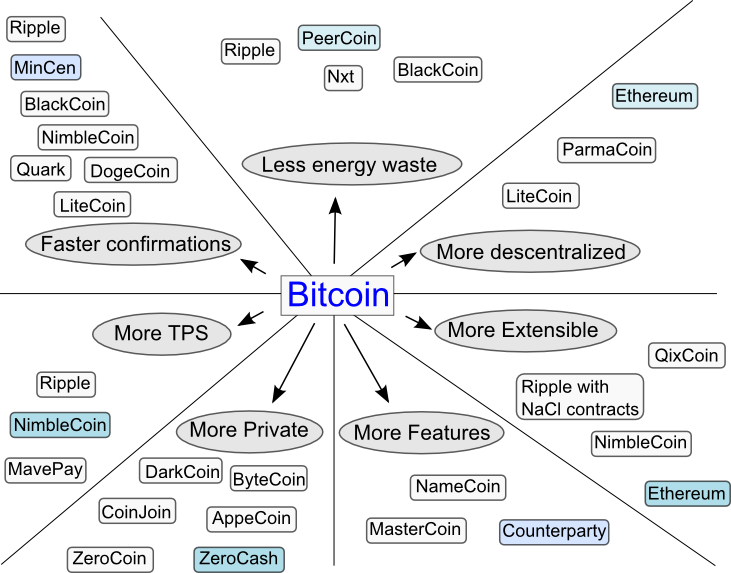
most “geeky” and futuristic use cases. To summarize I present diagram
with the current roads to innovation in cryptocurrencies. Bitcoin it is a
very well-balanced and conservative design and it’s plotted right in
the middle. I tried to plot how the current and past cryptocurrencies
have positioned themselves in the innovation landscape. In each category
I have chosen the most innovative ones and highlighted the best
cryptocurrency (IMHO). Note that Ripple is not part of the comparison
because it still relies on private servers and so it has an unfair
advantage. If it were truly open and yet secure, it will probably win in
most categories. Also note that faster payments confirmations is not
equal to lower block intervals: certain coins with low block intervals
have greater confirmation times because of stale block rate and frequent
chain undoes (such as Quark). When comparing new features, I’m
comparing cryptocurrencies with the features built-in and supported by
the core development team. Ethereum can emulate practically every
feature, but special scripts must be developed and maintained for each
feature added, so it wasn’t chosen in that category. There is another
category I haven’t included because it has too few members, which is
“More Security”. It comprises mainly the GHOST protocol.

Open your free digital wallet here to store your cryptocurrencies in a safe place.

Satoshi
alarm clock time 600x370

Is it too late to get Involved in Bitcoin?

(CoinDesk) So, you’ve only just learned about bitcoin, you’ve seen that people have become millionaires through investing in it. Your question is: “Can I still do the same, or has the bitcoin boat sailed?” Unfortunately there’s no simple answer to this. Can you still make millions from bitcoin? Possibly. Has the bitcoin boat sailed? Certainly not. Bitcoin,
and digital currency as a concept, is still very young. Created just five years ago, it’s still trying to find its feet and its price is suffering rather wild volatility. On top of this, recent company failures have left a lot of bitcoiners out of pocket. That said, there are plenty of people who have made a lot of money from
bitcoin, having invested in the early days and watched the price rocket since then. Those who invested two years ago, when the price was $5 a pop, have seen their investment increase a sickening 9,560% to $483 per bitcoin (at the time of writing). In order to enjoy the same percentage return over the next two years, the price of bitcoin would
have to increase from $483 to around $46,500. Sounds ridiculous, right? Actually, some people don’t think it’s that far fetched at all.

Bullish bitcoiners

A number of extremely bullish bitcoin price predictions have been voiced over the past year by some pretty notable commentators.
Ex-Facebook executive Chamath Palihapitiya kicked things off in May last year, writing in a piece for Bloomberg stating that each bitcoin could go on to be worth more than $400,000, provided it establishes itself as a “useful reserve currency”.
The Winklevoss twins (of the Facebook lawsuit fame) said in November that they believe the price could go on to increase 100-fold, with the market cap reaching $400bn (the market cap is currently $5.8bn).
A few weeks later, a report from Wall Street analysts Gil Luria and Aaron Turner predicted that the price of one bitcoin could increase to almost $100,000.

Titled ‘Bitcoin: Intrinsic Value as Conduit for Disruptive Payment Network Technology’, the report predicted the price of bitcoin could increase to 10-100 times its value at the time, which was around $1,000.

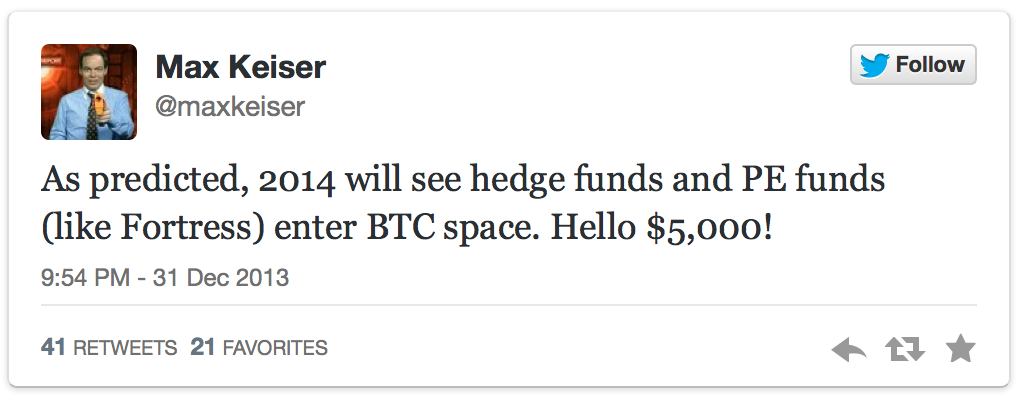
Political and financial pundit Max Keiser has been championing bitcoin for years, but in December he suggested it wouldn’t be long before the price hit $5,000.

CoinDesk polled its readers in January and found 56% of the respondents believed the price of bitcoin will reach a whopping $10,000 this year. Of the ‘young people’ quizzed for a separate survey by Wired, 42% said they believe bitcoin is a lasting currency and 30% consider investing in or mining bitcoins as safer than the more traditional stock market.

While it seems there are plenty of people flying the flag for bitcoin, it’s worth noting there is an endless supply of pessimists who think digital currency will crash and burn in the not-so-distant future.

Bearish naysayers

Warren Buffett recently nailed his colours to the mast, telling CNBC in no uncertain terms that he thinks bitcoin is an utter waste of time. “Stay away from it. It’s a mirage, basically,” the billionaire investor said, adding that “the idea that it has some huge intrinsic value is just a joke”.

American economist Paul Krugman voiced similar views in an opinion piece he wrote for the New York Times back in December called ‘Bitcoin is Evil’.
He said he was “deeply unconvinced” that bitcoin could actually work as a form of currency and he doesn’t think it works as a “store of value”. Sir Bob Geldof followed suit shortly after, damning bitcoin by saying digital currency “simply won’t work”. However, Max Keiser told the world not to pay any attention to the singer’s protestations, claiming that asking his opinion on bitcoin is a “worthless exercise”, akin to “asking a blind man his opinion on a Turner”. American economist Nouriel Roubini, who anticipated the collapse of the US housing market and the worldwide recession that started in 2008, is also not bitcoin believer. He has taken to his Twitter feed to label it an “irrational useless bubble fad”, a “Ponzi game” and a “lousy store of value”.

How to get involved 

If the above ranting hasn’t put you off getting involved in bitcoin, it’s likely you’re now wondering how best to start.
You’ve probably heard that bitcoins are generated through a process called mining, which involves the use of computer hardware to solve complicated mathematical equations. In the past, people could use their own PCs to mine bitcoins, but things have now evolved so that to make any significant return, you have to first invest in application-specific hardware that can cost thousands of dollars.
Most people are choosing, instead, to get involved in bitcoin simply by buying some of the digital currency via online exchanges, such as Bitstamp, BTC-e and BTC China, or marketplaces such as LocalBitcoins.com.

Digital currency isn’t going to go away any time soon. So, when are you going to take the plunge?

Once you’re in possession of some bitcoins, you then have to make a decision about what to do with them – do you stash them away and hope for the
best, do you spend them or do you do a bit of both? That’s completely up to you, but bitcoin’s value will only increase if its popularity increases, and for this to happen people need to use it, to spend it and to take advantage of the benefits it provides. By all means, store some in a bitcoin wallet, but don’t just leave all of them in there, gathering virtual dust. Create another wallet that you use for spending. Make some purchases, test it out, explore how easy it is. Tell your friends about it and give your investment the best possible chance of blossoming into the millions you’re praying for.

It’s important that you treat bitcoin like you would any high-risk investment – there’s a chance you could end up making a lot of money, but there’s also the chance you could lose everything. So, just be sensible and don’t invest more than you can afford to lose.
For now, the bottom line is that digital currency isn’t going to go away any time soon. So, when are you going to take the plunge?

Open your free digital wallet here to store your cryptocurrencies in a safe place.

Satoshi

MasterCard lobbyist adds Bitcoin to list of topics

(Bloomberg) When MasterCard Inc. paid a team of
lobbyists about $70,000 earlier this year to promote the bank-card network’s views, a new topic made their list: bitcoin.

Washington-based Peck Madigan Jones had five of its
lobbyists, including Jeff Peck, who leads the firm’s financial
services and capital markets practice, work on subjects
including “bitcoin and mobile payments” in the House of
Representatives and Senate during the first quarter, according
to a regulatory filing. Other topics the firm handled for
MasterCard included data breaches, interchange fees and gift
cards.

As big financial companies dismiss bitcoin’s prospects, the
document shows MasterCard is at least talking with lawmakers
about the virtual currency, which entrepreneurs pitch as a cheap
alternative to established payment systems. Investors in bitcoin
businesses are working to head off burdensome regulation and
capture some of the combined $61.3 billion in annual revenue
generated by the four largest U.S. credit-card networks.

“We were gathering information in connection with recent
congressional hearings to better understand the policy issues
around virtual and anonymous currencies,” said Jim Issokson, a
spokesman for Purchase, New York-based MasterCard.

Open your free digital wallet here to store your cryptocurrencies in a safe place.

Satoshi

Bitcoin Regulation Update – 03/07/14

(BitcoinMagazine) This
week saw the outing (or not) of Satoshi Nakamoto, Bitcoin’s alleged
inventor, who is said to have abruptly disappeared from the online
forums he was known to frequent in Bitcoin’s early days. Though the man
alleged to be Nakamoto, who was living under a different name in the
United States, denied involvement with Bitcoin, Newsweek, the
publication that broke the story, stands behind their work. The early
response from the online Bitcoin community could best be described as a
low grade form of moral outrage, combined with a dash of horror. What
seems to have upset Bitcoiners most is the fact that a media outlet was
able to identify and publicly name a person who clearly was not
interested in being identified, using little more than public
information and basic detective work. To the extent that the majority of
crypto enthusiasts value privacy, if not anonymity, the Satoshi
Nakamoto affair does not bode well.
Canada-based Bitcoin exchange Vault of Satoshi announced via Facebook on Thursday that it would discontinue
support for US customers due to an “increasingly hostile” regulatory
environment. The exchange, which connects users with others looking to
trade crypto currencies for fiat currencies, claimed to be facing
considerable difficulties complying with FinCEN’s anti-money laundering
rules, not the least of which was FinCEN’s policy disallowing the filing
of paper reports by money service businesses and the seeming
incompatibility of the online reporting system with foreign businesses.
The decision to abandon the US market entirely seems to be a fairly
drastic response to US law, which could rightly be described as overly
complicated. Vault of Satoshi is neither the first nor the only non-US
based company to face US regulatory requirements, so it isn’t clear why
it seems to be having unusual difficulty in this area.  The company’s
Bitcoin to US dollar volume on Friday stood at 280 coins as of 5:00 PM
CST, compared to 314 for Bitcoin to Canadian dollars. Under the new
policy, US traders will be unable to deposit or withdraw cash from the
exchange, but will be permitted to trade coins.
Yet another exchange, this time Canadian company Flexcoin, informed customers this week that it is insolvent
as the result of a hack induced theft and would have no choice but to
cease operations. The exchange lost an estimated $500,000 worth of coins
in its hot wallet, but a spokesman said that customer coins in cold
storage would be returned to their owners.  Flexcoin referred to its
terms of service, reminding its customers that they agreed not to hold
Flexcoin liable for theft, while informing everyone else that they were
out of luck. The operative verbiage states that “Flexcoin is not
responsible for insuring any bitcoins stored in the Flexcoin system.”
Whether this will be sufficient to ward off civil liability remains to
be seen.
Her Majesty’s Revenue and Customs service in the United Kingdom has reportedly dropped
a plan to apply value added taxes to mined bitcoins and Bitcoin
exchange transactions. However, the treasury maintained in a brief
delivered to British lawmakers that the 20% VAT still applies to goods
and services purchased with bitcoins, just the same as it would if those
same goods and services were purchased with Pounds. After a careful
review, HM Treasury was more likely to have discovered the near
impossibility of taxing Bitcoin at the point of exchange or the point of
creation, than to have determined that it falls outside the scope of
transactions subject to the tax.  Merchants, on the other hand, are
already accustomed to collecting VAT and equipped with the
infrastructure both to report it and to comply with the audit
requirements of the British government. The UK has developed a
reputation in the Bitcoin community of late for being comparatively
friendly to crypto currency from a regulatory standpoint and more
accessible than US regulators.
Vietnam’s Communist government has officially banned
all Bitcoin transactions. The Vietnamese central bank announced the
policy, citing Bitcoin’s alleged role in promoting money laundering and
other criminal activity. The bank did not specify how the ban would be
enforced or what the penalties for non-compliance would be. The
Vietnamese government maintains restrictive capital controls (ostensibly
to protect the Dong against speculators), that Bitcoin could be used to
subvert. Few exchanges offer the ability to convert from Bitcoin to the
Vietnamese Dong.  However, other currencies, such as the US dollar, are
in common use on Vietnam’s streets, especially in urban centers.
Japan has announced
that it will not attempt to regulate Bitcoin transactions carried out
within its borders on the grounds that bitcoins are not considered a
currency. However, Japanese banks will be prohibited from buying or
selling bitcoins. The Japanese government also clarified that it intends
to treat Bitcoin as a commodity and subject it to the applicable
taxation regime. Japan is the home of Mt. Gox, the collapsed Bitcoin
exchange which is currently the subject of a bankruptcy filing in that
country, along with at least one criminal probe and numerous civil
suits.

Open your free digital wallet here to store your cryptocurrencies in a safe place.

Satoshi
Australianflagatnewport

Australian writers awarded 12 BTC in Bitcoin Essay Competition

(CoinDesk) The winners of Australia’s first bitcoin essay competition were announced this week, with 12 BTC in prizes awarded to three writers.
The writing contest, sponsored by Sydney-based exchange Bit Trade Australia, posed the question: ‘Digital Currencies and the future: Will Bitcoin change the world?’.
The
competition opened in November last year to Australian and New Zealand
citizens with the intention to drive bitcoin and digital currency
awareness.
The prize has increased in value considerably since
the contest was announced. The 7 BTC first prize was worth around
AU$1,000 when announced, but is now worth over AU$4,000, despite this
week’s price turmoil.

First prize went to Gareth Williams, a New Zealand native who lives in Sydney and works full time as a Java programmer.

“I
feel that Bitcoin, just like the Internet in the early 1990s, is a
technology with enormous potential which is largely under-appreciated in
the mainstream,”
he said.

Open your free digital wallet here to store your cryptocurrencies in a safe place.

Satoshi