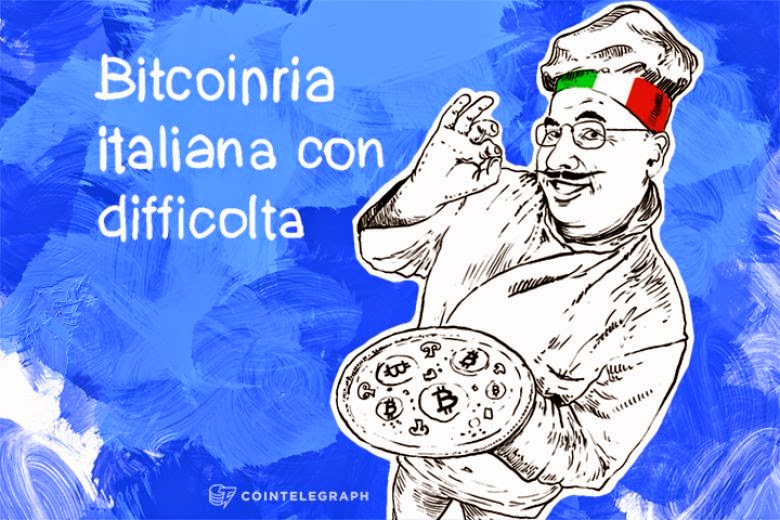
The difficulty of getting Bitcoin to catch on in Italy
first Bitcoin ATM was a Lamassu machine, installed in Udine,
a northeastern city nestled between the Alps and the Adriatic
Sea.
down the stuffed gnocchi.
anyone who needs help using the machine (it’s located in the hall of his family’s business).
He’s even had the interface translated into the local Friulian language, as
well as Italian.
his next step at this point is to install more machines around the country.
though.
Legal Obstacles
regarding Bitcoin, forcing him to operate in a grey area with which many
Bitcoin entrepreneurs are familiar.
pool of attorneys and legal experts advise him on what he could and could not
do. Italy,
they told him, does not regulate Bitcoin itself, nor are there any
know-your-customer regulations, but any transactions above 999.99 EUR need to
be reported.
“The use of electronic
currency is restricted to banks and electronic money institutions — that is,
private legal entities duly authorized and registered by the Central Bank of Italy.
Aside from these developments, Italy
does not regulate Bitcoin use by private individuals, and currently the
implementation of initiatives concerning the use of electronic currencies lies
with the EU.”
technology.
“Banca d’Italia is
studying the [Bitcoin] phenomenon, and perhaps — if they were fast — in 10-20
years we could have a law on it.”
local perception is something else entirely, Dordolo said.
“In Italy, we are at the beginning of
Bitcoin’s spreading among the population. There is an interesting Bitcoin
community [in Italy],
but it is still very hard to explain to Italian people the real value that
Bitcoin creates in the economy and the job opportunities it creates.This is because of
misinformation by the national media that actually regard it as a scam or worst
as associated with criminal deeds.Even the local Bitcoin
Foundation is not as active as it should be, so whatever can move this
situation is welcome.”
Open your free digital wallet here to store your cryptocurrencies in a safe place.
Satellite TV operator Dish Network to accept bitcoins!
Satellite TV operator Dish Network said it would accept bitcoin payments from customers from the third quarter, joining companies such as Overstock.com Inc and Zynga Inc in accepting the digital currency.
Dish said it selected Coinbase as the payment processor for bitcoin transactions with customers who choose to pay their bills online with the bitcoin wallet of their choice. Bitcoin is a digital currency that is not backed by any government or central bank and is bought and sold on a peer-to-peer network independent of central control.
In March, it launched its Instant Exchange feature, which will be used by Dish to convert bitcoins to U.S. dollars. Dish’s third quarter starts on July 1. While bitcoins may not be an alternative to established currencies, they can cut the cost of moving money around.
“We always want to deliver choice and convenience for our customers and that includes the method they use to pay their bills,” Bernie Han, Dish’s executive vice president and chief operating officer, said in a statement. “Bitcoin is becoming a preferred way for some people to transact and we want to accommodate those individuals.”
PricewaterhouseCoopers estimates that credit card companies charge around 3 percent in transaction fees and PayPal’s commission can go as high as 4 percent. The same transactions via bitcoin is likely to be free.
Open your free digital wallet here to store your cryptocurrencies in a safe place.

On the origins of money: Darwin and the evolution of cryptocurrency
(CoinDesk) Charles Darwin first published his theory of natural selection in his book On the Origin of Species
in 1859. The result of over 30 years of research, Darwin delivered to
the world a new understanding of how modern species came to be, evolving
over generations.
The son of a wealthy English family, Darwin was not a man in need of money. Nonetheless, for On the Origin of Species and his other publications, Darwin received royalties that were most likely paid in British Sterling.
Still in existence, the British Pound has origins dating back as far as 750
A.D. making it the world’s longest-surviving active currency. At the
time, I wonder if Darwin recognized that the very currency by which he
was being compensated would one day be subject to his very theory of
natural selection?
It is a realization that would become far more evident 150 years later with the advent of blockchain technology.
For the fortunate minority throughout history, as with Darwin, a given
currency is not subject to question. It serves as the accepted means of
exchange and is recognized as such from the time one is old enough to
understand value.
In this way, currencies are not understood as subject to the laws of natural selection. For the less fortunate
majority throughout history, and likely for more fortunate generations
to come, this may not be the case.
Natural Selection
Natural Selection can be defined as the process by which specific traits become
more or less common in a population over time and it serves as the
foundation for the theory of evolution. It is the result of the relative
success or failure of these traits competing in a given environment.
Put more simply, it embodies the concept of “survival of the fittest”.
Darwin famously defended his theory by describing the various species of
finches observed on the Galapagos Islands.
He noted 13 separate species of finch within the ecosystem, each with its
own unique food supply. The key differentiating trait between each
species was the unique structure and size of beak. Darwin argued that
each specie of finch had evolved as the result of varied food supply,
where each beak was the best suited to each specific food source
available within their environment.
The law of natural selection is most often observed in nature but can also be applied outside of this
realm. Corporations are forced to continuously compete and evolve to
remain relevant and profitable. Those corporations with the necessary
traits such as the ability to innovate, adapt and comply with
regulations succeed, while many more go extinct.
Whatever the environment may be, specific traits prove advantageous while others do
not. It is in understanding which traits provide advantage and which do
not that once can better understand how the fittest survived, and
furthermore predict who the fittest will be in the future.
The Traditional Traits of Money
Before we can understand how natural selection applies to currencies, we must
first define the traditional traits that have been used to characterize
them. For the purposes of keeping in line with the language of Darwin,
we will refer to what is traditionally stated as a property of money as a trait.
Table 1.0 displays the commonly accepted traits that characterize money as well as an
estimated rating as to the ability of each specific medium, in this case
gold and fiat currencies, to fulfil these traits within the modern
environment on a scale of High, Medium, and Low.
While the ratings of these traits are subject to debate, the table below provides a relatively accurate representation.
Gold has long served as an established means of exchange as well as a
commodity. Gold coins were adopted by King Croesus around 550 BC. King
Croesus was no fool. He selected gold as it fulfilled many of the
necessary traits to act as money.
Relative to the era, it was highly fungible, non-consumable, durable and scarce. These traits were
strong enough to become a leading form of money simply because there was
nothing else around that fulfilled these requirements as well.
But why did the king not select stones or feathers? The answer is that
these forms failed to be fungible, highly divisible, secure, and scarce.
The fact that gold has remained a valued commodity for thousands of years speaks to the
importance of these specific traits. In fact, the combination of traits
possessed by gold and other precious metals eventually provided the
foundation for the next evolution in money, fiat currency.
In money’s next evolution of specie, fiat currency fulfilled several
critical traits to an even greater degree than gold. Paper was more
portable and could be more easily transacted. That is not to say it was
entirely superior. In many cases fiat currencies lacked durability, and
as we will see, would eventually become less and less scarce. In fact,
many fiat currencies have failed due to inflation; a inevitable result
of the inability of the currency to remain scarce.
As a specie of currency, fiat currencies were not perfect but nonetheless
flourished in the last millennia. But how can this be? Are the benefits
of better fungibility and transportability really that significant as to
reign as the dominant specie of currency for so long?
In reality, much of the credit for their rise, survival and success is due to the
existence of another less recognized trait. The trait of centralized
sovereignty lead to the creation and issuance of hundreds of new forms
of money. Table 2.0 displays the degree to which gold and fiat
currencies fulfill the traditionally recognized traits of money in
addition to the newly recognized trait of sovereignty.
As of May 2014, there were 193 recognized fiat currencies in circulation regularly competing in global markets.
Each of these currencies belong to the same specie, fiat. It is important to
recognize that dollars, euros and yen were not mined or extracted from
the environment. These are man-made; designed and issued by centralized
authorities.
For centuries, the specie of fiat currency has thrived as a result of this fact and that these forms of money could be
used to pay taxes. In the course of its existence fiat currency has
evolved from a hybrid, by which the currency has been backed by a valued
commodity such as gold, to a self-standing form of money with no
physical backing.
During this period of time, the most notable trait to have changed for the world’s most widely recognized fiat
standard, the US dollar, has been scarcity. Once backed by gold, the
dollar was severed from the commodity in 1971 and as a result its
scarcity is no longer a trait that the specie of fiat currency fulfills.
In fact, to the surprise of many, there no longer remains a single fiat
currency in existence that is backed by gold. This evolution, or what
could possibly be regarded as de-evolution, of fiat currency as a specie
may have significant implications on its ability to compete and survive
in an environment with dynamically changing conditions.
Cryptocurrency and the New Traits of Money
The invention of the block chain has given rise to a new specie of currency, that of cryptocurrency.
The arrival of cryptographic-based currencies has enabled key new traits
previously not possible with traditional forms of money. Furthermore,
the realization of such traits will likely have a dramatic impact on the
environment in which these currencies compete.
Table 3.0 now includes the specie of cryptocurrency when rated against the
traditional and newly realized traits of money. The two newly-realized
traits include the following:
- Decentralized:
Defined as the delegation of power from a central authority to regional
and local authorities. With regards to block chain-based
cryptocurrencies decentralization implies a trust-less and distributed
network. This trait is a dramatically new innovation as a direct result
of the invention of the blockchain and was impossible with any other
prior form of money. - Smart (Programmable): The
trait of smart currency indicates the capability to fulfill a growing
array of functions still yet to be determined. Existing innovations in
the cryptocurrency space foreshadow the potential that currencies could
be designed as such to not only act as currencies but represent other
forms of value as well.
Survival and Extinction
Extinction can most simply be described as the failure of a specie to compete in
an environment to such at a degree that it eventually ceases to exist.
The inability to compete itself may be the result of two primary causes;
increased competition from superior species or a dramatic change in
environment.
For the dinosaurs, particularly land-based species,
the traits of size and strength were essential to their rise to
prominence. Although these traits enabled them to thrive for centuries
they did not allow them to compete as a specie forever.
The advantages they enjoyed at the time also meant that they required large
consistent amounts resources, most particularly food and oxygen. As a
result, at the end of the Cretaceous Period many specie were unable to
survive what is widely believed to have been the arrival of a
earth-shaking comet known as the K-T Event.
Evidence suggests that a large comet impacted earth and darkened the sky with dust and ash.
The blocking of the sun starved sun-dependent plant life and resulted in
a sharp reduction to the supply of oxygen.
The Journal of Geophysical Research-Biogeosciences estimates that this event killed off
75% of species. The traits that had once helped dinosaurs flourish now
proved to be the traits that left them susceptible to extinction.
Meanwhile, studies show that the freshwater organisms of the time only lost 10% of
their species. The commonly accepted explanation is that the freshwater
species were already conditioned to endure annual winter freezes where
their oxygen supplies were diminished.
Their relatively limited dependence on oxygen insulated them from the effects of changes to their
environment allowing them to survive. Dramatic changes to the
conditions brought on by the K-T Event changed the paradigm and a new
combination of traits became necessary to ensure competitiveness and
survival. Meanwhile, the majority of land-based species disappeared
forever, their greatest strengths having become their greatest weaknesses.
Currency, like the dinosaurs, has already shown us that it is not always the immediately dominant specie that will survive
the test of time. In an era that has seen hundreds of highly evolved
fiat currencies go extinct, gold endures.
Charles Darwin’s theory of natural selection originated to provide an evidence based explanation
of the past. We now leverage this theory to look forward and understand
its implications on the future of currency. Given the ever-changing
conditions of the future, will gold and fiat currencies continue to compete or go the way of the dinosaur?
The New Paradigm – Currency Competition
According to a study of 775 fiat currencies by DollarDaze.org the average life expectancy of a fiat currency is 27 years. The study
also indicated the most common causes of any given currencies extinction are hyperinflation, monetary reform, war and independence.
With fiat currencies being so susceptible to failure, gold has long served as an alternative as it is more scarce and durable. In terms of scarcity, fiat currencies can be printed and inflated at the will of their authorities.
With regards to durability, the US Federal Reserve
estimates the longest average lifespan of any paper bill is 15 years
($100 bill) with the shortest lifespan being 3.7 years ($50 bill). As a
result, gold has maintained a relatively high value in the era of fiat
currency and remains the primary alternative store of value when faith
in fiat currencies waiver. In this way, these stores of value have
primarily competed based upon only two of the traits of money; scarcity
and durability.
Fiat currencies and commodities now enter a new
paradigm where money can exist that possesses even more dynamic traits.
Gold and fiat currencies are not capable of possessing the newly
inherent traits that would make them decentralized or smart
(programmable).
Cryptocurrency has arrived adding heightened
competition. To date, bitcoin is the most widely recognized
cryptocurrency, but it is not alone. In the 5 years that
cryptocurrencies have existed over 200 have been established and the
list is growing.
Furthermore, the currencies themselves are in a state of hyper-evolution
as they continue to take on a varied array of distinctive traits that
set them apart from one another within their own competitive ecosystem.
Equally as threatening to traditional forms of money, the conditions of the
environment in which currencies compete is in a constant state of
change. Undertones of growing distrust in centralized entities encourage
populations to considered alternatives stores of value.
Sovereignty,
once a trait that was necessary for the survival of a currency, may now
be falling out of favor. Centralized failures such as the US financial
crisis of 2008 or hyper-inflated fiat currencies such as Zimbabwe
dollars or Argentinian pesos compound these sentiments. The most
profound of these conditions is the growing awareness throughout the
world that decentralized trust is possible.
It is interesting to imagine what Charles Darwin would make of the current state of currency.
History would have us believe that the existence and survival of any
entity, be it plant, animal, corporation, or currency is the subject to
the laws of natural selection.
With this understanding, it is hard to imagine Darwin contesting the opinion that cryptocurrency will prove
a competitive force against traditional specie of money.
Ultimately, the real question may not be whether or not Darwin would predict the
survival of cryptocurrency, rather would he be willing exchange those
British Sterling pounds for it?
Author Bio:
Ryan Walker is an independent
consultant and cryptocurrency enthusiast based out of Denver, Colorado.
Here, he joins the dots between Darwin’s theory of evolution, fiat money
and the rise of cryptocurrencies.
Open your free digital wallet here to store your cryptocurrencies in a safe place.

Bitcoin Society CEO: Why digital currency is a tool for global good
(CoinDesk) The weekend before last week’s Bitcoin2014 conference in Amsterdam, 22-year-old Matthew Kenahan had a choice to make – one that he said was “probably one of the most difficult decisions I’ve ever had to make”.
rewarded with not only winning the award for ‘Most Impactful Charity’, but also for ‘Bitcoin Champion’ after Andreas Antonopoulos was unable to accept the prize due to a conflict of interest.
My sincere thanks to anyone who voted for me in the blockchain awards. I apologize for not being able to accept due to conflict of interest
— AndreasMAntonopoulos (@aantonop) 16 Maggio 2014
Tool for charity
we’re trying to connect people,” Kenahan explained
“[Bitcoin] allows you to create a unique address, for a very specific cause […]
we see both the incoming and outgoing transactions, and we can see that
it’s used for a very specific cause.”
Image problem
Future plans
Open your free digital wallet here to store your cryptocurrencies in a safe place.
Bitcoin backers work to make it mainstream
geeks and enthusiasts had dreamed of: an international, decentralized,
anonymous, and transparent virtual currency that could potentially
replace inefficient traditional ones.
the Wall Street Journal, Bitcoin participation requires “a certain
faith in the benevolence of strangers.” But instead, the general public
is ambivalent at best about the virtual currency, while
many Bitcoin-related startups fight an uphill battle to convince the
world that it is at least comparable to its established counterparts, if
not better. Some retailers are pro-Bitcoin as well. Overstock.com and
TigerDirect now accept it as payment.
some time, are also bullish on the future of the digital currency and
believe there should be easier ways to invest in it. They established
their fund for people who are eager to invest in the currency, but who
don’t want to actually own bitcoins. Their first-of-its-kind
exchange-traded fund can be bought and sold on the public markets like a
stock or an index fund. Previously, people interested in trading
bitcoins as an asset class had to store the currency themselves and take
on the risk that goes with that. The brothers were recently quoted
saying their business will remove “the friction of buying…while offering
similar investment attributes to direct ownership”.
longstanding obstacles to its viability as a consumer product. It’s
likely that in the coming months new services will continue to emerge
that aim to make Bitcoin mainstream.
Open your free digital wallet here to store your cryptocurrencies in a safe place.
Andreessen sees bitcoin as the ‘big breakthrough’
Marc Andreessen, the tech entrepreneur who rose to fame as one of the founders of Netscape, takes the latter view, going as far as to say that in 20 years we will be talking about bitcoin the way we now talk about the Internet.
Andreessen argues that it has the potential to actually be a safer form of ecommerce than the credit card-based system that is currently in place.
Open your free digital wallet here to store your cryptocurrencies in a safe place.
The Rise of Cryptosponsorships
Dogecoin, the Internet meme turned cryptocurrency, has never had trouble gaining publicity. In January the Doge community sponsored the Jamaican bobsled team at the Sochi Olympics, then in March the Dogecoin subreddit sponsored NASCAR driver Josh Wise at Talladega Speedway. It was an idea, it seems, that has spawned a host of imitators.
For those who don’t know, this is an annual road race from France (this year the starting points are Paris in the north and Bordeaux in the south) down through Spain to Marrakesh, Morrocco. The race is only open to students aged 18 to 28, and they may only use Renault 4 cars. The teams have 10 days to make it from start to finish, over a course that includes 1,500 miles of harsh North African desert. Established in 1997 in Rennes, the 4L Trophy is mainly done to provide children with school supplies. This year an estimated 80 tons of school furniture was delivered by 2,648 students representing 1,324 teams from 1,460 colleges. With a market cap of less than $200K at the time of this writing, it is unclear if the KARMA team will be able to raise the funds necessary to participate in the race, With a volume of 50 billion KARMA in existence, it seems that they wish to compete with both doge and Reddcoin as the default tipping currency for the internet, so this could see the value rise as people buy KARMA to help sponsor the team.
 |
|
Image courtesy: abc.net.au
|
Another athlete being sponsored by crypto is Elsa Hammond who is attempting to row 2,400 miles across the Pacific Ocean from California to Hawaii in the first Great Pacific Race. Consisting of soloists or teams up to four, there are no sails or motors allowed, making this is a grueling test of physical and mental stamina. To help offset the cost ($336,000) Ms. Hammond, the only European contestant in the race, is asking donors for $70 (42 Pounds Sterling) per mile. In exchange Hammond will add your special woman’s name to her boat. She has also secured a sponsorship from Ultracoin whose founder has promised “substantial” amounts of Ultracoin after the completion of the event. With Ultracoin set to peak at 100 million coins the term “substantial” could really be anything, so that will be interesting to watch.
At the time of this writing Ultracoin has a market cap of over $400,000 and sell for roughly $.03 each, so the sponsorship could be significant. This would definitely be a good thing for Hammond since she plans to donate to gender equality charity The Great Initiative, as well as the Plastic Oceans Foundation.
VERTCOIN
Open your free digital wallet here to store your cryptocurrencies in a safe place.
Top 5 national altcoins available today!
of the gate and make an impression on the world. However, some digital
currencies are not intended to be used across the globe. Instead, they
are implemented within a country’s economy in order to help boost the
nation’s finances.
the concept of bitcoin, and use it locally. In most cases, national
coins are not allowed to be used outside of the country, as their is
fear that the value of such coins will fall. This alternative to using
money keeps the government separate from cash, all the while putting
power in the hands of the people.
National Altcoins
5. Swiftcoin
most national altcoins, swiftcoin can not be mined off of a
computer. Instead, swiftcoins are purchased with cash or bitcoin. They
can also be earned by selling goods and services using Oswift.com.
Uruguay, and allows locals to set up accounts, as well as buy and sell
digital coins like bitcoin and swiftcoin for cash or precious metals.
4. Isracoin
is already one of the world’s most successful national altcoins. The
digital currency allowed for public mining on March 26th, and was
airdropped to citizens on May 6th.
four phase process to get more people on board with the digital
currency. This well thought out plan will help circulate and introduce
locals to a new way of spending money.
that can also be found in bitcoin, such as low interest on deposits and
low cost transaction fees. With Isracoin, the goal is to disrupt the
current banking system of Israel.
3. Spaincoin
is ideal for Spaniards as it allows them to break free from the
shackles of the government. It was launched on March 12th, just a few
days before Isracoin.
to have its own national digital currency, with a population of over 46
million people. Spain’s economy has been in a rough spot for the past
couple of years, and with Spaincoin, there is a good chance that there
will be brighter days for the country.
of the coin will get 100 SPA each, and then the next 50,000 people will
get 50 SPA each. This will allow for a more balanced distribution.
2. Scotcoin
only allow people a chance to establish a new financial structure, but
also helps Scots gain independence from Britain and the pound.
The new coin works as a plan B to keep order in the economy in case
there is a major collapse with its already existing system.
“This
is a one-shot opportunity for Scotland to truly become an international
powerhouse if we can take back the power of our monetary issuance as
credit, as opposed to issued debt with interest from privately owned and
operated banking interests and cartels.”
1. Auroracoin
is based in Iceland, and was sent as a way to save the country’s
economy. The virtual coin is based on litecoin, and was devised
by Baldur Friggjar Odinsson.
real identity, similar to bitcoin creator Satoshi Nakamoto, the coin is a
saving grace to the people of Iceland.
potential of getting the people of Iceland out of what seems like an
endless financial rut. Success can’t truly be determined until
Auroracoin has ample time to make an impact on Iceland.
the coin a big success, citizens are going to have to be patient and not
run off selling their coins for cash at the first chance they get.
world’s economical crisis has put a large cloud over finance, but
digital coins hope to correct this issue. The planet has changed to
where everything is digital. So the obvious solution to correct the
economy could be to make money go digital as well. Whether national
altcoins or bitcoin, crypto currencies are a potential solution that the
world shouldn’t ignore.
Open your free digital wallet here to store your cryptocurrencies in a safe place.

Bitcoin transaction volume soon to surpass PayPal
Image Credit: screenmediadaily
CEO of Laureate Trust, Peter Tasca, explains:
“Whenever you have an instrument that trades over 300 million US dollars a day, it must be recognized; the digital currency works, bitcoin has greater volume transactions than Western Union and we anticipate it will overtake PayPal later this year.” According to Statistic Brain, PayPal processes just $315.3 million in transactions everyday, just slightly above the dollar amount of bitcoin’s daily transactions despite the digital currency still remaining at a relatively low percentage rate of consumer and merchant adoption.
The developer of the first biometrically protected bitcoin payment card, remains heavily leveraged in respect to bitcoin adoption; however, the company’s CEO, Chaya Hendrick, says that bitcoin’s sheer transaction volume will continue to rise at a staggering rate:
“In the next one or two years, Bitcoin can surpass the dollar transaction volumes of other established payment companies including Discover, and even American Express, MasterCard, and Visa.” While both Laureate and Hendrick see the number of bitcoin transactions climbing, Laureate, who currently manages a $5 billion hedge fund, predicts that along with increased volumes will come an increase in price, which he expects to be somewhere in the 50% range.
Increased Adoption
Meanwhile, SecondMarket CEO Barry Silbert, recently explained at the Core Club hosted forum in New York City that bitcoin currently remains in the “early majority” stage in which he refers to as the “venture capital stage”. However, the CEO and Bitcoin Investment Trust (BIT) founder says that “we’re probably just a few months away from Wall Street banks starting to trade bitcoin, starting to invest in bitcoin, and starting to create investment products for bitcoin.”
While bitcoin becomes an increasing threat to existing payment processors, in an interview with EcommerceBytes, CEO, John Donahoe, reffered to the digital currency as an exciting, new and emerging technology. “We think Bitcoin will play a very important role in the future. Exactly how that plays out, and how we can best take advantage of it and enable it with PayPal, that’s something we’re actively considering. It’s on our radar screen,” he said.
Open your free digital wallet here to store your cryptocurrencies in a safe place.

Former US Mint Chief: Bitcoin a serious challenge to government money

body responsible for producing the country’s physical coins, made waves
in the bitcoin community this week when he took to Twitter to voice his
enthusiasm for digital currencies.
$2.6B fine ‘won’t do much damage’: Credit Suisse CEO. It’s time banks got competition. Time for cryptocurrencies. http://t.co/OT3dBTDlrq
— Edmund Moy (@EdmundCMoy) May 22, 2014
However, Moy didn’t stop there. The former member of the Department of Homeland Security took to his blog on 23rd May to issue an entire post on how bitcoin is leading to “a revolution in payment systems”.
“Bitcoin,
and the ideas behind it, will be a disruptor to the traditional notions
of currency. In the end, currency will be better for it.”
full post lightheartedly addressed bitcoin and its strengths and
weaknesses, with Moy offering a perhaps surprisingly optimistic
assessment of how the technology will impact the global financial
marketplace.
Bitcoin removes government monopolies
most notably, Moy suggested that digital currencies can even help
prevent some of the more severe drawbacks associated with fiat
currencies. In particular, he predicts it will eliminate what he views
as the government monopoly on money, writing:
“It has a
low risk of collapse unlike a sovereign government’s currency (just ask
the Greeks or more broadly, the European Union).”
Bitcoin an innovative means of exchange
“As
a medium of exchange, bitcoin offers several unique innovations to
currency: global nature, infinite divisibility and easy to carry.”
today’s transaction systems “archaic”, he argued that bitcoin’s ability
to divide effortlessly would allow for new methods of monetization via
micropayments, and that it could eliminate existing barriers to global
markets.
Bitcoin will be a safe store of value
he took aim at critics of the idea who believe that government-backed
alternatives are perhaps more secure, saying that the US dollar is
driven mostly by market demand.
bitcoin could even allow governments the ability to dedicate more time
to monetary policy that could positively impact their economies should
it reach its full potential.
Open your free digital wallet here to store your cryptocurrencies in a safe place.