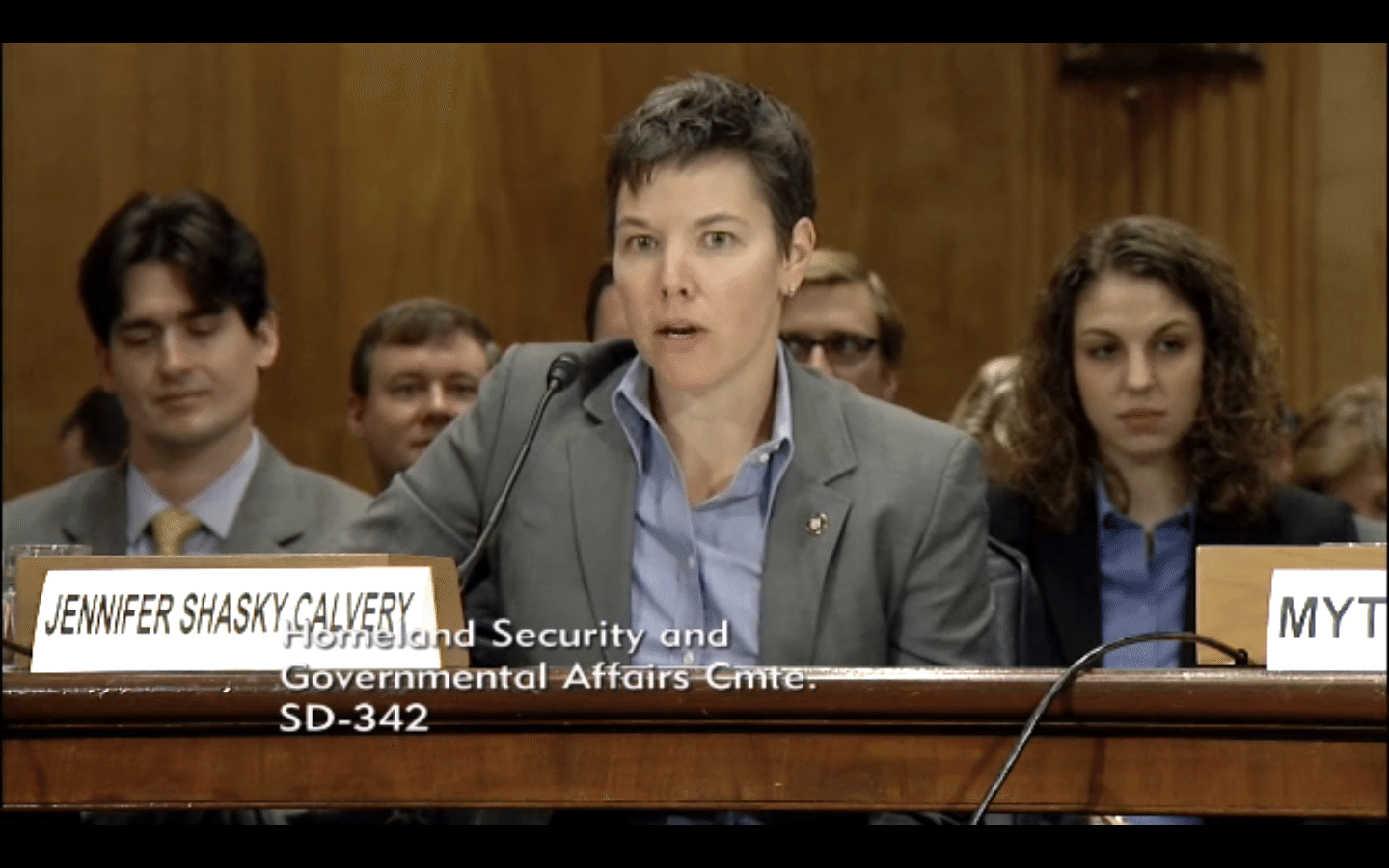
This Senate hearing is a Bitcoin lovefest
(WashingtonPost) The Senate Committee on Homeland Security and Governmental Affairs,
chaired by Sen. Tom Carper (D-Del.), is holding the first congressional
hearing on the future of Bitcoin. The first panel features senior
figures from the Obama administration. And their comments about Bitcoin
have been remarkably positive.
After the officials gave their opening statements, Carper’s first
question drew a parallel to the Internet. He pointed out that in the
early days of the Internet revolution, many people raised concerns about
illicit use of Internet technologies. Yet in the long run, he argued,
the Internet has had a hugely beneficial effect on peoples lives, making
possible previously unimagined services like Facebook and YouTube.
Carper wanted to know if the witnesses saw Bitcoin in the same light.
 Jennifer Calvery, director of the Financial Crimes Enforcement
Network, agreed with Carper. “Innovation is a very important part of our
economy. It’s something for us to be proud of,” she said.
“We are attuned to the criminal use,” added Mythili Raman of the
Justice Department. But “there are many legitimate uses. These virtual
currencies are not in and of themselves illegal.”
“There is good reason for us to remain watchful” about Bitcoin being
used for illicit purposes, Raman added. “But we also intend to balance
that against the need for legitimate users” to use the technology.
Later in the same panel, Edward Lowery of the Secret Service
testified that cyber criminals “have not by and large gravitated toward
peer-to-peer cryptocurrencies.” Rather, they “have by and large
gravitated toward centralized digital currencies that are based in a
locale that may have less regulatory guidelines and less aggressive law
enforcement.”
That’s been the tenor of the entire hearing so far. All three Obama
administration officials expressed concern about Bitcoin being used for
illicit uses. But they also stressed that Bitcoin has important
legitimate uses and that regulators need to be careful not to stifle
innovation in virtual currencies. And they seemed to believe that the
situation was under control, and none asked for new regulatory powers to
crack down on illicit uses of the currency.
Open your free digital wallet here to store your cryptocurrencies in a safe place.
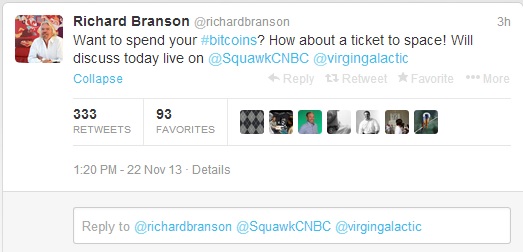
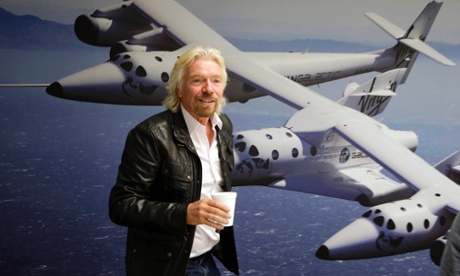
Virgin Galactic to accept Bitcoin for space flights
flight venture created by the billionaire entrepreneur Richard Branson,
is accepting Bitcoin: this means the new crypto-millionaires and space
aficionados can now use their digital coins to pay for an exciting and unique trip. The news was announced by Branson himself on CNBC’s show “Squawk Box”.
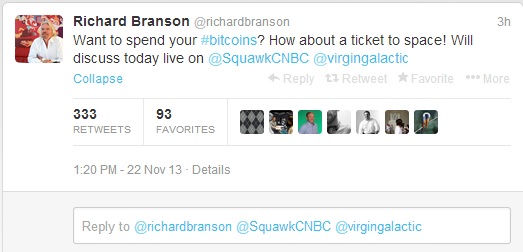
Branson said. The lucky space traveler is a flight attendant from
Hawaii. Apparently, the woman made “quite a lot of money getting into
Bitcoin early on”, he told CNBC.
and then Virgin Galactic converted the amount into US dollars,
specifically $250,000. “There’s a fixed price [and] we can actually pay
her money back, if she changes her mind about going to space in a few
months”.
and is holding on for the long-term. “I have invested in some Bitcoins
myself and find it fascinating how a whole new global currency has been
created”, he wrote on Virgin’s website. Brason even compared the virtual coin with his own business.
aren’t yet formally recognized by governments as a currency, but with some regulation I hope that it will become more widely accepted.
A few years ago many people had doubts about whether Virgin Galactic
would ever get off the ground. Now we have gone supersonic, are a long
way along the testing process, and are looking forward to launching
commercial space travel”.
Open your free digital wallet here to store your cryptocurrencies in a safe place.
Cypriot university to accept Bitcoin payments

(YahooFinance) Cyprus’ biggest private university said Thursday it will start
accepting the digital currency Bitcoin as an alternative way to pay
tuition fees.
been a hub for international banking before suffering a collapse in its
financial system this year, leading the government to impose controls on
the flow of capital as it accepted an international bailout.
But
the University of Nicosia said the move to accept Bitcoin was unrelated
to the controls. Rather, it was meant to help foreign students in
countries where traditional banking transactions are either difficult or
costly to pay for programs such as online degrees.
The
university’s chief financial officer, Christos Vlachos, said the
institution, which has about 8,500 students enrolled, is the first in
the world to take Bitcoin payments.
Bitcoin is a
cryptography-based digital currency that advocates say is
counterfeit-proof. Its value is determined by supply — which is limited
by its design — and demand. Among the various criticisms leveled at
Bitcoin are that it is too prone to price swings against other
currencies to be useful.
Vlachos said payments are free of risk
for the university since it immediately converts the digital currency to
euros at the day’s exchange rate.
He said that the university is
also offering a new Masters’ degree in digital currency, a field he says
is the monetary equivalent of the Internet in its infancy.
“It’s the gold of tomorrow,” Vlachos told the Associated Press.
He
said the Cypriot government should set up a regulatory framework to
attract digital currency trading companies and boost the bailed-out
country’s foundering economy.
Open your free digital wallet here to store your cryptocurrencies in a safe place.
A map of Bitcoin-friendly businesses

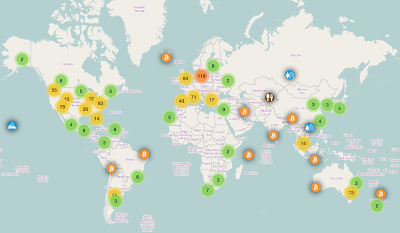
(WashingtonPost) The tech-crazed Bay Area seems like an obvious place to find
bitcoin-friendly businesses. But you’ll also find them in less likely
locations. Rooks Comics and Games, in Bozeman, Mont., for instance. An
antique shop in the French Quarter of New Orleans. Alberty’s Broadway
Liquor in Muskogee, Okla., about an hour out of Tulsa. And the Church of
Saint John the Evangelist in Goshen, N.Y.
On the East Coast, you’ll find at least four venues in Manhattan and
nine in Brooklyn. Washington, D.C., sadly, has only two places where you
can spend your digital cash, and one of them seems to be a think tank
of sorts. But take your bitcoins to Cambridge, Mass., and you’ll find a
welcome at a fusion eatery named Thelonious Monkfish and a diner called
Veggie Galaxy.
If you find a business that’s is accepting bitcoin, add it on Coinmap.org !
Open your free digital wallet here to store your cryptocurrencies in a safe place.
Bitcoin price skyrockets as Senate hearing concludes

(CoinDesk) The price of bitcoin spiked dramatically last night and the
transaction volume on the Bitcoin protocol (in USD) eclipsed that of
Western Union.
The spike took place after Jerry Brito, Patrick
Murck and Jeremy Allaire presented their testimonies on bitcoin and the
future of virtual currencies to the Homeland Security and Governmental
affairs committee in the US senate at the Senate hearing titled Beyond Silk Road: Potential Risks, Threats and Promises of Virtual Currencies.
The CoinDesk BPI read $650 on conclusion of the hearings, with Mt. Gox reporting a jump to $750 and, later, BTC China reaching a record high of 6,989 CNY (approximately $1,147) before crashing to almost 60% of this value in seconds, and then recovering to about $850. At the time of writing, the CoinDesk BPI puts the price at $602.
The
senate hearing is being hailed as an historic moment for bitcoin, with
even Ben Bernanke, current chairman of the Federal Reserve remarking
that virtual currencies “may hold long term promise” in an open letter
to Senator Thomas Carper (D) published 12th November.
At the
hearing, Senator Carper listened to commentary, criticism and praise of
bitcoin with a temperament that left many in the bitcoin community
impressed and even delighted, whilst Jennifer Shaskey Calvery from
FinCEN was measured in her analysis and assessment of the promises and
threats that virtual currencies present.
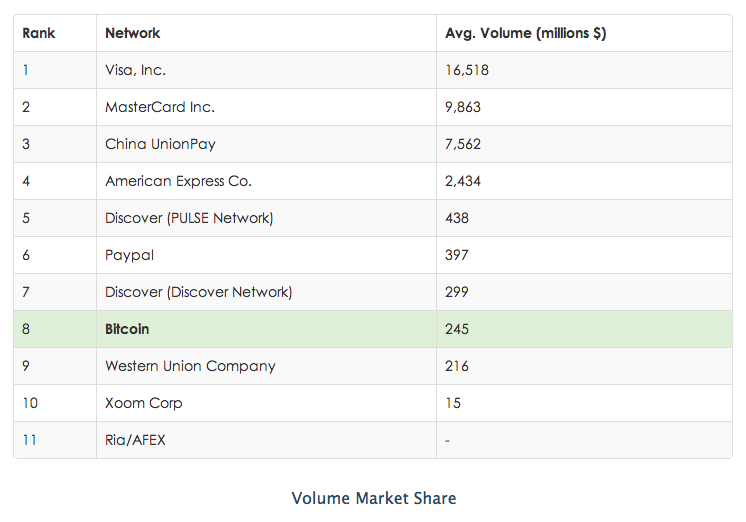
This morning, data analysis website Coinometrics reported
that bitcoin passed Western Union in daily transaction volume,
transacting an average of $245m compared with Western Union’s estimated
$216m but is still behind on the average number of daily transactions at
approximately 62,000, with Western Union clocking up approximately
633,000 transactions per day by comparison.
Open your free digital wallet here to store your cryptocurrencies in a safe place.
Bitcoin skyrockets to $600 after U.S. agencies label it legitimate
(DailyDot) The Department of Justice and Securities and Exchange Commission told senators that bitcoins are “legitimate financial instruments,” Bloomberg reports. The news comes just three days ahead of a U.S. Senate Committee on Homeland Security and Governmental Affairs hearing on Bitcoins,
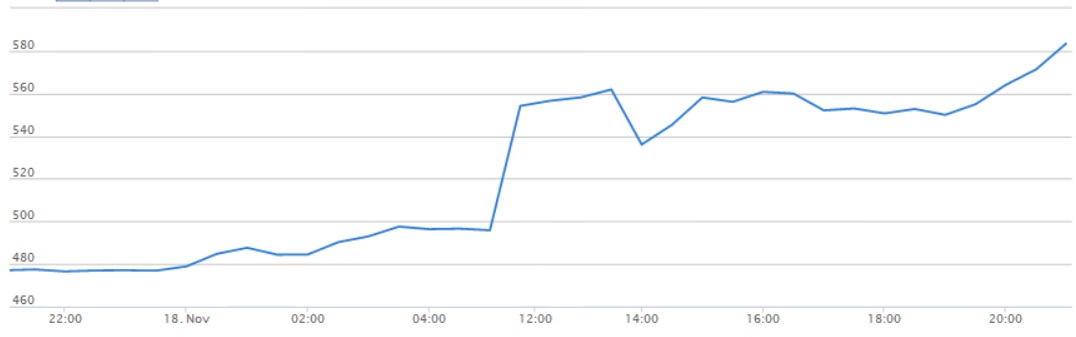
Almost immediately following the article publication at 12:01am ET, the
average price of Bitcoins jumped over $50, from $495 to $554, sprinting
past the $500 milestone. It has continued to climb to a $583 average in the hours since. At Mt. Gox, the largest Bitcoin exchange, the currency is already selling for $630.
The Senate committee, which was scheduled immediately following the fall of the Deep Web black market Silk Road, aims “to explore potential promises and risks related to virtual currency for the federal government and society at large.”
“The FBI’s approach to virtual currencies is guided by a recognition
that online payment systems, both centralized and decentralized, offer
legitimate financial services,” Peter Kadzik, principal deputy assistant
attorney general, wrote according to Bloomberg.
“Like any financial service, virtual currency systems of either type
can be exploited by malicious actors, but centralized and decentralized
online payment systems can vary significantly in the types and degrees
of illicit financial risk they pose.”
Ben Bernanke, the chairman of the Federal Reserve, said he had no plans
to regulate the currency. In fact, Bernanke isn’t sure if the Fed even
has the authority to do so.
In an article on Sunday, Time reported that the Senate hearings were “just the beginning.”
“Honestly, the environment seems to be a game of hot potato where no
politician wants to be caught being pro or anti bitcoin,” Charles
Hoskinson, director of the Bitcoin Education Project, told the magazine.
“Once the market cap gets to around $10 billion or so, then expect real
hearings and a lot of lobbying.”
At nearly $7 billion and triple what it was just two weeks ago, the cap is closing in fast on Hoskinson’s milestone.
The reaction in the Bitcoin world has been ecstatic. After similar reports of Chinese authorities saying the government has no plans to
regulate the digital currency, news that the U.S. is following suit is
exactly what Bitcoin-backers had hoped for. Around the Internet, bitcoin
enthusiasts talked about the adrenaline they felt watching the price
surge this morning.
There is already widespread speculation in the community that the currency will soon enough reach $1,000—and beyond.
Open your free digital wallet here to store your cryptocurrencies in a safe place.
Bitcoin couple travels the world using virtual cash
“In bitcoin,” Austin Craig repeated to the young woman behind the
counter at the Lean Crust Pizza parlor in the Fort Greene neighborhood
of Brooklyn, N.Y. “Can we pay in bitcoin?”
“In what?” came the reply.
Mr. Craig, 30
years old, was struggling to convince Nadia Alamgir of the existence of
the virtual currency that has gained traction across the world, and
whose value—after months of wild swings—on Wednesday reached records
around $400 per bitcoin.
It was midway through a tricontinental
odyssey taken with his wife, Beccy Bingham-Craig, 29, and a film crew
documenting their travails, which started in Provo, Utah. Their mission:
to live on bitcoin alone.
“It’s been consistently inconvenient
and occasionally frustrating,” Mr. Craig said outside Lean Crust, “but
never impossible.” Lean Crust advertised itself as bitcoin-friendly but
hadn’t seen much virtual foot traffic. Ms. Alamgir eventually contacted
the store’s owner, who arrived and processed the transaction, allowing
Mr. Craig to munch on several slices.
Lean Crust, though, is one
of a tiny but growing number of stores, travel agents and online
merchants starting to accept the once-obscure digital currency as a
means of payment. Bitcoin doesn’t exist, except in the virtual world,
and can only be passed from one person to another electronically. Its
origins are murky: Conventional wisdom says a man or group of people
going by the name Satoshi Nakamoto created bitcoin in 2009, stoking
demand by making it obtainable only through complicated algorithmic
searches by powerful computers.
But in the past 12 months, the
bitcoin zeitgeist has taken on a life of its own. The currency is
discussed at investing conferences now. The Winklevoss twins, known for
their fight with Facebook Inc. founder Mark Zuckerberg, have started a
bitcoin fund. It also has gained the attention of regulators who worry
it can be used to launder money.
For the Craigs, bitcoin represented a chance at adventure—and an underground movie career.
They
began their trek in October by driving east from Provo in Ms.
Bingham-Craig’s 2004 Volkswagen Jetta. After arriving in New York on
Oct 17, they flew to Stockholm, Berlin and Singapore before eventually
returning to Provo. In the end, they lasted 101 days, from July 23 to
Nov 1.
The Craigs weren’t part of the bitcoin underground when
they began the project. Mr. Craig said he first heard of the currency in
2011 and then came up with the plan to live and travel solely on
bitcoin.
“I’m really excited about bitcoin and its future,” Mr. Craig said. “It’s a reimagining of money.”
Starting
July 23, the day they returned from their honeymoon, the Craigs paid
for everything with bitcoin, from rent to food to gas. At that time, one
bitcoin was worth about $98, based on trading at the Tokyo-based Mt.
Gox exchange, a primary exchange bitcoin enthusiasts have tracked.
the trip, they had to not only introduce a number of people to the
fledging currency but to persuade them to use it. After a few weeks of
prodding, their landlord, Justin James, agreed to the plan—with the
sweetener of a small premium over the rent—and set up his own bitcoin
account.
“In the end,” Mr. James said, “it hasn’t been as much of
an inconvenience as I thought it would be.” While he hasn’t become a
convert, he did say he thought the experiment sounded like fun and was
“happy to be a part of it.”
Open your free digital wallet here to store your cryptocurrencies in a safe place.
What exactly does the US government really think of Bitcoin?
(CoinDesk) With the US Senate setting 18th November as the start date for its committee hearings into bitcoin, it’s time to
take a look at some of the more significant events in bitcoin’s short but colorful legal history.
The early Bitcoin timeline featured hacks, heists, drugs, demands for refunds and the first appeals to law enforcement, but 2013 saw official scrutiny rise almost as quickly as bitcoin’s value.

Whether or not bitcoin requires, or should seek, regulatory approval is a major source of heated debate on bitcoin discussion forums, but the regulation issue will remain prominent as long as significant amounts of wealth are at stake.
FinCEN issued guidelines that bitcoin-related businesses counted as “Money Service Businesses” (MSBs) under US law.
This meant bitcoin businesses were now officially required to provide authorities with information about potentially suspicious transactions and introduce policies to prevent money laundering. These regulations also affect the more centralized virtual currencies and point systems used in social networks and online games, including Facebook and Second Life. Lack of a centralized authority meant bitcoin itself could not comply, but any business associated with its use would need to — including individual miners, if they converted their bitcoin to fiat currency.
In something of a rare public compliment for bitcoin from the world of traditional finance, François R. Velde, senior economist of the Federal Reserve in Chicago wrote a glowing paper titled “Bitcoin: A Primer” in which he wrote bitcoin was a “remarkable conceptual and technical achievement, which may well be used by existing financial institutions.” He further described bitcoin as an “elegant solution” to the digital currency problem and claimed its value derived from certain beliefs about the nature and function of money, and the amounts of fiat currencies traded for it.
Open your free digital wallet here to store your cryptocurrencies in a safe place.
Regulation Of Bitcoin – The European Bitcoin Convention — 2013 Amsterdam
Regulation Of Bitcoin at the European Bitcoin Convention
Wieske
Ebbe (Dutch Central Bank), Michael Maier (Fidor Bank), Niels Ploeger
(Amsterdam Police), Joerg Platzer (Crypto Economics Consulting Group)
& Casper Riekerk (Finnius Lawyers)
Recorded By IamSatoshi
Open your free digital wallet here to store your cryptocurrencies in a safe place.
US Homeland Security committee to explore bitcoin’s potential in 18th Nov hearing
Open your free digital wallet here to store your cryptocurrencies in a safe place.