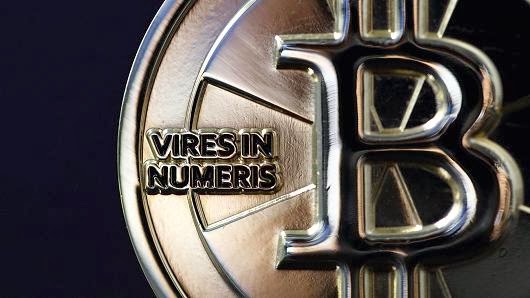
Bitcoin’s four steps to Wall Street acceptance
its recent rise above the $1,000 mark-is gaining it additional converts
to the belief that the cryptocurrency is for real.
One of the latest skeptics-turned-believers is Ty Danco, a respected
market veteran who has worked up one side of Wall Street and down the
other. Danco once oversaw more than $60 billion of assets and now is the
CEO at a trading firm called BuysideFX.
he outlines what he sees as the future for bitcoin, the digital
currency that last was trading at one unit equaling more than $900.
“The media thoroughly covered its meteoric rise in market value as a
currency, but the bigger story is that high-profile investors have
placed significant bets on Bitcoin-related businesses this year,
including Li-Ka Shing, Union Square Ventures, and Andreessen-Horowitz,”
Danco wrote. “Given their involvement, bitcoin demands a serious look.”
(Read more: Do you really know bitcoin? Here are 11 myths )
this week said it would accept bitcoins for payment-Danco said it faces
four challenges before gaining Wall Street’s acceptance:
It seems bitcoin’s path to legitimacy runs straight through government
and regulatory agencies, quite likely the Commodity Futures Trading
Commission. Says Danco:
Early signs from regulators are more promising than I initially
expected, but we still have a long way to go. CFTC: Bitcoin most likely
falls in your lap, whether as a commodity, currency, or derivative. Take
a stand!
Bitcoin indeed needs to shed its image as a toy created by hobbyists
and nerds. After all the leading bitcoin exchange is Mt.Gox, which is
not an abbreviation for “Mount Gox” but rather an acronym for Magic The
Game: Online Exchange, where folks used to trade cards for a Dungeons
& Dragons-esque game.
I can’t see Prudential Insurance, Vanguard or the Monetary Authority of
Singapore trusting their assets with these kids. Those of you running
Bitcoin exchanges, dump the rhetoric, go hire some pros from SWIFT, the
major credit card companies, central banks, the FSA, etc.
On 2B, bitcoin already has gotten some pretty weighty
endorsements-hedge fund titan Mike Novogratz, for instance-but could
use a little more heft, Danco said.
To get broad buy-in of its legitimacy, Bitcoin needs some sponsorship
by big players. Some well-known VCs have jumped in, but we need one or
two mammoth banks like JPMorgan (JPM) or Deutsche Bank (XETRA:DBK-DE) to come onboard; not shady entities based out of the Caymans
3. Establishing two-way transactions and delivery vs. payment (DVP).
DVP is another byway on the way to legitimacy. It ensures that users of
bitcoin aren’t going to get ripped off on the other end as it requires
payment at the time of delivery for the goods in question.
When a DVP and security registration can be automated via a
decentralized P2P process, Bitcoin takes the banking world by storm.
Finally, to become institutional, Bitcoin requires optional and
verifiable identity opt-ins. Identity for securities settlement
instructions is going to be known in advance before diving into
anonymous-looking alphanumeric strings of private and public keys. (An
exception may be made for dark pool transactions.) My guess is that
institutional “wallets” (read:custody accounts for bitcoin) may have
some identifiable and consistent beginning, then unique and
cryptographic back ends.
While achieving the
four steps will be difficult, it also is very doable, rendering bitcoin
skeptics increasingly into the shadows.
It’s hard
to go against 30 years of habit, but this old dog has converted from
Krugmanesque bitcoin hating to being optimistic about virtual
currencies. It will be time for new tricks soon, but bitcoin needs to
check a few boxes before it’s ready for primetime.
|
|
Tomohiro Ohsumi | Bloomberg | Getty Images
|
Open your free digital wallet here to store your cryptocurrencies in a safe place.
1 millionth Bitcoin wallet created on Blockchain.info
(CoinDesk) Blockchain.info has reached the biggest milestone in its history – it now boasts over a million wallets. A year ago it had fewer than 100,000 users and by late October the company announced that it had created 500,000 wallets, so it is evident that things are picking up.
A Blockchain representative told CoinDesk that the company plans to celebrate the latest milestone with some big prizes. Back in October, the lucky
user who created the 500,000th wallet was rewarded with 10 BTC, so the stakes are high. Blockchain acknowledged that reaching the one million mark is a major accomplishment for any service, especially in the bitcoin space. A company spokesman said:
“The year 2013 has been an unforgettable one for Blockchain. As the number of wallets has doubled from 500,000 since November, the world’s most popular bitcoin website is proud to announce reaching 1,000,000 wallets for their wallet service.”
Blockchain started 2013 with around 100,000 users. By contrast, 2014 is kicking off with more than a million users. The company said: “The growth seen over the past year has happened during a pivotal time for bitcoin. Blockchain plans to build this milestone into an outreach opportunity for bitcoin newbies and enthusiasts.”
Blockchain.info added that its leadership role in the bitcoin economy is “only just beginning,” so we can expect a lot more over the next few months.
It is also keen to emphasise that it is nearly a “100% bitcoin” business, as it pays its employees and most of its services in bitcoin. It also closes its business deals in bitcoins, including the recent acquisition of ZeroBlock, the most popular iOS/Android app for bitcoin.
If, by chance, you did open a Blockchain account over the last few hours, it might be a good idea to check whether you were the lucky one-millionth user.
Open your free digital wallet here to store your cryptocurrencies in a safe place.
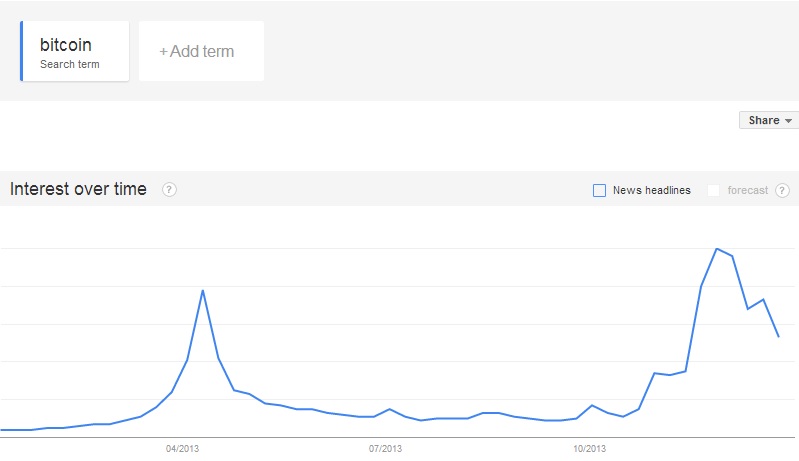
Google and Wikipedia: Bitcoin is one of the most researched words of 2013
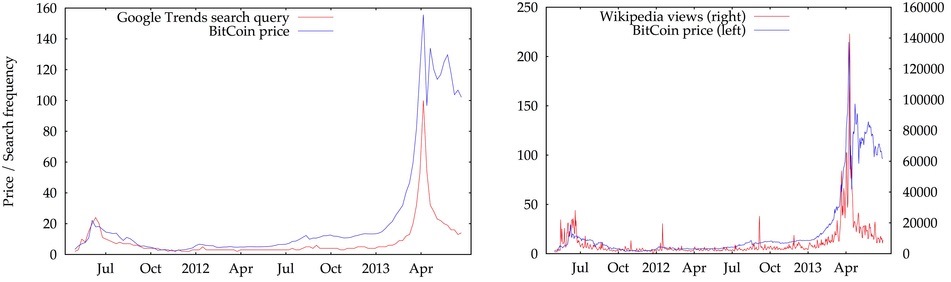
(BitcoinExaminer) This last year was definitely a great one for Bitcoin and 2014 promises even more good news. In 2013, Bitcoin became one of the most researched words across the world in platforms like Google or Wikipedia and there’s already a study made by a well-known economist that shows how the
people’s curiosity exponentially grows when cryptocurency’s price goes up.
Open your free digital wallet here to store your cryptocurrencies in a safe place.
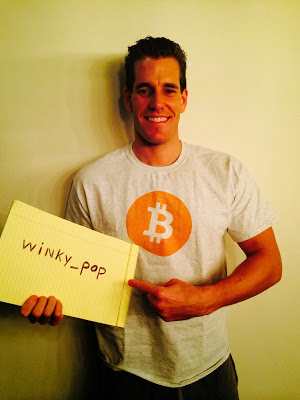
Winklevoss twin says Bitcoin valuation will top $40k
(TheNextWeb) Cameron Winklevoss, one half of the notorious twin brothers who once
battled Mark Zuckerberg over the origin of Facebook, took to Reddit to host an AMA this weekend to discuss the duo’s big interest: Bitcoin.
The Winklevoss twins were early Bitcoin advocates but have never revealed their total holding — though it was said to be worth
$11 million in April, when the crypto-currency peaked at $266. Given
today’s price ($875 average on Mt. Gox, at the timing of writing) and
Cameron’s admission that he is yet to sell a single Bitcoin, it could
now be worth as much as $35 million.
The twins are in the process of setting up the Winklevoss
Bitcoin Trust, a listed fund to manage their Bitcoin wealth and bring
greater legitimacy to the virtual currency. Papers for the initial
public offering were filed in July, but the final decision is still
pending. Due to regulations, Cameron was unable to discuss the trust in
the AMA.
The brothers are unsurprisingly bullish on Bitcoin. Cameron’s conservative
bet is that its US dollar valuation will surpass $40,000 per coin — a
potentially colossal figure — as he explained in a response to one
Reddit user:
dollar market cap, so 40,000 USD a coin, but I believe it could be much
larger. When this will happen, if it happens, I don’t know, but if it
happens, it will probably happen much faster than anyone imagines.

In another answer, Cameron played down the significance of the closure of The Silk Road
— the underground market place for illicit goods that many saw as a key
outlet for Bitcoin — instead arguing it is positive for the virtual
currency:
The Silk Road closure, and resulting price gains
demonstrate how the demand for BTC has little to do with illicit
transactions. If anything, Silk Road was holding Bitcoin back by
disproportionately dominating its narrative in a negative way.
It is estimated that the volume of bitcoin transacted on Silk Road
only represented ~4% of the total volume of bitcoins transacted on the
Block chain over the same period of time.
Bitcoin’s growth has seen interest in other alternate currencies — such as Litecoin and Quarkcoin – but Cameron says he and his brother have no interest in anything other than Bitcoin:
Do you see BTC ‘replacing’ currencies we have today, or being used alongside them?
Have you invested in any altcoins, if so, which and why?
I view BTC more as an alternative to fiat currencies than a replacement.
I have not invested in any altcoins because I don’t believe that any
of the “problems” or issues that they address can’t be addressed by
Bitcoin itself.
You can see the full range of answers — which include mentions of
rowing (the brothers represented the US at the Olympic Games) and the
Simpsons — at the thread here.
Given their background and early adoption of Bitcoin, the twins’
opinions and predictions for the future are interesting. They have both
predicted that there will be some form of regulation for the currency in
the future. They see it as an ‘answer’ to many fiscal problems and are
keen to help take it more mainstream.
Open your free digital wallet here to store your cryptocurrencies in a safe place.
Bitcoin-Litecoin ratio returns to historic norm, Peercoin climbs 200%
to record highs, reaching as high as $1,141 on Bitstamp, it is joined in
growth by a number of alternative digital currencies. The most visible
has been litecoin, which has returned to what might be considered a
normal trading range relative to bitcoin. Litecoin is not alone in its
gains, with others like Peercoin and Namecoin making similar gains.
over the past week, surprising many with its meteoric gains and
crossing of one billion dollars of market capitalization. Yet, the
dynamics in which it is actually traded are often overlooked,
particularly its relationship to bitcoin. On BTC-e, the leading litecoin
exchange by volume, the bitcoin-litecoin currency pair is traded with
as much or more volume as litecoin-dollar. It also regularly dictates
movement as visible through a series of technical factors.
litecoin and bitcoin are beginning to show signs of trading in a manner
similar to gold and silver. In particular, maintenance of a banded
price ratio is a dynamic well known to the precious metals and once
again proving its potential applicability to digital currencies. While
the original research on the matter explains in more detail, those
watching the ratio may well consider the latest litecoin-dollar gains to
be an expected correction. Having fallen out of range amid bitcoin’s
800% climb in the past month, it has since normalized.
alternative mining implementation based not only on bitcoin’s
proof-of-work scheme, but also a proof-of-stake. The proof-of-stake
system distributes new coins based on holdings rather than just finding
correct hashes. While PPC / BTC remains the dominant currency pair for
the altcoin so far, PPC / USD was recently added on BTC-e, leading to a
massive jump in its exchange rate.
Open your free digital wallet here to store your cryptocurrencies in a safe place.

British Island wants to make physical Bitcoins with UK Royal Mint deal
(CoinDesk) A tiny island in the English Channel, Alderney, wants to mint physical bitcoins as part of a larger campaign to become one of the world’s first financial services centers devoted to digital currency.
The Financial Times reported
that Alderney, just three miles long with a population of 1,900, wants
to become known as an international center for bitcoin transactions.
Intended to be fully compliant with anti money-laundering and other
financial regulations, it would offer merchant payment services,
exchanges, and a bitcoin storage vault of some kind.
The physical
bitcoins, like other such tokens, would be collectors’ items rather than
circulated, and would likely have a gold content (apparently around
£500 worth) to further their appeal and allow them to retain value
should bitcoin’s price crash.

They would also serve as promotional
tokens for the more ‘serious’ bitcoin payment and exchange services.
Alderney’s
coins would hopefully be minted in a collaboration with the UK’s Royal
Mint as part of a commemorative collection. Rather than having a private
key sealed inside, like the popular Casascius physical bitcoins
and their contemporaries, the Alderney bitcoins would be exchangeable
for the more useful digital kind by its holder paying a visit to the
island. They would not be official legal tender otherwise.
Production
would be overseen by an independent company, who would also take the
hit if bitcoin’s value vanished. The same company would also hold the
coins’ keys in an escrow service. If the deal goes ahead, The Royal Mint
would handle orders and take some of the money from sales.
With current bitcoin values hovering around $1,100 on CoinDesk’s BPI
(over $1,200 on Mt. Gox) and seeming to jump higher with each passing
day, more daring segments of the financial world are sensing an
opportunity to create a whole new industry. The high values, including
not only bitcoin’s but those of other digital currencies
as well, are wrenching the concept out of the hands of tech-savvy
entrepreneurs and delivering it to people more accustomed to
billion-dollar movements.
Bitcoin and digital currencies, despite
occasional murmurings and investigations by authorities, still have no
legal recognition as currencies in any major jurisdiction. No
legislation has been tabled specifically for digital currencies, though
exchanges and payment processors generally fall under the same
know-your-customer (KYC) and anti-money laundering (AML) regulations as other ‘money transmitters’.
The
Channel Islands, just off the coast of France, are ‘Crown Dependencies’
and not officially part of the UK. This special legal status has
traditionally made them a hub for offshore financial services, with most
of the activity happening on larger Guernsey and Jersey.
Alderney falls under the jurisdiction of the Bailiwick of Guernsey
but has been looking for ways to gain more financial independence from
its neighbors. The island has long produced stamps and minted its own
coins, called the Alderney pound, pegged 1:1 to UK pound sterling. The
coins are produced in denominations of £1, £2 and £5 in ordinary
cupro-nickel as well as gold and silver versions, and are also aimed
primarily at collectors.
Open your free digital wallet here to store your cryptocurrencies in a safe place.
China’s third-largest mobile network now accepts Bitcoin!
(CoinDesk) Consumers in China can now purchase smartphones with bitcoin from a
major carrier, after a local division of China Telecom announced a
promotional offer for new Samsung phones this week.
China Telecom’s subsidiary Jiangsu Telecom, in Jiangsu province on the east coast of the country, posted the offer on its website. Translated details were scarce, but it appears customers have the chance to use bitcoin instead of yuan to pre-order Samsung’s 2014 clamshell form-factor Android phone.

Any business newly accepting bitcoin, even in a small way, is
guaranteed to gain disproportionate attention in these times. So on the
surface, many recent stories of bitcoin acceptance from China seem more
promotional than revolutionary. Indeed, this is a limited offer for one
model phone from a local provider and not a major announcement of
large-scale bitcoin adoption.
However, it’s also a sign large state owned enterprises in China, or at least
certain divisions of them, are more open to experimentation with bitcoin
than their overseas counterparts.As of this month, most bitcoin
acceptance in other parts of the world remains limited to owner-operated
small businesses and startups. A division of Chinese internet search
giant Baidu also announced recently it would accept bitcoin as payment.
Jiangsu
Telecom’s offer also strikes a more positive note than previous reports
from China earlier in 2013, which suggested China Telecom was trying to block
bitcoin-related traffic from its services. China Telecom is China’s
largest fixed-line provider and its third-largest mobile carrier.
If
bitcoin can be used as a promotional tool to attract younger and more
technology-aware consumers, it also indicates the Chinese market itself
is more ready for alternate forms of payment.
Open your free digital wallet here to store your cryptocurrencies in a safe place.
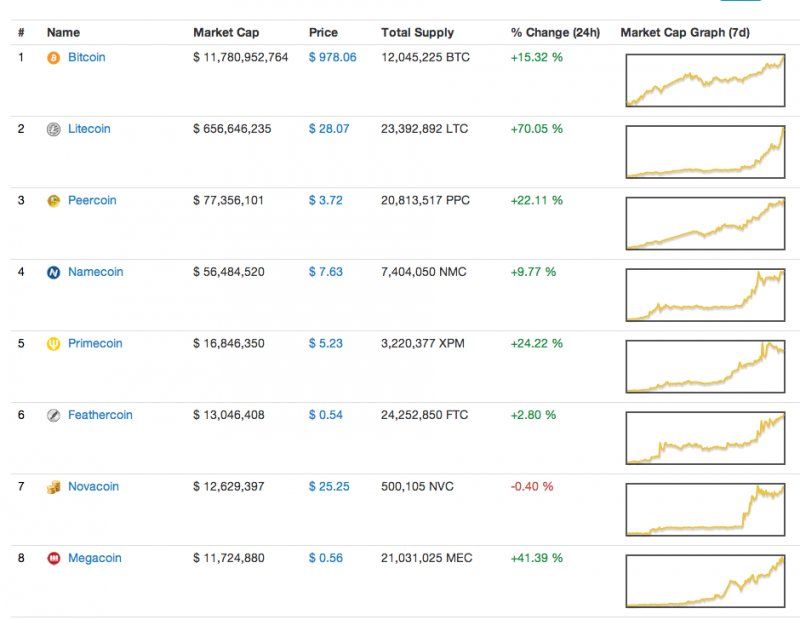
There are dozens of digital currencies that are all going insane right now
We just told you why another cryptocurrency, Litecoin, has been able to ride Bitcoin’s digital coattails to a 400% gain over the same period. But Litecoin is not alone.
According to that site, Peercoin, which now has the third-largest
market cap among digital currencies, is up 22% in the past 24 hours.
Peercoin‘s main feature is that it’s based on a protocol which, though
different from Litecoin‘s, achieves the same effect of preempting mining
cartels from forming and gaining too much control over prices.
Namecoin, with the fourth-largest market cap, is up 70% in the past
24 hours. Its principal attribute is that it exists outside the regular
Internet and therefore beyond control of The Internet Corporation for Assigned Names and Numbers (ICANN), the Internet’s regulatory body.
Open your free digital wallet here to store your cryptocurrencies in a safe place.
Korea announces favorable tax policy for Bitcoin
The bitcoin community in Korea is small, but growing, and it seems that governments around the world are taking the US Senate’s recent hearings as a signal to begin determining at least temporary policies regarding our favorite cryptocurrency.
Posted in Korea’s Bitcoin Community on Facebook is a statement from Korea’s National Tax Service stating that Koreans will not be taxed for capital gains on bitcoin for the time being.
While this is clearly good news for the few long-time miners in Korea as well as speculators that have experienced a windfall in the past month, it is important to remember that this is not a good long-term position toward bitcoin. Essentially, the Korean government is taking the stance that bitcoin investments are not real.
Currently, bitcoiners are happier to be left alone by the governments of the world and such a policy supports this in the long term. But if we hope to see bitcoin rise to a more commonly-accepted and competitive currency, we will need governments to recognize that BTC does, in fact, bear value and follow “safe and sane” regulatory procedures. While this is not the time to hold the argument over how much and what kind of regulation would be appropriate and positive, I think that most bitcoiners will agree that we don’t want it to be seen as monopoly money forever. Near-universal recognition and respect is needed.
Open your free digital wallet here to store your cryptocurrencies in a safe place.
Bitcoin defeats PayPal thanks to massive transaction of 194,993 BTC
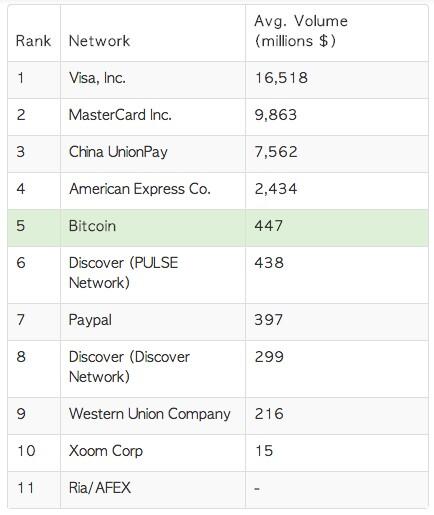
(BitcoinExaminer) The end of last week brought a symbolic milestone for Bitcoin. The cryptocurrency network recorded over $447 million in transactions in a single day, topping PayPal and Discover.
in the amount of daily transactions in US dollars and becoming the world’s fifth biggest payment network. Above cryptocurrency you could only find “giants” like Visa, MasterCard, China UnionPay and American Express.
 With the Bitcoiners getting curious, some experts discovered the transaction involved a large number of sending addresses. Some of them were from blocks mined in February 2010 or even earlier. Of course, it’s impossible not to think about Satoshi Nakamoto, Bitcoin’s mysterious founder.
Open your free digital wallet here to store your cryptocurrencies in a safe place.