Zcash Market Cap: top 10 cryptocurrencies
Zcash Market Cap climbed as much as $64.7m on April 4th, becoming one of the top 10 digital currencies by market capitalization.
This completely anonymous cryptocurrency was launched back in 2016 and it uses the so-called zero-knowledge proofs “zs-SNARKS” to help users hide their information during the transaction process.
In fact, the Zcash blockchain hides any information related to users and transaction amount, becoming one of the first completely anonymous digital currency together with Monero.
The major reason that helped to push zcash market cap is the rising supply of the protocol’s ZEC tokens, with the supply recently passing 1m ZEC.
While its token price rose to almost $6,000 after going live, the Zcash market cap grown only of about $1.9m.
Even if the current Zcash market cap fell back to twelfth place at press time, we expect it to rise again soon.
Zcash Wallet
Recently we at HolyTransaction launched our Zcash Wallet.
On our desktop wallet you can now store zcash, bitcoin, ether and more than other 20 digital currencies within the same login.
HolyTransaction, in fact, is a multicurrency wallet where you can buy and spend all the major cryptocurrencies, including: bitcoin, zcash, ether, dogecoin, litecoin, blackcoin, faircoin, gamecredits, tether, omni, decred, peercoin, gridcoin, dash and more, within the same account, allowing you to manage your cryptocurrencies in a safe and easy way.
Open your multicurrency wallet here.
Open your free digital wallet here to store your cryptocurrencies in a safe place.

Bitcoin Sweden regulation: the blockchain to record property deals
A new project for Bitcoin Sweden regulation has moved to its second phase. In fact, the Sweden’s land registry authority, the so- called Lantmäteriet, wants to use the distributed ledger tech with the main goal of recording property deals.
This project was conducted by the blockchain startup called ChromaWay and the consultancy group Kairos Future, that are also working in partnership with two banks: SBAB and Landshypotek.
Talking about the project’s potential, ChromaWay CEO Henrik Hjelte commented:
“It could be a great benefit for economic growth”.
Also, he said that Sweden is the ideal country to test a distributed ledger system for land titles, because trust in public authorities is higher than elsewhere and it could influence other countries to do the same in the next future.
Thanks to this system, a buyer and seller would open a contract where banks and the land registry can view the workflow of the deal, such as due dates for payments.
“In the blockchain confirmation of each step in the workflow is made with a hash, like the blockchain normally. Everyone has the same information and you can check it yourself,” said Magnus Kempe of Kairos Future.
Another use case for this project is the potential verification of an IOU issued by the bank to its property buyer.
“That part is going to be hidden for the others in the contract. You will only have the hash confirming from the bank that the IOU has been signed,” commented Kempe.
That said, SBAB Bank explaind it has no imminent plans to implement the blockchain:
“Our reason to participate in the project has not been to actually implement the solution in our current processes. But rather an opportunity for us to get a better understanding of the blockchain technology and how it might possibly fit in our future products/offerings.”
Bitcoin Sweden regulation: what is the EU doing?
Recently, the EU passed a directive that puts more weight behind digital signatures; a similar bill has been proposed in Arizona too.
Click here to read more about EU regulation related to bitcoin and blockchain.
A the moment, this land registry project is looking at new ways for working at this issue.
“Actually, the land registry today, they don’t receive much physical paper, they get PDFs of the contracts which are signed electronically so they don’t store the physical contracts. What we are thinking of is, you can actually sign the contract digitally in the blockchain to the land registry, they can award the land titles and then you can throw away the paper so you’re not dependent on the physical archive.”
According to ChromaWay’s Henrik Hjelte, the use of blockchain could be disruprive in order to manage ownership of property and improving transparency in real estate sales.
Open your free digital wallet here to store your cryptocurrencies in a safe place.

Blockchain regulation: Arizona recognizes it under state law
Another move has been made in Arizona in order to make Blockchain regulation more effective.
In fact, a legislature has creared a bill that would recognize the distributed ledger signature and smart contracts under state law.
At the moment the bill has been sent to the governor’s desk for a final approval.
As previously reported, this bill would make data tied to a blockchain “considered to be in an electronic format and to be an electronic record” in the US State of Arizona.
Also, the bill quotes specifically the Ethereum smart contracts, so there is a specific effort with the main goal of capturing new kinds of delivering information – the distributed ledger– under existing laws.
The bill explains:
“‘Smart contract’ means an event-driven program, with state, that runs on a distributed, decentralized, shared and replicated ledger and that can take custody over and instruct transfer of assets on that ledger.”
This bill was sent to sent to Governator Doug Ducey’s office on March 27th, after clearing the Senate by a 28-1 vote on the 23rd.
Even if it’s not so clear if or when the governor will sign the bill, its support suggests that this measure will see the light soon.
A few members of the legislature’s lower chamber, in fact, approved this bill unanimously previously this year.
This Arizona bill is similar to a legislation passed and signed in Vermont last year. There, lawmakers proposed to allow data embedded on a blockchain to be used in a court of law.
Click here to read more about Blockchain regulation worldwide.
Open your free digital wallet here to store your cryptocurrencies in a safe place.

IBM Blockchain Oil trade platform: a new innovative project
IBM – together with a group of other companies – has announced the development of a new blockchain-based crude oil trade finance platform.
This group also includes Trafigura and Natixis bank that decided to join the creation of this new tool.
The platform was created by using code from the Linux Foundation-led Hyperledger project. Also, IBM’s BlueMix cloud hosting service is utilized.
Thanks to this trade finance platform, users can view transaction data on the blockchain that also hosts documentation and updates on shipments, deliveries and payments.
Natixis is also a member of the R3 distributed ledger consortium and isn’t new to blockchain-related trade finance applications because it also joined the “Digital Trade Chain” project a few months ago.
According to, Natixis’ head of global energy and commodities, Arnaud Stevens, the bank believes the technolgy as a high potential of bringing down expense and boosting procedural transparency.
These are his words:
“We want to use blockchain to optimize the antiquated arena of commodity trade finance. The current process is paper and labor intensive, we have multiple friction points with high processing costs and limited automation. Distributed ledger technology brings some much-needed innovation into our industry.”
This news is only the latest related to projects that aims at bridging of the blockchain and trade finance worlds.
Also, we have to say that this is an application that attracted much interest from a wide range of companies and governments worldwide, including Dubai.
In the meantime there are also several other worldwide banks that are continuing to push ahead with related projects focused on the blockchain and commodities trade.
A few days ago, in fact, Dutch bank ING is working on an oil trading pilot built on the Ethereum blockchain that has already conducted live transactions.
Open your free digital wallet here to store your cryptocurrencies in a safe place.

Decred: the younger brother of Bitcoin
Decred (DCR) is a digital currency created back in 2015 by Bitcoin’s BTCSuite developers, an alternative full node bitcoin implementation written in Go.
“Decred uses a hybridized consensus system to strike a balance between miners and users to create a more robust currency”, as it was created both with proof of work (PoW) and with proof of stake (PoS).
This hybrid consensus system allows users to create a balance between proof-of-work miners and proof-of-stake users in order to have a much more robust consensus.
This relatively new cryptocurrency aims at addressing issues related to the increasing centralization of power within the bitcoin blockchain and the growing conflict of interest between the bitcoin community and those who fund the Bitcoin core project.
Also, it is important to say that Decred can be both mined and staked.
Why is another cryptocurrency needed?
When Bitcoin was originally released, it was working in a market that didn’t exist before. There were issues that could be fixed thanks to new digital currencies such as Litecoin or Dogecoin.
Of course, time is showing that Bitcoin is not a failure at all and it radically changed the idea of money.
Decred has several new features in order to combine the very best of proof-of-work and proof-of-stake chains with the main objective of utilising both systems in Decred.
Also, Decred defines itself as “self-funded and progressive” and it relies completely on a community governance and opensource features.
Decred developer Christina Jepson explained:
“The intention is not to attack what we currently have in Bitcoin. We want to recognize what has been done well, but instead, we want to take that and improve on what we think can be done better… That is the spirit that started the technology and we want to return to that to explore options to problems we cannot explore in the current system while we continue to support the Bitcoin software. Alternatives are progress and a way forward to improve the greater ecosystem.”
Decred Wallet
That said, if you want to start buying and selling Decred coins, you will need the right wallet to store them properly.
Recently, we at HolyTransaction added a new wallet on our platform in order to allow you to store your Decred right behind your bitcoin and more than other 20 digital currencies.
Within the same login, in fact, you can store all your cryptocurrencies in a safe place with low fees.
Open here your new wallet to store, buy and sell your favorite coins.
Open your free digital wallet here to store your cryptocurrencies in a safe place.
Decred Wallet: a new cryptocurrency joins HolyTransaction
We’re excited to announce that we’ve been working to provide you with a new service: a Decred wallet.
From now on, in fact, you can instantly purchase Decred through your Holytransaction wallet, transfer them to any HolyTransaction’s user for free, and make crypto-to-crypto transfers between Decred and more than 13 digital currencies.
All of our HolyTransaction users can create new addresses for Decred balances and use the simple HolyTransaction Web Wallet to send and receive transactions or to instantly convert them to any other cryptocurrency.
Just like Bitcoin and 12 other digital currencies, you can now:
- Send Decred to any address, even to addresses of other cryptocurrencies with instant conversion on the fly;
- Receive transactions;
- Exchange Decred with any supported coins;
- Make instant transactions between HT users;
- Get real time exchange rates on the website;
- Set up OTP for additional protection.
What’s Decred?

Decred (DCR) is a digital currency created back in 2015 by Bitcoin’s BTCSuite developers.
“Decred uses a hybridized consensus system to strike a balance between miners and users to create a more robust currency”, as you can read on their official website too.
This new digital currency aims to address issues related to the increasing centralization of power within the bitcoin blockchain and the growing conflict of interest between community and those who fund the Bitcoin core project.
About its technology, we have to say that Decred is a hybrid proof-of-work/proof-of-stake (PoW/PoS) digital currency that can be both mined and staked.
How to use the Decred Wallet
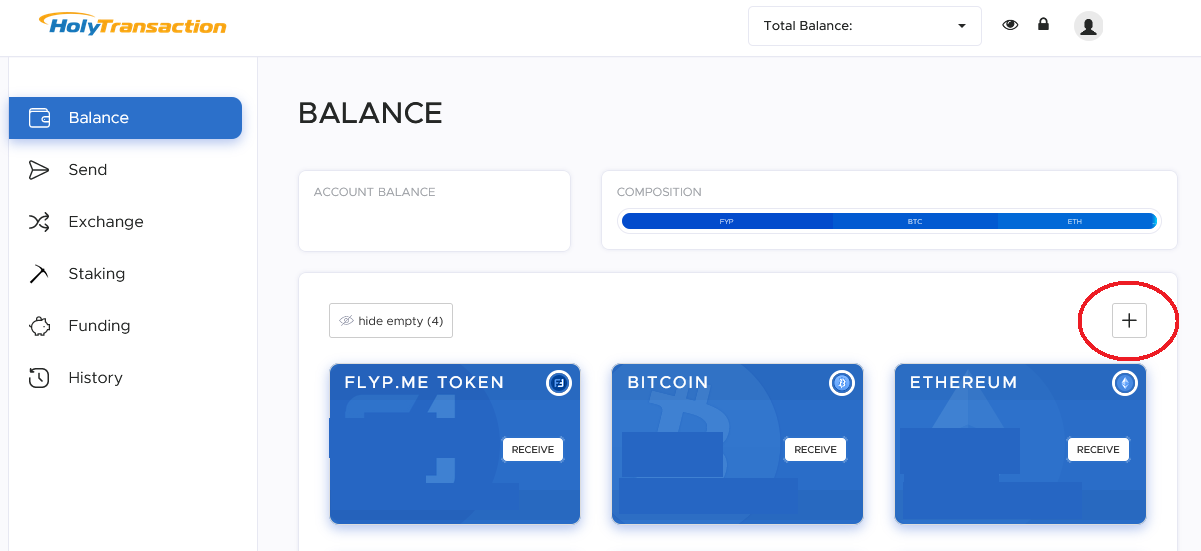
If you can’t see the newest Decred wallet, you just need to click on the “plus” button you find at the top right of the main page, once you have successfully entered your wallet.
You can find the “plus” button to select the wallets you want to see in the balance page, just like shown in the picture below.
Click on the image to enlarge it:
We are so glad to be part of this new community!
Open your new multicurrency wallet here. You just need 1 minute.
Open your free digital wallet here to store your cryptocurrencies in a safe place.
Bitcoin fork: why developers keep calm
Right now the debate about a possible Bitcoin fork is very noisy and maybe it is the main factor that is driving the cryptocurrency price at the moment.
At press time, bitcoin value is less than $1000 with some traders that are liquidating their positions.
Amidst one of the more volatile period of bitcoin, developers seem not to be scared or worried about this two-year scaling debate.
Several miners are running the so-called solution “Bitcoin Unlimited“, a popular alternative bitcoin software that opened a discussion of a possible fork of the network which could generate two different digital currencies, a result similar to what happened with the recent Ethereum hard fork that lead to the creation of Ethereum Classic.
Bitcoin Core contributor Eric Lombrozo has taken a skeptical point of view, explaining that the bitcoin community is not new to this issues.
Bitcoin XT and Bitcoin Classic, or other software alternatives that aims at changing the bitcoin blockchain- related rules, have emerged, but also declined, over the last few days.
While users who support the Bitcoin Unlimited think that is the real future for bitcoin, arguing that a bitcoin fork will bring it as the winning software, critics view it as broken.
Lombozo explained:
“The idea you can change bitcoin by lobbying one group of stakeholders against another is fundamentally flawed, as is the idea you can force controversial consensus rule changes. Bitcoin requires more tactful politics.”
On the other hand, Bitcoin Unlimited supporter Peter Rizun believes that bitcoin will see a block size increase, making bitcoin competitive with the other alternative cryptocurrencies.
“In my opinion, there’s a 75% chance we get an upgrade to larger blocks in 2017,” he commented.
So, while some people substain that only one software will be able to survive after this possible bitcoin fork, other experts suggested that most people won’t move to a new blockchain, so Bitcoin Unlimited will lead to another digital currency.
But, of course, the greatest part of the community want only one bitcoin.
Bitcoin Core contributor Luke Dashjr said to Coindesk:
“A hard fork is by definition an altcoin that the entire community decides to adopt as a replacement. Since most of the community rejects Bitcoin Unlimited, it is impossible for it to become a hard fork. Anyone can fork at any time. That people don’t speaks to the strong incentives not to.”
Open your free digital wallet here to store your cryptocurrencies in a safe place.

GameCredits will release its free to use API
Gamecredits Inc wants to change the cryptocurrency market, by releasing its free to use API.
Gamecredits is a digital currency payment solution that can be used within any videogame.
Developers who want to accept gamecredits payments can decide to reduce fees by up to 20%, eliminating chargebacks and increasing user deposit limits and payments speed.
Gamecredits provides all these benefits and takes 10% of game developers revenues, instead of the usual 30% charged by Apple, Google or Steam.
In order to avoid the current issue and let users change their habits starting to use digital currencies, Gamecredits offers several features, so gamers can find coupon codes for the cryptocurrency just by playing their videogames.
The announcement of the release of Gamecredits API comes after the recent announcement of Gamecredits Mobile Store that is set to launch this spring with more than 300 games that will receive instant access to the API.
You can buy or exchange your Gamecredits by using our wallet, as we at HolyTransaction recently integrated this digital currency into our platform.
By using HolyTransaction wallet, you will be able to:
- Send Gamecredits to any address, even to addresses of other cryptocurrencies with instant conversion on the fly;
- Receive transactions;
- Exchange Gamecredits with any supported coins;
- Make instant transactions between HT users;
- Get real time exchange rates on the website;
- Set OTP for additional protection.
Open your Gamecredits wallet here. You just need an email account and the process can be done in only 1 minute.
Open your free digital wallet here to store your cryptocurrencies in a safe place.

Nevada stops blockchain transactions taxes
A new bill has been proposed to the Nevada Senate and, if it pass, will stop local taxes and fees on the use of a blockchain ledger, both for payments and contracts.
Nevada Senate Bill 398 was filed yesterday and presented by Senator Ben Kieckhefer, who wants to create a legal level for the use of blockchain-based networks.
Notably, this bill will also stop local governments asking for taxes on the use of the distributed ledger or to require a special licensure in order to use it.
This new proposed bill explains:
“A local governmental entity shall not: Impose any tax or fee on the use of a blockchain or smart contract by any person or entity; Require any person or entity to obtain from the local governmental entity any certificate, license or permit to use a blockchain or smart contract; or Impose any other requirement relating to the use of a blockchain or smart contract by any person or entity.”
If this bill pass, its benefits won’t be applied only to these potential economic expenses.
Kieckhefer’s suggestion, in fact, will allow blockchain records to be used in proceedings, noting that “if a law requires a record to be in writing, submission of a blockchain which electronically contains the record satisfies the law”.
“A smart contract, record or signature may not be denied legal effect or enforceability solely because a blockchain was used to create, store or verify the smart contract, record or signature. In a proceeding, evidence of a smart contract, record or signature must not be excluded solely because a blockchain was used to create, store or verify the smart contract, record or signature,”the proposed bill states.
Last month a similar proposal was made in Arizona, or a further move to legitimize the use of blockchain distributed ledger; a previous effort was also proposed in Vermont back in 2016.
Open your free digital wallet here to store your cryptocurrencies in a safe place.

Bitcoin exchange regulation in China
Soon a new bitcoin exchange regulation in China may be required to ensure know-your-customers (KYC) verifications.
According to an article published by Caixin, the People’s Bank of China issued a new paper for the Chinese exchanges on which it is looking for comments for the proposed regulation.
This move is part of a effort by the Chinese central bank in order to have a bitcoin exchange regulation and avoid money laundering and other financial crimes.
According to the official press release, this paper explains both a regulation related to the anti-money laundering (AML) issues and the creation of a customer identification system.
Bitcoin users will have to own an on-site certification if they want to deposit funds. To do se, they will have to present identification at the time of registration. Also, for clients who hold more than ¥50,000 (over $7,200) in volume, a remote video certification will be required to authenticate their own identity.
The document also contemplates that there must be a senior management team who controls AML procedures and reports dubious transactions.
This news come after the PBoC’s decision made back in January that indicates to intervene in the Chinese bitcoin market during this period of heavy bitcoin price volatility.
Since then, bitcoin exchanges started to implement several new policies, ending margin trading and freezing withdrawals for a few cryptocurrencies.
At the moment, while I’m writing this article, bitcoin Chinese exchange withdrawals are still frozen.
Open your free digital wallet here to store your cryptocurrencies in a safe place.