Wallet Zcash: how to store Zcash
We always work to provide you with a better service, and now we are glad to announce our new Wallet Zcash.
We are very proud about this new implementation for storing safely this disruptive digital currency.
So, from now on you can instantly purchase Zcash through your own Holytransaction wallet, transfer them to any HolyTransaction’s user for free, and make crypto-to-crypto transfers from/to Zcash, and 12 cryptocurrency’s networks.
All HolyTransaction customers can create a new address for their own Wallet ZCash and use the simple HolyTransaction Web Wallet to send and receive transactions or to instantly convert them to any other supported cryptocurrency.
Just like Bitcoin and 11 cryptocurrencies we currently support, you can now:
- Send ZCash to any address, even to addresses of other cryptocurrencies with instant conversion on the fly;
- Receive transactions;
- Exchange Zcash with any supported coins;
- Make instant transactions between HT users;
- Get real time exchange rates on the website;
- Set OTP for additional protection.
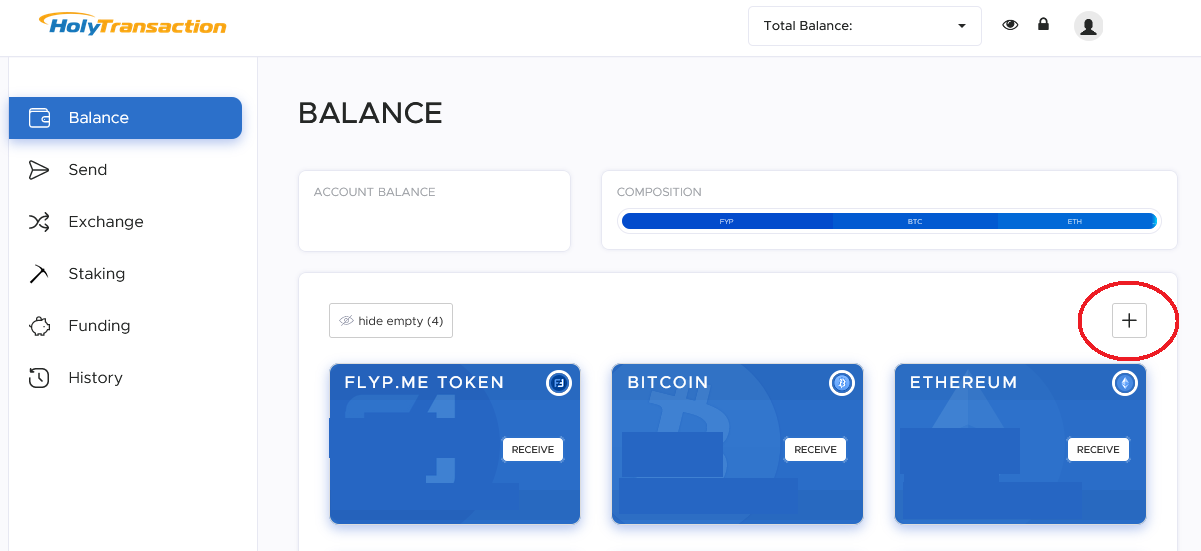
If you can’t see your newest Wallet Zcash, you just need to click on the “plus” button that you find at the top right of the balance page, once you successfully enter into your wallet.
You can use the “plus” button to select the wallets you want to see in the main page like shown in the picture below.
We’re really excited to be part of this new community!
NOTE: on our multicurrency wallet you can store 21 digital currencies, including: Bitcoin, Dash, Ethereum, Dogecoin, Faircoin, Gamecredits, Litecoin, Dogecoin, Blackcoin, Gridcoin and Zcash, among the others.
Open your free digital wallet here to store your cryptocurrencies in a safe place.
Value of Bitcoin: the digital currency’s higher price
The value of bitcoin has grown a lot in the last period, reaching its all-time high set back in 2013.
According to the CoinDesk Bitcoin Price Index, at the moment the value of bitcoin is less than $30 below the maximum ever value of $1,165.89 reached on November 30th, 2013.
This latest rise comes after bitcoin’s longest ever period at over $1,000, and a period of average volatility during the recent few months.
Also, this high might reflect the traders and investors confidence in an industry field that has been recently affected by the Chinese central bank’s plan to restrict the Chinese bitcoin exchanges environment, with the result of several of them to temporarily stop any withdrawals of the digital currency.
Click here to better understand what gives Bitcoin value with an infographic.
Another possible news to having an influence on the value of Bitcoin is the currently SEC decision on the Winklevoss brothers’ bitcoin ETF – an event that some experts explained that traders are already pricing in a potential approval.
On March 11st we could see the approval of the first bitcoin ETF within the U.S.A. market, opening the virtual currency to a larger group of investors.
However, many experts in the industry cannot see a high propension of financial regulators to approve this move.
For more charts about the Value of Bitcoin in the past, click here.
Open your free digital wallet here to store your cryptocurrencies in a safe place.

Blockchain investments: all the fintech services in one infographic
From American Express to Goldman Sachs and Deloitte, a lots of financial firms decided to make blockchain investments.
To provide you a insightful and easy to read, we want to share with you the following infographic originally published by CB Insight.
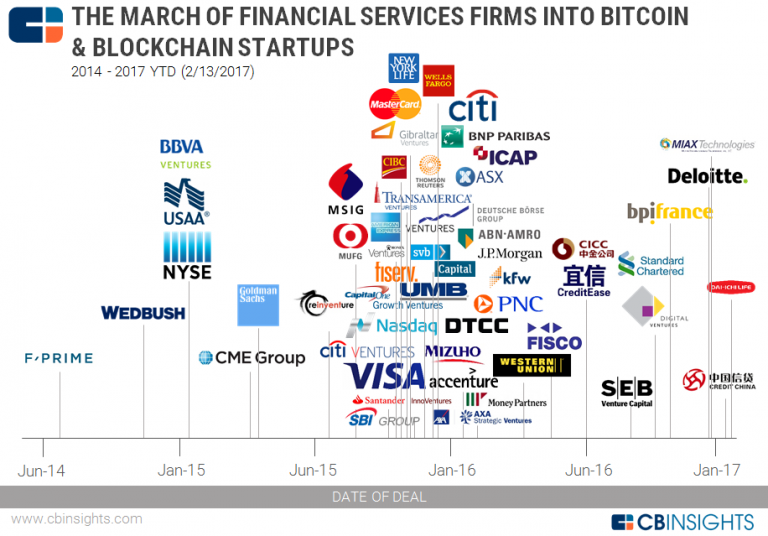
Consortia are not included in this infographic.
Even if the quarterly deal activity reached its lowest point since Q2’14 in Q4’16, the quarter’s top two financing deals featured investments by the most important financial companies.
This way, Axoni saw Wells Fargo lead its $18M Series A, which included a few important investors such as JP Morgan, Goldman Sachs, F-Prime Capital and Thomson Reuters.
During the last 3 years, blockchain investments reached their apex in the fall of 2015 and in the winter of 2016.
Recently, Deloitte, Miami International Holdings (MIAX) and Credit China placed their first blockchain investment and Deloitte took a corporate minority stake in a platform called SETL.
In total, more than 50 financial companies decided to invest in a bitcoin or blockchain-related startups since the beginning of 2014.
Also, it is important to note that a small group of blockchain startups received the greatest part of the total investment. Those – who have received nearly $625M in funding – include: Ripple, BitFury Group, Blockstream, Digital Asset Holdings, and Chain.
Let’s see what happen in 2017 and stay tuned for more relevant news!
Open your free digital wallet here to store your cryptocurrencies in a safe place.

Europe Bitcoin report published by the EU Parliament. Read it here.
Below you can read the full Europe Bitcoin research published by the European Parliament a few days ago.
It is related to the blockchain technology and digital currencies, exploring distributed ledger use cases including digital payments, patent protection, smart contracts and online voting.
This research provides an educational point of view for EU’s legislative members, so probably we will experience a new Bitcoin regulation in the next future.
Researchers who works at the EU Parliament have studied several aspects of the distributed ledger in the past.
For example, a working group sponsored by the Parliament studied how the blockchain’s power to secure data could provide transparency during elections.
“Although blockchains are not the solution for every problem, and even if they will not revolutionize every aspect of our lives, they could have a substantial impact in many areas, and it is necessary to be prepared for the challenges and opportunities they present.”
“Europe Bitcoin” paper
The research suggests a few possible approaches for the European lawmakers, who recently approved the creation for a new task force focused on blockchain and digital currencies.
Also, the paper suggests more future explorations by saying that regulators could regulate and yield legal legitimacy to digital currencies transactions. More and more countries are regulating bitcoin and other virtual currencies during the last few monts.
The document’s authors explained also that this revolutionary techbology could provide many benefits to European citizens, even if it seems to be applicable only in a few cases.
“While the most idealistic and revolutionary visions of blockchain development will probably remain no more than visions, even moderate implementation of blockchain may still promote some degree of redistribution and transparency,” explained the authors in the document.
Click here to read the full Europe Bitcoin document for free.
Open your free digital wallet here to store your cryptocurrencies in a safe place.

Bitcoin regulation is necessary for its success, said Bank of Canada
According to a recent paper published by Bank of Canada, researches explain that Bitcoin regulation is necessary for it to reach worldwide success.
A paper published this week, in fact, suggests that digital currencies like bitcoin won’t succeed in the long-term without any government support.
To write this research, experts examinated the viability of virtual currency, looking to previous examples of Canadian currency such as the so-called “Dominion” as a guide.
This is not the first time Bank of Canada is involved in blockchain and bitcoin-related projects.
A few months ago, in fact, we saw Bank of Canada involved in the so-called “Project Jasper” to develop a prototype system for issuing a bank-backed digital currency and a payment system using the technology.
While we are still waiting to know more details about Project Jasper, the just released paper explains a common thinking among central banks on the topic of cryptocurrencies: bitcoin and other private digital currencies need goverment support to succeed.
“We conclude that well designed and managed private digital currencies could circulate widely but only with appropriate government regulation to ensure their safety, soundness, and uniformity.”
Bank of Canada has already expressed its concern about digital currency, saying a few years ago that digital money popularity could reduce the effectiveness of monetary policy.
“A central bank can always get its digital currency into circulation, but its digital currency will not necessarily drive out existing private digital currencies,” wrote the authors of the paper.
Bitcoin regulation worldwide
From Poland to Denmark, from Switzerland and Japan, several countries all around the world are working on Bitcoin regulation projects.
Recently European Commission created also a task force to study and regulate digital currencies and the blockchain within the whole country.
Click here to read more about Bitcoin regulation in Europe and beyond.
Open your free digital wallet here to store your cryptocurrencies in a safe place.

Blockchain Regulation in Europe: everything you need to know
Today I want to explain you everything you need to know about the Blockchain Regulation in Europe.
Recently, in fact, the executive arm of the European Union government revealed that is working on the blockchain to “support” distributed ledger-based projects.
According to this new official press release published on February 7th, the Commission is looking for growing its efforts on supporting more projects related to the distributed ledger technology (DLT).
The European Commission is “actively monitoring Blockchain and DLT developments” and is working on exploring “DLT benefits and challenges as well as fields for application in financial services”.
Also, the official press release explained that the Commission wants to “pilot projects to foster decentralised innovation ecosystems and help reshape interactions between consumers, producers, creators and among citizens, businesses and administrations to the end benefit of society”.
A task force for Blockchain Regulation
Last year, the European Parliament also created a new task force led by the Commission, to study the blockchain.
This task force has not only the goal of studying the blockchain but also to support projects related to the ledger and studying a way for a blockchain regulation.
The European Commissioner for Digital Single Market and Vice President of the European Commission, explained:
“The Commission is already supporting distributed ledger tech-enabled projects (DECODE, D-Cent, MyHealth MyData). Support activities are going to increase in the coming months (e.g. Decentralised Data Management). A study will be launched to investigate how DLT can help in reshaping public services and preparing for EU specific DLT actions to address relevant EU challenges.”
Ansip also said that the Commission will collaborate with the Parliament to organize blockchain events and workshops.
“The Commission will organise a kick-off conference with the European Parliament on Demystifying Blockchain and a series of workshops to look at Blockchain developments and use case applications”.
Open your free digital wallet here to store your cryptocurrencies in a safe place.

Matchpool: a blockchain startup to find love
Of course everybody knows that today we celebrate Valentine’s day, so I want to dedicate this article to the blockchain startup called Matchpool that aims at helping you to find love.
“When I looked at the dating industry, I saw it was expensive to reach a critical mass of users and open a niche dating site. That’s why dominant sites are one-size-fits-all, but that’s not what most of us look for.” explained Yonatan Ben Shimon to Coindesk.
He is the founder and CEO of Matchpool, a new blockchain-based startup for dating with the main goal of bringing people together thanks to a matchmaking system: successful matchmakers earn a cryptocurrency reward for their work.
The unique selling proposition of Matchpool is combining together elements from traditional matchmaking with the transparency of Ethereum smart contracts.
Those potential matchmakers start pools, groups of users linked by a common interests – similar to Facebook groups – where users can private message one another in the hope of finding the right match.
Pool owners can monetize their matchmaking work in a few ways, including setting a membership fee to join or charging an amount for each message sent.
Also, they can try to maintain group diversity by setting smart contract-based options between different user attributes: for example, a 50/50 male-female split or a balanced age range.
Rather than using the everyone-for-themselves, search-and-filter strategy of platforms such as OKCupid, you can define Matchpool as a different approach to dating.
Matchpool tokens for dating rewards
But why is Matchpool wants to create its own cryptocurrency token?
Ben Shimon explained that his company was attracted to the idea of using a blockchain-based database to store data about user interactions so they can be difficult to edit.
He thinks that cryptocurrencies can be an attractive option if the objective is rewarding users with small amounts of money (micropayments) on a regular basis, especially if compared to traditional gateway of payments.
Also, Matchpool’s token called Guppy will be used to attract users: 20% of the token supply will be used to incentivize new signups with a money prize – which for the time being will only be given to women.
“I believe that if we reward early users with real money – in a way that we couldn’t do with dollars – then we can cheaply overcome the initial barriers that come from the lack of network effect”.
With a token sale (also called “initial coin offering” or “ICO”) scheduled for March, and a launch date set in May, Matchpool won’t wait too long to see its results.
Open your free digital wallet here to store your cryptocurrencies in a safe place.

Gamecredits wallet: the ultimate guide about Gamecredits
A few days ago we at HolyTransaction decided to allow you to store a new digital currency on our platform, by creating a Gamecredits wallet.
Gamecredit is a new payment gateway for the gaming industry that aims at avoid limitations and challenges linked to the traditional payment solutions.
This digital currency is backed by its blockchain (proof of work), providing gamers and gaming companies with a variety of unique benefits such as:
- Variable coin value;
- Security;
- Large deposit limits;
- Pseudononymity;
- Possibility to transfer currency from game to game.
With a genesis block created back in 2014, Gamecredits was developed by a team of developers and game lovers that launched their innovative payment solution in the popular game called Fragoria, a 8 million player RPG (Role-Playing Game) designed by Datcroft Games.
The VP of Development at GameCredits and owner of Datcroft Games, Sergey Sholom explained:
“As a Game developer I experience many problems with traditional payment methods. These problems include chargebacks/fraud, payment processing periods, and consumer deposit limits”.
In fact, traditional payment methods often take a few days to process transactions and your deposit limits can be very low.
GameCredits allow you to process payments in minutes and give players higher purchasing power, so you can enjoy transferability and control over cash flows.
Also, according to the recent article published by Forbes you can read here, Gamecredits could be able to popularize cryptocurrencies all around the world.
In the next future, Gamecredits will also launch a new mobile store, or a blockchain based mobile game platform where you will find over 300 games from 150 different game developers. This app will be available in early second quarter 2017, as revealed in a press release.
Gamecredits Wallet
As I said, HolyTransaction is very proud to include this new digital currency among its multicurrency wallet.
From now on, in fact, you can store your Gamecredits on our platform.
Just like Bitcoin and our other digital currencies, you can now:
- Send Gamecredits to any address, even to addresses of other cryptocurrencies with instant conversion on the fly;
- Receive transactions;
- Exchange Gamecredits with any supported coins;
- Make instant transactions between HT users;
- Get real time exchange rates on the website;
- Set OTP for additional protection.
So, HolyTransaction multicurrency wallet can now support: Bitcoin, Litecoin, Dogecoin, Ethereum, Dash, Tether, Blackcoin and the recent added Gamecredits and Faircoin.
Open your Gamecredits wallet by clicking here.
Once you successfully enter, if you can’t see the newest Gamecredits wallet, you just need to click on the “wheel” button you find at the top right of the main page. You can find the “wheel” button to select the wallets you want to see in the main page.
Open your free digital wallet here to store your cryptocurrencies in a safe place.

Blockchain Properties: bitcoin tech to verify property transactions
One of the major use cases for the distributed ledger can be identified as “blockchain properties“, or the way to register and verify property transactions on the blockchain.
A few days ago, the first government to do so was Georgia that signed an agreement to use the blockchain to verify property transactions by using the well-known company BitFury services.
This is the first time that an American government uses the distributed ledger to prove and authenticate national operations using this disruptive technology.
Government on Blockchain
The private blockchain ledger that is an alter-proof ledger is also provable using the core bitcoin Blockchain that is in the public domain.
The Georgian National Agency of Public Registry and BitFury wrote a memorandum of understanding trying to find how to extend services to new land titles registration, property demolitions, mortgages, purchases and sales of land titles, rental and notary services.
There are a few other ideas focused on Blockchain land title services also in Sweden, Honduras and Cook County in Chicago which are being developed by ChromaWay, Factcom and Velox too.
Magazines also revealed that Peruvian Economist Hernando de Soto is involved with the Georgian Blockchain properties project too.
De Soto, in his book Mystery of Capital, estimates that there is “dead capital” of $20 trillion globally, consisting of buildings and lands without legal title.
Blockchain Properties on mobile
Tea Tsulukiani, Georgia’s Minister of Justice, commeted that she is very proud and happy that her country will work with the blockchain technology with the goal of having real estate quotations in a completely safe and secure system.
Also, chairman of the Georgian National Agency of Public Registry commented in a press release that he is “very pleased with the technical progress and looks forward to continuing their fruitful collaboration.”
BitFury CEO Valery Vavilov explained that the Georgian government is excited about the whole project and the methods used. Also, he continued by explaining that all the changes were executed for the citizens of Georgia, so they can track if a title is authentic when it is entered into the system.
The software is going to be completely operational during this year, he said.
“The big goal is to move the process to smartphones, so people can use it in any moments and all transactions are secured, transferrable and accountable.”
Applied on properties management, the Blockchain technology maintains agreements in a few ways: in blockchain-based entries, records are time-stamped and this system would allow members interested in a property to verify and establish the date of previous sales.
Open your free digital wallet here to store your cryptocurrencies in a safe place.

Fair Coin Wallet: everything you need to know about this cryptocurrency
HolyTransaction recently added a Fair Coin wallet system on its multicurrency wallet, so we want to make sure you know everything you need about this digital currency.
Faircoin is a digital currency that strives to have low fees for its users, by implementing the Proof-of-Cooperation system by the end of 2017, Faircoin aims of becoming the most ecological and resilient cryptocurrency, providing a safe and fast method of payment all around the world.
Faircoin History
Faircoin history started back in 2014 when an anonymous developer created it. A few weeks later he/she abandoned the project, but Enric Duran retrieved the digital currecny with the help of Thomas König.
50 million faircoins were created and during the 6th and 8th of March they were distributed through an ‘airdrop’, or a massive gift of 1000 FAIR per hour to all those who registered.
In this way, Faircoin was distributed to promote equality over financial possibilities.
Faircoin as a social tool
By using Faircoin, Enric Duran built a new project called FairCoop, a free worldwide cooperative that organizes itself through the web, outside the limits and controls of the State, as the group aims at create an alternative global economy based on ethic and solidarity, reducing financial and social differences among people.
What really makes Faircoin different from other currencies is its specific use as a tool for FairCoop: this cryptocurrency acts as a FairCoop value’s reserve and redistribution of capital in socially and environmentally coherent projects.
Faircoin aims at overcoming the limitations of social currencies that are designed for local use and not interconnected as they are still related to fiduciary money and can suffer the same ups and downs.
Faircoin is one of the most ecological cryptocurrency because it doesn’t need big computational resources to generate new currencies.
Technical features
On a security level, Faircoin uses the blockchain: every 5 minutes there is a POW block and every 10 minutes a POS block. Thus, the two systems are combined together to provide the best result in each method and to avoid the complete control of the cryptocurrency from the Proof-of-Work.
In the next upgrade Faircoin 2: with Proof of Cooperation (POC), will go further, and the energy efficiency will be big, as no more coins will be created.
The first block contains 50 million coins mined, distributed initially to all the registered people, avoiding that only people with capital or mining resources could access them.
Fair Coin Wallet
For these reasons, we at HolyTransaction decided to include a Fair Coin wallet among our services.
We think that it is a digital currency with important goals and objectives, so we wanted to let you use FairCoin on our platform.
Just like Bitcoin and the other cryptocurrencies we already have, you can now:
- Send Faircoin to any address, even to addresses of other cryptocurrencies with instant conversion;
- Receive transactions;
- Exchange Faircoin with any supported coins;
- Make instant transactions between HT users;
- Get real time exchange rates on the website;
- Set OTP for an additional protection.
To know more about the new functions of our wallet and to manage your FairCoin Wallet, click here.
FairCoin and a fair economic system from Radi.ms on Vimeo.
Open your free digital wallet here to store your cryptocurrencies in a safe place.