
Tag Archives: bitcoin

shutterstock 113057557 630x402

Under the microscope: conclusions on the costs of Bitcoin

Hass McCook is a chartered engineer and freshly minted Oxford MBA. He has been researching bitcoin over the past several months and recently joined the Lifeboat Foundation’s New Money Systems advisory board.
This, the final instalment in his five-part series, evaluates the relative sustainability of the bitcoin network against the costs of gold production, the printing and minting of physical currency and the legacy banking system.
Under the Microscope has aimed to cast a critical eye over the social, environmental and economic impacts of the way we currently transact and transfer wealth, be it through legacy systems like gold and fiat currencies, or through newer digital cryptographic ones.
The series has also endeavoured to give readers a clearer idea of the human and environmental impacts associated with both current and future monetary systems, and allow them to draw their own conclusions on the relative sustainability of the old and new systems when viewed from a holistic “triple-bottom-line” approach.
Although it is not necessarily fair to compare bitcoin to the entire legacy banking system, there was doubt in the community about the impact of the legacy banking system, and thus, it has been quantified for completeness.
It should be noted that the only thing involved in bitcoin mining is electricity use, and as the world moves towards clean and renewable energy, Bitcoin will have even less of an impact on the environment (See Koomey’s and Moore’s Laws). There is also much larger scope for energy efficiency improvements in integrated circuits and computing than there are in gold recycling.
As can be conclusively seen, the relative impact of the bitcoin network does not even register on the radar of the fiat and gold-based monetary systems, representing a very conservative relative environmental impact of just over 0.13%, and a relative economic impact of just under 0.04%. When one considers Koomey’s Law, we can expect energy/GH to continue to half every 18 months until 2048.
This means that we can expect our current industry best efficiency of 0.733 W/GH to reach 0.0000000873804 W/GH. Thus – armchair academics take note – in the event that bitcoin scales to a million times its current size and market cap over the next 30 years, it’s environmental impact will still be insignificant compared to existing systems.
When considering Moore’s Law, we can expect $/GH to continue to half every 18 months until at least 2020. When we consider the advent of decentralised emission-free renewable energy, we can expect tCO2/GH, and possibly even $/kWh, to tend towards zero.
The more agile and dynamic bitcoin companies can take advantage of these trends, but the sluggish, inert and over-encumbered incumbents simply cannot. As time goes on, bitcoin only becomes more sustainable, while legacy systems continue to bloat year-on-year.
There are no negative social externalities as a result of bitcoin proliferation, and any money laundering and shadow economy dealings that currently happen on the network will reduce drastically in proportion as adoption grows and regulations firm up on the on-and-off ramps into the bitcoin economy.
Rome wasn’t built in a day, and the crypto-currency space will take time to evolve to ensure that the issues faced and created by our legacy monetary systems do not continue to plague us for the next century and beyond.
It has been demonstrated that institutional fraud is a problem systemic to humans, and not to monetary systems. However, transactional fraud is only a problem in legacy systems due to the infallibility of the fact that 2 + 2 will always equal 4.
Although this paper has shied away from all of the ideological and philosophical debates surrounding bitcoin, what is clear is that the argument that bitcoin is superior monetary system – from the benefits and protections it provides to merchants and consumers, to the relative lack of negative impact it has on our planet and humanity in general – is a strong one.
The world is currently crippled by several issues, and the human race faces several existential threats such as climate change, the global ageing population demographic crisis and wealth and income inequality.
It is also unacceptable in 2014 to still have tens of millions of people forced into labour, and current monetary systems are somewhat responsible for several of the social ills brought about by corruption, money laundering and the black market.
For those who are willing to back their principles and morals with their money, bitcoin provides the opportunity for socially, environmentally and economically conscious global citizens to choose to no longer participate in the fragile and rotten legacy monetary system, and voluntarily participate in the open and wondrous bitcoin ecosystem.
Due to the several benefits and significantly reduced burden on our planet and society, there is a certain feeling of inevitability about digital currencies, whether it be bitcoin, or a future currency that proves to be even more sustainable and beneficial for humanity.
You can read Hass McCook’s paper ‘An Order-of-Magnitude Estimate of the Relative Sustainability of the Bitcoin Network‘ (on which this series is based) in full here.

Open your free digital wallet here to store your cryptocurrencies in a safe place.
Satoshi

Bitcoin: Education can make a difference

(TheHill) Every so often, a transformative new technology emerges that has the potential to affect everyone on the planet. But whether the technology’s potential is realized or or not depends heavily on public opinion. Positive coverage can encourage people to embrace innovation, while negative stories can make them avoid something new — or even encourage governments to legislate against it.
We’ve seen such controversies around issues like stem cell research or genetically modified foods. Some people praise their potential for curing diseases or feeding billions of people. Other people warn that these allegedly unsafe and untested technologies could be hugely damaging.
A similarly polarized dynamic has now arisen around Bitcoin, a new technology that has the potential to become a global money for a global economy. Bitcoin combines the advantages of instant online payment (like PayPal) with being a store of value (like gold). At its core is a powerful cryptographic technology called the “blockchain,” which Jeff Garzik, one of the Bitcoin protocol’s core developers, describes as an elegant and unexpected solution to distributed systems: how computers talk to each other, and how to keep them coordinated.
Many people believe that Bitcoin can make our financial system cheaper, faster, and safer. Yet, coverage rarely focuses on these benefits. Instead, stories about money laundering, drug trading, exploded exchanges, and price crashes predominate the news cycle, to the point where many people are inclined to see Bitcoin as an undesirable phenomenon. A recent Reason-Rupe poll shows that although only a small minority (8 percent) of people say that they really understand Bitcoin, the majority (56 percent) want the government to ban it.
So why are some people so positive, and others so negative?
Support for Bitcoin often comes from tech visionaries. Paul Graham, a prominent venture capitalist, refers to Bitcoin as a paradigm shift that is unfortunately “derided as a toy, just like microcomputers.” Entrepreneur Marc Andreessen has written that the potential of Bitcoin today is analogous to personal computers in 1975 and the Internet in 1993. Today, it’s the preoccupation of “nerds,” but tomorrow it can change the life of everyone. Indeed, Bitcoin is already starting to become a mainstream phenomenon, with tangible benefits for ordinary people.
Bitcoin’s critics commonly mention its role in money laundering and corruption, epitomized by the infamous underground online market Silk Road. But they often fail to mention that any currency can be used for socially undesirable purposes. In theory, Bitcoin is easier to track and regulate than paper cash, so we have legitimate reason to believe that Bitcoin’s wide adoption would lead to less criminal activity, not more.
Consider, too, that there are 2.5 billion unbanked people in the world, equivalent to eight times the population of the United States. Just by giving them access to a cell phone and Bitcoin, we have potentially added 2.5 billion people to the global economy. Furthermore, with Bitcoin, people can send money anywhere in the world, without crippling bank fees or fear of government extortion. When we consider that the World Bank expects migrants to send $436 billion in remittances to their home countries this year, the advantages could be enormous.
On top of this, you can now use Bitcoin at an increasing number of retailers. Seemingly every week, a new brand-name retailer is added to the list of merchants who accept Bitcoin, which now includes the likes of Overstock, Expedia, and OkCupid. This makes Bitcoin a credible and desirable currency in the developed world, as well.
In response to the fearmongering and lack of credible information about Bitcoin, I started an educational platform called “Bitcoin Girl” — but that’s really just the start of what we should be doing. If we want to prevent negative public opinion and uninformed legislation from crippling Bitcoin in its infancy, we need to educate the people who understand humans better than computers.

Open your free digital wallet here to store your cryptocurrencies in a safe place.

Satoshi

Bitcoin: the future of payments

The implications of bitcoin’s effect on consumer finance, investment and banking are not fully understood, a new report from Innopay suggests.
(CoinDesk) The payments and transaction service consulting firm explored the nature of digital currency and its impact on a broad range of market sectors, tapping everyone from European central bankers to core members of the bitcoin community for insight. At its heart, the Innopay report points to a broad awakening within the global economy to the benefits of bitcoin and its underlying technology, but acknowledges that ignition remains held back by and large.
Apprehension about the security and stability of bitcoin, especially among banks, large companies and a broader subset of consumers keeps the clear benefits of digital currencies from achieving mainstream usage. The experts interviewed by Innopay agree that bitcoin will deeply affect how people transact with one another, but remained split on how digital currency technology will manifest in the years ahead.
Economist and CoinDesk contributor Tuur Demeester told Innopay:
“Just like the Internet has broken open the information market, one can expect the same paradigm shift to occur with cryptocurrencies on the financial market.”
Digital currencies were also seen through the lens of regional financial crises, consumer technology and the future of the internet. The rules of global finance, the Innopay report explores, could be fundamentally rewritten by the likes of bitcoin and other currencies.

Payments networks revisioned with bitcoin

One area explored in the report is the concept that bitcoin can change how businesses and consumers pay one another. At the center of this, Innopay notes, is the change in how financial parties trust one another. The evolving nature of this trust structure carries the potential for significant benefits – and complications.
As Demeester remarked, the number of bitcoin transactions continues to grow steadily but this fact does not preclude traditional payments networks from maintaining a significant role by comparison. However, he said that many of the core services offered by banks may be facilitated more cheaply and efficiently with digital currencies, suggesting that banks are at risk of market loss for their inaction.
He said:
“The traditional financial system is being challenged to step up their game in terms of efficiency because the bitcoin environment is removing middlemen.”
Others who spoke with Innopay were less convinced.
Kim Gunnink, an official with the Dutch Central Bank’s Payments Systems Policy Department, said that the central bank views bitcoin usage today as “a fad”. Gunnink argues that bitcoin’s performance as a type of money is poor overall, citing its fluctuating value as a critical flaw that makes it ineffective as both a unit of account and a store of value. As well, the official said that the future of bitcoin transaction fees could pose a long-term issue.
On the other hand, Gunnink noted the growing influence of digital economies among businesses and consumers, leaving the door open for the technology to grow in usage. Gunnink added that the addition of new services and avenues for digital currency acquisition would ease adoption, saying:
“Cryptocurrencies could be gaining ground in the field of cross-currency payments, as a growing payment method for global online purchases or peer-to-person payments. To what extent this growth will become a reality is still unclear.”

Why bitcoin is held back

Innopay’s report also confirmed what many other observers have said about the barriers to bitcoin’s success. A mixture of uncertain regulation, poor consumer information and complicated means to acquire bitcoin makes it difficult for broader use to take off.
Dave Birch, a director for IT advisory firm Consult Hyperion, remarked that governments remain cautious about passing definitive legislation about bitcoin because they both lack understanding of its underlying technology and fear missing out on future tax revenue. However, he predicted that governments will eventually see bitcoin’s potential to create “a dynamic and efficient economy”.
A lack of bank participation makes the situation even more untenable, but according to the report, bitcoin technology may one day find a strong ally in the global banking sector. Owing to the need to update legacy money networks worldwide – and the possible erosion of their core services – banks may have little choice but to embrace bitcoin.
However, it’s likely that this shift will manifest in the utilization of the protocol itself rather than bitcoin or another digital currency. But this isn’t necessarily a problem for bitcoin, as Innopay itself notes in the report’s conclusion:
“The quest to find better ways to do transactions often leads to innovations that open up opportunities, like we have seen in other industries and with other technologies.”

Open your free digital wallet here to store your cryptocurrencies in a safe place.

Satoshi

Bitcoin vs. banking: an infographic

There’s no denying that Bitcoin is changing the way we think about the financial market and investors are finally getting on board.
Companies that specialize in buying and selling gold have made announcements that they will be expanding into Bitcoin. According to Richard Waters, a writer in the Financial Times, reported A-Listers in Silicon Valley are climbing onto the bitcoin bandwagon.
Perhaps even more notable is what Hikmet Ersek, the CEO of Western Union, had to say during an interview with Bloomberg. Mr. Ersek expressed a willingness to accept Bitcoin into Western Union’s portfolio if, and that’s a big if, bitcoin becomes regulated like other currencies.
Right now Bitcoin transactions are equal to only 0.7% of the credit card transaction in the U.S alone.
There is still plenty of room for cryptocurrency to grow into. In 2013, there were $11.2 billion dollars worth of transactions in the U.S per day, compared to bitcoins $78.2 million worldwide. That number is up 183% from last year and a whopping 437% from two years ago.
Credit Cards go through four processes before a transaction is approved while bitcoins go through only three. If you store your money in a traditional bank, you risk bank runs, inflation and deflation due to government actions. Bitcoins main concern for risk is someone breaking into a wallet without proper preventative measures, such as encrypting your wallet, and your coins being taken.
All this information and numbers can get confusing and are difficult to find. Thank to Visual Capitalist, you can have it all in one place. Visual Capitalist merge art, data and storytelling to create a coherent and continuous infographic. Recently the people at Visual Capitalist have created an infographic that explores and explains the difference between Bitcoin and traditional banking. The infographic is entitled “Bitcoin vs. Banking” and sports the bold subheading, “How cryptocurrency can and will disrupt the current financial system”.
That’s not the only infographics that the people over at Visual Capitalist have made regarding the subject of Bitcoin. Back in February of this year Visual Capitalist released an infographic entitled, “The Definitive History of Bitcoin” which explores the history of Bitcoin ranging from; the Bitcoin design paper by Satoshi Nakamoto that was published back in October of 2008, the first real transaction with bitcoins, the rise and downfall of Mt.Gox, and ends in December when China announced they would not allow banks to handle bitcoins.
Regardless of how much you do or do not know about Bitcoin, these infographics are helpful for everyone. The majority of us are visual learners and infographics like this help bring information and statistics to us in a visually appealing and memorable way. You can share their infographics via Facebook and Google+, tweet or pin it. For myself, I will be forwarding these onto my friends who keep asking the same question every time, “So what is a Bitcoin?”
Check out Bitcoin vs. Banking below:
bitcoin-disrupt-financial-system-infographic-3

Open your free digital wallet here to store your cryptocurrencies in a safe place.
jorge
Bitcoin Trends 630x392

How the Bitcoin landscape is evolving in 2014

The bitcoin landscape is evolving so rapidly that it’s hard to believe we’re already halfway through the year.

(CoinDesk) Like any new industry, there are so many areas to explore in the bitcoin space that sometimes make a week’s worth of developmentsit feel like a month or two have gone by.

Bitcoin has certainly seen a lot of action in 2014. The collapse of Mt. Gox, hefty venture capital investments in bitcoin startups and the US government auction of 30,000 bitcoins seized from the Silk Road all generated buzz in the mainstream media.
CoinDesk’s recent State of Bitcoin Q2 2014 report highlights some of the key developments that have influenced bitcoin’s journey over the past few months, providing context for the digital currency’s ever-changing position in society.
While only time will tell what’s in store for bitcoin’s future, a number of trends have emerged in the industry this year that could shape the direction and velocity of bitcoin’s growth.
Here are five bitcoin trends that have emerged in the first half of 2014:

1. Big-name retailers jumping on board

The year started with a bang when Overstock became the first major retailer to accept bitcoin. News of Overstock’s success with the digital currency served as a signal for other large companies to follow suit.
Electronics retailer TigerDirect integrated bitcoin as a payment option by the end of January, and other household names like the Sacremento Kings, Lord & Taylor and REEDS Jewelers got on board soon after.
By the end of June, three companies with at least $2b in annual revenue had begun accepting bitcoin: DISHExpedia and Newegg.
With smaller businesses also continuing to accept bitcoin at a fervent pace, we estimate that around 100,000 merchants will accept bitcoin by the end of 2014:

State of Bitcoin Q2 2014

2. A warming regulatory climate

While it certainly hasn’t been all smooth sailing between governments and bitcoin this year, it seems like tides are changing and regulators around the world are starting to take a more open-minded approach to the digital currency.
In the beginning of 2014, China’s stance on bitcoin was ambiguous at best. By April, China’s Central Bank Governor said that banning bitcoin was “out of the question,” referring to it as more of an asset than a currency.
Russia, after releasing stern warnings about bitcoin early this year, recently reconsidered its stance on the digital currency.
Gerogy Luntovsky, the deputy chairman of Bank of Russia, explained that his agency is going to take time to examine bitcoin as the industry continues to evolve:
“At this stage, we need to watch how the situation develops with these kinds of currencies. These instruments should not be rejected.”
Progress has also been made in places like California, where Governor Jerry Brown has granted bitcoin ‘legal money’ status, and Switzerland, where similar ‘legal money’ regulations are being considered.
Regulators seem increasingly willing to hold off on impulsive legislation in favor of working with the bitcoin community to find the best resolutions to prevent money laundering and fraud without stifling innovation.

3. VC firms keep betting big

Not everybody is as slow as governments to embrace bitcoin.
Serious venture capital investments in bitcoin companies were already taking place in 2013, but VCs have certainly kicked it up this year, with a total of $150m having already been invested in 2014.
With 2014′s Q2 VC investments reaching $73m (up from $57m in Q1), CoinDesk estimates that by the year’s end, 2014 VC investments in bitcoin companies will have surpassed 1995 VC investments in Internet companies:
Bitcoin VC Investment Compared to the Early Internet

State of Bitcoin Q2 2014

The venture capital flowing into the bitcoin space supports the industry’s infrastructure both explicitly and implicitly: startups gain access to resources that allow them to build much-needed products and services around the Bitcoin protocol, and the investors’ confidence in the digital currency brings legitimacy to bitcoin’s reputation.

4. Building on the block chain

Most people who take the time to really learn about bitcoin realize that the true genius in Satoshi Nakamoto’s invention is not the coins themselves, but rather the block chain.
The term ‘Bitcoin 2.0′ is often used to describe applications that use the technology of the block chain to address issues like smart contracts and identity verification that were once impossible to solve in a decentralized way on the Internet.
Jeff Garzik, one of the bitcoin protocol’s core developers, described the significance of the block chain beyond the scope of digital currencies:
“As a computer scientist, and in computer science in general, when you talked about building distributed systems, there tended to be a purely theoretical view about how computers would talk to each other, how to keep them coordinated. Satoshi and the blockchain really solved that problem in an elegant and unexpected way.”
Block chain-focused startups like BlockScore and BlockCypher have already secured funding this year from investors. As 2014 rolls on, expect to see new uses of the block chain technology solving problems in a uniquely decentralized manner.

5. New emphasis on transparency

The collapse of Mt. Gox, once the biggest bitcoin exchange in the market, was a wake-up call to many in the community.
The former exchange’s CEO Mark Karpeles was notoriously opaque in the months leading to its bankruptcy, causing confusion among users who held bitcoins on Gox.
Ultimately many people lost BTC through the course of Mt. Gox’s downfall. Outcries from the community started pouring in, demanding other big exchanges prove their solvency with professional audits.
Exchanges like BitstampKraken and Coinbase all agreed to be audited in the aftermath of Mt. Gox’s liquidation.
The demand for more transparency in the industry doesn’t stop at exchange audits, though. Revered bitcoin evangelist Andreas Antonopoulos recently took to Twitter to announce his departure from the Bitcoin Foundation, citing a lack of transparency as a primary concern:
If the first half of 2014 proves anything, it’s that the technology underlying bitcoin is resilient even under catastrophic circumstances (Mt. Gox), and that the community is willing to rally together in bringing bitcoin to mass adoption.
There’s a reason people call it the “honey badger of money.

Open your free digital wallet here to store your cryptocurrencies in a safe place.
Satoshi
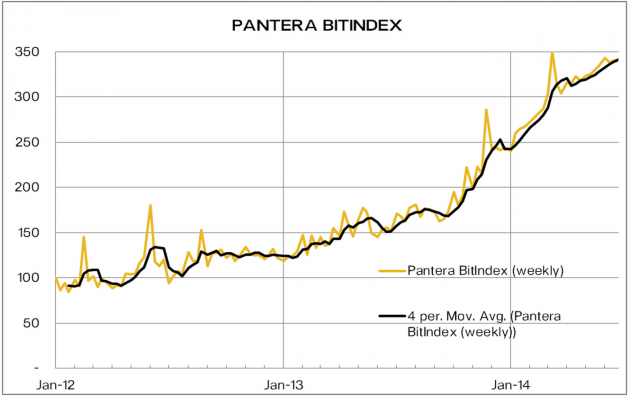
bitindexchart 630x396

Pantera Launches BitIndex to Track Bitcoin

Pantera Capital, an investment fund that focuses on bitcoin, has announced an index it says will allow investors to track the cryptocurrency over a medium-term timeframe.
(CoinDesk) Dubbed the BitIndex, it takes into account seven different factors that Pantera believes accurately charts bitcoin’s overall progress.
What’s interesting is Pantera Capital is not including price in the BitIndex, instead tracking other data sources that it believes lends to bitcoin’s technological progression.
In the fund’s monthly report for June, Pantera stated:
“While some other indices also offer guidance (such as trade in USD), we chose not to include them because of unreliable data, limited availability, or other statistical problems.”

Components of index

The seven measures that the BitIndex includes, in order of importance, is as follows:
  1. Developer interest on GitHub.
  2. Merchant adoption as a measure of consumer adoption.
  3. Wikipedia views measuring bitcoin education.
  4. Hashrate by logarithmic scale corresponding to orders of magnitude.
  5. Google searches captured by the number of times “bitcoin” appears.
  6. User adoption as measured by wallets.
  7. Transaction volume on the bitcoin network.
Pantera’s letter does not indicate how it calculates the merchant adoption metric, although statistics for hashrate, user adoption by wallets and transaction volume are publicly available from a number of different data sources.
Information from websites such as GitHub for developer interest, as well as Wikipedia and Google to identify mainstream interest and popularity, is also readily available.
While it appears the BitIndex closely followed pricing movements in the latter half of last year, measurements the fund uses show that, despite negative news events like Mt. Gox and the US Marshals’ BTC auction, bitcoin is on an uptrend.

Always about price

BitIndex offers a different look at technological aspects of bitcoin rather than infatuation with the cryptocurrency’s valuation.
In fact, the firm says that it is value distortions that influenced the creation of BitIndex, specifying, “price manipulation at Mt. Gox and/or the Chinese and in the first quarter of 2014 due to the collapse of Mt. Gox”, as problems defining bitcoin’s true worth.
There is a lot of interest in bitcoin’s value, and the vast number of exchanges with different prices has created a need for composite pricing information.
CoinDesk has its Bitcoin Price Index and the Winklevoss twins, who are major investors in bitcoin and are trying to launch an ETF for the cryptocurrency, also have the creatively named Winkdex.
However, Pantera states unequivocally in its letter that the BitIndex gives people a longer-range view of bitcoin than what price indexes offer:
“Pantera has developed the BitIndex to inform our views on bitcoin. It is not a tool to forecast bitcoin’s price. This index is designed to assist us in forming our views on what may happen to bitcoin in the medium term.”

Focus on investing

While the BitIndex may provide a glimpse into where bitcoin is going, it is questionable whether it offers insight into the bitcoin economy’s adoption rate as a store of value – seemingly something Pantera’s investment clients would be wanting the firm to do.
“The index looks at the interest level across a couple key populations: general public, users, developers, and merchants, and should be a pretty accurate judge of the overall growth of bitcoin”, said Andy Beal, a lawyer with Crowley Strategy that advises bitcoin startups.
He added, however:
“The only group that was not included that can really affect growth is investors.”
Pantera is backed by Fortress Investment Group, Ribbit Capital and Benchmark Partners. Its focus on bitcoin began in 2013, and the firm invests directly in BTC as well as funds startups that operate within the industry.
Bloomberg’s company overview information indicates that, prior to concentrating on bitcoin, Pantera Capital previously invested in public equity, fixed income, currency and commodity markets.

Open your free digital wallet here to store your cryptocurrencies in a safe place.

Satoshi
polish flag3

Polish Finance Ministry says Bitcoin can be used as financial instrument

(CoinDesk) Poland’s deputy finance minister Wojciech Kowalczyk has released a
document confirming that under the country’s existing financial
regulations, bitcoin can be considered a financial instrument.
The statement follows a previous inquiry from Michal Pacholski, an
opposition member of Parliament for the liberal Twoj Ruch (Your
Movement) party. At the time, Pacholski asked Poland’s Ministry of
Finance to explain the legal status of bitcoin transactions.
Specifically, his query focused on whether or not “options and futures
contracts can be considered as a financial instrument” if they are
denominated in a digital currency.
The Finance Ministry replied that bitcoin fits within that legal framework, stating:

“Options or futures contracts which are based on
[bitcoin] as a base instrument can be considered as derivative
instruments, and as such, they can be considered as financial
instruments, according to the bill on financial instruments.”

Bitcoin’s legal status clarified

In the notice, Kowalczyk confirmed that bitcoin is not an officially
recognized currency in Poland. He said in the policy document:

“An analysis of national regulations allows to conclude
that bitcoin … is not a legally defined and universally accepted
currency, because it cannot be classified as either a national currency …
or a foreign currency.”

Previously, Pacholski had pressed the Finance Ministry on the
possibility of issuing options and futures contracts in the form of
derivatives based on bitcoin market indexes. These issuances, he said,
would be similar to the derivatives which are based on stock market
indexes.
Kowalczyk’s document confirms that these instruments may be made
available to Polish investors. This, the Finance Ministry said, is in
accordance with the country’s banking services regulations.

Regulators accept bitcoin usage

Ultimately, the Polish government statement on bitcoin’s use in
derivatives markets suggests the continued evolution of government
policy toward digital currencies in Poland. While bitcoin can be used as
a medium of exchange and financial tool, it remains unrecognized as a
legal currency by regulators.
This policy stance has been stated by Poland’s financial regulators in the past, including officials from the Finance Ministry.
Speaking at a seminar held at the Warsaw School of Economics (SGH) in December,
Szymon Wozniak, a Finance Ministry representative, said that the
ministry does not consider bitcoin to be illegal, but it does not
consider it to be a legal currency either. He remarked:

“What is not forbidden is permitted. However, we certainly cannot consider bitcoin to be a legal currency.”

Open your free digital wallet here to store your cryptocurrencies in a safe place.
Satoshi
700 aHR0cDovL2NvaW50ZWxlZ3JhcGguY29tL3N0b3JhZ2UvdXBsb2Fkcy92aWV3L2NlMmJhOTU2OGY5MzczM2ZhODBkM2IxNmQ1YjBhMzZhLnBuZw

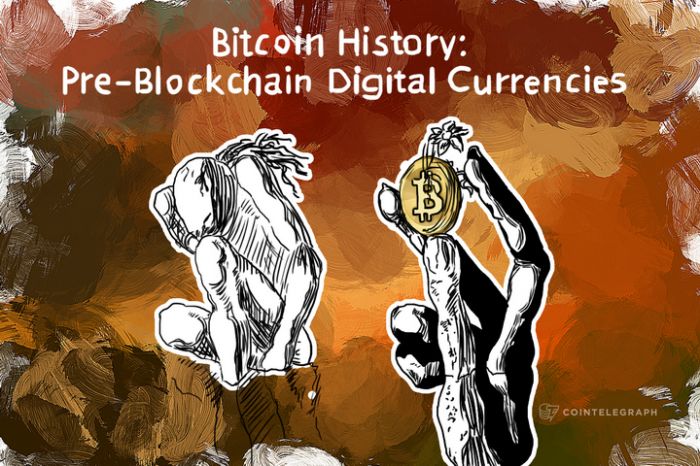
Bitcoin history: pre-blockchain digital currencies

(CoinTelegraph) For anyone not involved in
mid-90s cypherpunk scenes or early e-cash projects, the term “digital
currency” probably never came up in conversation until quite recently,
after the advent of Bitcoin.
But Satoshi’s white paper
did not invent digital money; that’s an idea as old as mainstream
internet usage itself. Bitcoin, and the altcoins it spawned, just
happened to be so revolutionary that all those electronic currencies
pre-2009https://holytransaction.com/page/before-bitcoin get overshadowed.
It’s like the Christian calendar. There is before-Bitcoin (BB), and then there is the current era, (AB).
Let’s take a look at some pre-Bitcoin technologies to get an idea of how far cryptocurrencies have come since.

1990: DigiCash

In 1982, cryptographer David Chaum applied the idea of blind signatures to money in his paper “Blind Signature for Untraceable Payments.”
Eight years later, he took these cryptographic protocols to market with
DigiCash, a company that ultimately went bankrupt in 1998.

1996: E-Gold

E-Gold sounded like a fine idea at the time: Create an account, send
in your gold or silver, and your accounted would be credited. Those
credits could then be easily transferred among accounts. The company
slowly built a successful operation through the late 90s.
By 2001, E-Gold was running into problems, however. The US Patriot
Act, first of all, tightened regulations on businesses that could be
classified as money transmitters. Gaining money transmitter licenses for
all 50 states proved too big of a hassle for E-Gold and its
competitors.
Furthermore, a campaign began to grow against E-Gold that marked it
as the currency of money launderers and child pornographers. A federal
indictment followed in 2005, which marked the end of E-Gold as a
meaningful alternative currency.

1998: Beenz.com

Beenz was a currency created to incentivize behavior such as visiting
specific websites, logging on through specific ISPs or shopping at
certain stores. This was back before the dot-com bubble burst, when
bored teenagers could take online quizzes, and marketing companies would
send them free stuff in the mail.
But the fetten Jahren ran their course, and Beenz.com was gone by 2001.

1999: Flooz.com

Flooz had a similar name and similar model to Beenz: Users were
rewarded for activity with flooz, which served as a medium of exchange
among its network of partners. Like Beenz, also, Flooz went bust in the
dot-com crash.

1999: InternetCash.com

InterenetCash.com filed a number of patents to protect its monetary
system based on prepaid cards, and it also relied on a network of
participating merchants where that cash could be redeemed. The company
ultimately raised $10 million in funding and had a staff of about 70
employees before the dot-com crash forced the company to close in August
2001.
After 2001, when economic realities hit many internet startups hard,
digital money never really caught on again, beyond some niche users,
until Nakamoto published the Bitcoin white paper in 2008. Of course, it
took a few years for most of us in the cryptocurrency community to catch
on, at which point cryptocurrencies took off far beyond what their
predecessors did.

We asked some community experts what present feature or
present reality in cryptocurrency tech today we will find funny and
old-fashioned in 15 years or so?

Aleksey Bragin:
“So many useless (or sometimes funny, as DogeCoin for example) alt
cryptocurrency clones emerged so quickly. That would go out of fashion
quicker than within 15 years, I suppose.”
Gideon Gallasch (coinsulting.eu): “I think mining – so much power and electricity is not sustainable long term.”
Lech Wilczyński (Co-Founder/CEO / Developer at InPay S.A.): “Centralized exchanges.”
J. Ryan Conley (CEO & Founder at Ryan Conley
Marketing & Training and CEO & Founder at Team Extreme
Worldwide): “That the banks were last to catch on to this awesome
concept! Staged viral video marketing platform.”
Patrick Dugan (CIO of Crypto Currency Concepts): “Centralized exchanges for sure, mining possibly.”
Lech Wilczyński (InPay.pl): “Bitcoin payment gateway.”

Open your free digital wallet here to store your cryptocurrencies in a safe place.

Satoshi

New Zealand central banker: cryptocurrencies could supplant cash

Geoff Bascand, deputy governor and head of operations at the Reserve Bank of New Zealand (RBNZ) has said that digital currencies could one day evolve to supplant cash as we know it.
(CoinDesk) In a recent speech delivered to the Royal Numismatic Society in Wellington over the weekend, Bascand described digital currencies as a “challenge to the form and provenance” of money.
He outlined a number of advantages associated with digital currencies, along with the more or less usual list of concerns and risks.

Advantages and drawbacks

Bascand said digital currencies like bitcoin were created as an alternative means of payment and store of value, adding:

“[Bitcoin] is a very low cost payment method with strong security features and usable for cross-border transactions, making it advantageous in some regards relative to more traditional payment mechanisms.”

However, he also noted that cryptocurrencies still have a number of drawbacks, with few businesses accepting them as a form of payment and price volatility remaining a concern.
Bascand went to on explain how, if certain conditions are met, digital currencies could replace normal money:

“Key attributes of trust (that the ‘money’ gives rise to settlement of the obligation) and anonymity (it is often efficient for the sale/purchase parties not to have to identify one another) must be met, but if these can be accomplished reliably and sustainably, new technologies could supplant cash as we know it in years to come.”

Banks need to keep up

Bascand argued that central banks do not need to be overwhelmed by such innovations. Instead, they need to keep track of developments in the field and develop their regulatory and currency operations roles accordingly.
In this way, he said, they will manage to keep up with developments in technology and the evolving needs of the public.
Both the Reserve Bank of New Zealand and the Reserve Bank of Australia issued digital currency warnings late last year.
Apart from the carefully worded statement, regulators have taken any measures to curb or control the development of the bitcoin economy in the region.
Australia’s bitcoin business scene in particular seems to be thriving, and one company even launched on its stock exchange in June.

Open your free digital wallet here to store your cryptocurrencies in a safe place.

Satoshi

Why Bitcoin may re-write banking practice

(BusinessTech) Bitcoin has grown from an experiment in digital cash to a vibrant, global economy supporting multi-million dollar companies with a market cap of $10 billion.

While the road has been bumpy, and quite a rollercoaster ride, it is still nascent and holds immense promise to change the world in unprecedented ways,” said Simon de la Rouviere, speaking at the recent Nedgroup Investments Cash Solutions Treasurers Conference.

In 2013, the hockey-stick growth often found in the technology space kicked off for Bitcoin, seeing adoption increase worldwide.” De la Rouviere, a technology entrepreneur who develops cryptocurrency applications, believes that Bitcoin’s global, public, distributed asset ledger is a fundamental innovation that could upset various industries – from banking to public records. “Any business in the field of recording information fit into a ledger that charges fees to be a middleman is at risk of becoming obsolete,” he said. As copy of Bitcoin’s ledger exists on every network participant’s computer, and is continually updated, reconciled and synchronized in real-time. Each member can make entries into the ledger, which records transactions of a certain amount of currency from one participant to another. Each entry is propagated to the network, so that every copy on every computer is updated near simultaneously and all copies of the ledger remain synchronized. “This blockchain technology could easily be adopted to work with title deeds, physical keys, private equity, derivatives, escrow, dispute mediation, passports, wills, domain names, and sim cards – to name but a few,” De la Rouviere said.

The future

Looking farther ahead, the technology could potentially bring about a new apolitical reserve currency that allows programs and machines to own forms of value without the requirement of human intervention.

This could herald an almost sci-fi era, where machines earn their keep by providing services to humanity at an even more cost-efficient, break-even level than currently possible, De la Rouviere said.

By thinking of Bitcoin not as a currency, but as a single solution to a previously unsolved algorithmic problem in distributed systems, colloquially known as the Byzantine Fault Tolerance, humanity can create global systems of consensus powered by mathematics.” Bitcoin is a grand experiment, currently at the forefront of showing the equalizing force that the internet brought about. “It might still one day fail,” he added, “but rest assured, it is spurring innovative thinking across the board.” Sean Segar, head of cash solutions at Nedgroup Investments, said that while the bank  believes in staying abreast of trends or fads that may affect the industry, “we have no plans to launch a Bitcoin fund”.

Open your free digital wallet here to store your cryptocurrencies in a safe place.

Satoshi